
Quick Takeaways
- A commercial property inspection is a visual walk-through assessment of a building’s structure, roof, building systems, site, and life safety features, written up in a report for the buyer, lender, owner, or tenant.
- Commercial inspections typically follow ASTM E2018-24 or CCPIA’s ComSOP. Home inspections follow residential standards covering properties with four or fewer units.
- The report records each defect with photos, a priority, and a recommended fix, and may include opinions of probable cost.
- Property inspection apps replace paper notes with digital checklists, photo evidence, and reports generated on site.
Buying or managing a commercial property is a monumental task with its share of potential pitfalls. A meticulous commercial property inspection can help you detect any deficiencies early on and ensure you make an informed decision.
But this doesn’t mean you should settle for archaic pen-and-paper checklists and cumbersome reporting. Famous hotel chains like Hyatt and Latour Hotels & Resorts have already switched to digital inspection tools.
What is a Commercial Building Inspection?
A commercial building inspection is a visual assessment of a commercial property’s structure, systems, and site that records its condition and flags defects before a purchase, lease, refinance, or capital plan. One can also opt for a commercial building inspection for maintenance purposes.
A commercial real estate inspection helps you check potential threats associated with a commercial property. These may include safety hazards, code violations, environmental issues, maintenance problems, etc. With a thorough commercial inspection, you can estimate the value of a property. It can also help you budget for repairs and better picture your future ROI.
However, what comprises a commercial property? A commercial property is a real estate built on a commercial space for generating revenue. Commercial properties can be categorized into five types:
- Office spaces such as office buildings, coworking spaces, etc.
- Retail/hotels such as shopping malls, cafes, restaurants, etc.
- Multifamily residences such as condos, rental property units, etc.
- Land
- Others: these may include fitness facilities, warehouses, etc.
Commercial vs. Home Inspection
A commercial inspection covers more systems, follows different standards, and takes longer than a home inspection.
| Feature | Commercial Inspection | Home Inspection |
| Inspection standards | ASTM E2018-24, Standard Guide for Property Condition Assessments: Baseline Property Condition Assessment Process, or CCPIA’s International Standards of Practice for Inspecting Commercial Properties (ComSOP) | InterNACHI Home Inspection Standards of Practice (properties with four or fewer residential units) |
| Typical fee range | $500 – $5,000+ | $300 – $500 |
| Pricing basis | Square footage, complexity, scope | House size, inspector qualifications |
| Common inspection areas | Major building systems, roof, exterior, mechanical & electrical | Radon testing, termite inspections, and pool inspections |
| Additional services | Environmental surveys, accessibility audits, energy audits | Radon testing, termite inspections, pool inspections |
Who Performs a Commercial Building Inspection?
A commercial building inspection is usually carried out by a commercial property inspector or by an engineer or architect, hired by the buyer, lender, asset manager, or portfolio manager:
- Engineer/Architect: They are domain experts in building structures, maintenance, and related subjects. They have a keen eye for defects present in a commercial property. However, due to their level of expertise and experience, their hourly rates may burn a hole in your pocket.
- Professional Inspectors: You can hire inspectors from inspection agencies or companies. However, you must verify that they offer a specialized inspection for commercial properties and charge no hidden fees.
Regular property inspections are a lifeline for asset and portfolio management companies. They safeguard investments by spotting issues before they become expensive problems. Timely maintenance keeps occupants of the commercial building safe and happy, minimizing vacancies and maximizing rental income.
However, hiring inspectors or engineers/architects for regular inspections is expensive. A digital inspection tool like GoAudits can be a more affordable and easy-to-use alternative.
With the right digital inspection tool, you can perform as many commercial real estate inspections as you like. They offer commercial inspection checklists that allow you to delegate tasks to your team members and access the real-time data at your fingertips anywhere.

Who Orders a Commercial Property Inspection and When?
The buyer, tenant, lender, or owner orders the inspection, and the timing follows the transaction. Buyers order one during the due diligence window before closing. Tenants order one before signing a lease on space they will be responsible for. Lenders order one before placing or refinancing a loan. Owners and property managers commission them to plan capital spending rather than to complete a deal.
Most commercial inspections also include a document review that a home inspection would not: leases, certificates of occupancy, code violation notices, service contracts, and prior inspection reports. Ask for these early. They routinely take longer to collect than the inspection itself takes to run.
→ Commercial Real Estate Due Diligence Checklist
Paper-Based vs. Digital Commercial Property Inspection Walkthrough
Paper-based inspections and digital inspections differ most in what happens after the walk-through.
| Paper-based | Digital | |
|---|---|---|
| Capturing findings | Pen and paper, sticky notes, voice recorder | Checklist on a phone or tablet |
| Photos | Separate camera, matched to notes later | Attached to the item as you go |
| Report turnaround | Hours or days of retyping | Generated on site |
| Finding things later | Paper files, risk of loss | Searchable record by property and date |
| Acting on defects | Email or verbal follow-up | Assigned with an owner and a due date |
The gap that matters most is the third row. Property managers running inspections across a portfolio routinely spend a day or more rebuilding photos and notes into a report an owner can read. If you are moving a portfolio off paper, our guide to building inspection apps compares what to look for in one.
What Does a Commercial Real Estate Inspection Involve?
A commercial real estate inspection involves a walkthrough by the inspector you hire. During the walkthrough, the inspector will take photos of the deficiencies observed in the building. They will also take note of the potential threats or fixes needed in the future. Additionally, the inspector would conduct exterior, interior, document, and system verifications of the building.
After inspection, the inspector would document their findings in a report and hand it over to the client. Ideally, the report should contain photos of the defects. However, due to the manual process, photos might need to be found.
What is Not Included in a Commercial Property Inspection?
A commercial property inspection is visual and non-invasive, so it does not include destructive testing, code compliance certification, or specialist environmental work. Common exclusions:
- Tenant improvements such as commercial kitchen equipment and cubicle walls, unless added to the scope.
- Environmental assessments such as asbestos, lead-based paint, radon and mold testing, usually ordered as separate services.
- Specialist testing such as structural engineering calculations, infrared scans or elevator load tests.
- Concealed areas that are locked, occupied, or not safely accessible on the day.
Agree the scope and exclusions in writing before the inspection, so the report answers the questions the buyer or lender actually needs answered.
How to Conduct a Commercial Property Inspection: A Quick Guide
A thorough commercial property inspection is a multi-step process. While a professional is always recommended for a full due diligence inspection, here is a quick guide for regular maintenance and monitoring:
Step 1: Plan and Prepare
Before you begin, gather all necessary documents, including previous inspection reports, floor plans, and maintenance records. This provides a baseline for your assessment. A detailed checklist is your most important tool, ensuring you don’t miss any critical areas.
Step 2: Start with the Exterior
Begin by walking the perimeter. Look for signs of damage or wear on the roof, siding, foundation, and windows. Check drainage systems for clogs and ensure landscaping isn’t causing a risk to the building structure.
Step 3: Move to the Interior
Systematically inspect each room. Pay close attention to ceilings, walls, and floors for signs of leaks or structural issues. Test doors, windows, and fire safety equipment. Document any signs of mold, pest infestations, or code violations.
Step 4: Assess Major Systems
Crucial to any inspection is a check of the building’s core systems:
- HVAC: Check for proper operation, filter cleanliness, and any unusual noises.
- Plumbing: Look for leaks, water damage, and proper water pressure.
- Electrical: Inspect the main panel for signs of overheating and ensure all outlets and lights are working.
Step 5: Document Everything
For a successful inspection, detailed documentation is key. Use high-quality photos and videos to capture issues. Write clear, specific notes for each finding. The easier it is to organize and share this data, the more effective your inspection will be.
What Do Commercial Property Inspectors Look For?
A commercial inspector generally looks at the following aspects of a property:
- Property Documents: The inspector verifies documents associated with the commercial property. These include planning applications, appraisals, contracts, environmental studies, certifications, permits, evacuation plans, etc.
- Building’s Exteriors: Includes inspections of landscaping, roofing, parking lots, etc. The inspector might work with construction experts to inspect roofing and landscaping.
- Building’s Interiors: Walls, working spaces, windows, kitchen and pantry facilities, etc., comprise the components of interior inspection.
- Building Systems: There are five major systems that an inspector would check: electrical, heating, air conditioning, plumbing, and ventilation. In case of a defective system, the inspector would include the cost of repair or replacement in the commercial field inspection report.
- Fire and Life Safety: Alarms, sprinklers, extinguishers, emergency lighting and exits, along with elevators and escalators and their certificate dates. These are the systems most likely to carry a compliance deadline rather than just a repair cost.
The Property Condition Report (PCR) is a significant part of the inspection process. It helps the portfolio manager, asset manager, or investor understand the actual condition of a commercial property.
However, in most cases, reporting is manual. Hence, inspection agencies or companies might spend several hours and resources on it. Digital commercial inspection tools like GoAudits propose an easy solution for this.
How Much Does a Commercial Property Inspection Cost?
A commercial property inspection, sometimes called a commercial building inspection, costs more than a home inspection because the building is larger, has more systems and usually needs more than one specialist.
Four factors drive the fee:
- Size and number of buildings. Floor area and the number of units, floors, and roof sections set the time on site.
- Age and condition. Older buildings need more document review and more time on mechanical and electrical systems.
- Scope. Add-ons such as an ADA accessibility survey, environmental testing, infrared scans, or elevator inspections are priced separately.
- Report requirements. Opinions of probable cost and lender-specific formats take longer to prepare.
A small commercial inspection may take a day on site. A large or multi-building property can take several days, plus report writing time afterwards.
Free Resources: Commercial Property Inspection Report and Checklists
Explore these free commercial property inspection report and checklist templates. Each one can be used as it is or edited to match your own scope and property type.
What Does a Commercial Property Inspection Report Include?
A commercial property inspection report usually contains:
- Property details: address, property type, gross floor area, year built, inspection date, inspector name and credentials.
- Scope and standard: the standard followed, what was inspected, and the limitations and exclusions that applied.
- Executive summary: overall condition and the items that need immediate action.
- Site: paving, parking, drainage, landscaping, exterior lighting, accessible route.
- Structure and building envelope: foundation, frame, facade, windows, doors.
- Roof: covering, drainage, penetrations, visible leaks.
- Mechanical, electrical, and plumbing: HVAC, electrical distribution, plumbing, and water heating.
- Vertical transportation: elevators and escalators, with certificate dates.
- Fire and life safety: alarms, sprinklers, extinguishers, emergency lighting, exits.
- Interior elements and accessibility observations.
- Document review: permits, certificates of occupancy, service records, prior reports.
- Findings with photos: each with a priority (immediate, short term, long term) and a recommendation.
- Opinions of probable cost, where these are in scope.
- Sign-off: inspector signature and date.
A report without priorities on each finding is hard to act on. The buyer cannot tell what to negotiate over, and the owner cannot tell what to budget for first.
Free Commercial Property Condition Report Template
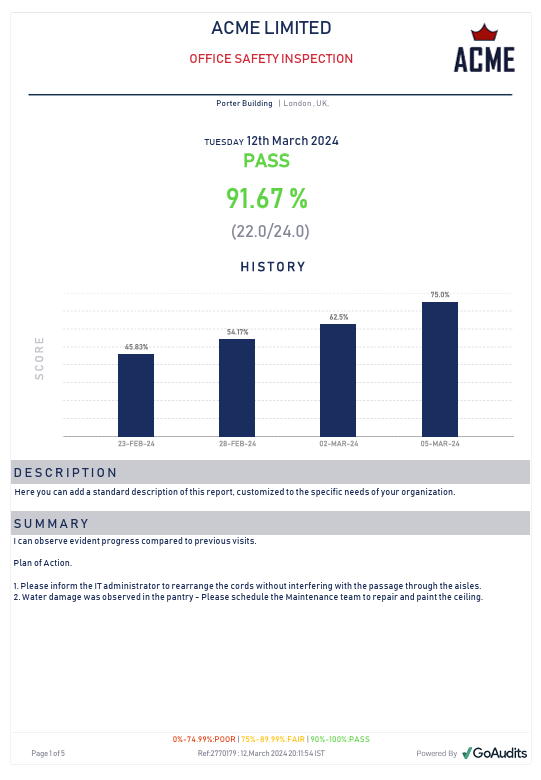
Here’s an example of a commercial property condition report sample for an office, generated with GoAudits:
Here’s what Kristin Ingram, Regional Director of Resort Operations at Latour Hotels & Resorts, has to say about GoAudits’ reporting feature:
“GoAudits provides us with trend reports that assist us in our annual budgeting processes. In addition to the portfolio trends, we now know the top 5 issues for each property and can reserve funds to correct them.”
Kristin Ingram, Regional Director of Resort Operations, Latour Hotels & Resorts
Popular Commercial Inspection Checklists
Here are some ready-to-use commercial building inspection checklists:
- Commercial Building Property Inspection Checklist
- Building Exterior Maintenance Checklist
- Property Damage Report Templates
- Window Inspection Checklist
- Stair Inspection Checklist
- ADA Checklist for Existing Facilities
- Commercial Roof Inspection Checklist
- Commercial Electrical Inspection Checklist
- Commercial Plumbing Inspection Checklist
- Property Condition Assessment Checklist
- Commercial Real Estate Due Diligence Checklist
- Structural Audit Checklist for Commercial Properties
- Building Facade Inspection Checklist
- Life Safety Code Checklist

How Often Should Commercial Buildings Be Inspected?
Commercial buildings are inspected at key transactions and on a recurring schedule set by the owner, insurer, or lease. The schedule below is a common starting point, not a legal requirement. Local codes, insurers, and manufacturer guidance can set different intervals.
| Inspection | When | Who usually does it | Why it matters |
|---|---|---|---|
| Pre-purchase or pre-lease | Before closing or signing | Commercial property inspector or engineer | Finds defects to negotiate on before the deal closes |
| Refinance or lender inspection | When the loan is placed or renewed | Inspector appointed by the lender | Confirms the asset’s condition behind the loan |
| Exterior drive-by | Set by the owner | Property or asset manager | Catches visible damage, signage and parking issues early |
| Fire and life safety checks | Interval set by fire code or insurer | Site team or contractor | Keeps extinguishers, exits and emergency lighting in date |
| Annual condition walk-through | Yearly | Property manager or engineer | Feeds the capital plan and reserve budget |
| Post-event inspection | After storms, floods or fires | Inspector or engineer | Records damage for insurance and repairs |
Catching a small roof leak early costs far less than repairing the water damage it causes, which is the case for the recurring rows above as much as the transactional ones.
Property managers running these across a portfolio hit two problems a one-off pre-purchase inspection never raises: keeping each check inside its compliance window, and turning site photos into a report an owner or investor can read.
A US commercial real estate firm ran 300 monthly fire extinguisher and exit light inspections from a notebook and a spreadsheet, each due within a 30-day window.
👉 Read more: Facility maintenance software for scheduling recurring inspections across multiple sites.
Commercial Property Inspection Software: How GoAudits Works
GoAudits is commercial property inspection software that runs your checklists on a phone or tablet, attaches photos to each finding, and generates the report before you leave the site.
With GoAudits, you can run regular inspections across every property you manage. You can perform as many inspections and for as many properties as you like, because we do not charge based on the number of inspections.
With the GoAudits mobile app, you can:
- Conduct commercial property inspections on the go, from the GoAudits app on iOS and Android
- Capture every detail with photos and notes
- Assign specific checklist items to non-users such as roofers and plumbers
- Generate and distribute reports instantly
- Monitor the condition of all your properties on a single analytics dashboard
With a rating of 4.8 stars on Capterra, GoAudits is trusted by some of the biggest names in the hospitality, retail, and facility management industries.
» Customer Success Story: Read how organizations leverage GoAudits to save time and improve standards.
FAQs
There is no national licensing requirement for commercial property inspectors in the US. Licensing where it exists is set at the state level and usually written around home inspections, so a commercial inspector may hold a home inspection license, an engineering or architecture registration, or a CCPIA credential. Ask what standard the inspector works to and what comparable buildings they have inspected.
A property condition assessment (PCA) is a type of commercial property inspection that follows ASTM E2018-24 and usually adds opinions of probable cost for repairs. A general commercial inspection may follow CCPIA’s ComSOP instead. See our property condition report template for what a PCA report looks like.
A major defect usually moves the deal rather than ending it. Buyers renegotiate the price, request a repair before closing, or ask for a credit at settlement. Lenders may hold back funds until the work is done. The report should price the fix, or say plainly that pricing it needs a specialist.
Yes, and most inspections happen in occupied buildings. The limitation is access: areas that are locked, in use, or full of tenant property cannot be inspected and are listed as exclusions in the report. Giving tenants notice in advance is the single biggest factor in how much of the building actually gets seen.
The inspector issues a report with findings, photos, and priorities. Buyers use it to renegotiate the price or request repairs before closing. Owners use it to build a capital plan. Either way, each finding needs an owner and a due date, or the report produces no change.