The food industry’s complex supply chain involves numerous stakeholders, from farms and food manufacturers to retailers and restaurants or hotels. Implementing robust food safety management systems is essential for food businesses to ensure the safety and quality of their products, as well as to meet all the requirements for food safety compliance. However, increasingly, companies large and small find it necessary to achieve a widely recognized international food safety certification, to strengthen their reputation or to access wider markets. The industry’s many safety certifications and acronyms can seem complex and difficult to interpret.
In this article, we’ll discuss some of the most widely recognized food safety standards and certifications, how they’re different, tips to choose the right certification, and free checklists to ensure compliance.
- What are Food Safety Standards?
- No-Benchmark Food Safety Standard Examples
- Major GFSI-Benchmarked Food Safety Standard Examples
- Perform Internal Audits to Prepare for Food Safety Certifications
- FREE Checklists to Comply with Food Safety Standards
- How to Choose the Best Food Safety Certification?
- Levels of Food Safety Compliance and Certifications
- FAQs
What are Food Safety Standards?
Food safety standards are formal guidelines, principles, and regulatory requirements designed to ensure that food is safe for consumption at every stage of the supply chain, from production and processing to storage, distribution, and serving.
These standards define how food businesses should identify hazards, maintain hygiene, control contamination risks, and implement preventive systems to protect public health. Many globally recognized frameworks require organizations to systematically identify, prevent, and control food safety risks throughout the food chain.
👉 In simple terms, food safety standards explain what must be done to keep food safe.
The Importance of Food Safety Standards
Here are some reasons why food safety standards are important for food establishments:
- Ensure compliance with national food regulations and industry laws
- Reduce the risk of contamination, recalls, and legal penalties
- Protect brand reputation and consumer trust
- Improve operational consistency and process control
- Enable access to international markets and supply chains
- Strengthen supplier and vendor management practices
- Support risk-based decision-making across the food chain
If you want to prepare for certification audits and enjoy these benefits above, try GoAudits for FREE.

Difference Between Food Safety Standards and Certifications
Though often used interchangeably, food safety standards and certifications are different from each other.
| Basis | Food Safety Standards | Food Safety Certifications |
| Meaning | Set of rules, frameworks, or guidelines that define safe food handling practices | Formal proof issued by an accredited body confirming compliance with a standard |
| Purpose | Provide a structure for managing food safety risks | Demonstrate that the structure has been independently verified |
| Nature | Can be regulatory or voluntary guidelines | Always voluntary but market-driven and audit-based |
| Example | HACCP principles, ISO 22000 requirements, national food regulations | ISO 22000 certification, FSSC 22000 certification, HACCP certification |
| Focus | What businesses should implement | Proof that implementation meets requirements |
| Issued by | Governments, international bodies, or industry organizations | Accredited certification bodies after audits |
| Business impact | Guides internal food safety systems | Builds external credibility and market acceptance |
No-Benchmark Food Safety Standard Examples
“Non-benchmark” standards are not accredited or benchmarked by any external body. Each certification agency writes and approves its own standard without external oversight or approval. The brand recognition of the chosen certification body will determine how widely accepted the food safety certification will be.
Here are the main food safety standards that aren’t benchmarked:
Good Manufacturing Practices (GMP)
GMP forms the operational foundation of food safety by defining hygiene, sanitation, equipment maintenance, and personnel practices that prevent contamination during production. These practices act as prerequisite programs for more advanced systems and help create a controlled manufacturing environment.
👉 GoAudits GMP software offers free GMP audit checklists to perform GMP audits and adhere to GMP principles. Or, you can digitize your current GMP SOPs.
- GMP Inspection Checklist
- GMP Checklist for Breweries
- 21 CFR Part 110 – GMP Checklist
- Good Manufacturing Practice Audit Checklist
- GMP Audit Checklist for Cosmetics
- GMP Audit Checklist for Pharma
Hazard Analysis Critical Control Points (HACCP)
HACCP is a preventive methodology that focuses on identifying, evaluating, and controlling biological, chemical, and physical hazards across the food process. Rather than relying on end-product testing, HACCP emphasizes risk analysis and control points within operations, making it a core system for proactive food safety management.
👉 Leverage GoAudits HACCP software to digitize your HACCP SOPs and perform HACCP audits.
You can sign up for free and start using these HACCP checklists.
- HACCP Plan Checklist
- BRC Audit Checklist – HACCP (Clause 2)
- HACCP Audit Checklist
- HACCP-Based SOPs
- HACCP Plan Self-Assessment Checklist
- HACCP Food Safety Checklist
- HACCP Internal Audit Checklist

Food Safety Management Systems (ISO 22000)
ISO 22000, developed by the International Organization for Standardization, provides a structured food safety management framework applicable to any organization in the food chain. It integrates HACCP principles, prerequisite programs, and management system controls to ensure consistent production of safe food and improved communication across the supply chain.
AIB International Standards
AIB International standards focus on inspection-based food safety practices, facility conditions, sanitation programs, and operational controls. These standards are commonly used to assess food manufacturing environments and help organizations strengthen compliance, hygiene, and risk-prevention procedures across their facilities.
Major GFSI-Benchmarked Food Safety Standard Examples
The Global Food Safety Initiative (GFSI) is an industry-driven collaboration that benchmarks food safety certification programs to promote consistency, trust, and harmonization across the global food supply chain. Established in 2000 following a series of food safety incidents, GFSI does not perform audits or issue certificates itself. Instead, it evaluates Certification Program Owners (CPOs) against its benchmarking requirements and recognizes those schemes that meet its criteria, enabling companies certified under them to gain international acceptance across markets and supply chains.
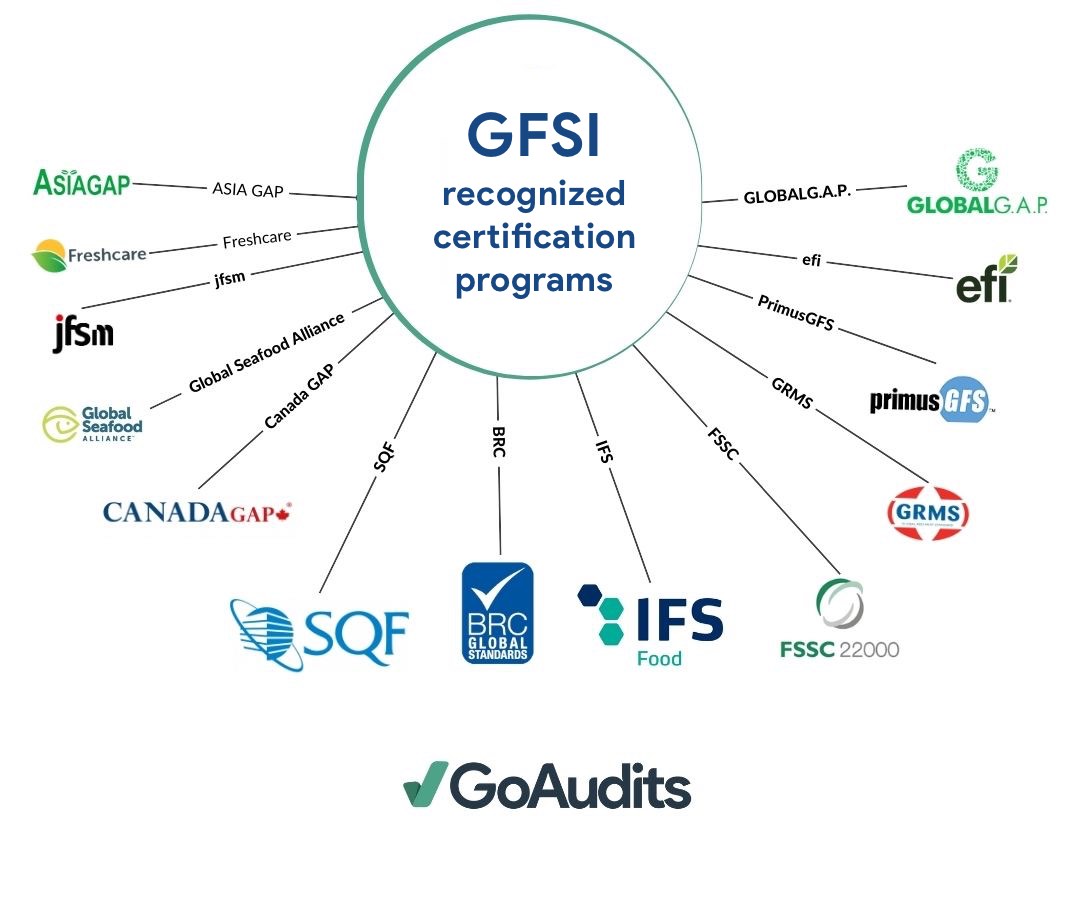
It’s important to note that not all of the standards offered by these CPOs are recognized by GFSI.
GFSI’s most popular food safety certification schemes are:
British Retail Consortium Global Standards (BRCGS)

Among the most widely adopted GFSI-recognized schemes is the BRCGS Global Standard for Food Safety, originally developed by the British retail sector.
It is a prescriptive, process-focused certification emphasizing product integrity, traceability, and manufacturing controls, and is strongly recognized across the UK, Europe, and global retail supply chains.
👉 Free Resources
Use these free BRC checklists to perform internal BRC audits.
→ BRC Management Commitment Checklist (Clause 1)
→ BRC Food Safety Plan HACCP Checklist (Clause 2)
→ BRC Food Safety & Quality Management System Checklist (Clause 3)
→ BRC Audit Site Standards Checklist (Clause 4)
→ BRC Audi Product Control Checklist (Clause 5)
→ BRC Audit Process Control Checklist(Clause 6)
→ BRC Personnel Checklist (Clause 7)
→ BRC Production Risk Zones Checklist (Clause 8)
→ BRC Audit Traded Products Checklist (Clause 9)
Safe Quality Food (SQF)

The Safe Quality Food (SQF) Program is another leading scheme, particularly prominent in North America.
Built on HACCP principles and regulatory preventive-control concepts, SQF offers a comprehensive food safety and quality management framework covering the entire supply chain from production to distribution.
👉 Free Resources
Use thes checklists to perform internal SQF audits and prepare for external audits & certification.
→ SQFI Quality Checklist
→ SQFI Food Packaging Checklist
→ SQFI Food Manufacturing Audit Checklist
→ SQFI Storage And Distribution Checklist
→ SQFI Primary Plant Production Checklist
→ SQFI Primary Animal Production Checklist
→ SQFI Aquaculture Checklist
→ SQFI Pet Food Manufacturing Checklist
→ SQFI Animal Product Manufacturing Checklist
→ SQFI Manufacturing of Food Packaging Checklist
Food Safety Management System (FSSC 22000)

FSSC 22000 provides a management-system-based certification built on ISO food safety principles combined with prerequisite programs and additional scheme requirements. Its structure allows organizations to integrate food safety into broader business management systems, making it popular among multinational manufacturers and exporters.
In terms of scope, FSSC is a generic food safety standard that can be applied to any type of food product, while SQF and BRC are both more specific to certain sectors of the food industry. Also, there are some differences in the way the standards are structured and assessed.
For example, SQF and BRC both use a scoring system to assess compliance, while FSS does not. Additionally, the requirements for certification and recertification may vary between these standards.
👉 Conduct internal FSSC 22000 audits faster with free FSSC 22000 checklists.
International Featured Standards (IFS)
The International Featured Standards (IFS) certification focuses on both food safety and product quality, emphasizing documentation, traceability, and supplier control. It is widely used by European retailers and processors, especially in countries such as Germany and France, where retailer-driven certification requirements are common.
👉 Use this IFS audit checklist to perform IFS audits and ensure compliance with IFS version 8.
BRCGS, SQF, FSSC, and IFS are all globally recognized food safety and quality standards. These certifications are all based on international food safety standards and regulations, and they provide a comprehensive approach to ensure food safety and quality.
However, there are some differences between them.
👉 For example, the FSSC and BRC are both widely recognized in the retail industry; IFS is more prevalent in Europe, while BRC is more commonly used in the UK. FSSC requirements include additional emphasis on environmental sustainability and social responsibility, while SQF has additional requirements for food defense and food fraud prevention.
PrimusGFS
PrimusGFS is a GFSI-recognized scheme tailored primarily to the fresh produce sector. It covers farming operations, packing, handling, and minimally processed products. It integrates requirements for agricultural practices, food safety management systems, and preventive controls to address risks across the produce supply chain.
Examples of Food Safety Standards by Country
Food safety regulations vary across countries, but most follow a similar risk-based approach built on hazard prevention, food traceability, and consumer protection.
In the United States, federal frameworks such as the Food Safety Modernization Act primarily govern food safety oversight, while agencies like the Food and Drug Administration and the USDA enforces it, with a strong focus on preventive controls and supply-chain accountability.
In Canada, national legislation such as the Food and Drugs Act guides food safety standards, while the Canadian Food Inspection Agency enforces them. It integrates inspection, labeling, and compliance systems across food sectors.
Food standards in Australia are aligned with New Zealand under a joint regulatory framework administered by Food Standards Australia New Zealand, which develops the Australia New Zealand Food Standards Code used by both countries. This system promotes consistent food composition rules, labeling requirements, and safety controls across the region.
Across the United Kingdom and the European Union, food safety laws are built on comprehensive “farm-to-fork” legislation, including the General Food Law Regulation (EC) No. 178/2002, which establishes traceability, risk analysis, and consumer protection principles for all food placed on the market. Regulatory bodies such as the European Food Safety Authority support scientific assessment and policy development across member states.
In India, the Food Safety and Standards Act created a unified national framework overseen by the Food Safety and Standards Authority of India, consolidating earlier fragmented food laws into a single system that sets hygiene standards, labeling rules, and compliance requirements for food businesses.
Many other countries operate similar national systems aligned with Codex Alimentarius principles, ensuring that food safety regulations support international trade while protecting public health.
A Comparison of Other GFSI-Benchmarked Certifications
GFSI’s program is renowned for its comprehensive and rigorous standards, ensuring that all areas and elements of food safety are appropriately addressed. In this regard, aside from its most popular certifications, GFSI’s benchmark also includes specialized certifications covering a wide range of aspects and areas of food safety, for example: the use of Good Agricultural Practices and Seafood (The Global Seafood Alliance), Food Safety for Fresh Fruits and Vegetables (CanadaGAP), Global Red Meat Standard (GRMS), EFI (Equitable Food Initiative), JFSM (Japan Food Safety Management Association), GLOBALG.A.P, PrimusGFS and Freshcare.
It is imperative that any plan takes into account the time, money, and resources required for certification. It is common for certification processes to be lengthy and expensive, but the rewards are well worth the effort. If you wish to succeed in the certification process, you must be proactive and prepare for internal and external audits beforehand.
Perform Internal Audits to Prepare for Food Safety Certifications
You should carefully evaluate which standard is the most appropriate for your business needs, customer requirements, and choose the best food safety software to help you with this process and with your food safety inspections without paperwork and heavy admin workload.
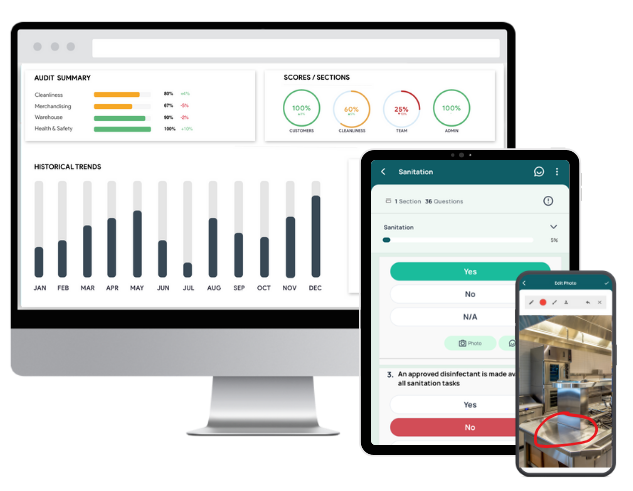
Our comprehensive food safety software helps you automate many of the manual tasks involved in the food safety inspections process:
- Easier data collection in the field with smart forms
- Instant reporting to share audit information quickly, pinpointing every non-conformance or highlighting critical non-conformances
- Smart dashboards for real-time analysis
- Assign corrective actions to specific team members, internally or externally
- Acess a vast library of audit checklist templates and customize them to get started as quickly as possible.
Both your company and the external auditors will be able to access up-to-date information about the performance of your inspections at any time.
The best part? GoAudits can automate this whole process. With food safety software, you can rest assured that your certification audit will go through without a hitch and that you’ll receive the certificate in no time.
FREE Checklists to Comply with Food Safety Standards
Try these food safety audit checklists for FREE, or digitize your existing food SOPs.
- Food Quality Control Checklist
- Food Safety & Hygiene Checklist
- Food Safety Inspection Checklist
- Food Safety Kitchen Inspection Checklist
- Warehouse Food Safety Checklist
- Food Manufacturing SOP
- Food Hygiene Inspection Checklist
- Food Facility Self-Inspection Checklist
- Food Premises Self Inspection Checklist
- Food Supplier Audit Checklist
- Rodent Prevention Checklist for Food Establishments
- Pest Control Checklist for Food Industry

How to Choose the Best Food Safety Certification?
Selecting the right food safety certification involves choosing the one that aligns with your business goals, market expectations, and operational scope. The wrong choice can delay approvals, increase costs, or even block market entry.
Start With Your Market Requirements
Your target market often determines the certification you need. Retailers, exporters, and global buyers may demand specific schemes. For example, retail supply chains frequently prefer stricter standards, while broader food-chain businesses may accept general management-system certifications.
Tip: Always check buyer, regulator, or importer expectations before choosing.
Consider Your Position in the Food Chain
Different certifications suit different roles in the supply chain:
- Manufacturing and processing businesses often benefit from system-based standards covering the full food safety management structure.
- Packaging, storage, and logistics operations may need sector-specific schemes tailored to their risks.
Choosing a food safety certification that matches your operational risks ensures better compliance and audit outcomes.
Evaluate Scope and Complexity
Some certifications focus on structured management systems, while others emphasize prescriptive operational controls.
- Management-system-driven certifications integrate risk assessment, prerequisite programs, and HACCP planning.
- More prescriptive standards define detailed operational practices and inspection criteria.
Pick the approach that best fits your internal capabilities and resources.
Check Global Recognition and Market Access
If export growth is part of your strategy, ensure your certification is widely recognized by buyers and international initiatives. Certain schemes provide stronger access to global supply chains and retail programs than others.
Assess Cost, Audit Frequency, and Resources
Certification involves training, audits, documentation, and ongoing compliance. Audit frequency, facility size, and complexity can significantly influence the cost and effort required.
Choose a food safety certification that your team can realistically maintain, not just obtain.
Levels of Food Safety Compliance and Certifications
To simplify, we can think of the different food safety & quality programs as climbing up the stairs. Each step includes additional requirements to obtain a certification:
At the most basic level, to have permission to operate, companies have to ensure compliance with their local food safety laws and regulations. Examples include the FDA Food Code in the US, the SFCR in Canada, or the Food Standards Act from the UK’s Food Standards Agency. Food safety regulations typically require having a Food Safety Management System (FSMS), with documentation of a Food Safety Plan following GMP or HACCP principles.
Companies that want to go beyond the basic regulatory requirements can obtain their certification in voluntary food safety programs. However, third-parties must audit and certify them.
The next level in food safety includes certification to non-benchmarked standards such as GMP, HACCP, and ISO. Non-benchmarked essentially means that each certification agency writes and approves its own standard without specific external oversight.
Finally, the highest level of food safety compliance comes with GFSI-recognized certifications. GFSI is an international industry body that aims to harmonize food safety standards by setting stringent norms. It recognizes only a limited number of certification programs and certification bodies. The most widespread programs include BRC, SQF, FSSC 22000, and IFS. Obtaining one of these certifications is often a prerequisite to getting access to international markets.
By understanding the nuances between standards, certifications, different organizations, and how they interact, you will be able to determine the right type of food safety audit for your business.
FAQs
Food safety certifications recognized by GFSI, such as FSSC 22000 or BRCGS, are typically preferred for global supply chains because buyers trust their benchmarking process and consistent audit requirements across countries.
Small businesses usually start with prerequisite programs and a basic HACCP plan before pursuing certification. Digital inspection tools like GoAudits help standardize processes, automate workflows, and demonstrate compliance evidence, which reduces audit preparation time and lowers the operational burden for smaller teams.
Most businesses need three to twelve months depending on readiness, documentation maturity, and audit findings. Preparation time includes building procedures, staff training, and internal audits. Using structured inspection workflows and audit platforms like GoAudits can significantly shorten the readiness phase.
Most certifications remain valid for one year, with annual surveillance audits required to maintain them. Recertification audits typically occur every three years. Continuous monitoring, corrective action tracking, and digital audit histories with solutions like GoAudits help maintain compliance between audit cycles.
The governments, international organizations, and industry bodies create food safety standards. Global frameworks often align with Codex Alimentarius principles, while the GFSI benchmarks certification schemes to ensure consistency and credibility.
Risk-based standards focus on identifying hazards before they occur and controlling critical points in the process rather than relying on end-product testing. Frameworks built on HACCP principles use preventive controls, monitoring, and documentation to reduce contamination risks across operations.
Food safety certifications are not free because they require accredited audits, documentation review, and surveillance assessments.
Food safety standards protect consumers by reducing contamination risks, ensuring accurate labeling, and improving traceability during recalls. International frameworks such as the Codex Alimentarius Commission were specifically created to safeguard public health and promote trust in the global food supply.
Non-compliance can lead to product recalls, legal penalties, loss of market access, and severe brand damage. It also increases the risk of foodborne illness outbreaks, which undermine consumer trust and may trigger regulatory intervention or business closure in serious cases.