Food Safety Audit Checklists & Inspection Report Template
Template Library > Food & Hospitality Checklists > Food Safety Checklist
Conduct Faster Inspections with Food Safety Checklist Templates
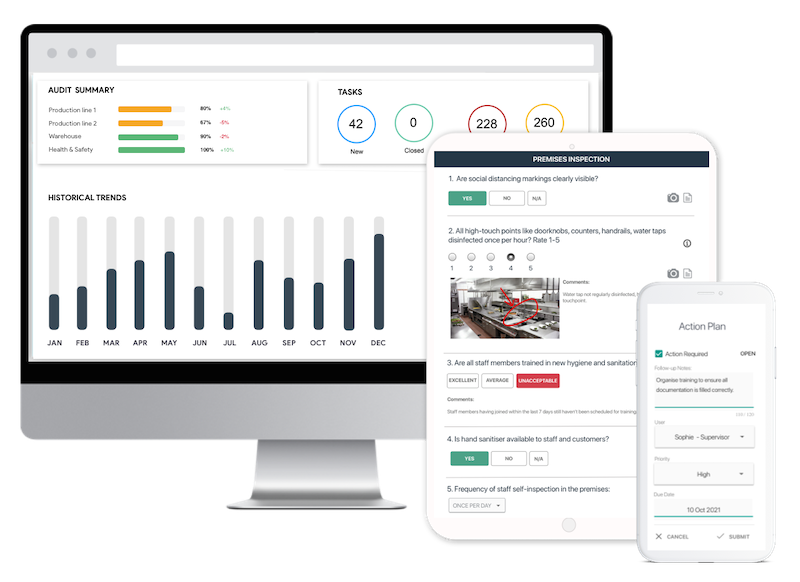
This food safety inspection checklist is designed for evaluating hygiene and safety standards in food production establishments. It includes checks covering policy arrangements, delivery, storage, sanitization, food preparation, cooking, temperature monitoring, food service, personal hygiene, pest control, waste management, and more. With GoAudits, you can conduct up to 5x faster audits.
- Conduct food safety, hygiene, and quality inspections with ease, even without internet access
- Automatically generate detailed reports right after inspections
- Assign and track follow-up tasks instantly, ensuring prompt attention to issues
- Instantly generate ready-to-be-shared reports at the end of each inspection
- Assign corrective actions and involve the right people at the right time
- Get a complete overview of audit scores across locations, teams, or topics.

With the GoAudits Food Safety Software, you can:
- Eliminate paperwork: conduct efficient digital audits
- Customise this template or easily create your own
- Save time with instant reports & assign corrective actions
Personal Hygiene
Food Preparation
Hot Holding
Cold Holding
Refrigerator, Freezer, And Milk Cooler
Food Storage And Dry Storage
Cleaning And Sanitizing
Utensils And Equipment
Large Equipment
POLICY ARRANGEMENTS
Ambient Storage
Delivery
Storage
Cooking & Reheating
Initial Food Preparation
Sanitisation
Cold Storage
Hot Food
Temperature Monitoring Procedures
Bad Habits
Clothing
Complaints Procedure
Food Service
Hair
Hand Washing
Loose Fittings
Personal Hygiene Standards
Wood, Packing Materials, Cloths, WireWool Etc.,
Food Hygiene Training
Food Safety Policy Training
Food Sampling & Retention
Maintenance
Pest Control
Cleaning Schedule, Etc
Cleaning Standards
Vending Machines
Refrigeration & Maintenance Records
Sanitary Provision
What are Food Safety Checklists?
Food safety checklists are digital tools used to ensure food is safely handled, prepared, stored, and served within establishments like restaurants, food manufacturing facilities, and other food service environments. These checklists cover key areas necessary to prevent foodborne illnesses, uphold food safety standards and regulatory compliance, and ensure customer satisfaction. These include personal hygiene, proper food storage and preparation, sanitation of facilities and equipment, temperature controls, pest control, and waste management.
There are various types of food safety checklists, including the following:
- Kitchen health and safety checklist
- FSMA compliance checklist
- Food safety due diligence checklist
- Food safety checklist for restaurants
- Food truck health inspection checklist
- Warehouse food safety checklist, etc.
Each checklist is designed to suit specific food business needs, ensuring regular safety tasks are completed and infrequent ones, such as deep cleaning or pest inspections, are not overlooked.
Food safety checks run on different cycles depending on risk.
- Daily checks cover opening and closing, temperature logs, personal hygiene, and cleaning tasks, completed by staff on shift.
- Weekly checks cover deep cleaning, stock rotation, and equipment condition. Monthly checks cover pest control review, probe calibration, and training records.
- Annual audits cover the full food safety management system.
A daily food safety checklist is the one that actually changes behaviour, since it is the only one staff use often enough to internalise.
Why are Food Safety Audit Checklist Templates Important?
The benefits of using food safety audit checklists are manifold, including the following:
- Ensure compliance with industry regulations and food safety standards (e.g., FDA, GFSI).
- Maintain consistent food quality through systematic monitoring and corrective actions.
- Prevent foodborne illnesses by identifying and addressing hygiene and handling risks.
- Streamline and simplify the audit process with a structured evaluation framework.
- Improve operational efficiency and reduce costs by minimizing food waste and preventing non-compliance penalties.
- Provide clear documentation and verifiable evidence of compliance for audits and certifications.
What are the Key Components of Food Safety Audit Checklists?
Here are the key components of any food safety inspection checklist.
- Personal Hygiene: Essential for preventing foodborne illnesses. A food safety checklist inspection form should ensure that all food handlers practice good hygiene. These include regular hand washing, wearing clean uniforms, and avoiding direct contact with food when ill.
- Food Handling and Preparation: Focuses on reducing the risk of contamination during food handling and preparation. A food hygiene checklist should cover areas such as washing hands and surfaces often, separating raw and cooked foods to prevent cross-contamination, and avoiding the use of food beyond its expiry date.
- Cleaning and Sanitation: Essential for eliminating foodborne pathogens. Regular cleaning and sanitizing of all food contact surfaces, equipment, and utensils are required, along with proper waste disposal to maintain a clean and sanitary kitchen environment.
- Procurement of Raw Materials: A food hygiene inspection checklist covers areas ensuring the quality and safety of all ingredients used. This includes selecting fresh and wholesome foods, choosing foods processed for safety (e.g., pasteurized milk), and ensuring that water and ice are from safe sources.
- Cooking and Serving: Ensures that food is cooked and served safely. Key practices include cooking food thoroughly, especially meat, poultry, eggs, and seafood, and keeping food at safe temperatures until served.
- Temperature Control: Crucial for slowing down or stopping the growth of harmful microorganisms. Food should not be left at room temperature for more than 2 hours, and cooked and perishable foods should be refrigerated promptly.
- Storage: Involves keeping food under conditions that will help maintain its safety and quality. A food hygiene daily checklist should cover areas, including the food is stored at the correct temperature and storage areas are regularly checked for signs of pests or contamination.
- Pest Control: Regular inspections and effective pest control measures are necessary to prevent infestation and ensure a clean, pest-free environment.
- Waste Storage and Disposal: Proper waste management practices are critical to avoid attracting pests and reducing the risk of contamination. A food safety checklist template involves proper waste segregation, ensuring it is stored correctly, and disposed of regularly and safely.
Learn more: How digital checklists help implement Food SOPs

Food Hygiene Checklists and the UK Food Hygiene Rating Scheme
Food hygiene and food safety describe the same discipline in different markets: UK and EU operators generally say food hygiene, while US operators say food safety. The checks are largely the same, but the compliance framework differs.
In the UK, the Food Standards Agency runs the Food Hygiene Rating Scheme (FHRS), scoring businesses from 0 to 5. The rating is displayed publicly and, in Wales and Northern Ireland, must be displayed by law. It assesses three areas:
- Hygienic food handling: preparation, cooking, cooling, reheating, and storage
- Cleanliness and condition of facilities: layout, ventilation, lighting, pest control, and building fabric
- Management of food safety: your documented system, records, and staff training, which is where most businesses lose points
The third area is the one operators underestimate. An inspector can find the kitchen clean and the practices correct, and still mark the rating down because the paperwork does not evidence it.
Use the Food Hygiene Rating Checklist to self-assess against all three before an EHO visit, the Food Hygiene Inspection Checklist for routine inspections, and the EHO Visit Checklist to prepare specifically for an environmental health officer.
How to Prepare for a Food Safety Audit
Most audit failures are documentation failures rather than practice failures: the operation is doing the right thing but cannot prove it. Preparation is largely about closing that gap.
- Four to six weeks before: run a full self-audit using the same checklist the auditor will use. Fix what you find, and document the fix.
- Two weeks before: verify your records are current and complete. Temperature logs, cleaning schedules, pest control reports, supplier approvals, training certificates, calibration records, and evidence that previous corrective actions were closed. Gaps in these are the most commonly cited non-conformities.
- One week before: brief the team. Staff should know what the auditor may ask, where records are kept, and who answers what. An auditor asking a line cook about allergen procedure and getting a shrug is a finding, regardless of whether the procedure exists.
- On the day: have your food safety management system documentation, HACCP plan, and previous audit reports ready in one place rather than assembled while the auditor waits.
What is a Food Safety Audit Report?
A food safety audit report is a detailed document that evaluates how well a food business complies with established food safety standards and regulatory requirements. It highlights the findings of a food safety audit, including observed practices, non-conformities, corrective actions, and overall compliance status.
An internal food safety inspection report is the same document under a different name. Businesses use both terms interchangeably for the report their own team produces after a self-audit. A food inspection report issued by a regulator is a different document, covered further down this page.
It is typically prepared by certified food safety auditors or third-party inspection agencies who assess food handling, storage, processing, hygiene, and documentation systems within the organization.
A food audit report is essential for maintaining audit readiness and ensuring compliance. It helps identify potential risks, verify the effectiveness of your food safety management system, and demonstrate regulatory adherence. Addressing gaps before external inspections can prevent violations, strengthen your organization’s commitment to food safety excellence, and enhance consumer trust.
Key Components of a Food Safety Inspection Report Template
Here are the key components of a food audit report:
- Audit Overview: Define the audit’s purpose, outline its scope across processes and facilities, and describe the methodology used for inspection, sampling, and evaluation to ensure transparency and consistency.
- Detailed Findings: Present precise observations supported by verifiable evidence, specify compliance status for each criterion, identify non-conformities, and classify their severity to prioritize corrective measures.
- Corrective Actions: Provide clear recommendations addressing each non-conformity, including actionable plans with responsible parties, establish agreed completion dates, and define follow-up procedures to verify implementation and effectiveness.
- Key Areas of Evaluation: Assess hygiene practices, food storage and handling procedures, sanitation standards, pest control measures, and staff training programs to ensure full adherence to food safety regulations and best practices.
Steps to Prepare a Food Safety Inspection Report
Follow the steps below to create a food safety inspection report:
Review the Food Safety Standard and Regulation Requirements
Begin by reviewing all relevant food safety standards and regulatory requirements. Understand the specific obligations under national laws, local authority guidelines, and international frameworks such as HACCP, FSSC 22000, IFS, BRCGS, SQF, etc. This helps define audit objectives and ensures the evaluation criteria reflect the latest compliance expectations.
As of 2026, the current editions are BRCGS Food Safety Issue 9, SQF Code Edition 10 (applying to audits from the second half of 2026), FSSC 22000 Version 6, and IFS Food Version 8. Successor versions are in development for BRCGS, FSSC, and IFS, so confirm which edition your next audit will be assessed against before building your internal checklist.
Use Food Safety Checklists to Perform Audits
Leverage digital checklists to streamline the audit process. Digital food safety checklists enable consistency, minimize manual errors, and allow real-time data collection. Customize these checklists based on operational areas. Using standardized templates also ensures that every audit covers all critical control points systematically.
Record Observations and Classify Them
During the audit, record both compliance and non-compliance findings with supporting evidence. Clearly classify non-conformities as minor, major, or critical based on their impact on food safety. It helps prioritize issues and ensures that corrective actions target high-risk areas first.
Recommend Corrective Actions
After identifying non-conformities, recommend specific and achievable corrective actions, and include preventive measures to avoid recurrence. Each recommendation should be clear and actionable to address the root cause of the issue, define timelines for implementation, and strengthen the effectiveness of the food safety management system.
Prepare, Review, and Share the Report
Compile all findings into a structured report. Ensure the report is factual, concise, and supported by evidence. Share the report promptly for timely action, facilitating internal review meetings and driving continuous improvement across food safety operations. However, make sure to review it for accuracy and consistency before sharing.
👉 GoAudits generates audit reports immediately after an audit is finished. You receive a fully formatted report within seconds, already including your notes, photos, timestamps, geolocation data, and assigned actions. You can avoid manual compilation, reduce the risk of errors, and gain a clear, structured summary that is ready to share immediately. This gives you more time to act on findings, maintain accountability across teams, and make faster, better-informed decisions.
Food Safety Inspection Report Template and Sample
Use the food safety inspection report template below as a reference for structure and level of detail. It shows a completed internal audit: scored sections, photo evidence attached to individual findings, non-conformities classified by severity, and corrective actions with owners and due dates.
A report that only lists violations is a record. A report that assigns each one to a person with a deadline is a control. The difference shows up at the next audit.
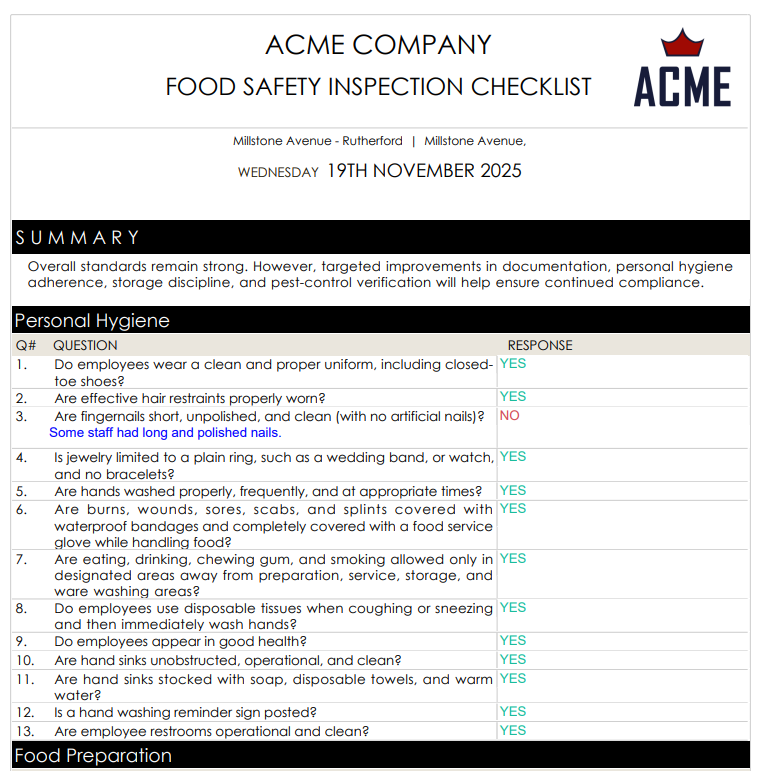
With GoAudits, this report is generated automatically the moment an inspection is submitted, already containing notes, photos, timestamps, and assigned actions.
Food Inspection Report from a Regulator: What It Is and How to Read It
Two different documents share the same name. Mixing them up causes real problems.
An internal food safety inspection report is the one your team produces. You run a checklist, record findings, assign corrective actions, and keep the report as evidence that your food safety management system is working. You control the format, the scope, and the frequency.
A regulatory food inspection report is issued by an inspector from outside the business: an environmental health officer in the UK, or a county or state health department inspector in the US. It records violations against a legal code, not against your internal standards. In most US jurisdictions, it is published, so customers can read it before they read the menu.
The internal report is how you avoid problems in the regulatory one.
What a Food Inspection Report Contains
A regulatory food inspection report generally includes:
- Establishment name, address, permit number, and the person in charge at the time of the visit
- Inspection type: routine, follow-up, complaint-driven, or pre-opening
- Each violation observed, mapped to a specific section of the applicable food code
- Risk classification for each violation. The US Food Code uses priority, priority foundation, and core. UK inspections feed into the Food Hygiene Rating Scheme score instead of publishing individual violation classes
- Temperature readings taken during the visit
- Which violations were corrected on site before the inspector left
- Correction deadlines and whether a re-inspection is scheduled
- Inspector notes and signatures from both the inspector and the operator
How to Read a Food Inspection Report
- Read the classification, not the count. Five core violations are a lesser problem than one priority violation. A report with a long list and no priority items usually means an inspector documenting maintenance issues, not a facility with a food safety failure.
- Check what was corrected on site. Violations marked corrected during the inspection still appear on the published report. They indicate a lapse that was fixable in minutes, which is a different problem from one requiring capital spend.
- Look for repeats across visits. The same violation appearing on consecutive reports is the finding regulators weight most heavily, because it shows the corrective action never happened or never held.
- Read the inspector notes. The narrative section usually explains why something was cited when the violation code alone does not make it obvious.
- Check the date against your last internal audit. If the inspector found something your own self-audit missed within the previous month, the gap is in your checklist, not in your team.
Where to Look Up a Food Inspection Report
In the US, food inspection reports are published by county or state health departments rather than centrally. The Association of Food and Drug Officials maintains a state-by-state index of the portals that publish them. Larger cities run their own lookup tools, and reports are typically posted around two weeks after the inspection.
In the UK, the Food Standards Agency publishes food hygiene ratings on its ratings site, but the full inspection report is not published alongside the score. Businesses can request their own copy from the local authority that carried out the visit, and members of the public can request one through a freedom of information request to that authority.
If you are looking up your own establishment’s report to prepare for a re-inspection, the more useful exercise is to run the same checklist the inspector used before they return. Use the food safety inspection checklist and the food hygiene rating checklist on this page for that.
Food Safety Audit Checklist PDF Free Download
Food Hygiene Inspection Checklist
This food inspection checklist is designed for the systematic evaluation and assurance of compliance with hygiene standards in food-related processes and facilities. It covers areas such as waste disposal, toilets, training and certificates, records and documentation, personal hygiene, receiving, food storage, cold storage, food preparation, hot/cold holding, delivery, and refreshment areas.
FSSC (Food Safety System Certification) 22000 is a globally recognized certification scheme that ensures the safety and quality of food products throughout the supply chain. Use our free checklists for internal audits, to establish compliance in preparation of the certification audit.
A HACCP checklist is a tool used to ensure that a HACCP plan is being implemented effectively. It provides a systematic way to identify, monitor, and control potential food safety hazards throughout the food production process.
BRC audit checklists provide a standardized framework for evaluating your food safety management system against the requirements of the BRC Global Standard for Food Safety. They cover a wide range of critical components, each designed to evaluate specific aspects of your food safety management system.
The Safe Quality Food (SQF) Program is a GFSI-recognised certification used widely across North American food manufacturing, storage, and distribution.
SQF Code Edition 10 was published in March 2026 and applies to audits from the second half of 2026, introducing measurable food safety culture objectives, a formal change management clause, competency-based training (staff must demonstrate they can apply practices, not just attend training), and a reintroduced pre-audit document review for first-time certifications.
Start your self-assessment with the free SQFI Food Manufacturing Audit Checklist, SQFI Storage and Distribution Checklist, and SQFI Quality Checklist.
Food Manufacturing Hygiene Audit
This food safety audit checklist helps you review food safety and hygiene practices in food production establishments. It covers pest control, cleanliness, staff hygiene, waste management, and more. You can use this checklist to identify areas for improvement and ensure compliance with food safety regulations.
This food hygiene rating checklist helps you ensure compliance with UK food safety standards for a higher hygiene rating. It covers areas such as food safety and hygiene procedures, structural requirements, and confidence in management procedures, covering aspects such as staff hygiene, hand washing, food storage, allergen management, equipment cleanliness, pest control, and waste management.
Pest Control Checklist for Food Industry
The food safety checklist template for pest control is designed for the food industry to systematically inspect and manage pest-related risks. It includes food debris sweeping, sealed storage for food products, sealing gaps and holes, maintaining clean yards and areas, using approved chemicals, regular checks for pest activity, repairing fly screens, and maintaining a clean environment to prevent pest infestation.
The food inspection checklist for personal hygiene helps you ensure that staff handling food adhere to proper personal hygiene practices. It covers aspects such as wearing protective clothing, maintaining the cleanliness of clothing and shoes, ensuring nails are short and clean, avoiding jewelry and uncovered skin wounds, confirming staff health, and avoiding bad body odor or strong perfumes.
Food Safety Self-Inspection Checklist
This food safety checklist is designed for self-inspections, covering a broad range of topics to ensure food safety. It includes cleanliness of storage areas, pest control measures, food safety management systems like HACCP, staff training in food safety procedures, cooking and storage temperature guidelines, hand washing practices, storage of raw and ready-to-eat food separately, staff hygiene practices, sickness recording, prevention of cross-contamination, etc.
Food Safety Kitchen Inspection Checklist
This kitchen health and safety checklist helps US businesses systematically review food safety practices and facilities to ensure hygiene standards in kitchens. It covers a wide range of topics such as notice and documentation, food safety, employee health, water and plumbing, equipment and utensils, hand washing facilities, floors, walls, ceilings, toilet facilities, lighting and ventilation, pest control, toxic materials, and garbage handling.

Food Safety Audit Report: Common Mistakes & Tips to Avoid Them
Inadequate Documentation
When records are incomplete or disorganized, it becomes difficult to verify findings or demonstrate compliance. You should ensure that every observation, corrective action, and verification detail is properly recorded and traceable. Supporting evidence such as photographs, test results, or process records strengthens the credibility of your report and minimizes ambiguity.
Lack of Objectivity
Allowing assumptions or personal opinions to influence the report can lead to biased conclusions. You should base every observation strictly on evidence and measurable data. Maintaining neutrality ensures the report reflects actual conditions rather than interpretations. This not only enhances transparency but also builds trust among stakeholders.
Ignoring Root Cause Analysis
Ignoring root cause analysis weakens the corrective action process. Simply noting a nonconformance without identifying its source often results in recurring issues. You should investigate underlying causes instead of addressing only surface-level symptoms. A thorough root cause analysis allows you to propose corrective actions that prevent future deviations.
Overlooking Follow-Up Actions and Audits
Overlooking follow-up actions and audits also undermines the value of the report. An audit is not complete until corrective measures have been verified and their effectiveness confirmed. You should document follow-up timelines, responsibilities, and evaluation criteria. Conducting periodic reviews ensures that improvements are maintained and compliance standards are upheld consistently.
FAQs
What is the difference between food safety and food hygiene?
They describe the same discipline in different markets. Food hygiene is the standard term in the UK and EU; food safety in the US. Food hygiene sometimes refers more narrowly to cleanliness and handling practices, while food safety covers the whole system, including HACCP and management controls.
What should a daily food safety checklist include?
Opening and closing checks, fridge and freezer temperature logs, hot and cold holding temperatures, staff health and hygiene confirmation, cleaning task sign-off, and any deliveries received with their temperatures recorded.
How do you prepare for a food safety audit?
Run a self-audit using the same checklist the auditor will use, four to six weeks ahead. Then verify your records are current: temperature logs, cleaning schedules, pest control documentation, training certificates, and evidence that previous corrective actions were closed.
Who carries out food safety audits?
Internal audits are conducted by your own team or head office. Certification bodies conduct external audits for schemes like BRCGS, SQF, FSSC 22000, or IFS, and regulators such as environmental health officers in the UK and health departments in the US.
How long should you keep food safety inspection reports?
Certification schemes generally require records to be retained for the life of the certificate plus the previous cycle, so a minimum of two years in practice, and BRCGS and SQF auditors routinely ask for the prior audit and evidence that its findings were closed. Regulatory reports are worth keeping indefinitely, because a repeat violation is judged against your full history rather than the last twelve months. Internal inspection reports should be retained at least as long as the product shelf life they cover.
Other Popular Food & Hospitality Templates:

Food Safety Software App
- Easily perform audits anywhere in the facility using a mobile device.
- Capture and attach photos as proof of compliance or areas needing attention.
- Assign tasks, set deadlines, and track progress, all within a single app
- Analyze data from audits to identify trends, pinpoint recurring issues, and assess compliance levels.