Key Takeaways
- Free FSSC 22000 V6 audit checklist templates: mobile-first, customizable, exportable as PDF reports.
- V6 is the current valid version. V5.1 certificates expired March 31, 2025.
- V7 publishes early May 2026 with a 12-month transition window, so V6 stays operational through 2027.
- An FSSC 22000 audit verifies three layers: ISO 22000:2018, the sector PRPs (ISO/TS 22002 series), and the 14 V6 additional requirements.
FSSC 22000 is a GFSI-recognized food safety certification scheme owned by Foundation FSSC and used in 150+ countries by food manufacturers, packaging producers, transport operators, retailers, and feed producers. The scheme is built on three layers: ISO 22000, sector-specific prerequisite programs (PRPs), and the FSSC additional requirements. It also aligns with ISO 9001 and ISO 14001 for integrated management systems.
V6 is the current valid version. V7 publishes in early May 2026 with a 12-month transition window, so V6 stays operational through 2027. This guide covers the V6 audit checklist (free download), the 14 V6 additional requirements, the audit process, and what’s changing in V7.
What is the FSSC 22000 Standard?
An FSSC 22000 audit is an independent assessment of a food safety management system against the standard’s three layers: ISO 22000:2018, the sector PRP (Prerequisite Programs), and the 14 additional FSSC requirements. It is conducted by an accredited certification body and applies across food manufacturing, packaging, transport, storage, retail, and animal feed production.
A passing audit yields an FSSC 22000 certificate, recognized by GFSI since 2010 and accepted by major retailers and food service buyers worldwide. The scheme is owned by Foundation FSSC; V6 is current, V7 publishes May 2026.
Free & Customizable FSSC 22000 Checklists
Downloading these free FSSC 22000 audit checklists from GoAudits is a proactive step toward conducting internal audits and ensuring compliance with industry-leading food safety standards.
FSSC 22000 Version 6 Checklist
The FSSC 22000 V6 Gap Analysis Checklist is the primary template for V6 internal audits. It maps to the V6 additional requirements and the underlying ISO 22000:2018 clauses to identify gaps before your external certification audit. It covers:
- The 14 FSSC V6 additional requirements (food defense, food fraud, food safety culture, environmental monitoring, allergen management, equipment management, food loss and waste, etc.)
- ISO 22000:2018 management system clauses and the sector-specific PRPs (ISO/TS 22002 series) for your category
- Operational controls (temperature, cross-contamination, pest control, personal hygiene), FSMS documentation, corrective action and non-conformity tracking.
ISO 22000 Food Safety Checklist (FSMS)
The ISO 22000 Food Safety Checklist (FSMS) covers the ISO 22000:2018 management system requirements at the foundation of FSSC 22000. Use it for FSMS inspections or as a baseline if you’re not yet ready for the full FSSC scheme. Areas covered: waste disposal, ingredient and material management, cross-contamination prevention, personnel training and hygiene, building construction, equipment maintenance, pest control, product recall, food defense, biovigilance, and bioterrorism.
A separate ISO 22000 Internal Audit Checklist is available for facilities running annual ISO 22000 internal audits.
FSSC 22000 V5 Audit Checklist (Legacy Reference)
The FSSC 22000 Version 5 Audit Checklist is provided as a legacy reference. V5.1 certificates expired March 31, 2025; this checklist is no longer valid for certification audits. Switch to the V6 gap analysis checklist above.
Customer story: Nissin Foods USA
The US arm of Nissin Foods (the original maker of Cup Noodles) uses GoAudits across its manufacturing facilities for GMP, HACCP, and GFSI-aligned audits, averaging a 96%+ GMP audit completion rate and using real-time report distribution to action findings the same day.
“One of the key features of GoAudits that made the difference for us, is the ability to immediately email the report to the relevant parties. This real-time information allows us to address much quicker any issues that are found.” — Eddie Odie, Nissin Foods
Read the full case study →
What’s New in FSSC 22000 V7 (Coming May 2026)
Foundation FSSC publishes FSSC 22000 V7 in early May 2026, with a 12-month transition window before it becomes the only valid version. V6 audits stay valid throughout, so most certified organizations will run V6 well into 2027.
V7 changes:
- Adoption of the new ISO 22002:2025 PRP series (replaces the older ISO/TS 22002-x versions used under V6)
- Alignment with GFSI Benchmarking Requirements v2024, keeping FSSC 22000 recognized by major retailers and global supply chains
- Strengthened sustainability requirements to support the UN Sustainable Development Goals
- Clearer food chain category structure to reduce ambiguity about which PRP applies
- Expanded additional requirements around food loss and waste, quality control, equipment management, allergen management, and food safety and quality culture
Once V7 scheme documents are published, V6-certified facilities should gap-analyze against V7 and align internal audit checklists to the new PRP series before transition. Treat the 12-month window as roughly 9 months of work plus 3 months of buffer; the V5.1→V6 transition was tightest for organizations that started in the final quarter.
Other Food Safety & Inspection Checklists
The GoAudits food audit checklist library covers HACCP, BRC, GMP, SQF, and other frameworks. Sign up free, or digitize your food SOPs into structured checklists.
Most relevant to FSSC 22000 audits:
- Food Safety Checklists
- HACCP Audit Checklist and HACCP checklists guide: HACCP is integral to FSSC 22000’s hazard control requirements
- GMP Audit Checklists: covers PRPs that underpin FSSC 22000
- BRC Audit Checklists: alternative GFSI-recognized scheme
- Food Safety & Hygiene Checklist
- Food Manufacturing SOP
- SQFI Manufacturing of Food Packaging Checklist
- Food Fraud Vulnerability Assessment Template (supports FSSC additional requirement #4)
- Kitchen Equipment Maintenance Checklist
- HACCP-Based SOPs
See also: GFSI audits and certification and food safety standards and certification programs.

What Are the FSSC 22000 V6 Additional Requirements?
The FSSC 22000 V6 additional requirements are 14 mandatory clauses beyond ISO 22000 and the sector PRPs. External auditors check evidence across each:
| Additional Requirement | What It Covers |
|---|---|
| 1. Management of services and purchased materials | Approving and monitoring suppliers and outsourced services |
| 2. Product labeling and printed materials | Verifying labels match product specs and regulatory rules |
| 3. Food defense | Preventing intentional contamination threats |
| 4. Food fraud mitigation | Assessing economically motivated adulteration risk |
| 5. Logo use | Correct use of FSSC 22000 marks on documentation and packaging |
| 6. Management of allergens | Allergen risk assessment, validated cleaning, labeling controls |
| 7. Environmental monitoring | Risk-based program for pathogens and indicator organisms in production environments |
| 8. Food safety and quality culture | Management commitment, communication, training, accountability |
| 9. Quality control | Documented quality control activities tied to product specifications |
| 10. Transport, storage, and warehousing | Temperature, contamination, and pest controls during transit and storage |
| 11. Hazard control and cross-contamination | Physical, microbiological, and allergen cross-contamination controls |
| 12. PRP verification | Routine verification that prerequisite programs are working as intended |
| 13. Product development | Food safety considered from design and reformulation stage |
| 14. Health status | Worker health screening relevant to food handling |
A practical V6 audit checklist assigns one or more verification questions to each, plus references to ISO 22000 clauses and the sector PRP. The V6 gap analysis checklist above is structured this way. Full text: FSSC 22000 V6 scheme document, Part 2 Section 2.5.
What Changed in FSSC 22000 V6 compared to the previous version?
Foundation FSSC published V6 of the FSSC 22000 scheme in March 2023; V5.1 expired March 31, 2025. Main changes in V6 vs V5.1:
- Food chain categories realigned with ISO 22003-1:2022; Trading and Brokering (Category FII) added; Farming and FSSC 22000-Quality removed from scheme scope
- Food safety and quality culture integrated as mandatory (was encouraged in V5.1)
- New mandatory requirements for quality control, food loss and waste, and equipment management
- Strengthened additional requirements for allergen management and environmental monitoring
- Certification process changes including audit duration and unannounced audits
- QR codes added to certificates for instant verification
Which Industries Does FSSC 22000 V6 Apply To?
FSSC 22000 V6 applies across the food supply chain through ISO 22003-1:2022 aligned categories, each with its own PRP standard.
| Category | What It Covers | Applicable PRP |
|---|---|---|
| Food manufacturing | Safety and quality controls for food production operations | ISO/TS 22002-1 |
| Catering | Food safety in commercial catering: handling, preparation, serving | ISO/TS 22002-2 |
| Food packaging manufacturing | Production of packaging in direct or indirect contact with food | ISO/TS 22002-4 |
| Animal feed production | Safety controls for animal feed and pet food | ISO/TS 22002-6 |
| Transport, storage, and warehousing | Temperature, contamination, and pest controls in transit and storage | NEN/NTA 8059 and related |
| Trading, retail, wholesale, and e-commerce | Food safety across selling and distribution platforms (Category FII, added in V6) | FSSC additional requirements |
| Production of biochemicals | Safety and quality standards for biochemical production | ISO/TS 22002-4 + sector additions |
| Pre-process handling of plant products | Hygiene and safety in initial handling of plant products | Category-specific PRPs |
When scoping an audit, choose the matching category and pull the applicable PRP alongside the ISO 22000 and additional requirements clauses.
What Is the FSSC 22000 Audit Process?
The FSSC 22000 audit process has three phases: pre-audit prep, on-site audit, and post-audit follow-up. Initial certification audits run 2–5 days on-site (Stage 1 documentation review, Stage 2 implementation check); surveillance audits 1–2 days. Internal audits, required at planned intervals under ISO 22000 clause 9.2 (typically annual), use the same structure.
How Do You Prepare for an FSSC 22000 Audit?
Close documentation and operational gaps before the auditor arrives. Run an internal gap analysis using the V6 gap analysis checklist 4–8 weeks ahead of the external audit.
- Set scope, timeline, category (which PRP, sites, products)
- Use a V6-aligned checklist mapping to additional requirements, ISO 22000 clauses, sector PRP
- Assign roles and brief area owners on what evidence will be reviewed
- Pull together FSMS docs: policies, procedures, training records, validation studies, complaint logs
How Do You Conduct an FSSC 22000 Internal Audit?
An internal audit walks the checklist items and gathers evidence through interviews, observation, and documentation review. Find non-conformities before the certification body does.
- Work through the checklist, capturing evidence at each item (photos, document IDs, interview notes)
- Inspect production areas, storage, hygiene practices, and high-risk control points in person
- Review corrective action records, validation studies, environmental monitoring, and PRP verification
- Log every non-conformity clearly. Vague findings become disputed findings.
What Happens After an FSSC 22000 Audit?
Post-audit work converts findings into closed corrective actions. The next surveillance audit starts by checking that previous findings are closed.
- Compile the audit report: findings, non-conformities, corrective action recommendations
- Develop a corrective action plan with owners, deadlines, verification methods per non-conformity
- Run targeted re-inspections or evidence reviews to confirm actions are working
- Track open and closed actions against root causes
What Are the Most Common FSSC 22000 Audit Findings?
The most frequent FSSC 22000 V6 non-conformities cluster around the additional requirements introduced or strengthened in V6:
- Environmental monitoring programs without risk-based sampling or trend analysis
- Allergen cleaning validation evidence missing or out of date
- Food fraud vulnerability assessments not reviewed after supplier or recipe changes
- PRP verification activities performed but not documented as such
- Food safety and quality culture commitments without measurable indicators
- Corrective actions closed without root cause analysis or effectiveness verification
Catching these in an internal audit 4–8 weeks before the certification body arrives is the entire point of running a V6 gap analysis.
Automate your FSSC 22000 Internal Audits
GoAudits food safety software replaces paper checklists and spreadsheets with a structured workflow built for FSSC 22000 V6 internal audits and certification prep:
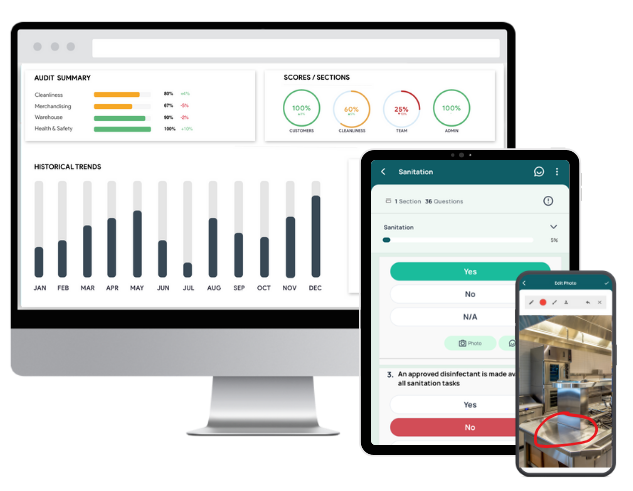
- V6-aligned templates. Use the V6 gap analysis checklist, the ISO 22000 FSMS checklist, or your own. We’ll build them at no extra cost.
- Mobile audits, even offline. Capture evidence on iOS, Android, or web (photos, annotations, signatures, barcodes); audits sync when reconnected.
- Instant reports. Each audit generates a professional report on submission, ready to email to area owners and certification body contacts for same-day corrective action.
- Action plans tracked against findings. Log non-conformities, assign owners and deadlines, track close-out via dashboard.
- Multi-site visibility. Trend reports and drill-down dashboards across sites, facilities, and audit categories.
FSSC 22000 vs ISO 22000: What’s the Difference?
ISO 22000 is a food safety management system standard. FSSC 22000 is a GFSI-recognized certification scheme that verifies an organization meets ISO 22000 plus sector-specific PRPs and 14 additional FSSC requirements.
| ISO 22000 | FSSC 22000 | |
|---|---|---|
| What it is | Management system standard | Certification scheme |
| Owned by | International Organization for Standardization | Foundation FSSC |
| Built on | ISO 9001 / 14001 management system structure | ISO 22000 + sector PRPs + FSSC additional requirements |
| Sector-specific PRPs | Not included | Required (ISO/TS 22002 series) |
| Additional requirements | Not included | 14 mandatory clauses (food defense, food fraud, food safety culture, etc.) |
| GFSI recognition | No | Yes |
| Certification body audit | Optional | Required |
When buyers ask for “GFSI certification,” they typically mean FSSC 22000, BRC, SQF, or another GFSI-benchmarked scheme. ISO 22000 alone won’t satisfy that, but ISO 22000:2018 is a reasonable starting point if you’re working toward FSSC 22000. For ISO 22000 internal audits, GoAudits offers a dedicated ISO 22000 Internal Audit Checklist and ISO 22000 FSMS Checklist.
Why Does FSSC 22000 Certification Matter?
FSSC 22000 certification is the food safety credential global retailers and food service buyers list as a baseline supplier requirement, and the reason ISO 22000 alone usually isn’t enough to win their business.
Three reasons certified organizations cite most often:
- Brand defense. A current FSSC 22000 certificate (with QR-code verification under V6) is a one-look proof point during supplier onboarding, due diligence, and after a food safety incident.
- Buyer access. GFSI-recognized certification is the entry ticket for selling into major retail and food service supply chains.
- Operational risk reduction. The V6 framework forces a structured approach to hazard control, allergen management, food fraud, and food defense.

Frequently Asked Questions
What is the latest version of FSSC 22000?
FSSC 22000 V6 is the current valid version, mandatory since April 1, 2025 when V5.1 certificates expired. V7 publishes in early May 2026 with a 12-month transition. V6 audits stay valid throughout the V7 transition.
What are the FSSC 22000 V6 additional requirements?
The V6 additional requirements are 14 mandatory clauses covering food defense, food fraud mitigation, food safety and quality culture, allergen management, environmental monitoring, quality control, equipment management, food loss and waste, transport and storage controls, PRP verification, product development, worker health status, logo use, and management of services and purchased materials.
How long does FSSC 22000 certification take and what does it cost?
Initial FSSC 22000 certification typically takes 6 to 12 months from project kickoff to certificate issuance, depending on the maturity of your existing food safety management system. Audit costs from accredited certification bodies vary by facility size, category, and region, but typically range from $8,000 to $25,000 for initial certification (Stage 1 + Stage 2) plus $4,000 to $12,000 per annual surveillance audit. Internal preparation costs (consultancy, training, software, internal audit hours) usually exceed audit fees in the first year.
How often do you need to run FSSC 22000 internal audits?
ISO 22000 clause 9.2 (which FSSC 22000 inherits) requires internal audits at planned intervals, with most certified facilities running them at least annually. Larger or higher-risk operations typically split coverage across the year — different sites, departments, or processes audited each quarter — to maintain continuous oversight. Certification bodies expect to see internal audit records covering all clauses and additional requirements within the certification cycle.
Can FSSC 22000 internal audits be done remotely or with mobile audit software?
Internal audits can be done remotely for documentation review, but the operational portions (production area inspection, environmental monitoring observation, hygiene practices) require on-site or hybrid execution. Mobile audit software like GoAudits is designed for this hybrid model — auditors capture evidence in the field on iOS, Android, or web (photos, signatures, barcode scans), audits work offline, and reports are generated and distributed instantly to area owners and certification body contacts.
What should I look for in FSSC 22000 audit software?
Software for FSSC 22000 V6 internal audits offer V6-aligned checklist templates that map to the additional requirements and sector PRPs (not generic GMP templates relabeled), offline mobile capture for in-plant inspections where Wi-Fi is unreliable, instant report generation for same-day corrective action distribution, action plan tracking the certification body can review at the next surveillance audit, and multi-site visibility for QA teams managing more than one facility.
GoAudits is one of the platforms built around this profile, with a dedicated FSSC 22000 V6 gap analysis checklist, offline mobile audits on iOS, Android, and web, and a managed template service that builds custom checklists at no extra cost. Many food safety and QA teams still run FSSC 22000 audits in Excel and paper, which works until the certification body asks for an evidence trail across 12 months of corrective actions.
What’s the difference between ISO 22000 and FSSC 22000?
ISO 22000 is a food safety management system standard. FSSC 22000 is a certification scheme built on ISO 22000 that adds sector PRPs and 14 additional requirements ISO 22000 alone doesn’t cover. FSSC 22000 is GFSI-recognized; ISO 22000 by itself is not.
Is the FSSC 22000 audit checklist available in Excel and PDF?
Yes. The GoAudits FSSC 22000 V6 audit checklist runs as a mobile-first digital template that exports as PDF reports. It’s fully customizable, works offline, and generates a structured report after each audit, replacing the Excel and paper templates many teams still use.
What changed between FSSC 22000 V5.1 and V6?
V6 realigned food chain categories with ISO 22003-1:2022, added Trading and Brokering, removed Farming and FSSC 22000-Quality, and made food safety and quality culture, quality control, and equipment management mandatory. V6 also added food loss and waste requirements and introduced QR codes on certificates.