- Library
- Food & Hospitality
- BRC Audit checklist Site Standards (Clause 4)
BRC Audit checklist Site Standards (Clause 4)
124 questions in 29 sectionsInteractive preview: try the answers
Section 1 of 29 · 4 questionsExternal Standards And Site Security
Consideration shall be given to local activities and the site environment, which may have an adverse impact on finished product integrity, and measures shall be taken to prevent contamination. Where measures have been put into place to protect the site (from potential contaminants, flooding etc.), they shall be reviewed in response to any changes.
The external areas shall be maintained in good order. Where grassed or planted areas are located near buildings, they shall be regularly tended and well maintained. External traffic routes under site control shall be suitably surfaced and maintained in good repair to mitigate the risk of contamination of the product.
The building fabric shall be maintained to minimise potential for product contamination (e.g. elimination of bird-roosting sites, sealing gaps around pipes to prevent pest entry, ingress of water and other contaminants).
Policies and systems shall be in place to ensure that access to the site by staff, contractors and visitors is controlled. A visitor recording system shall be in place. Contractors and visitors, including drivers, shall be made aware of the procedures for access to the site. Only authorised personnel shall have access to production and storage areas. Contractors working in product processing or storage areas shall be the responsibility of a nominated person. Staff shall be trained in site security procedures.
Section 2 of 29 · 4 questionsFood Defence
Where personnel are engaged in threat assessments and food defence plans, the individual or team responsible shall understand potential food defence risks at the site. This shall include knowledge of both the site and the principles of food defence. Where there is a legal requirement for specific training, this shall be in place.
The company shall undertake a documented risk assessment (threat assessment) of the potential risks to products from any deliberate attempt to inflict contamination or damage. This threat assessment shall include both internal and external threats. The output from this assessment shall be a documented food defence plan. This plan shall be kept under review to reflect changing circumstances and market intelligence. It shall be formally reviewed at least annually and whenever: • A new risk emerges (e.g. a new threat is publicised or identified) • An incident occurs where product security or food defence is implicated. Where applicable, the food defence plan shall meet the legal requirements in the country of sale or intended use.
Where raw materials or products are identified as being at particular risk, the food defence plan shall include controls to mitigate these risks. Where prevention is not sufficient or possible, systems shall be in place to identify any tampering. These controls shall be monitored, the results documented, and the controls reviewed at least annually.
Areas where a significant risk is identified shall be defined in the food defence plan, monitored and controlled. These shall include external storage and intake points for products and raw materials (including packaging). Staff shall be trained in food defence procedures.
Section 3 of 29 · 6 questionsLayout, Product Flow And Segregation
The site shall assess the production risk zones required for the products manufactured, processed or packed at the site, using the definitions in Appendix 2 of the Standard.
There shall be a map of the site. At a minimum, this map shall define: • Production risk zones, where product is at different levels of risk from pathogen contamination – for example, high-risk, high-care, ambient high-care, low-risk and enclosed product areas (see clause 4.3.1 and Appendix 2) • Access points for personnel • Access points for raw materials (including packaging), semi-finished products and open products • Routes of movement for personnel • Routes of movement for raw materials (including packaging) • Routes for the removal of waste • Routes for the movement of rework • Location of any staff facilities, including changing rooms, toilets, canteens and smoking areas • Production process flows • Any areas where time segregation is used to complete different activities (for example, time segregation for high-care areas).
Contractors and visitors, including drivers, shall be made aware of the requirements of the areas they are visiting, with special reference to hazards and potential product contamination.
The movement of personnel, raw materials, packaging, rework and/or waste shall not compromise the safety of products. The process flow, together with the use of demonstrably effective procedures, shall be in place to minimise the risk of the contamination of raw materials, intermediate/semi-processed products, packaging and finished products.
Premises shall allow sufficient working space and storage capacity to enable all operations to be carried out properly under safe hygienic conditions.
Temporary structures constructed during building work or refurbishment etc. shall be designed and located to avoid pest harbourage and ensure the safety and quality of products.
Section 4 of 29 · 11 questionsBuilding Fabric, Raw Material Handling, Preparation, Processing, Packing And Storage Areas
Walls shall be finished and maintained to prevent the accumulation of dirt, minimise condensation and mould growth, and facilitate cleaning.
Floors shall be suitably hard-wearing to meet the demands of the process, and withstand cleaning materials and methods. They shall be impervious, be maintained in good repair and facilitate cleaning.
Drainage, where provided, shall be sited, designed and maintained to minimise risk of product contamination and not compromise product safety. Machinery and piping shall be arranged so that, wherever feasible, process waste water goes directly to drain. Where significant amounts of water are used, or direct piping to drain is not feasible, floors shall have adequate falls to cope with the flow of any water or effluent towards suitable drainage.
Ceilings and overheads shall be constructed, finished and maintained to prevent the risk of product contamination.
Where suspended ceilings or roof voids are present, adequate access to the void shall be provided to facilitate inspection for pest activity, unless the void is fully sealed.
Where elevated walkways, access steps or mezzanine floors are adjacent to or pass over production lines which have open products, they shall be: designed to prevent contamination of products and production lines easy to clean correctly maintained.
Where there is a risk to product, windows and roof glazing which are designed to be opened for ventilation purposes shall be adequately screened to prevent the ingress of pests.
Doors (both internal and external) shall be maintained in good condition. At a minimum: • External doors and dock levellers shall be close fitting or adequately proofed • External doors to open product areas shall not be opened during production periods except in emergencies • Where external doors to enclosed product areas are opened, suitable precautions shall be taken to prevent pest ingress.
Suitable and sufficient lighting shall be provided for correct operation of processes, inspection of product and effective cleaning.
Adequate ventilation and extraction shall be provided in product storage and processing environments to prevent condensation or excessive dust.
Where plastic strip curtains are present, these shall be maintained in good condition, clean, fitted correctly (e.g. to prevent pest ingress or for temperature control), and shall not pose a food safety risk.
Section 5 of 29 · 3 questionsUtilities: Water, Ice, Air And Other Gases
All water (including ice and steam) used as a raw material in the manufacture of processed food, the preparation of product, hand-washing or equipment or plant cleaning shall be supplied in sufficient quantity, be potable at point of use, be fit for purpose and pose no risk of contamination according to applicable legislation. Where water is stored and handled on site (e.g. in storage or holding tanks), these shall be managed to minimise food safety risks. The microbiological and chemical quality of water shall be analysed as required by legislation or at least annually. The sampling points, scope of the test and frequency of analysis shall be based on risk, taking into account the source of the water, on-site storage and distribution facilities, previous sample history and usage.
An up-to-date schematic diagram shall be available of the water distribution system on site, including water source, holding tanks, water treatment and water recycling as appropriate. The diagram shall be used as a basis for water sampling and the management of water quality.
Air and other gases used as an ingredient or that are in direct contact with products shall be monitored to ensure this does not represent a contamination risk. Compressed air that is in direct contact with the product shall be filtered at point of use.
Section 6 of 29 · 7 questionsEquipment
There shall be a documented purchase specification for any new equipment detailing the site requirements for the equipment. This may, for example, include: • Any relevant legislation • here applicable, requirements for food contact surfaces to meet legal requirements • Details of intended use of the equipment and the type of materials it will be handling. Depending on its intended use, new equipment to site (including second-hand equipment) may require authorisation from a multi-disciplinary team. The supplier should provide evidence that equipment meets these site requirements prior to supply.
The design and construction of equipment shall be based on risk, to prevent product contamination. For example, the use of the correct seals, impervious surfaces or smooth welds and joints, where they are exposed to product and could otherwise result in foreign-body, microbiological or allergen contamination of the product. Equipment that is in direct contact with food shall be suitable for food contact and meet legal requirements where applicable.
A documented, risk-based commissioning procedure shall be in place to ensure that food safety and integrity is maintained during the installation of new equipment to site. Installation work shall be followed by a documented hygiene clearance procedure. New equipment to site shall be inspected by an authorised member of staff before being accepted into operation. The commissioning procedure shall include the update of any other site procedures that are affected by the new equipment, for example, training, operating procedures, cleaning, environmental monitoring, maintenance schedules or internal audits. The design and placement of equipment shall ensure that it can be effectively cleaned and maintained.
A procedure shall be in place to manage the movement of static equipment in production areas, to ensure that food safety is managed and the integrity of the equipment is maintained.
Equipment that is not used or is taken out of service shall be cleaned and stored in a manner that does not pose a risk to the product. Equipment stored in internal production and storage areas shall be kept clean. Food contact equipment that has been stored but is not in daily use shall be cleaned and, where necessary, disinfected prior to use.
Mobile equipment (e.g. forklift trucks, pallet trucks, scissor lifts and ladders) used in open product areas shall not pose a risk to the product. Where the use of mobile equipment in external areas cannot be avoided and poses a risk to the product, the equipment shall be cleaned and disinfected prior to entering production areas.
Battery-charging equipment shall not be stored in open product areas (unless the batteries are fully sealed and/or maintenance-free) or where there is a risk to products.
Section 7 of 29 · 6 questionsMaintenance
There shall be a planned preventive maintenance schedule or condition monitoring system which includes all plant, processing equipment and mobile equipment. The maintenance requirements shall be defined when commissioning new equipment and reviewed after repairing existing equipment.
In addition to any planned maintenance programme, where there is a risk of product contamination by foreign bodies arising from equipment damage, the equipment shall be inspected at predetermined intervals, the inspection results documented and appropriate action taken.
Where temporary repairs are made, these shall be documented and controlled to ensure that the safety or legality of products is not jeopardised. These temporary measures shall be permanently repaired as soon as practicable and within a defined timescale.
The site shall ensure that the safety or legality of products is not jeopardised during maintenance and subsequent cleaning operations. Maintenance work shall be followed by a documented hygiene clearance procedure. Equipment and machinery shall be inspected by an authorised member of staff to confirm the removal of contamination hazards, before being accepted back into operation.
Materials and parts used for equipment and plant maintenance shall be of an appropriate grade or quality. Those materials (such as lubricating oil) that pose a risk by direct or indirect contact with raw materials (including primary packaging), intermediate products and finished products shall be food grade and of a known allergen status.
Engineering workshops shall be kept clean and tidy, and controls shall be in place to prevent transfer of engineering debris to production or storage areas.
Section 8 of 29 · 8 questionsStaff Facilities
Designated changing facilities shall be provided for all personnel, whether staff, visitor or contractor. These shall be sited to allow direct access to the production, packing or storage areas without recourse to any external area. Where this is not possible, a risk assessment shall be carried out and procedures implemented accordingly (e.g. the provision of cleaning facilities for footwear).
Storage facilities of sufficient size to accommodate personal items shall be provided for all personnel who work in raw material-handling, preparation, processing, packing and storage areas.
Outdoor clothing and other personal items shall be stored separately from production clothing within the changing facilities. Facilities shall be available to separate clean and dirty production clothing.
Suitable and sufficient hand-washing facilities shall be provided at access to, and at other appropriate points within, production areas. Such hand-washing facilities shall provide, at a minimum: • Advisory signs to prompt hand-washing • A sufficient quantity of water at a suitable temperature • Water taps with hands-free operation • Liquid/foam soap • Single-use towels or suitably designed and located air driers.
Toilets shall be adequately segregated and shall not open directly into production or packing areas. Toilets shall be provided with hand-washing facilities comprising: • Basins with soap and water at a suitable temperature • Adequate hand-drying facilities • Advisory signs to prompt hand-washing. Where hand-washing facilities within toilets are the only hand-washing facilities provided before re-entering production, the requirements of clause 4.8.4 shall apply and signs shall be in place to direct people to hand-washing facilities before entering production.
Where smoking is allowed under national law, designated controlled smoking areas shall be provided which are both isolated from production areas to an extent that ensures smoke cannot reach the product and fitted with sufficient extraction to the exterior of the building. Adequate arrangements for dealing with smokers’ waste shall be provided at smoking facilities, both inside and at exterior locations. Electronic cigarettes shall not be permitted to be used or brought into production or storage areas.
All food brought into manufacturing premises by staff shall be appropriately stored in a clean and hygienic state. No food shall be taken into storage, processing or production areas. Where eating of food is allowed outside during breaks, this shall be in suitable designated areas with appropriate control of waste.
Where catering facilities (including vending machines) are provided on the premises, they shall be suitably controlled to prevent contamination of products (e.g. as a source of food poisoning, the use of allergenic ingredients or introduction of new allergenic material to the site).
Section 9 of 29 · 2 questionsChemical Control
Processes shall be in place to manage the use, storage and handling of non-food chemicals to prevent chemical contamination. These shall include, at a minimum: • An approved list of chemicals for purchase • Availability of material safety data sheets and specifications • Confirmation of suitability for use in a food-processing environment • Avoidance of strongly scented products • The labelling and/or identification of containers of chemicals at all times • A designated storage area (separate from chemicals used as raw materials in products) with access restricted to authorised personnel • Use by trained personnel only • Procedures to manage any spills • Procedures for the safe, legal disposal or return of obsolete or out-of-date chemicals and empty chemical containers.
Where strongly scented or taint-forming materials have to be used, for instance for building work, procedures shall be in place to prevent the risk of taint contamination of products.
Section 10 of 29 · 5 questionsGlass, Brittle Plastic, Ceramics And Similar Materials
Glass or other brittle materials shall be excluded or protected against breakage in areas where open products are handled or there is a risk of product contamination.
Procedures for handling glass and other brittle materials (other than product packaging) shall be in place where open products are handled or there is a risk of product contamination. These procedures shall include, at a minimum: • A list of items detailing location, number, type and condition • Recorded checks of the condition of items, carried out at a specified frequency that is based on the level of risk to the product • Details on cleaning or replacing items to minimise the potential for product contamination.
Procedures detailing the action to be taken in the event of breakage of glass or other brittle items shall be implemented and include the following: • Training of staff in the correct procedure • Quarantining the products and production area that were potentially affected • Cleaning the production area • Inspecting the production area and authorising production to continue • Changing of workwear and inspection of footwear • Specifying those staff authorised to carry out the above points • Recording the breakage incident • Safely disposing of contaminated product.
Where they pose a risk to product, glass windows shall be protected against breakage.
Where they pose a risk to product, bulbs and strip lights (including those on electric fly-killer devices) shall be adequately protected. Where full protection cannot be provided, alternative management such as wire-mesh screens or monitoring procedures shall be in place.
Section 11 of 29 · 2 questionsMetal Control
There shall be a documented policy for the controlled use and storage of sharp metal implements including knives, cutting blades on equipment, needles and wires. This shall include a record of inspection for damage and the investigation of any lost items. Snap-off blade knives shall not be used.
The purchase of ingredients and packaging which use staples or other foreign-body hazards as part of the packaging materials shall be avoided. Staples, paper clips and drawing pins shall not be used in open product areas. Where staples or other items are present as packaging materials or closures, appropriate precautions shall be taken to minimise the risk of product contamination.
Section 12 of 29 · 3 questionsOther Physical Contaminants
Procedures shall be in place to prevent physical contamination of raw materials by raw material packaging (e.g. during debagging and deboxing procedures to remove the packaging).
Portable handheld equipment, e.g. stationery items (pens, pencils etc.), mobile phones, tablets and similar portable items used in open product areas, shall be controlled by the site to minimise the risk of physical contamination. The site may consider, for example: • Excluding non-approved items • Restricting the use to site-issued equipment • Ensuring stationery items such as pens are designed without small external parts and are detectable by foreign-body detection equipment, or are used in designated areas where contamination is prevented.
Based on risk, procedures shall be implemented to minimise other types of foreign-body contamination (i.e. types of contamination that are not specifically covered in section 4.9).
Section 13 of 29 · 3 questionsProducts Packed Into Glass Or Other Brittle Containers
The storage of the containers shall be segregated from the storage of raw materials, product or other packaging.
Systems shall be in place to manage container breakages between the container-cleaning/inspection point and container closure. This shall include, as a minimum, documented instructions which ensure: • The removal and disposal of at-risk products in the vicinity of the breakage; this may be specific for different equipment or areas of the production line • The effective cleaning of the line or equipment which may be contaminated by fragments of the container; cleaning shall not result in the further dispersal of fragments, for instance by the use of high-pressure water or air • The use of dedicated, clearly identifiable cleaning equipment (e.g. colour-coded) for removal of container breakages; such equipment shall be stored separately from other cleaning equipment • The use of dedicated, accessible, lidded waste containers for the collection of damaged containers and fragments • A documented inspection of production equipment is undertaken following the cleaning of a breakage, to ensure cleaning has effectively removed any risk of further contamination • Authorisation given for production to restart following cleaning • The area around the line being kept clear of broken glass.
Records shall be maintained of all container breakages on the line. Where no breakages have occurred during a production period, this shall also be recorded. This record shall be reviewed to identify trends and potential line or container improvements.
Section 14 of 29 · 1 questionWood
Wood should not be used in open product areas except where this is a process requirement (e.g. maturation of products in wood). Where the use of wood cannot be avoided, its condition shall be monitored on a risk-based frequency to ensure it is in good condition and free from damage or splinters which could contaminate products. Wood used for food contact purposes shall be fit for purpose (e.g. free from damage or splinters, free from taint; and wood treatments, where used, are used only in accordance with legislation and approved for food use).
Section 15 of 29 · 2 questionsContainer Cleanliness – Glass Jars, Cans And Other Rigid Containers
Based on risk assessment, procedures shall be implemented to minimise foreign-body contamination originating from the packaging container (e.g. jars, cans and other pre-formed rigid containers). This may include the use of covered conveyors, container inversion and foreign-body removal through rinsing with water or air jets.
The effectiveness of the container-cleaning equipment shall be checked and recorded during each production. Where the system incorporates a rejection system for dirty or damaged containers, the check shall incorporate a test of both the detection and effective rejection of the test container.
Section 16 of 29 · 2 questionsFilters And Sieves
Filters and sieves used for foreign-body control shall be of a specified mesh size or gauge and designed to provide the maximum practical protection for the product.
Filters and sieves shall be regularly inspected or tested for damage at a documented frequency based on risk. Records shall be maintained of the checks. Where defective filters or sieves are identified, this shall be recorded and the potential for contamination of products investigated and appropriate action taken.
Section 17 of 29 · 1 questionMagnets
The type, location and strength of magnets shall be fully documented. Procedures shall be in place for the inspection, cleaning, strength testing and integrity checks of magnets used for food safety purposes, including final product testing, e.g. to remove product contamination. Records of all checks shall be maintained.
Section 18 of 29 · 4 questionsMetal Detectors And X-ray Equipment
Metal detection equipment shall be in place unless risk assessment demonstrates that this does not improve food safety. Where metal detectors are not used, justification shall be documented. The absence of metal detection would only normally be based on the use of an alternative, more effective method of protection (e.g. use of X-ray, fine sieves or filtration of products). The metal detector or X-ray equipment shall incorporate one of the following: • An automatic rejection device, for continuous in-line systems, which shall divert contaminated product either out of the product flow or to a secure unit accessible only to authorised personnel • A belt stop system with an alarm where the product cannot be automatically rejected (e.g. for very large packs) • In-line detectors which identify the location of the contaminant to allow effective segregation of the affected product.
The site shall establish and implement procedures for the operation and testing of the metal detection or X-ray equipment. This shall include, at a minimum: • Responsibilities for the testing of equipment • The operating effectiveness and sensitivity of the equipment and any variation to this for particular products • The methods and frequency of checking the detector • Recording of the results of checks.
Metal detector testing procedures shall, at a minimum, include: • Use of test pieces incorporating a sphere of metal of a known diameter selected on the basis of risk. The test pieces shall be marked with the size and type of test material contained • Tests carried out using separate test pieces containing ferrous metal, stainless steel and typically non-ferrous metal, unless the product is within a foil container where a ferrous-only test may be applicable • A test to prove that both the detection and rejection mechanisms are working effectively under normal working conditions • Tests of the metal detector by passing successive test packs through the unit at typical line operating speed • Checks of failsafe systems fitted to the detection and rejection systems. In addition, where metal detectors are incorporated on conveyors, the test piece shall be passed as close as possible to the least sensitive area of the metal detector (usually the centre of the metal detector aperture). Wherever possible, the test piece shall be inserted within a clearly identified sample pack of the food being produced at the time of the test. Where in-line metal detectors are used, the test piece shall be placed in the product flow wherever this is possible, and the correct timing of the rejection system to remove identified contamination shall be validated. Testing of in-line metal detectors shall be completed during both line start-up and at the end of the production period.
X-ray equipment testing procedures shall, at a minimum, include: • Use of test pieces incorporating a sphere of suitable material (e.g. a typical contaminant) of a known diameter selected on the basis of risk. The test pieces shall be marked with the size and type of test material contained • Tests carried out using separate test pieces • A test to prove that both the detection and rejection mechanisms are working effectively under normal working conditions • Tests of the X-ray equipment by passing successive test packs through the unit at typical line operating speed • Checks of failsafe systems fitted to the detection and rejection systems. In addition, where X-ray equipment is incorporated on conveyors, the test piece shall be passed as close as possible to the least sensitive area of the X-ray equipment (e.g. this may be close to the X-ray source or close to the X-ray equipment). Wherever possible, the test piece shall be inserted into a clearly identified sample pack of the food being produced at the time of the test. Where in-line X-ray equipment is used, the test piece shall be placed in the product flow wherever this is possible, and the correct timing of the rejection system to remove identified contamination shall be validated. Testing of in-line equipment shall be completed both during line start-up and at the end of the production period.
Section 19 of 29 · 1 questionOptical Sorting Equipment
Optical sorting equipment used for final product testing shall be checked in accordance with the manufacturer’s instructions or recommendations. Checks shall be documented.
Section 20 of 29 · 1 questionOther Foreign-Body Detection And Removal Equipment
Other foreign-body detection and removal equipment, such as gravity separation, fluid bed technology or aspirators, shall be checked in accordance with the manufacturer’s instructions or recommendations. Checks shall be documented.
Section 21 of 29 · 4 questionsSelection And Operation Of Foreign-Body Detection And Removal Equipment
A documented assessment in association with the food safety plan (see section 2 – The food safety plan) shall be carried out on each production process to identify the potential use of equipment to detect or remove foreign-body contamination. Typical equipment to be considered may include: • Filters and sieves • Metal detection and X-ray detection equipment • Magnets • Optical sorting equipment • Other physical separation equipment (e.g. gravity separation, fluid bed technology).
The type, location and sensitivity of the detection and/or removal method shall be specified as part of the site’s documented system. Industry best practice shall be applied with regard to the nature of the ingredient, material, product and/or packed product. The location of the equipment or any other factors influencing the sensitivity of the equipment shall be validated and justified.
The site shall ensure that the frequency of the testing of the foreign-body detection and/or removal equipment is defined and takes into consideration: • Specific customer requirements • The site’s ability to identify, hold and prevent the release of any affected materials, should the equipment fail. The site shall establish and implement corrective action and reporting procedures in the event of a failure of the foreign-body detector and/or removal equipment. Action shall include a combination of isolation, quarantining and re-inspection of all products produced since the last successful test or inspection.
Where foreign material is detected or removed by the equipment, the source of any unexpected material shall be investigated. Information on rejected materials shall be used to identify trends and, where possible, instigate preventive action to reduce the occurrence of contamination by the foreign material.
Section 22 of 29 · 4 questionsCleaning In Place (CIP)
All CIP equipment shall be designed and constructed to ensure effective operation. This shall include: • Validation confirming the correct design and operation of the system • An up-to-date schematic diagram of the layout of the CIP system • Where rinse solutions are recovered and re-used, an assessment of the risk of cross-contamination (e.g. due to the re-introduction of an allergen or the existence of different production risk zones within the site). Alterations or additions to the CIP system shall be authorised by a suitably competent individual before changes are made. A record of changes shall be maintained. The system shall be revalidated at a frequency based on risk, and following any alteration or addition.
Limits of acceptable and unacceptable performance for key process parameters shall be defined to ensure the removal of target hazards (e.g. soil, allergens, micro-organisms, spores). At a minimum these parameters shall include: • Times for each stage • Detergent concentrations • Flow rate and pressure • Temperatures. These shall be validated and records of the validation maintained.
The CIP equipment shall be maintained by suitably trained staff to ensure effective cleaning is carried out. This shall include: • Routine checking of detergent concentrations • Monitoring of recovered post-rinse solutions for build-up of carry-over from the detergent tanks • Cleaning and inspection of filters, where fitted, at a defined frequency • Storing flexible hoses (where used) hygienically when not in use, and inspecting them at a defined frequency to ensure that they are in good condition.
CIP facilities, where used, shall be monitored at a defined frequency based on risk. This may include: • Monitoring of process parameters defined in clause 4.11.7.2 • Ensuring correct connections, piping and settings are in place • Confirming the process is operating correctly (e.g. valves are opening/closing sequentially, spray balls are operating correctly) • Ensuring effective completion of the cleaning cycle • Monitoring for effective results, including draining where required. Procedures shall define the action to be taken if monitoring indicates that processing is outside the defined limits.
Section 23 of 29 · 3 questionsEnvironmental Monitoring
The design of the environmental monitoring programme shall be based on risk, and at a minimum include: • Sampling procedures • Identification of sample locations • Frequency of tests • Target organism(s) (e.g. pathogens, spoilage organisms and/or indicator organisms) • Test methods (e.g. settle plates, rapid testing and swabs) • Recording and evaluation of results. The programme and its associated procedures shall be documented.
Appropriate control or action limits shall be defined for the environmental monitoring programme. The company shall document the corrective action to be taken when monitored results indicate a failure to meet a control limit, or when monitored results indicate an upward trend of positive results (i.e. a trend towards a control or action limit).
The company shall review the environmental monitoring programme at least annually and whenever there are: • Changes in processing conditions, process flow or equipment which could impact the environmental monitoring programme • New developments in scientific information (e.g. new pathogens of concern) • Failures of the programme to identify a significant issue (e.g. regulatory authority tests identifying positive results which the site programme did not) • Product failures (products with positive tests) • Consistently negative results (e.g. a site with a long history of negative results should review its programme to consider whether the correct parts of the factory are being tested, whether the testing is being conducted correctly, whether the tests are for the appropriate organisms, etc.).
Section 24 of 29 · 6 questionsHousekeeping And Hygiene
The premises and equipment shall be maintained in a clean and hygienic condition.
Documented cleaning and disinfection procedures shall be in place and maintained for the building, plant and all equipment. Cleaning procedures for the processing equipment and food contact surfaces shall, at a minimum, include: • Responsibility for cleaning • Item/area to be cleaned • Frequency of cleaning • Method of cleaning, including dismantling equipment for cleaning purposes where required • Cleaning chemicals and concentrations • Cleaning materials to be used • Cleaning records (including records for completion and sign-off) and responsibility for verification. The frequency and methods of cleaning shall be based on risk. The procedures shall be implemented to ensure appropriate standards of cleaning are achieved.
Limits of acceptable and unacceptable cleaning performance shall be defined for food contact surfaces and processing equipment. These limits shall be based on the potential hazards relevant to the product or processing area (e.g. microbiological, allergen, foreign-body or product-to-product contamination). Therefore, acceptable levels of cleaning may be defined by visual appearance, ATP bioluminescence techniques (see glossary), microbiological testing, allergen testing or chemical testing as appropriate. The site shall define the corrective action to be taken when monitored results are outside of the acceptable limits. Where cleaning procedures are part of a defined prerequisite plan to control the risk of a specific hazard, the cleaning and disinfection procedures and their frequency shall be validated and records maintained. This shall include the risk from cleaning chemical residues on food contact surfaces.
The resources for undertaking cleaning shall be available. Where it is necessary to dismantle equipment for cleaning purposes or to enter large equipment for cleaning, this shall be appropriately scheduled and, where necessary, planned for non-production periods. Cleaning staff shall be adequately trained or engineering support provided where access within equipment is required for cleaning.
The cleanliness of equipment shall be checked before equipment is released back into production. The results of checks on cleaning, including visual, analytical and microbiological checks, shall be recorded and used to identify trends in cleaning performance and to instigate improvements where required.
Cleaning equipment shall be: • Hygienically designed and fit for purpose • Suitably identified for intended use (e.g. colour-coded or labelled) • Cleaned and stored in a hygienic manner to prevent contamination.
Section 25 of 29 · 4 questionsWaste And Waste Disposal
Where licensing is required by law for the removal of waste, it shall be removed by licensed contractors and records of removal shall be maintained and available for audit.
Internal and external waste collection containers and rooms housing waste facilities shall be managed to minimise risk. These shall be: • Clearly identified • Designed for ease of use and effective cleaning • Well maintained to allow cleaning and, where required, disinfection • Emptied at appropriate frequencies. External waste containers shall be covered or doors kept closed as appropriate.
Waste removal from open product areas shall be managed to ensure that it does not compromise product safety.
If unsafe products or substandard trademarked materials are transferred to a third party for destruction or disposal, that third party shall be a specialist in secure product or waste disposal and shall provide records which include the quantity of waste collected for destruction or disposal.
Section 26 of 29 · 3 questionsManagement Of Surplus Food And Products For Animal Feed
Surplus customer-branded products shall be disposed of in accordance with customer-specific requirements. Customer brand names shall be removed from packed surplus products under the control of the factory before the product enters the supply chain, unless otherwise authorised by the customer.
Where customer-branded products which do not meet specifications are sold to staff or passed on to charities or other organisations, this shall be with the prior consent of the brand owner. Processes shall be in place to ensure that all products (own-branded and customer-branded) which are sold to staff or passed on to charities or other organisations are fit for consumption and meet legal requirements, and that their traceability is maintained.
By-products and downgraded/surplus products intended for animal feed shall be segregated from waste and protected from contamination during storage. Products for animal feed shall be managed in accordance with the relevant legislative requirements.
Checklist by GoAudits. This checklist is an example: we do not guarantee compliance with the laws applicable to your territory or industry. Seek professional advice to adapt it to your workplace or jurisdiction.
Free PDF
Download the BRC Audit checklist Site Standards (Clause 4)
By downloading this checklist you agree to the GoAudits privacy policy and terms of service.
NEW! Try generating a custom checklist with our free AI tool:
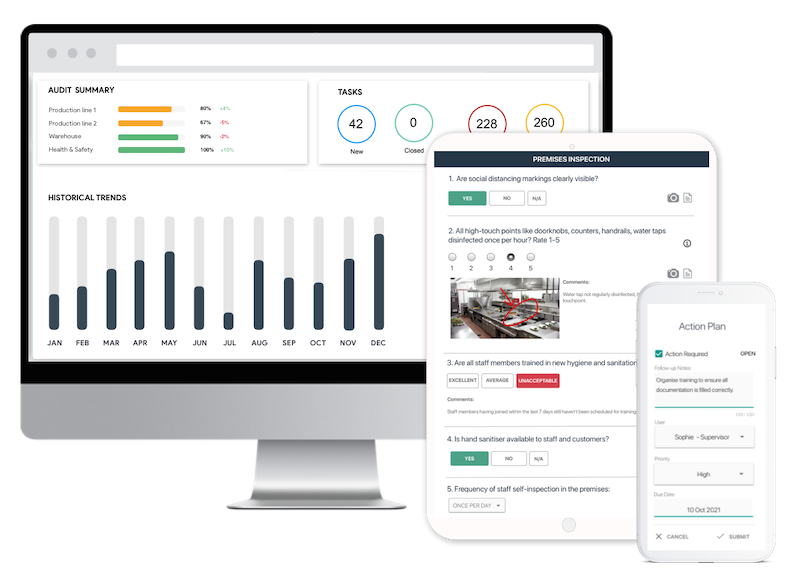
Easy inspection app for your digital checklists
- Conduct inspections anytime, anywhere - even offline
- Capture photos as proof of compliance or areas needing attention
- Instantly generate and share detailed reports after the inspections
- Assign & track follow-up tasks, view historical trends on a centralized dashboard