- Library
- Food & Hospitality
- GMP Checklist for Breweries
GMP Checklist for Breweries
47 questions in 1 sectionInteractive preview: try the answers
Section 1 of 1 · 47 questionsInspection Criteria
Is responsibility for overall plant sanitation specifically assigned to an individual?
Does this person have a firm understanding of beer production and knowledge of federal, state, and local laws and regulations?
Does this person have formal education and/or training in beer/beverage/food industry processing plant sanitation?
Does this person have the aptitude to develop a strong sanitation program and train staff accordingly?
Are raw materials and ingredients adequately inspected, processed as necessary, and stored to assure that only clean, wholesome materials are used?
Have all raw materials to be used in production been clearly identified as such?
Have raw materials and containers been inspected to ensure there is no visible contamination or deterioration?
Have raw materials been handled or processed in a manner that avoids contamination?
Have raw materials been stored in areas where there are inspections for possible contamination breaches?
Have raw materials been washed, processed, or cleaned as necessary to remove soil or other contamination?
Is water used for washing, rinsing, or conveying food safe and of adequate sanitary quality?
Is ice (where used) manufactured from potable water and stored and handled in a sanitary manner?
Is the water used to create ice safe and of adequate sanitary quality?
Has the water used to create ice been manufactured in accordance with current good manufacturing practices?
Is ice being handled and stored in a clean, sanitary manner until use?
Is food processing conducted in a manner to prevent contamination and minimize harmful microbiological growth?
Is careful monitoring of physical factors such as time, temperature, pH, pressure, and flow rate being conducted?
Is there a plan in place to prevent spoilage and contamination of ingredients, packaging materials, and beer during periods of mechanical failure?
Are chemical, microbiological, or extraneous material testing procedures used where necessary to identify sanitation failures of food contamination?
Is the facility equipped with instruments or the means to test for chemical, microbiological, or extraneous material?
Are instruments such as sieves, traps, magnets, electronic metal detectors, or other suitable effective means being deployed?
Are packaging processes and materials adequate to prevent contamination?
Is there a documented QC operation in effect at all critical control points to ensure consumer saftey during packaging?
Is identification and traceability maintained for all packaging materials?
Are packaging materials safe and appropriate for the intended use?
Are products/materials receiving physical protection from contamination, particularly airborne contamination?
Are sanitary handling procedures being adhered to and materials not stored in direct contact with the floor?
Are only approved food and/or color additives used?
Are ingredients whose use is generally recognized as safe (where government approval is not needed) being used?
Are ingredients whose use is not generally recognized as safe (where government approval is needed) being used?
Are all products that are contain food and/or color additives labeled as such?
Are products coded to enable positive lot identification, and are records maintained in excess of expected shelf life?
Are all product labels in adherence to TTB compliance standards for alcoholic beverages?
Are all lot identifications, Julian dates, "born-‐on", and "best-by" dates legible, and easy to identify and interpret?
Are all records of preceding lots kept in chronological order, and easy to access and interpret?
Are weighing and measuring practices adequate to ensure the declared quantity of contents?
Is there a standard "Maximum Allowable Variation" (MAV) for an individual package beyond which the deficiency is considered to be unreasonable?
Does the average net quantity of contents of packages in a lot at least equal the net quantity of contents as declared on the label?
Are permitted variations limited so that the average of the quantities in the package is not below the stated label quantity?
Are labels of products covered during inspection in compliance?
Are all beer labels and keg rings in compliance with the TTB and local regulations?
Are finished products stored and shipped under conditions that will avoid contamination and deterioration?
If there is a possibility of cross contamination, are activities adequately separated by physical or other effective means?
Are all findings recorded on a shipping report or receiving report to document deficiencies to management?
If used, are all tanker trucks and rail cars verified to be clean prior to loading with ingredients or beer?
Is the loading of vehicles or shipping containers carried out in a manner that prevents damage and are loads secured to prevent movement during transit?
Are staff notified and trained accordingly regarding products requiring special handling conditions?
Checklist by GoAudits. This checklist is an example: we do not guarantee compliance with the laws applicable to your territory or industry. Seek professional advice to adapt it to your workplace or jurisdiction.
Free PDF
Download the GMP Checklist for Breweries
By downloading this checklist you agree to the GoAudits privacy policy and terms of service.
NEW! Try generating a custom checklist with our free AI tool:
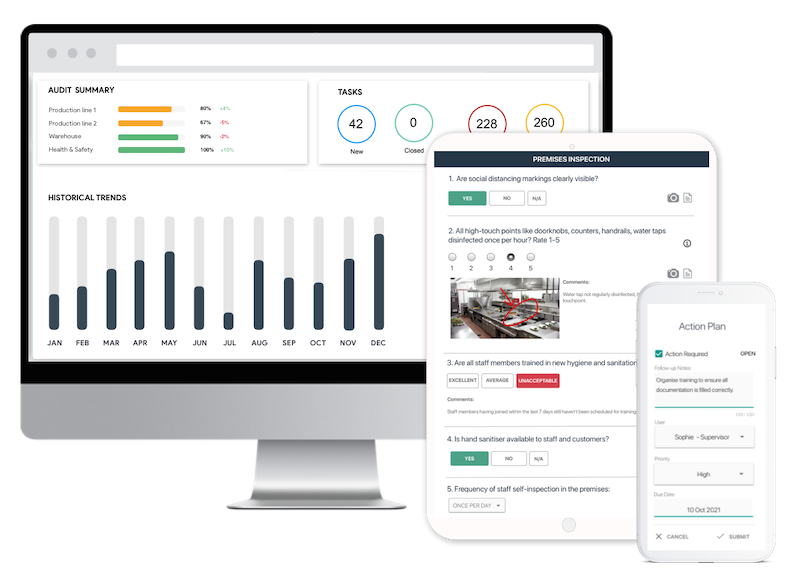
Easy inspection app for your digital checklists
- Conduct inspections anytime, anywhere - even offline
- Capture photos as proof of compliance or areas needing attention
- Instantly generate and share detailed reports after the inspections
- Assign & track follow-up tasks, view historical trends on a centralized dashboard