- Library
- Agro Tech Industry
- SQFI Primary Animal Production Checklist
SQFI Primary Animal Production Checklist
319 questions in 49 sectionsInteractive preview: try the answers
Section 1 of 49 · 4 questionsGeneral Information
Opening Meeting - People Present at the Opening Meeting (Please list names and roles in the following format Name: Role separated by comas)
Closing Meeting - People Present at the Closing Meeting (Please list names and roles in the following format Name: Role separated by comas)
Facility Description - Auditor Description of Facility (Please provide facility description include # of employees, size, production schedule, general layout, and any additional pertinent details
Auditor Recommendation
Section 2 of 49 · 6 questionsAllergen Management - Allergen Management (Mandatory)
The methods and responsibility for the control of allergens and to prevent sources of allergens from contaminating product shall be documented and implemented. The allergen management program shall include: i. A hazard and risk analysis and control measures of those agricultural inputs, including food grade lubricants, that contain food allergens (refer to 2.4.3 food safety plan);
The methods and responsibility for the control of allergens and to prevent sources of allergens from contaminating product shall be documented and implemented. The allergen management program shall include: ii. An assessment of workplace-related food allergens that may originate from change rooms, vending machines, lunchrooms, and visitors;
The methods and responsibility for the control of allergens and to prevent sources of allergens from contaminating product shall be documented and implemented. The allergen management program shall include: iii. A register of allergens that is applicable in the country of production and the country(ies) of destination if known;
The methods and responsibility for the control of allergens and to prevent sources of allergens from contaminating product shall be documented and implemented. The allergen management program shall include: iv. A list of allergens that is accessible by relevant staff; and
The methods and responsibility for the control of allergens and to prevent sources of allergens from contaminating product shall be documented and implemented. The allergen management program shall include: v. Individual management plans for control of identified allergens.
Product labeling, in accordance with regulatory requirements, shall include allergens where risks from cross-contamination have been documented.
Section 3 of 49 · 5 questionsDocument Control And Records - Document Control (Mandatory)
The methods and responsibility for maintaining document control, including records, shall be documented and implemented. They shall ensure that documents and records are i. Controlled;
The methods and responsibility for maintaining document control, including records, shall be documented and implemented. They shall ensure that documents and records are ii. Current;
The methods and responsibility for maintaining document control, including records, shall be documented and implemented. They shall ensure that documents and records are iii. Safely stored to prevent unauthorized access, loss, damage, and deterioration;
The methods and responsibility for maintaining document control, including records, shall be documented and implemented. They shall ensure that documents and records are iv. Organized in a registry or listing form; and
The methods and responsibility for maintaining document control, including records, shall be documented and implemented. They shall ensure that documents and records are v. Readily accessible in a manner that ensures employees use up-to-date and current policies, procedures (work instructions/task lists), and forms when documenting food safety related activities.
Section 4 of 49 · 6 questionsDocument Control And Records - Food Safety Management System (Mandatory)
Electronic and/or hard copy documentation shall be maintained and kept current. It will be made available to relevant staff and include: i. Food safety policies and organization chart;
Electronic and/or hard copy documentation shall be maintained and kept current. It will be made available to relevant staff and include: ii. Products covered in the scope of certification;
Electronic and/or hard copy documentation shall be maintained and kept current. It will be made available to relevant staff and include: iii. Food safety regulations that apply to the site and to the country of sale if known;
Electronic and/or hard copy documentation shall be maintained and kept current. It will be made available to relevant staff and include: iv. Agricultural input/materials, packaging, and finished product specifications; and
Electronic and/or hard copy documentation shall be maintained and kept current. It will be made available to relevant staff and include: v. Written procedures and programs (Good Production Practices) and other documentation necessary to support the development, implementation, maintenance, and control of the SQF System (e.g., food safety plans, validation, and verification).
Food safety plans, Good Production Practices, and all relevant aspects of the SQF System shall be reviewed, updated, and communicated as needed when any potential changes implemented have an impact on the site’s ability to deliver safe food.
Section 5 of 49 · 2 questionsDocument Control And Records - Records (Mandatory)
All manual or electronic/digital records shall be legible, suitably authorized, and/or signed by those undertaking activities to demonstrate that inspections, supervisory reviews, testing, and other essential activities have been completed.
Records shall be retained in accordance with periods specified by a customer or regulations or at a minimum no less than product shelf life.
Section 6 of 49 · 10 questionsFood Defense And Food Fraud - Food Defense Plan (Mandatory)
A food/product defense threat assessment shall be conducted to identify potential threats caused by a deliberate act of sabotage or terrorist-like incident.
A food defense plan shall be documented, implemented, and maintained based on the threat assessment (refer to 2.7.1.1). The food defense plan shall meet legislative requirements as applicable and shall include at a minimum: i. The methods, responsibility, and criteria for preventing food adulteration caused by a deliberate act of sabotage or terrorist-like incident;
A food defense plan shall be documented, implemented, and maintained based on the threat assessment (refer to 2.7.1.1). The food defense plan shall meet legislative requirements as applicable and shall include at a minimum: ii. The name of the senior site management person responsible for food defense;
A food defense plan shall be documented, implemented, and maintained based on the threat assessment (refer to 2.7.1.1). The food defense plan shall meet legislative requirements as applicable and shall include at a minimum: iii. The methods implemented to ensure only authorized personnel have access to production equipment and vehicles and storage areas through designated access points;
A food defense plan shall be documented, implemented, and maintained based on the threat assessment (refer to 2.7.1.1). The food defense plan shall meet legislative requirements as applicable and shall include at a minimum: iv. The methods implemented to protect sensitive operational points from intentional adulteration;
A food defense plan shall be documented, implemented, and maintained based on the threat assessment (refer to 2.7.1.1). The food defense plan shall meet legislative requirements as applicable and shall include at a minimum: v. The measures taken to ensure the secure receipt and storage of inputs, equipment, and hazardous chemicals to protect them from deliberate acts of sabotage or terrorist-like incidents;
A food defense plan shall be documented, implemented, and maintained based on the threat assessment (refer to 2.7.1.1). The food defense plan shall meet legislative requirements as applicable and shall include at a minimum: vi. The measures implemented to ensure inputs and products are held under secure storage and transportation conditions; and
A food defense plan shall be documented, implemented, and maintained based on the threat assessment (refer to 2.7.1.1). The food defense plan shall meet legislative requirements as applicable and shall include at a minimum: vii. The methods implemented to record and control access to the premises by employees, contractors, and visitors.
Instruction shall be provided to all relevant staff on the effective implementation of the food defense plan (refer to 2.9.2.1).
The food defense threat assessment and prevention plan shall be reviewed and tested at least annually or when the threat level as defined in the threat assessment changes. Records of reviews of the food defense plan shall be maintained.
Section 7 of 49 · 3 questionsFood Defense And Food Fraud - Food Fraud (Mandatory)
The methods, responsibility, and criteria for identifying the site’s vulnerability to food fraud shall be documented, implemented, and maintained. The food fraud vulnerability assessment shall include the site’s susceptibility to product substitution, mislabeling, dilution, and counterfeiting or stolen goods, which may adversely impact food safety.
A food fraud mitigation plan shall be developed and implemented that specifies the methods by which the identified food fraud vulnerabilities shall be controlled and how the plan is communicated to relevant staff to ensure effective implementation.
The food fraud vulnerability assessment and mitigation plan shall be reviewed and verified at least annually with gaps and corrective actions documented. Records of reviews shall be maintained.
Section 8 of 49 · 3 questionsFood Safety System - Food Legislation (Mandatory)
The owner/senior site manager shall ensure that, at the time of delivery to its customer, the animal product supplied shall comply with food safety and production legislation applicable in the country of use and sale, if known. Any specific licensing requirements or commodity-specific regulations shall be maintained and kept current.
The methods and responsibility for ensuring the organization is kept informed of changes to relevant legislation, scientific and technical developments, emerging food safety issues, and relevant industry codes of practice shall be documented and implemented.
SQFI and the certification body shall be notified in writing within twenty-four (24) hours as a result of a regulatory warning or event. Notification to SQFI shall be by email to foodsafetycrisis@sqfi.com.
Section 9 of 49 · 20 questionsFood Safety System - Food Safety Plan (Mandatory)
A HACCP-based referenced food safety plan, developed by a responsible authority, shall be implemented in the absence of a specifically developed food safety plan for the site. The site shall: i. Maintain a current record indicating that is has reviewed the food safety plan and ensures its scope of hazard analysis, risk assessments, and control measures such as Good Production Practices cover all products produced and sold by the site and are within the scope of certification;
A HACCP-based referenced food safety plan, developed by a responsible authority, shall be implemented in the absence of a specifically developed food safety plan for the site. The site shall: ii. Document where changes in the food safety plan have impacted their Good Production Practices. (Note: Sites shall choose either 2.4.3.1 or 2.4.3.2 with the subsequent 2.4.3 requirements as the mandatory element.)
Where a site has developed its own food safety plan, either by choice or due to product(s) not included within the scope of a HACCP-based model as per 2.4.3.1, it shall be implemented and maintained and outline the means by which the organization controls and assures food safety of the products or product groups included in the scope of the SQF certification and their associated processes. More than one HACCP food safety plan may be required to cover all products included in the scope of certification.
The food safety plan or plans shall be developed and maintained by a team that includes the SQF practitioner and those site personnel with agricultural, technical, and/or machinery knowledge relevant to the commodities and products. Where the relevant expertise is not available on-site, advice may be obtained from other sources to assist the food safety team.
The scope of each food safety plan shall be developed and documented including the start and endpoint of the processes under consideration and all relevant inputs and outputs.
Product descriptions shall be developed and documented for all products included in the scope of the food safety plans. These shall reference and/or include: i. The finished product specifications;
Product descriptions shall be developed and documented for all products included in the scope of the food safety plans. These shall reference and/or include: ii. Information relevant to product safety, such as production techniques, types of herding/pens/cages; and
Product descriptions shall be developed and documented for all products included in the scope of the food safety plans. These shall reference and/or include: iii. The intended use of each product, which includes target consumer groups, the potential for consumption by vulnerable groups of the population, requirements for further processing, and potential alternative use of the product.
The food safety team shall develop and document a flow diagram covering the scope of each food safety plan. The flow diagram shall include every step in the process of primary production, all agricultural inputs, packaging material, service inputs (e.g. water, feed, medication), process delays, and all process outputs including feed, waste, and rework. Each flow diagram shall be confirmed by the food safety team to cover all stages and hours of operation.
The food safety team shall identify and document all food safety hazards that can reasonably be expected to occur at each step in the processes, including agricultural inputs.
The food safety team shall conduct a hazard analysis for every identified hazard to determine which hazards are significant, i.e., their elimination or reduction to an acceptable level is necessary to control food safety. The methodology for determining hazard significance shall be documented and used consistently to assess all potential hazards.
The food safety team shall determine and document the control measures that must be applied to all significant hazards. More than one control measure may be required to control an identified hazard, and more than one significant hazard may be controlled by a specific control measure.
Based on the results of the hazard analysis (refer to 2.4.3.8), the food safety team shall identify the steps in the process where control must be applied to eliminate a significant hazard or reduce it to an acceptable level (a critical control point or CCP). In instances where a significant hazard has been identified at a step in the process, but no control measure exists, the food safety team shall modify the process to include an appropriate control measure.
For each identified CCP, the food safety team shall identify and document the critical limits that separate safe from unsafe product. The food safety team shall validate all of the critical limits to ensure the level of control of the identified food safety hazard(s) and that all critical limits and control measures, individually or in combination, effectively provide the level of control required (refer to 2.5.2.1).
The food safety team shall develop and document procedures to monitor CCPs to ensure they remain within the established limits (refer to 2.4.3.11). Monitoring procedures shall identify the personnel assigned to conduct testing, the sampling and test methods, and the test frequency.
The food safety team shall develop and document deviation procedures that identify the disposition of affected product when monitoring indicates a loss of control at a CCP. The procedures shall also prescribe actions to correct the process step to prevent recurrence of the safety failure.
The documented and approved food safety plan(s) shall be implemented in full. The effective implementation shall be monitored by the food safety team, and a full review of the documented and implemented plans shall be conducted at least annually or when changes to the process, equipment, inputs, or other changes affecting product safety occur.
Procedures shall be in place to verify that critical control points are effectively monitored and appropriate corrective actions are applied. Implemented food safety plans shall be verified as part of SQF System verification (refer to 2.5).
Critical control point monitoring, corrective action, and verification records shall be maintained and appropriately used.
Where food safety regulations in the country of production and destination (if known) prescribe a food safety control methodology other than the Codex Alimentarius Commission HACCP guidelines, the food safety team shall implement food safety plans that meet both Codex and food regulatory requirements.
Section 10 of 49 · 1 questionFood Safety System - Good Production Practices (Mandatory)
The site shall ensure the applicable Good Production Practices described in Module 5 of this food safety code are documented and implemented (refer to 2.2.1.1) or exempted according to a written risk analysis outlining the justification for exemption or evidence of the effectiveness of alternative control measures to ensure that food safety is not compromised.
Section 11 of 49 · 6 questionsFood Safety System - Input And Product Sampling, Inspection, And Analysis
The sampling, inspecting, and/or analyzing of agricultural inputs and finished product shall be documented and implemented. The procedures applied shall ensure: i. Inspections and analyses are completed at regular intervals as required and to agreed specification (e.g., animal confirmation, weight, fat as per 2.3.2.1) and regulatory and labeling requirements;
The sampling, inspecting, and/or analyzing of agricultural inputs and finished product shall be documented and implemented. The procedures applied shall ensure: ii. Records of all inspections and analyses are maintained; and
The sampling, inspecting, and/or analyzing of agricultural inputs and finished product shall be documented and implemented. The procedures applied shall ensure: iii. All analyses are conducted to nationally recognized methods or alternative methods that are validated as equivalent to the nationally recognized methods. Where external laboratories are used to conduct input or product analyses, the laboratories shall be accredited to ISO 17025 or an equivalent national standard, licensed or recognized by a regulatory authority if required, and shall be included on the site’s contract service specifications register (refer to 2.3.2.1). Where internal laboratories are used to conduct input or product analyses, appropriate sampling and testing methods shall be used and in accordance and with the applicable requirements of ISO 17025, including annual proficiency testing for personnel conducting analyses.
On-site laboratories conducting chemical and microbiological analyses that may pose a risk to product safety, shall ensure the following: i. Be located separate from any animal product handling activity and designed to limit access only to authorized personnel;
On-site laboratories conducting chemical and microbiological analyses that may pose a risk to product safety, shall ensure the following: ii. Provisions are made to isolate and contain all laboratory waste held on the premises and manage it separately from farm waste. Laboratory wastewater outlets are at a minimum downstream from drains that service animal production and handling areas; and
On-site laboratories conducting chemical and microbiological analyses that may pose a risk to product safety, shall ensure the following: iii. Signage is displayed that identifies the laboratory area as a restricted area, accessible only by authorized personnel.
Section 12 of 49 · 3 questionsFood Safety System - Non-conforming Agricultural Inputs And Animal Products
The methods and responsibility for how to control non-conforming agricultural inputs and animal products and/or livestock shall be documented and implemented. The procedures shall ensure: i. Non-conforming livestock are identified, quarantined (held), handled, re-worked, or disposed of in a manner that minimizes the risk of inadvertent or improper use or risk to the integrity of other livestock;
The methods and responsibility for how to control non-conforming agricultural inputs and animal products and/or livestock shall be documented and implemented. The procedures shall ensure: ii. All relevant personnel are aware of the site’s hold and release instructions and approvals, and
The methods and responsibility for how to control non-conforming agricultural inputs and animal products and/or livestock shall be documented and implemented. The procedures shall ensure: iii. Records of non-conforming product holds, release, and dispositions are maintained.
Section 13 of 49 · 3 questionsFood Safety System - Product Release (Mandatory)
The methods and responsibility for releasing finished animal product shall be documented and implemented. The methods applied shall ensure i. The product is released by authorized personnel;
The methods and responsibility for releasing finished animal product shall be documented and implemented. The methods applied shall ensure ii. The product is released only after all inspections and analyses have been successfully completed, reviewed, and documented;
The methods and responsibility for releasing finished animal product shall be documented and implemented. The methods applied shall ensure iii. The product meets regulatory and other established food safety controls. Records of all product releases shall be maintained.
Section 14 of 49 · 5 questionsFood Safety System - Product Rework
The responsibility and methods outlining how animal products are reworked shall be documented and implemented. The methods applied shall ensure: i. Reworking operations are supervised by qualified personnel;
The responsibility and methods outlining how animal products are reworked shall be documented and implemented. The methods applied shall ensure: ii. Reworked animal product is clearly identified and traceable;
The responsibility and methods outlining how animal products are reworked shall be documented and implemented. The methods applied shall ensure: iii. Each batch/lot of reworked animal product is inspected or analyzed as required before release;
The responsibility and methods outlining how animal products are reworked shall be documented and implemented. The methods applied shall ensure: iv. Inspections and analyses conform to the requirements outlined in element 2.4.4.1; and
The responsibility and methods outlining how animal products are reworked shall be documented and implemented. The methods applied shall ensure: v. Records of all reworking operations are maintained.
Section 15 of 49 · 3 questionsManagement Commitment - Complaint Management (Mandatory)
The methods and responsibility for handling and investigating the cause and resolution of complaints from commercial customers, consumers, and authorities that may result in a food safety issue arising from products grown or handled on-site, shall be documented and implemented. Records of customer complaints, their investigation, and resolution shall be maintained.
Adverse trends of customer complaint data shall be investigated and analyzed and root cause established by personnel knowledgeable about the incidents.
Corrective and preventative action shall be implemented based on the seriousness of the incident and the root cause analysis as outlined in 2.5.3.
Section 16 of 49 · 24 questionsManagement Commitment - Management Responsibility (Mandatory)
Senior site management shall prepare and implement a policy statement that outlines at a minimum the commitment of all site management to: i. Supply safe food;
Senior site management shall prepare and implement a policy statement that outlines at a minimum the commitment of all site management to: ii. Establish and maintain a food safety culture within the site;
Senior site management shall prepare and implement a policy statement that outlines at a minimum the commitment of all site management to: iii. Establish and continually improve the site’s food safety management system; and
Senior site management shall prepare and implement a policy statement that outlines at a minimum the commitment of all site management to: iv. Comply with customer and regulatory requirements to supply safe food.
Senior site management shall prepare and implement a policy statement that outlines at a minimum the commitment of all site management to: The policy statement shall be: v. Signed by the senior site manager and displayed in prominent positions; and
Senior site management shall prepare and implement a policy statement that outlines at a minimum the commitment of all site management to: The policy statement shall be: vi. Effectively communicated to site personnel in language(s) understood by site personnel.
Senior site management shall lead and support a food safety culture within the site that ensures at a minimum: i. The establishment and documentation of clear and concise food safety objectives and performance measures and their communication to all relevant staff;
Senior site management shall lead and support a food safety culture within the site that ensures at a minimum: ii. Adequate resources are available to meet food safety objectives and performance measures;
Senior site management shall lead and support a food safety culture within the site that ensures at a minimum: iii. Food safety practices and all applicable requirements of the SQF System are adopted and maintained;
Senior site management shall lead and support a food safety culture within the site that ensures at a minimum: iv. Staff are informed and are aware of their food safety and regulatory responsibilities;
Senior site management shall lead and support a food safety culture within the site that ensures at a minimum: v. Staff are aware of their role in meeting the requirements of the SQF Food Safety Code: Primary Animal Production and are held accountable for meeting these requirements;
Senior site management shall lead and support a food safety culture within the site that ensures at a minimum: vi. Staff are positively encouraged and required to notify management of actual or pending food safety issues; and
Senior site management shall lead and support a food safety culture within the site that ensures at a minimum: vii. Staff are empowered to act to resolve food safety issues within their scope of work.
The reporting structure shall identify and describe the site personnel with specific responsibilities for tasks within the food safety management system. Job descriptions for those personnel shall be documented and include a provision to cover for the absence of key personnel. Site management shall ensure departments and operations are appropriately staffed and organizationally aligned to meet good safety objectives.
Senior site management shall designate a primary and substitute SQF practitioner for each site with responsibility and authority to: i. Oversee the development, implementation, review, and maintenance of the SQF System, including Good Aquaculture Practices outlined in 2.4.2, and the food safety plan outlined in 2.4.3.
Senior site management shall designate a primary and substitute SQF practitioner for each site with responsibility and authority to: ii. Take appropriate action to ensure the integrity of the SQF System; and
Senior site management shall designate a primary and substitute SQF practitioner for each site with responsibility and authority to: iii. Communicate to relevant personnel all information essential to ensure the effective implementation and maintenance of the SQF System.
The SQF practitioner shall: i. Be employed by the site;
The SQF practitioner shall: ii. Hold a position of responsibility in relation to the management of the site’s SQF System;
The SQF practitioner shall: iii. Be competent to implement and maintain HACCP-based food safety plans; and
Checklist by GoAudits. This checklist is an example: we do not guarantee compliance with the laws applicable to your territory or industry. Seek professional advice to adapt it to your workplace or jurisdiction.
Free PDF
Download the SQFI Primary Animal Production Checklist
By downloading this checklist you agree to the GoAudits privacy policy and terms of service.
NEW! Try generating a custom checklist with our free AI tool:
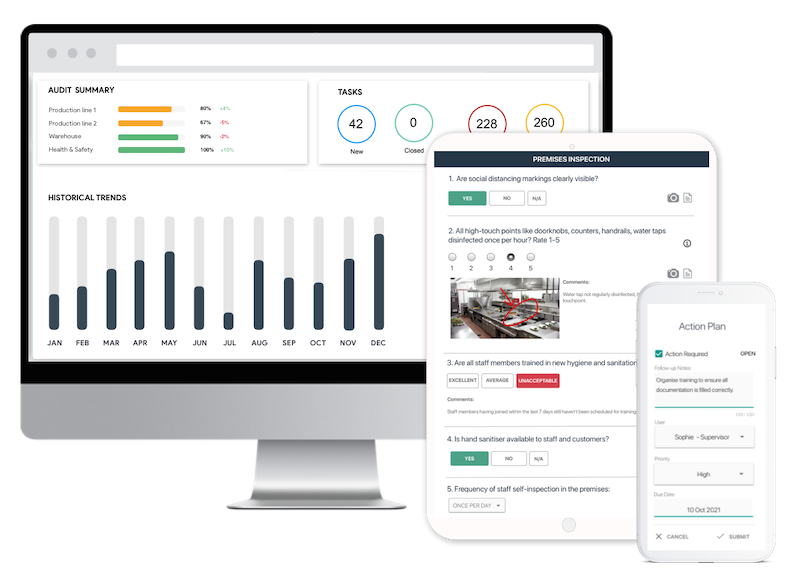
Easy inspection app for your digital checklists
- Conduct inspections anytime, anywhere - even offline
- Capture photos as proof of compliance or areas needing attention
- Instantly generate and share detailed reports after the inspections
- Assign & track follow-up tasks, view historical trends on a centralized dashboard