- Library
- Hotels & Vacation Rentals
- Food Premises Self Inspection Checklist
Food Premises Self Inspection Checklist
66 questions in 12 sectionsInteractive preview: try the answers
Section 1 of 12 · 12 questionsFood
Is food purchased from an approved source (licensed by the country, state, or federal government)?
Is food inspected and found to be free from contamination, adulteration, and spoilage?
Are unpackaged foods which have been served or returned from the dining area discarded?
Are all foods stored a minimum of 6” off the floor?
Are restrooms not used for the storage of food, equipment, or supplies?
Are all paper products stored in a manner so as to protect them from contamination?
Are food and food-related products being protected from dirt, unnecessary handling, overhead leakage, and other forms of contamination?
Do all food storage containers have tight-fitting lids and are properly labeled?
Are foods dispensed in the self-serve area in an approved manner?
Is the use of sulfites restricted?
Are food products labeled in an approved manner?
Are food products with an alcohol content exceeding .5% properly labeled?
Section 2 of 12 · 7 questionsTemperature Control
Are potentially hazardous foods maintained below 4oF or above 135oF at all times?
Is a thermometer, accurate to + or -2oF, provided either as an integral part of the refrigerator and freezer (dial outside), or is located inside each unit at its warmest point?
Are thermometers readily visible?
Is an accurate metal probe thermometer, suitable for measuring food temperatures, readily available and used to check food temperatures daily?
Are food products thawed in one of the following methods only: a) in refrigeration units, b) under cold running, potable water of sufficient velocity to flush loose food particles, c) in a microwave oven, d) as part of the cooking process?
Is frozen food maintained in a frozen state?
Are thawed food items not refrozen? Cooked or processed foods may be refrozen.
Section 3 of 12 · 9 questionsPersonnel
On or before January 1, 2000, did each food facility have an owner or employee who successfully passed an approved and accredited food safety certification examination?
Have all employees handling food or utensils obtained their Food Worker's Certification?
Do employees wash their hands with soap and warm water for the following reasons: a) before starting work b) immediately after using the bathroom c) any time needed to prevent food contamination?
Do employees handling food or utensils have no open sores?
Are employees wearing clean outer garments?
Are tongs or other implements used for serving food products?
Is the hair of employees properly confined?
Do employees not smoke or use tobacco inside the facility?
Are clothing and personal effects stored away from food products in a proper manner?
Section 4 of 12 · 3 questionsWater And Sewage
Are all sinks fully operable with hot and cold water at each faucet?
Do all sinks drain properly? Are floor drains and floor sinks in good working order?
Is the plumbing in good repair?
Section 5 of 12 · 4 questionsEquipment
Is all equipment (i.e. stoves, grills, refrigerators, tables, sinks, etc.) clean and well maintained?
Has inoperable equipment been repaired or replaced (removed from the facility)?
Is equipment NSF (National Sanitation Foundation) or equivalent?
Has any equipment been replaced, moved, or added without prior approval from the local environmental health department?
Section 6 of 12 · 6 questionsUtensils
Are multiservice utensils being washed by one of the following means only: a) hand washing in a three-compartment sink (wash, rinse, sanitize), b) chemical sanitizing (dish machine) conforming to NSF standards, c) dishwasher rinse water reaches at least 180O F for 30 seconds?
Are testing materials to adequately test sanitizing methods readily available?
Are all utensils clean and well-maintained?
Have damaged or unapproved utensils been repaired or replaced?
Are utensils properly protected during storage?
Ventilation is provided in each restroom and is in proper working order.
Section 7 of 12 · 2 questionsFloors / Walls / Ceilings
Are floors clean, well-maintained, and in good repair?
Are walls, ceilings, and windows clean, well-maintained, and in good repair?
Section 8 of 12 · 6 questionsToilet/ Dressing Room / Handwashing Sinks
Are toilet facilities clean, well-maintained, and in good working order?
Do self‐closing doors in the toilet and dressing rooms work properly?
Are single-service soap and towel dispensers above all handwash sinks operable and full?
Are toilet tissue dispensers full?
Are legible handwashing signs properly posted?
Is ventilation provided in each restroom and in proper working order?
Section 9 of 12 · 3 questionsLight And Ventilation
Is adequate lighting and ventilation provided throughout the facility?
Are exhaust ventilation filters clean and well-maintained?
Do light fixtures have approved safety covers?
Section 10 of 12 · 4 questionsPest Control
Is the facility free from insect and rodent infestations?
Are live animals, birds, or fowl not located in the facility?
Do outside doors and screen doors self‐close, and are closures in working order?
Are air curtains operating properly?
Section 11 of 12 · 4 questionsRefuse
Are trash containers lined with disposable plastic bags at all times?
Are plastic bags tied before placing in refuse containers?
Are outside trash bin lids closed?
Is the outside premise and refuse areas clean and well-maintained?
Section 12 of 12 · 6 questionsOperation
Are hazardous substances (examples: chemicals, cleaning supplies, etc.) properly labeled and stored away from food products?
Are there no living quarters within the facility?
Are no smoking and first aid signs (choking) properly posted?
Are cleaning equipment and soiled linens properly stored?
Are returned, damaged, or unlabeled food products properly stored?
Does the facility have a current Environmental Health Permit to operate?
Checklist by GoAudits. This checklist is an example: we do not guarantee compliance with the laws applicable to your territory or industry. Seek professional advice to adapt it to your workplace or jurisdiction.
Free PDF
Download the Food Premises Self Inspection Checklist
By downloading this checklist you agree to the GoAudits privacy policy and terms of service.
NEW! Try generating a custom checklist with our free AI tool:
Easy inspection app for your digital checklists
- Conduct inspections anytime, anywhere - even offline
- Capture photos as proof of compliance or areas needing attention
- Instantly generate and share detailed reports after the inspections
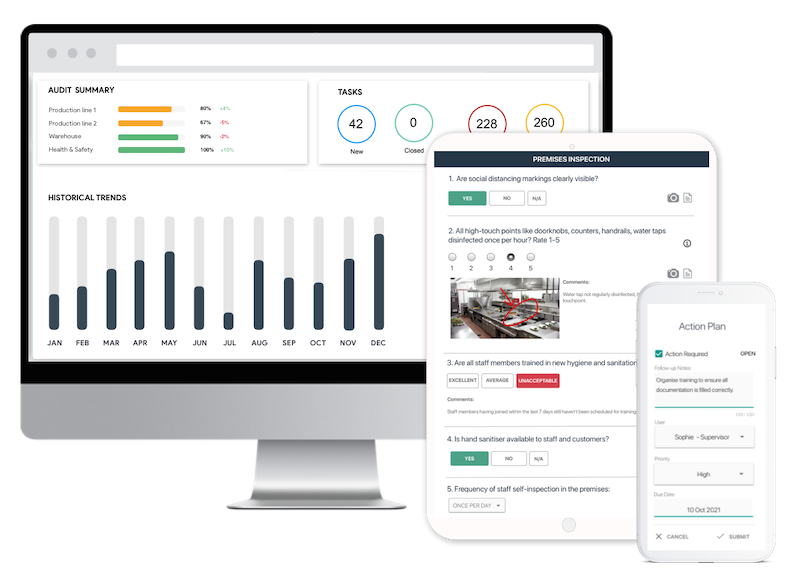
- Assign & track follow-up tasks, view historical trends on a centralized dashboard