Key Takeaways
- A HACCP checklist turns your HACCP plan into daily, repeatable monitoring steps for hazards, critical control points, and corrective actions.
- Small food businesses still need food safety procedures based on HACCP principles, but the documentation can stay simple and proportionate to risk.
- Small caterers and event caterers in the UK can use the FSA’s free Safer Food, Better Business pack, which applies HACCP principles without the jargon.
- Download any of the 10 HACCP checklist templates below, or run them digitally in the GoAudits food safety app.
Hazard Analysis and Critical Control Points (HACCP) is a systematic and preventative approach to food safety. It identifies and controls potential biological, chemical, and physical hazards that can occur throughout the food supply chain. Implementing a HACCP plan is essential for any food business that wants to ensure the safety of its products and protect its customers.
While the HACCP framework provides a roadmap for food safety, effectively navigating it requires clear, actionable steps. HACCP checklists bridge the gap between theoretical planning and practical implementation, ensuring consistent monitoring throughout the food production process.
This article will explore how HACCP checklists pinpoint potential hazards, outline specific monitoring procedures, and ensure compliance and immediate identification of any deviations.
- What are HACCP Audit Checklists?
- What Areas Does a HACCP Checklist Cover?
- Top 10 HACCP Checklists to Download
- Digitize Your HACCP Checklists With a User-Friendly App
- Free Food Safety, Hygiene & Audit Templates
- What are the Different Types of HACCP Checklists?
- What's Inside a HACCP Plan Template?
- How does a HACCP Plan depend on the HACCP Principles?
- FAQs
What are HACCP Audit Checklists?
A HACCP checklist is a tool used to ensure that a HACCP plan is being implemented effectively. It provides a systematic way to identify, monitor, and control potential food safety hazards throughout the food production process. By using an HACCP checklist, businesses can identify and address potential problems before they lead to food safety hazards. It can help to protect consumers and maintain product quality.
👉 However, you must develop a HACCP plan adhering to the HACCP principles before implementing the HACCP checklists. While HACCP plans are not mandatory for all businesses, most food establishments will benefit from implementing HACCP checklist templates to ensure food safety and compliance.
Here’s a breakdown of who generally should use the HACCP checklist:
- Restaurants and food service establishments
- Food distributors and retailers
- Food safety inspectors and auditors
- Quality assurance and food safety professionals
- Food safety consultants
- Government agencies
What are the Benefits of Using HACCP Inspection Checklists?
Here are some of the key benefits of using HACCP compliance checklists:
- Ensures consistent monitoring of critical control points (CCPs), standardizes procedures, and reduces human error across all production stages.
- Eliminates guesswork and repeated setup, allowing staff to work faster and focus on execution rather than recall.
- Supports consistent application of the seven HACCP principles and provides clear documentation for audits, inspections, and continuous improvement.
- Delivers accurate, repeatable data for monitoring processes, improving food quality, safety, and internal communication.
- Creates clear documentation of monitoring and corrective actions, supporting traceability, due diligence, and ongoing improvement.
- Identifies hazards early, minimizing recalls, spoilage, and costly disruptions.
- Builds a solid foundation for certification, strengthens customer trust, and enhances competitive positioning.

What Areas Does a HACCP Checklist Cover?
A HACCP inspection checklist typically includes the following sections:
- Personal hygiene
- Food preparation
- Hot and cold holding
- Refrigeration
- Food and dry storage
- Cleaning and sanitizing
- Utensils and equipment
- Food waste storage and disposal
- Pest control
- Documentation and recordkeeping

Top 10 HACCP Checklists to Download
With GoAudits, you get access to a free library with hundreds of food safety checklist templates for all situations. To help, we have compiled a list of the top 10 checklists for ensuring HACCP compliance, food safety, and hygiene.
1. HACCP Audit Checklist
The HACCP audit checklist is a vital tool for maintaining food safety compliance. It facilitates rigorous inspections of critical areas, including equipment functionality, hazard analysis, critical control points, and corrective actions. By employing this checklist, you can meticulously examine your food safety practices and ensure adherence to the highest standards.
2. HACCP Food Safety Checklist
The HACCP food safety checklist provides a comprehensive roadmap for upholding food safety throughout the entire handling process. Covering personal hygiene, food preparation, storage, cleaning, and sanitation, this checklist ensures that every stage complies with stringent food safety protocols. By diligently following this HACCP checklist, you can safeguard your food products and protect consumers from potential hazards.
3. HACCP-Based SOPs
HACCP-based SOPs offer a structured approach to implementing a HACCP plan. These SOPs meticulously outline preventive measures, monitoring processes, and corrective actions, enabling you to mitigate risks effectively. You can enhance food safety and ensure the consistent delivery of high-quality products with HACCP-based SOPs.

4. HACCP Internal Audit Checklist
Tailored specifically for internal assessments, the HACCP internal audit checklist enables you to comprehensively evaluate Good Manufacturing Practices (GMP) and hygiene standards. This checklist provides a systematic framework for assessing various aspects of your facility, identifying areas for improvement, and ensuring ongoing compliance with regulatory requirements.
5. HACCP Plan Self-Assessment Checklist
The HACCP plan self-assessment checklist serves as a valuable tool for evaluating the efficacy of your implemented HACCP plans. It includes hazard identification, control measures, and record-keeping, allowing you to assess your food safety management system critically. By using this checklist, you can identify gaps and make necessary adjustments to optimize your HACCP plan and enhance food safety.
6. HACCP Prerequisite Program Checklist
The HACCP prerequisite program checklist verifies the foundational aspects underpinning a robust HACCP plan. It encompasses personal practices, food handling, storage, and cleanliness, ensuring these essential elements are in place. By diligently completing this checklist, you can establish a solid foundation for effective HACCP implementation and maintain high food safety.
7. Plan for HACCP
Ensuring food safety relies on a meticulous plan. This HACCP Plan checklist is a simple tool to help you evaluate the existing system, categorize food safety hazards, and delineate team responsibilities. With this checklist, you can efficiently manage and control potential risks associated with food safety.
8. BRCGS Audit Checklist Food Safety Plan – HACCP (Clause 2)
BRCGS Audit Checklist Food Safety Plan – HACCP (Clause 2) involves a meticulous review of your food safety procedures and systems to ensure compliance with BRC standards. It includes an examination of your HACCP plan, enabling you to assess the effectiveness of your HACCP system. You can identify potential hazards, implement control measures, and ensure ongoing monitoring.
It also enables you to verify that your HACCP team is adequately trained, that the plan covers all relevant hazards, and that critical control points are well-defined and managed to mitigate risks effectively. You can efficiently prepare for your third-party BRC certification audit by digitizing your internal audits for streamlined conformance assessment.
👉 Additionally, the GoAudits library includes more BRC audit checklists to ensure compliance with all other clauses of the BRC standards.
9. Food Safety & Hygiene Checklist
In food manufacturing environments, ensuring hygiene and safety standards is crucial. This food safety and hygiene checklist is a comprehensive tool for evaluation. It covers various aspects such as policies, food supply and storage, cleanliness, food preparation procedures, personal hygiene, cleaning and sanitation, pest control, and waste management. You can tailor this checklist to fit your specific requirements and guarantee compliance with safety and hygiene policies throughout the process.
10. Food Contact Surfaces Cleaning Log
The Food Contact Surfaces Cleaning Log is an essential checklist for catering and restaurant staff. This SOP checklist helps you during inspections, guaranteeing thorough cleaning and disinfection of surfaces, sinks, and equipment that the food might come into contact with. It helps you maintain hygiene standards and reduce potential contamination risks without relying on subjective assessment.
Digitize Your HACCP Checklists With a User-Friendly App
GoAudits offers a comprehensive HACCP app & food safety software designed for your internal audits. It facilitates the digitization of various crucial processes, including hygiene, restaurant visits, process and quality reviews, kitchen inspections, personnel or health & safety checks, etc.
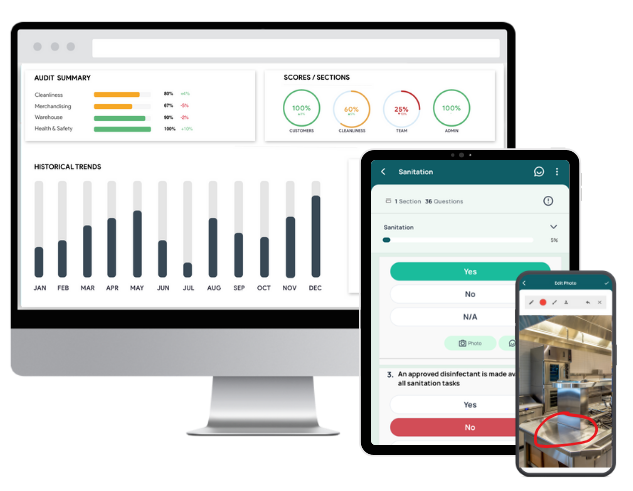
- Whether you need to comply with HACCP, BRC, FSSC, ISO, or other food safety standards, GoAudits has you covered. Its pre-built checklists are tailored to specific standards, ensuring you’re addressing all relevant criteria.
- GoAudits streamlines the entire inspection process, from creating custom checklists to assigning tasks and generating reports. It allows you to conduct more frequent inspections, identify potential issues faster, and mitigate risks more effectively.
- GoAudits empowers you to personalize your inspections. You can easily add, remove, or modify existing checklists to reflect your unique workflow and focus on the areas most relevant to your operation.
👉 Explore firsthand experiences that show how GoAudits impact retail, hospitality, and food manufacturing.
Free Food Safety, Hygiene & Audit Templates
Here are some more food safety checklist templates you can get with the GoAudits HACCP app & software:
- Personal Hygiene Checklist
- Food Allergen Checklist
- Hygiene Checklist for the Food Industry
- Food Manufacturing Hygiene Audit
- GMP (Good Manufacturing Practice) Audit
- SQFI Storage and Distribution Checklist
- SQFI Manufacturing of Food Packaging Checklist
- ISO 22000 Food Safety Checklist (FSMS)
- Food Safety Kitchen Inspection Checklist
- Food Safety Self-Inspection Checklist
- Food Safety Inspection Checklist
- Food Facility Self-Inspection Checklist
- Pest Control Checklist for the Food Industry

What are the Different Types of HACCP Checklists?
Implementing HACCP checklists is essential for maintaining food safety and ensuring compliance with regulatory standards. They help identify, monitor, and control potential hazards within food production and handling processes. Here’s an overview of various types of HACCP checklists tailored to specific areas:
HACCP Audit Checklist
A HACCP audit checklist is vital for evaluating your food safety management system’s effectiveness. It encompasses all seven HACCP principles, including hazard analysis, identification of critical control points (CCPs), establishment of critical limits, monitoring procedures, corrective actions, verification processes, and record-keeping. It can help identify non-conformities and areas for improvement, ensuring continuous compliance with food safety standards.
HACCP Food Safety Checklist
A general HACCP Food Safety Checklist includes monitoring of personal hygiene, food preparation areas, storage conditions, temperature controls, and sanitation practices. This checklist ensures that all aspects of food handling comply with safety standards, reducing the risk of contamination.
👉 What are the key differences between an HACCP audit checklist and a food safety checklist?
A HACCP audit checklist and a food safety checklist serve different purposes within food safety management:
The HACCP audit checklist evaluates the design, documentation, and implementation of a food facility’s HACCP system. It focuses on identifying and controlling specific hazards in the food production process, ensuring that critical control points are effectively managed to prevent, eliminate, or reduce food safety hazards to acceptable levels.
A food safety checklist assesses general food safety practices and compliance with industry regulations. It covers various aspects such as sanitation, personal hygiene, equipment maintenance, and facility cleanliness, aiming to ensure overall compliance with food safety standards beyond the specific hazard controls addressed by HACCP.
HACCP Checklists for Restaurants
In a restaurant setting, HACCP checklists are designed to oversee various aspects of food safety, such as personal hygiene, food preparation, storage, and serving practices. HACCP checklists for restaurants ensure that all processes, from receiving ingredients to serving customers, adhere to safety protocols, minimizing the risk of foodborne illnesses.
👉 GoAudits restaurant management software offers 10 restaurant checklists every restaurant should use to streamline operations, improve restaurant service standards, and keep customers happy.
HACCP Checklists for Kitchens
They focus on critical areas like equipment sanitation, cooking temperatures, cross-contamination prevention, and proper storage of ingredients. Kitchen staff can perform kitchen inspections, monitor these factors, maintain a hygienic environment, and ensure the safety of the food prepared.
HACCP Checklists for Cleaning
HACCP cleaning checklists detail the procedures for sanitizing equipment, utensils, and surfaces. They specify cleaning agents, methods, and frequencies required to prevent contamination, ensuring that all areas meet stringent hygiene standards.
HACCP Checklists for Sanitation
HACCP sanitation checklists cover personal hygiene practices, facility cleanliness, waste management, and pest control measures. Using these checklists helps maintain an environment that supports food safety and complies with health regulations.
HACCP Plan Review and Verification Checklist
The HACCP plan review checklist is used to assess the adequacy and completeness of your HACCP plan, ensuring all potential hazards are identified and properly controlled.
The HACCP verification checklist focuses on confirming that the HACCP system is functioning as intended through activities like record reviews, audits, and validation of control measures.
HACCP Gap Analysis Checklist
A HACCP gap analysis checklist helps identify discrepancies between current food safety practices and HACCP requirements. This analysis is crucial for organizations seeking HACCP certification or aiming to enhance their food safety management systems.
HACCP Templates for Small Businesses
Small food businesses need food safety procedures based on HACCP principles, but the paperwork can stay simple. Food safety law does not expect a small cafe or takeaway to produce the same volume of documentation as a large manufacturer. The system should match the size and risk of the operation, which means a short, well-kept HACCP template for small business use is often enough.
A HACCP template for a small business usually covers a few core areas: hazard analysis, critical control points, monitoring, corrective actions, and record-keeping. Keeping it focused makes it easier for owners and staff to use day-to-day, instead of filing it away and forgetting it.
You can download a free HACCP plan checklist and self-assessment checklist from the list above and adapt them to your menu and processes. For businesses that want to skip paper, the GoAudits food safety app runs the same checklists on a phone or tablet, attaches photos to each record, and keeps everything ready for an inspector.
HACCP Plans for Small Caterers and Event Caterers
Small caterers and event caterers must have food safety procedures based on HACCP principles, the same as any other food business. The difference is that catering often happens away from a fixed kitchen, with food prepared in one place, transported, and served somewhere else. That adds risk around temperature control, cross-contamination, and timing that a standard restaurant checklist may not fully cover.
In the UK, the Food Standards Agency (FSA) provides a free toolkit called Safer Food, Better Business (SFBB) for small caterers. The SFBB caterers pack applies HACCP principles through plain-language “safe methods” and a daily diary, without using technical HACCP wording. The FSA also publishes Safe Catering, a similar guide that helps small businesses produce a food safety management plan and keep the right records.
For event caterers, a good HACCP template for catering should add steps for off-site preparation, transport temperatures, holding times, and venue setup. You can build these into the HACCP checklist templates above, or run them in the GoAudits app so each event keeps its own dated record with photos and sign-off. Also, check out our guide on catering SOPs and catering safety to learn more.
What’s Inside a HACCP Plan Template?
A HACCP plan template gives you a ready-made structure for documenting your food safety system, so you are not building the paperwork from a blank page. Most templates follow the same core layout, which maps directly to the seven HACCP principles. Filling in each part in order gives you a plan an auditor or inspector can follow.
A standard HACCP plan template includes the following parts:
- Business and product details: Record your business name, site address, the product or menu, and how the food is intended to be used. This sets the scope of the plan.
- HACCP team: List who is responsible for the plan and their roles. In a small business, this may be one or two people who handle several duties.
- Process flow diagram: Map each step the food goes through, from delivery to service or dispatch. The diagram is the basis for spotting where hazards appear.
- Hazard analysis: Identify the biological, chemical, and physical hazards at each step, and rate how likely and severe each one is. This is the risk assessment at the heart of the plan.
- Critical control points (CCPs): Mark the steps where a hazard must be controlled, such as cooking or chilling.
- Critical limits: Set the measurable limit for each CCP, for example, a core cooking temperature or a maximum chill time.
- Monitoring: Define how and how often you check each CCP, and who does it.
- Corrective actions: State what staff must do when a limit is missed, such as extending cooking time or rejecting a delivery.
- Verification: Note how you confirm the plan is working through record reviews, checks, and periodic audits.
- Records: Keep dated logs of monitoring, corrective actions, and verification. These show due diligence if a problem is ever investigated.
A paper template works, but a digital HACCP template keeps the same structure while timestamping every entry, storing photos, and flagging missed checks automatically. You can download the HACCP plan checklist above as a starting point or build the full structure in the GoAudits app.
How does a HACCP Plan depend on the HACCP Principles?
A HACCP plan is a comprehensive document that outlines the specific procedures and practices necessary to ensure the safety of food products. It is based on the seven principles of HACCP, which provide a framework for identifying, preventing, and controlling food safety hazards.
Here’s how the following seven principles are reflected in a HACCP plan:
- Conduct a hazard analysis: This involves identifying all potential biological, chemical, and physical hazards associated with the food product and processing steps. The plan should also assess the severity and likelihood of each hazard occurring.
- Determine critical control points (CCPs): These are the points in the process where a hazard can be prevented, eliminated, or reduced to acceptable levels. Identifying CCPs requires careful consideration of the nature of the hazard and the effectiveness of control measures.
- Establish critical limits: These are the specific parameters that must be met at CCPs to ensure food safety. Critical limits can be related to factors such as temperature, time, pH, or moisture content.
- Monitor CCPs: This involves regularly measuring or observing CCPs to ensure they are within critical limits. Monitoring procedures should be clearly defined and documented in the HACCP plan.
- Establish corrective actions: These actions must be taken if a CCP is found to be outside of its critical limits. Corrective actions should be designed to bring the CCP back under control and prevent unsafe food from being produced.
- Verify the HACCP plan: This involves regularly reviewing and validating the HACCP plan to ensure it is effective and up-to-date. Verification can include activities such as conducting audits, reviewing records, and monitoring trends.
- Recordkeeping and documentation: All aspects of the HACCP plan and its implementation should be documented, including monitoring records, corrective actions, and verification activities. This documentation helps to ensure traceability and accountability for food safety.
To ensure top-notch food safety in your business, understanding the HACCP plan in line with its principles is crucial. It will help you develop and implement a comprehensive food safety management system that prevents foodborne illness and protects consumers.

FAQs
Most small food businesses must have food safety management procedures based on HACCP principles, even when a full formal HACCP plan is not required. The rules are proportionate to risk, so a small cafe needs far less documentation than a manufacturer. In the UK, completing the FSA’s Safer Food, Better Business pack meets this requirement for most small caterers and retailers.
A HACCP risk assessment is the hazard analysis step of a HACCP plan, where you identify biological, chemical, and physical hazards in your process and judge how likely and severe each one is. The results decide your critical control points. A HACCP risk assessment template gives you a structured grid to record each hazard, its risk level, and the control measure.
A HACCP plan is the full written document that identifies hazards, sets critical control points, and defines monitoring and corrective actions. A HACCP checklist is the day-to-day tool you use to confirm the plan is being followed. The plan is the strategy; the checklist is how you check it in practice.
Yes, event caterers need food safety procedures based on HACCP principles, with extra attention to off-site risks. Preparing food in one location and serving it at a venue adds hazards around transport temperature, holding times, and setup hygiene. A HACCP template for catering should cover these steps so each event keeps its own record.
You can download free HACCP templates from the list of 10 checklists above, including the HACCP plan checklist and the self-assessment checklist. Each one is editable for your menu and processes. UK small caterers can also download the FSA’s free Safer Food, Better Business pack, and GoAudits offers the same checklists to run digitally in its food safety app.