Key Takeaways
- Food QA prevents defects by building controls into the process; food QC detects them by testing the output. Both are needed, and neither substitutes for the other.
- Food safety and food quality are not the same thing. Safety asks whether a product can harm someone; quality asks whether it meets specifications.
- A food QMS is what holds QA and QC together: defined responsibilities, documented procedures, monitoring records, corrective actions, and internal audits, framed by a standard such as ISO 22000, FSSC 22000, BRCGS, SQF, or IFS.
- Quality inspections done on paper are slow to act on. Food quality and safety inspection software generates the report as the audit is completed, assigns corrective actions, and tracks trends across sites.
Ensuring food quality is critical for consumer safety, regulatory compliance, and brand reputation. With complex supply chains and savvy consumers, food quality challenges are evolving, making quality assurance and quality control more essential than ever. Food quality assurance (QA) is like a strategic roadmap, setting up smart systems to prevent problems before they occur.
Meanwhile, food quality control (QC) acts like a vigilant inspector, testing each batch to catch any inconsistencies or contaminants. Together, they form a comprehensive food safety management system to both protect public health and build trust in your brand.
This article will explore how food QA and QC work together to create a robust food quality management system, with fresh perspectives on procedures and best practices to deliver consistently high standards.
- What is Food Quality Assurance?
- What is Food Quality Control?
- Food QA and QC in the Food Industry: Key Differences
- What is a Food Quality Management System?
- Quality Assurance in the Food Industry: Components & Procedures
- Food Quality Testing: Analysis, Inspection Methods & Best Practices
- Quality Control in the Beverage Industry
- Enhance Food Quality Assurance & Compliance with GoAudits
- Food QA & QC: Challenges & Tips to Overcome Them
What is Food Quality Assurance?
Food quality assurance is a comprehensive system ensuring that food products consistently meet established food quality standards and comply with regulatory requirements. It covers all aspects of food production, from raw material sourcing to final product distribution, aiming to prevent defects and ensure safety and consistency.
The scope of food QA is extensive, covering various stages and processes, including:
- Raw material sourcing
- Processing controls
- Packaging and labeling
- Storage and distribution
- Regulatory compliance
👉 How do safety assurance systems ensure the quality of food products?
Similar to food QA, food safety assurance systems are structured practices and protocols designed to ensure that food products are safe for consumption. They identify, evaluate, and control hazards throughout the food production and supply chain. They aim to prevent contamination and foodborne illnesses, ensure consumer protection, regulatory compliance, and brand reputation.
Quality Assurance Role in the Food Industry
In the food industry, QA addresses various critical aspects:
- Establishes preventive controls to eliminate hazards and protect consumers from foodborne risks.
- Ensures products meet all applicable national and international food safety regulations.
- Maintains uniform standards across batches to meet specifications and customer expectations.
- Detects issues early to prevent recalls, rework, and unnecessary product loss.
- Builds consumer trust through reliable quality and demonstrable safety commitment.
- Improves processes to reduce errors, optimize resources, and lower production costs.
- Aligns products with international QA standards to support export and market expansion.
- Drives ongoing process optimization to keep pace with regulatory, industry, and consumer changes.

What is Food Quality Control?
Food quality control, on the other hand, is a more reactive process. It is a set of operational techniques and activities that focus on identifying and addressing defects in produced food products. Food QC involves systematic inspections, testing, and verification to ensure that food products meet established safety and quality standards.
It applies to specific checkpoints within the food supply chain, such as raw material assessment, production monitoring, and final product testing, to detect inconsistencies, ensure products comply with safety regulations, and prevent non-compliant products from reaching the market.
Requirements of Quality Control in the Food Industry
- Adhering to local, national, and international food safety regulations (e.g., FDA, USDA, Food Standards Agency (FSA), the European Food Safety Authority (EFSA), etc.), including meeting specific guidelines for production, packaging, labeling, and distribution.
- Verify and test incoming raw materials to confirm they meet quality and safety specifications before production.
- Implement strict handling, sanitation, and labeling controls to prevent allergen cross-contamination.
- Maintain accurate records to enable full traceability, transparency, and rapid response to recalls or incidents.
- Enforce rigorous sanitation and cleanliness standards for facilities, equipment, and food handling processes.
- Train personnel regularly on food safety, hygiene, and quality procedures to minimize contamination risks.
- Use quality data, audits, and consumer feedback to continuously optimize processes and product quality.
Examples of Quality Control in the Food Industry
Here are some examples of quality control and assurance:
Quality assurance in the dairy industry
Implementing pasteurization processes and regular microbial testing to ensure milk and cheese products are free from harmful bacteria.
Quality assurance in the meat industry
Conducting audits to identify and control potential contamination risks during slaughtering and processing.
Quality control in the beverage industry
Using filtration and sterilization in juice and soft drink manufacturing to prevent microbial growth and extend shelf life, with Brix and pH checks at blending to confirm every batch matches the recipe specification.
Quality assurance in the bakery industry
Monitoring baking times and temperatures to ensure products are cooked thoroughly.
Seafood industry quality assurance
Ensuring proper handling and storage temperatures to prevent histamine development in fish products, which can cause foodborne illnesses.
Food QA and QC in the Food Industry: Key Differences
While both food QA and QC aim to maintain high standards, the approach differs significantly.
| Food QA | Food QC | |
| Definition | QA is a proactive, process-oriented approach that focuses on preventing defects in food products. | QC is a reactive, product-oriented process that centers on identifying and correcting defects in finished products. |
| Focus | It involves establishing and maintaining systematic activities and procedures during production to ensure that quality standards are met consistently. | It entails inspecting and testing products to ensure they meet the specified quality criteria before reaching consumers. |
| Implementation timing | Implemented throughout the production process, QA emphasizes early detection, prevention of potential issues, and averting defects before they occur. | QC is applied at specific checkpoints, typically during and after the production process to detect and address defects. |
| Objectives | Food QA helps develop processes that prevent defects, ensuring consistent production of safe and high-quality food products, emphasizing process improvement, standardization, and employee training. | It identifies and rectifies defects in the final products, ensuring they meet predefined quality standards. It focuses on product testing and inspection. |
| Approach | Activities include developing standard operating procedures (SOPs), conducting internal audits, and implementing risk management strategies. | Activities encompass sampling, sensory evaluation, microbiological testing, and employing statistical methods to monitor and control product quality. |
| Role in compliance | By implementing comprehensive QA systems, food businesses can demonstrate adherence to food safety regulations and industry best practices, facilitating smoother certification processes. | Food QC ensures that the end products meet all regulatory and safety standards before they reach consumers, preventing non-conforming products from entering the market and safeguarding public health. |
What is the Difference Between Food Safety & Quality Assurance
Understanding the distinction between food safety and quality assurance is essential for ensuring both the safety and quality of food products.
| Aspect | Food Safety | Food Quality Assurance |
| Definition | Handling, processing, and storing food to prevent contamination and foodborne illnesses. | Systematic activities ensuring food products consistently meet established standards. |
| Focus Areas | Controlling biological, chemical, and physical hazards. | Maintaining attributes like taste, texture, appearance, and nutritional value. |
| Objective | Protect public health by minimizing risks associated with foodborne illnesses. | Ensure customer satisfaction by maintaining product consistency. |
| Approach | Uses proactive measures like HACCP to identify hazards and implement controls. | Follows a process-driven approach with SOPs and GMPs to meet industry expectations. |
| Regulatory Compliance | Enforced by agencies like the FDA and the USDA to protect consumers from harmful products. | Ensures compliance with safety regulations and broader industry-specific quality standards. |
Key Differences Between Food Safety and Food Quality Control
While both food safety and quality control ensure that food products are suitable for consumption, they focus on different aspects and use distinct methodologies.
Food safety and food quality are related but not interchangeable, and the distinction matters when you are deciding what to audit. Food safety asks whether the product will harm someone. Food quality asks whether it meets the specification a customer expects. A product can be entirely safe and still fail on quality, and the systems that manage each overlap without being identical.
Definition and Key Focus Areas
Food safety involves practices that prevent contamination and foodborne illnesses during preparation, handling, and storage. Its primary goal is to ensure that food does not harm consumers when prepared and consumed as intended. This includes measures like personal hygiene, pest control, waste management, and temperature regulation.
Food quality control, in contrast, focuses on inspecting and evaluating food products to ensure they meet specified standards and consumer expectations. It identifies and corrects defects before products reach the market, assessing aspects like taste, appearance, texture, and nutritional value.
Regulatory Compliance
Food safety is heavily regulated to protect public health. Food businesses must comply with standards such as ISO 22000, which establishes requirements for a food safety management system, ensuring hazard control and product safety.
Quality control in the food industry, while also regulated, aligns more with ISO 9001, emphasizing customer satisfaction and product consistency. It involves continuous monitoring and evaluation to maintain desired quality levels.
Methods of Implementation
A proactive approach is essential for food safety, involving hazard identification, critical control points, staff training, hygiene protocols, and routine inspections.
Quality control relies on systematic activities like sampling, testing, and reviewing products to detect and address defects. Common techniques include statistical process control and sensory evaluation to uphold quality standards.
Impact on Food Businesses and Consumers
Prioritizing food safety helps businesses prevent contamination incidents, avoid legal issues, and protect their reputation. For consumers, it ensures the food they consume is free from harmful hazards, promoting public health.
Strong quality control leads to products that consistently meet or exceed expectations, fostering customer loyalty. High-quality products help brands stand out in a competitive market, potentially increasing sales and market share.
What is a Food Quality Management System?
A food quality management system (FQMS or FSQMS) is the documented framework that holds QA and QC together. QA defines how quality is built into the process; QC verifies the output. The management system is what specifies who owns each control, how it is recorded, how deviations are handled, and how the whole thing is reviewed and improved.
Without one, QA and QC exist as activities rather than a system: checks happen, but nobody can demonstrate they happen consistently.
What an FSQMS Contains
- Quality policy and objectives. A stated commitment with measurable targets, not a statement of intent.
- Defined responsibilities. Who owns each control point, who verifies it, and who authorises release of held product.
- Documented procedures. SOPs, work instructions, and specifications for every process affecting product quality.
- Hazard and risk controls. HACCP plan, prerequisite programmes, and allergen management integrated rather than bolted on.
- Monitoring and records. What is measured, at what frequency, against what limits, and where results are retained.
- Corrective and preventive action. A closed-loop process from finding to root cause to verified fix.
- Internal audit programme. Scheduled verification that the system works as documented.
- Management review. Periodic assessment of performance data, audit findings, complaints, and improvement opportunities.
- Document and change control. One current version of every procedure, with a record of what changed and who approved it.
Which standard applies? ISO 22000 is the international food safety management system standard. FSSC 22000 builds on it with sector-specific prerequisite programmes and GFSI recognition. BRCGS, SQF, and IFS each provide their own FSQMS framework, and most retailers specify which they require. ISO 9001 sits alongside these, covering quality management generally rather than food safety specifically.
The practical difference between a system that works and one that exists on paper is whether the records are generated as work happens or assembled before an audit.
Who is Responsible for Food Quality?
Food quality is evaluated by several parties, internally and externally, and confusion about where responsibility sits is a common audit finding in itself.
- Production operators run in-process checks as part of the job: temperature readings, weight checks, visual inspection at line-side. When operators own the checks on their own line, results arrive in real time rather than at shift end.
- Quality controllers and quality technicians perform sampling, testing, and verification. A food quality controller typically handles incoming raw material checks, in-process sampling, and finished product testing against specification.
- Quality assurance managers own the system rather than the samples: specifications, procedures, the internal audit programme, supplier approval, and the release decision on held product.
- The quality control department in a larger manufacturer usually combines both functions, with QC performing verification and QA maintaining the management system, reporting to a technical or quality director.
- Everyone else. Hygiene, allergen control, and traceability depend on people who are not in the quality team at all, which is why training and culture sit inside the management system rather than alongside it.
In smaller operations, one person often holds several of these roles. That works, provided the separation between performing a check and approving its result is preserved somewhere, since self-verification is where most quality systems quietly fail.
Quality Assurance in the Food Industry: Components & Procedures
Implementing food QA and QC procedures helps maintain high standards, comply with regulations, and protect consumer health.
Quality Metrics and Standards
Defining clear quality metrics is essential for any QA system. These benchmarks establish acceptable criteria for product attributes like taste, texture, appearance, and nutritional content. Aligning them with regulatory requirements and consumer expectations ensures consistency and safety.
Standard Operating Procedures (SOPs)
Detailed food SOPs and quality assurance and quality control SOPs provide step-by-step guidance for production processes such as ingredient measurement, mixing, cooking, and packaging. Following these procedures reduces variability and ensures every product meets established quality standards.
Raw Material Inspection and Supplier Management
The quality of raw materials directly affects the final product. Strict inspection protocols help detect issues early, while strong supplier relationships and regular audits ensure a reliable supply of high-quality ingredients.
Food Safety Testing, Evaluation, and Monitoring
Regular testing verifies that products comply with safety and quality standards. Microbiological, chemical, and physical testing help identify contaminants, while continuous monitoring of critical parameters like temperature and pH ensures process control.
Traceability and Recall Systems
Traceability systems track products across the supply chain. In case of safety concerns, efficient recall procedures quickly remove affected products from the market, protecting consumers and preserving public trust.
Internal and External Audits
Audits assess the effectiveness of QA and QC systems. Internal audits ensure compliance with internal standards, while external audits provide independent evaluations against industry and regulatory benchmarks, identifying areas for improvement.
Regulatory Compliance with Food Safety Standards
Adhering to national and international food safety standards ensures products meet legal and consumer requirements. They provide structured frameworks for developing effective food safety management systems.
Employee Training and Continuous Improvement
A well-trained workforce is key to effective food QA and QC implementation. Ongoing training keeps employees updated on best practices, emerging technologies, and regulatory changes. Encouraging continuous improvement fosters proactive problem-solving, leading to safer, higher-quality products.
Structured Food Quality Inspections
Food quality inspections are systematic checks conducted to ensure that food products meet established safety and quality standards. They safeguard public health by identifying and mitigating potential hazards within the food supply chain. Regular food quality inspections ensure food products are safe, hygienic, and meet the standards set by regulatory bodies. Identifying and addressing potential issues proactively protects consumer health and maintains public trust in the food industry.
Taken together, these components are how companies maintain high food quality standards consistently rather than intermittently: quality is built into the process, verified at defined points, and reviewed as a system rather than a series of individual checks.
Food Quality Testing: Analysis, Inspection Methods & Best Practices
Food quality testing, food quality analysis, and food quality assessment describe overlapping activities: measuring a product or process against a defined specification. Testing usually refers to the laboratory or instrument measurement itself, analysis to the interpretation of those results, and assessment to the broader judgement of whether a product meets a standard.
In practice, most food businesses run all three under a single inspection programme. Implementing it effectively involves several key practices:
Establishing Clear Standards
Define detailed specifications aligned with regulatory guidelines and industry benchmarks. Use HACCP and similar frameworks to identify and manage potential hazards in the production process before they compromise product safety.
Regular Training and Calibration
Provide comprehensive training to inspectors to ensure they are well-versed in current inspection protocols. Regularly calibrate equipment to maintain accuracy in measurements, thereby ensuring consistency across inspections.
Comprehensive Documentation
Maintain detailed records of inspections, tests, and corrective actions. This supports traceability and accountability throughout the production process, facilitating swift responses to any identified issues.
Implementing Preventive Measures
Prioritize early detection of potential issues by integrating continuous monitoring systems and conducting periodic audits. This minimizes risks before they escalate, ensuring ongoing compliance with safety standards.
Using Advanced Technology
Modern tools such as near-infrared spectroscopy and electronic noses should be adopted to enhance the speed and objectivity of testing. They offer rapid, non-destructive analysis, improving the efficiency of quality inspections.
Continuous Improvement
Regularly review procedures, update protocols, and incorporate feedback from audits to enhance quality over time. This ensures that the food safety management system remains effective and up-to-date.
Key Methods for Food Quality Inspections
To check food quality in practice, businesses combine several methods rather than relying on any one:
- Process Control: Establishing SOPs and using methods like HACCP are crucial for monitoring critical production stages, maintaining consistency, detecting risks, and ensuring food safety. For example, temperature control monitoring prevents spoilage and maintains product quality.
- Physical Examination & Inspection: Physical inspections assess the tangible attributes of food products to ensure they meet specified standards. This includes evaluating texture, appearance, and color, detecting foreign objects, and verifying packaging integrity.
- Sensory Evaluation: It involves trained assessors or consumer panels to judge organoleptic properties such as taste, smell, texture, and appearance. This helps ensure that food products meet consumer expectations and maintain consistency.
- Microbiological Testing: This detects harmful microorganisms such as bacteria, viruses, and molds that can cause foodborne illnesses. Common methods include culture techniques, polymerase chain reaction (PCR), and enzyme-linked immunosorbent assay (ELISA).
- Chemical Analysis: It identifies and quantifies chemical contaminants and ensures compliance with nutritional labeling. Key areas include pesticide residue testing, heavy metal detection, and additive and preservative verification.
- Nutritional Labeling Verification: Accurate nutritional labeling is essential for regulatory compliance and consumer transparency. Verification involves laboratory testing, compliance checks against regulatory guidelines, and allergen assessments to prevent misleading information.
- Shelf-Life Testing: It determines the period during which a product remains safe and retains its desired sensory, chemical, physical, and microbiological characteristics. This involves real-time storage under typical conditions, periodic testing, and accelerated testing under stress conditions to predict shelf life.
- Food Packaging and Integrity Checks: Quality control includes verifying packaging integrity, proper sealing, and accurate labeling to prevent contamination, extend shelf life, and ensure regulatory compliance.
- Weight & Portion Control: Ensuring that products meet specified weight and volume standards maintains consistency, prevents financial loss, and upholds consumer trust.
- Equipment Calibration and Maintenance: This ensures consistent performance, prevents breakdowns, and reduces quality deviations. Malfunctioning equipment can compromise food safety and product quality.
Quality Control in the Beverage Industry
Beverage production sits inside the same regulatory frameworks as solid food manufacturing, but the control points are different. Liquid products move through closed pipework rather than across open surfaces; they are filled and sealed at speeds measured in hundreds of units per minute, and a single out-of-spec batch can be palletized and shipped before anyone tastes it. Quality control in the beverage industry is built around those differences.
Water is the first of them. In soft drinks, juices, and bottled water, water is most of the finished product, so incoming water treatment and filtration set the ceiling on everything downstream. No amount of finished-product testing recovers a batch made with poor water.
What Quality Control in the Beverage Industry Covers
Beverage quality control runs across five stages:
- Water and ingredient quality. Incoming water treatment, filtration performance, and supplier specifications for concentrates, sweeteners, acidulants, and CO2. Verified through supplier approval and goods-in checks.
- In-process control. Brix, pH, titratable acidity, carbonation volume, and dissolved oxygen are measured at blending and filling. These are the numbers that decide whether the batch matches the recipe.
- Microbiological control. Yeast, mold, and spoilage organism counts on finished product, plus verification that clean-in-place cycles actually ran to specification. CIP verification is the single most common gap found in beverage plant audits.
- Packaging and fill integrity. Fill level, net content, cap torque, seal integrity, closure application, date coding, and label placement. Most consumer complaints in beverages come from this stage rather than from the liquid itself.
- Sensory and shelf life. Trained panel assessment of taste, aroma, color, and mouthfeel, plus accelerated and real-time shelf-life trials.
Quality Control Tests for Beverages
| Test | What it checks | Typical stage |
|---|---|---|
| Brix | Sugar content and syrup-to-water ratio | Blending, filling |
| pH and titratable acidity | Acidity balance and microbial stability | Blending |
| Carbonation volume | CO2 content against specification | Filling line |
| Dissolved oxygen | Oxygen pickup that shortens shelf life | Filling |
| Turbidity and clarity | Visible haze, sediment, particulates | Post-filtration |
| Microbiological plate count | Yeast, mold, and spoilage organisms | Finished product hold |
| Fill level and net content | Legal net quantity and fill consistency | Filling line |
| Torque and seal integrity | Closure application and pack seal | Capping |
| Sensory panel | Taste, aroma, color, mouthfeel | Finished product |
Laboratory tests answer whether a batch is in specification. They do not answer whether the process that produced it was followed. That second question is what beverage quality audits exist for, and it is where most quality failures actually originate.
Quality Control in Soft Drink and Juice Production
Soft drink quality control centers on three variables that consumers notice immediately: sweetness, acidity, and carbonation. Brix and pH are checked at every syrup batch and again at fill, because a small drift in the syrup-to-water ratio produces a product that is technically safe and commercially unacceptable. Industrial quality assurance of soda also covers CO2 purity, since off-spec gas carries taints straight into the finished pack.
Quality control in fruit juice processing adds two problems soft drinks do not have. Raw fruit varies by season, grower, and lot, so incoming specifications need tolerance bands rather than fixed targets. Juice is also a target for economically motivated adulteration, so authenticity testing sits alongside routine quality control for anyone buying concentrate on the open market.
Standard Testing Procedures in Beverage Production Quality Control
A standard testing procedure defines four things: what gets measured, at what frequency, against what specification limits, and what happens when a result falls outside them. The last one is where most written procedures stop short. A procedure that specifies a Brix range but not the hold-and-release decision that follows an out-of-spec reading leaves the call to whoever is on shift.
Workable beverage testing procedures share the same structure:
- Sampling plan. Where on the line the sample is drawn, by whom, and how often. Line-start, mid-run, and line-end at minimum.
- Method reference. The specific method used, so results are comparable between shifts and between sites.
- Specification limits. Target value, acceptable range, and the action limit that triggers intervention before the reject limit is reached.
- Recording requirement. Where the result is logged and how long it is retained for traceability.
- Deviation response. Who is notified, whether the affected product is held, and what evidence releases it.
Beverage Quality Audits and Inspections
A beverage quality audit checks the system rather than the batch. Where a quality control test tells you a sample was within specification, a beverage quality inspection tells you whether the sampling actually happened at the stated frequency, whether the calibration records exist, whether corrective actions from the last finding were closed, and whether the operators can describe the procedure without reading it.
Product inspection in the beverage industry typically covers:
- Goods-in checks on concentrates, packaging materials, and CO2
- Line hygiene and CIP verification records
- In-process check completion against the sampling plan
- Equipment calibration status for meters, probes, and torque testers
- Finished pack inspection: fill, seal, coding, and label accuracy
- Traceability from finished pallet back to raw material lot
Beverage brands running more than one production site face a harder version of this. When each plant runs its own checklist, results are not comparable, and head office cannot tell whether a low score in one location reflects worse performance or a stricter local auditor. Consistency comes from running one standardized audit template everywhere, with the same scoring model and the same corrective action workflow, so trends across sites mean something.
Packaging is worth auditing separately. Fill and seal defects generate a disproportionate share of consumer complaints relative to the attention they get. A structured packaging inspection catches drift in torque, coding, and label placement before it reaches a pallet.
Enhance Food Quality Assurance & Compliance with GoAudits
Ensuring impeccable food safety and quality is paramount in the food industry. GoAudits food safety software is an all-in-one platform to streamline your food safety audits and compliance processes.
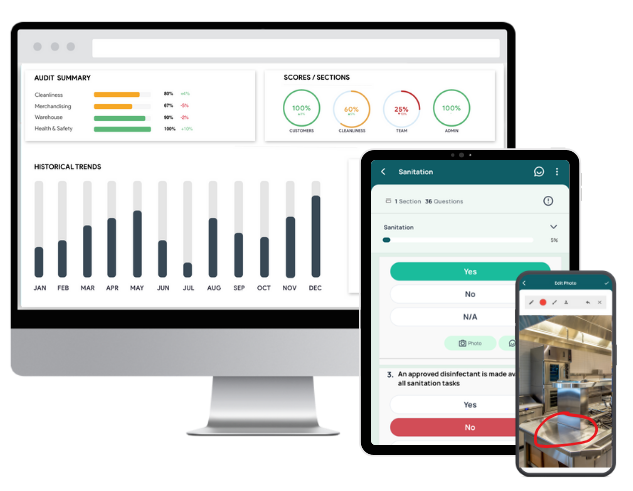
- Conduct food quality inspections up to 5 times faster directly from your mobile device, even when you’re offline.
- Capture photos, add annotations, and document findings in real-time, eliminating the need for paper forms.
- Generate professional, branded reports automatically upon inspection completion. These reports include attached photos, assigned actions, timestamps, and geolocation for full transparency and accountability. Configure automated distribution to key stakeholders for immediate review and action.
- Assign corrective actions to specific team members with clear priorities and due dates. Automated notifications and reminders keep everyone on track, ensuring timely resolution of issues.
- Track completion status and escalate overdue tasks through a centralized dashboard.
- Monitor performance and identify trends with interactive dashboards. Track key metrics, pinpoint recurring failures, and compare performance across locations or teams.
Nissin Foods, a global leader in instant noodles and food products, used the GoAudits auditing app to streamline its food quality and safety inspections across its manufacturing facilities. It was able to enhance the efficiency of its inspection processes, improve operational workflows, and ensure compliance with food safety standards.
👉 GoAudits helped Nissin Foods digitize their quality checks and GMP inspections, achieving a completion rate of 96%. This enabled their team to conduct inspections via mobile devices or computers, access information readily, and receive immediate inspection reports and notifications, saving a significant amount of time. Corrective actions could be logged directly during inspections, facilitating prompt follow-ups.
We are now averaging over 96% completion ratios for our GMP audits. With the ability to immediately email the report to the relevant parties, we get real-time information that allows our supervisors to sign off corrective actions and resolve any issues much quicker than before. The GoAudits customer support team is extremely professional, cares about our concerns, and wants us to be successful in using their platform. – Eddie Odie, Quality Control Manager at Nissin Foods USA
Let’s look at how another leader in the food industry used GoAudits to enhance their food quality assurance and safety processes.
The Independent Food Company, a prominent UAE-based hospitality group, manages over 25 locations under seven distinct brands. Traditionally, their Quality Assurance and Food Safety team relied on paper forms and manual reporting to ensure food safety and quality. This led to delays of 3 to 4 days between conducting an audit and implementing corrective actions.
👉 GoAudits transformed the auditing process of Independent Food Company, and now they submit reports immediately after site visits, enabling the Operations team to address 90% of action plans within 1 to 2 days; a fourfold increase in efficiency.
The GoAudits team is the most helpful and understanding team ever. They have assisted me in all the implementation processes and are still answering all my questions 24/7! GoAudits has brought a lot of added value to our work, and it is clear that our QA and Food Safety team’s efficiency improved tremendously. – Eliane E., Quality & Hygiene Manager at The Independent Food Company
Free Food Quality Control & Safety Inspection Checklists
GoAudits offers a wide range of customizable food safety audit checklists. You can sign up for free and start using these checklists to ensure food safety and compliance.
- HACCP Plan Checklist
- HACCP Audit Checklist
- HACCP-Based SOP
- HACCP Food Safety Checklist
- HACCP Internal Audit Checklist
- Food Hygiene Rating Checklist
- GMP Inspection Checklist
- Food Safety & Hygiene Checklist
- Food Manufacturing Hygiene Audit
- ISO 9001:2015 Supplier Audit Checklist
- Food Manufacturing Hygiene Audit
- Food Manufacturing SOP
- SQFI Food Manufacturing Audit Checklist
- SQFI Manufacturing of Food Packaging Checklist
- Vendor Quality Audit Checklist

Food Quality Standards Essential to Food QA & QC
Food quality inspections require compliance with specific food quality standards and regulations that govern food safety and trade. They ensure that food products meet legal and safety requirements across different regions and markets.
Codex Alimentarius
Developed by FAO and WHO, Codex sets global food safety benchmarks, including hygiene and HACCP principles, and serves as a reference for national regulations and trade agreements.
Good Manufacturing Practices (GMPs)
GMP defines core requirements for hygienic production, equipment maintenance, process control, and staff training to ensure consistent product quality.
👉 Check out GoAudits GMP software to digitize your GMP SOPs into user-friendly GMP audit checklists, speed up GMP audits, and ensure compliance with GMP principles and regulations.
Hazard Analysis and Critical Control Points (HACCP)
HACCP is a preventive system for identifying and controlling food safety hazards through defined critical control points (CCPs) and monitoring procedures.
👉 To ensure effective implementation of HACCP plans, regular HACCP audits are essential. HACCP app & software offers a wide range of HACCP checklists and HACCP-based SOPs to help you identify potential risks and hazards, verify compliance, and ensure food safety.
ISO 22000
An international food safety management system standard that integrates HACCP and prerequisite programs. ISO 22000 audits are applicable across the entire food chain.
Food Safety System Certification (FSSC) 22000
FSSC 22000 is a comprehensive certification scheme for Food Safety Management Systems, aligned with the ISO Management System approach. FSSC 22000 is directly based on ISO 22000 with sector-specific prerequisite programs and additional requirements.
Version 7 was published in 2026, with a 12-month transition period for certified organizations. It incorporates the new ISO 22002-x:2025 prerequisite programme series, aligns the scheme with GFSI benchmarking requirements v2024, strengthens requirements supporting the Sustainable Development Goals, and restructures the food chain category divisions. Version 6 remains valid during the transition and continues to use the existing ISO/TS 22002-X series.
👉 Compared to ISO 22000, FSSC 22000 is recognized by the Global Food Safety Initiative (GFSI) through its annual benchmarking process. This gives FSSC-certified food organizations more business opportunities in both national and international markets.
Brand Reputation Compliance Global Standards (BRCGS)
Originally known as the British Retail Consortium (BRC), BRCGS provides a framework to manage product safety, integrity, legality, and quality. It is widely used by suppliers and retailers worldwide. BRCGS audits cover areas such as food safety, packaging materials, storage and distribution, consumer products, and retail.
👉 Top 9 BRC audit checklists every food manufacturer, supplier, and retailer should use to ensure compliance with BRCGS.
Safe Quality Food (SQF)
SQF is a rigorous food safety and quality program recognized by GFSI. SQF meets the needs of retailers and suppliers worldwide, covering all sectors from primary production to manufacturing, distribution, and agent/broker management.
SQF Code Edition 10 was published in March 2026 and applies to audits from the second half of 2026, introducing measurable food safety culture objectives, a formal change management clause, and competency-based training.
International Featured Standards (IFS)
A globally recognized certification ensuring compliance with legal and customer requirements, with updated criteria in IFS version 8 reflecting current industry practices.
US Food and Drug Administration (FDA)
The FDA regulates most of the US food supply, enforcing preventive controls, hazard analysis, labeling accuracy, and import safety.
United States Department of Agriculture (USDA)
The USDA oversees meat, poultry, and egg products through continuous inspection, sanitation verification, and residue control.
Check which edition applies. These standards are revised on their own cycles, and certification is always against a specific edition. As of September 2026,
- SQF Edition 10 applies to audits from the second half of the year
- IFS Food Version 8 is current, and BRCGS Food Safety Issue 9 remains the certifiable standard, with Issue 10 in development
- ISO 9001:2026 publishes on 16 September 2026 with a three-year transition.
Confirm the edition your next audit will be assessed against before building internal checklists.
Food QA & QC: Challenges & Tips to Overcome Them
Maintaining food safety and quality is crucial in the food industry, yet several challenges can hinder effective QA and QC processes. Overcoming these obstacles through best practices ensures compliance, efficiency, and consumer trust.
Lack of Proper Training and Knowledge
Inadequate training increases the risk of mishandling and safety violations. Establishing ongoing education programs, including workshops and certifications, ensures staff stay informed on industry standards and best practices.
Inadequate Documentation and Recordkeeping
Poor recordkeeping affects traceability and compliance. Digital systems improve accuracy, accessibility, and response times, streamlining quality control efforts.
Meeting Regulatory Compliance Requirements
Navigating complex regulations can be daunting. Staying informed about local and international food safety standards is crucial. Regular audits and consultations with regulatory experts can aid in maintaining compliance.
Improper Product Testing and Quality Control
Inconsistent testing methods can result in subpar products reaching consumers. Establishing standardized testing protocols and using advanced analytical tools ensures product consistency and safety. Routine calibration of equipment and validation of methods are also vital.
Resistance to Change
Employees may hesitate to adopt new processes. Encouraging a culture of continuous improvement, involving staff in decisions, and clearly communicating benefits can ease transitions.
Cost Constraints
Limited resources and cost constraints can impact quality initiatives. Strategic investment in critical areas like training and technology can prevent costly recalls and improve long-term efficiency.
Lack of Consumer Feedback
Without consumer insights, improving product quality becomes difficult. Surveys, helplines, and data analysis help align products with customer expectations.
Constant Food Safety Risks
New pathogens and contamination sources pose ongoing threats. Regularly updating HACCP plans and staying informed on scientific advancements helps mitigate risks.

FAQs
Food quality is the set of attributes that determine how acceptable a food product is to the person eating it: taste, texture, appearance, aroma, nutritional content, shelf life, and consistency with the specification. It is distinct from food safety, which concerns whether the product can cause harm. A product can be completely safe and still be poor quality, and vice versa.
Three reasons, in ascending order of cost. Poor quality generates complaints and returns. Repeated poor quality loses customers and retail listings. And quality failures frequently indicate process control problems that also create safety risks, since the same weaknesses that produce an out-of-specification product can produce an unsafe one.
Line operators run in-process checks such as Brix, pH, and fill level as part of the production routine. A quality technician or laboratory analyst handles microbiological testing and sensory panels. The quality manager owns the specifications, the sampling plan, and the release decision on held product. Splitting it this way matters: when operators own the checks on their own line, the results arrive in real time rather than at the end of the shift, and problems get caught while the batch is still running.
Partly. In-process checks including Brix, pH, carbonation, fill level, torque, and seal integrity are all line-side measurements requiring handheld or bench instruments rather than a laboratory. Microbiological testing, chemical contaminant analysis, and shelf-life trials need lab facilities, and smaller producers usually contract these to an external laboratory on a scheduled basis. What cannot be outsourced is the verification layer: confirming the line-side checks actually happened at the stated frequency, that instruments are in calibration, and that out-of-spec results triggered the documented response.
The framework is the same, but the risk profile shifts. Alcohol content itself suppresses most pathogens, so microbiological risk in spirits and fortified products is lower, and control focuses instead on fermentation consistency, alcohol by volume accuracy for duty and labeling purposes, and spoilage organisms tolerant of alcohol. Non-alcoholic beverages carry higher microbiological risk and depend more heavily on pasteurization, filtration, and preservative systems. Beer and low-alcohol products sit between the two.