Key Takeaways
- A property condition survey report is a non-negotiable tool for due diligence, capital planning, and mitigating long-term risk across all property types.
- Manual report compilation is time-consuming, error-prone, and leads to costly delays in management and investment decisions.
- A property inspection app like GoAudits streamlines data collection and instantly generates professional, comprehensive reports, turning hours of office work into minutes.
A robust Property Condition Report is a critical risk management and financial planning tool. From minimizing tenant disputes to securing multi-million-dollar investments, the quality of your condition assessment matters.
Explore how to draft comprehensive, high-quality Property Condition Reports, complete with a free, downloadable building condition report template generated using the GoAudits inspection app.
- What is a Condition Survey Report, and How is it Used?
- What are the Different Types of Property Assessment Reports?
- How to Write a Property Condition Survey Report
- How to Standardize Property Condition Reports Across a Portfolio
- Free Property Condition Report Template (Sample PDF)
- Draft Comprehensive Condition Reports in Minutes
- Streamline Property and Building Condition Surveys With GoAudits
- FAQs
What is a Condition Survey Report, and How is it Used?
A condition survey report is a formal, detailed document resulting from a physical inspection of a property or facility. It provides an objective evaluation of the building’s current condition, noting visible defects, necessary repairs, potential maintenance issues, and the overall state of major building systems.
This report is typically prepared by a qualified property inspector, building surveyor, facility manager, or environmental engineer, who is also known as a Property Condition Assessor. The preparer must possess the necessary technical expertise to assess structures, systems (like HVAC, electrical, and plumbing), and building envelopes.
A common condition report example is the RICS Condition Report, now known as a RICS Home Survey Level 1, in the UK. We’ll discuss this and other major report types in the following sections.
What’s the Purpose of a Property Condition Report (PCR)?
A well-drafted real estate condition report serves several vital purposes across the real estate lifecycle:
- Due Diligence and Risk Mitigation: For buyers and lenders (especially in commercial real estate), the report provides essential information for a go/no-go investment decision. It highlights liabilities and potential costs, allowing the buyer to renegotiate the purchase price or request seller credits.
- Maintenance Planning: It pinpoints existing defects and deferred maintenance issues that require immediate attention, allowing property managers to schedule and prioritize work orders efficiently.
- Legal & Insurance Compliance: In cases of sale, transfer, or insurance claims, the report provides an indisputable record of the property’s condition at a specific point in time.
- Capital Planning: A robust report often includes an estimate of the immediate and near-term capital expenditures (CapEx) needed over a defined period (e.g., 5 to 10 years). This is crucial for budget forecasting and long-term asset management.

What are the Different Types of Property Assessment Reports?
The term “condition report” is broad and changes slightly depending on the property type, audience, and goal of the assessment.
Home & Residential Building Condition Assessment Reports
These reports are primarily focused on an individual homebuyer. The primary goal is to inform the buyer about the condition of the home before closing, covering everything from the roof to the foundation and major home systems. The RICS Level 1 Report falls under this category.
What Exactly are RICS Surveys?
In the UK, the Royal Institution of Chartered Surveyors (RICS) standardizes residential property surveys into three clear levels of reporting:
– Level 1 (Condition Report/Home Survey Level 1): This is the most basic inspection, providing a simple “traffic light” rating of defects. It’s best suited for newer, standard properties that are in good condition.
– Level 2 (Home Buyer Report): A more detailed report than Level 1, which includes advice on repairs and potential maintenance issues, making it suitable for standard properties in reasonable condition.
– Level 3 (Building Survey): This is the most comprehensive survey. It is essential for older, large, unique, or run-down properties, as it includes a thorough analysis of construction and defects.
Commercial Property Condition Assessment Reports (PCAs)
The acronym PCA is common in the USA. A Property Condition Assessment Report is specifically designed for commercial real estate transactions. This assessment is a vital component of the due diligence process for lenders and investors.
A typical PCA follows the ASTM E2018 Standard, currently in its E2018-24 edition, effective 1 January 2024 and replacing the 2015 version with over 140 revisions. The update tightened the definitions of “physical deficiency” and “immediate costs”, and broadened “observe” beyond visual inspection to include what an assessor hears and smells. Lenders increasingly specify the 2024 edition for new transactions, so confirm which version a proposal is written against.
A PCA typically includes:
- An inspection of the physical condition of the property.
- A review of pertinent documents (e.g., building permits, maintenance records).
- Interviews with property managers and owners.
- The preparation of a “Replacement Reserve” schedule, which is an estimate of costs for major system replacements over the projected holding period.
Facility Condition Assessment Reports
A Facility Condition Assessment Report is a strategic tool for facility and asset managers, often performed on a portfolio of properties. Unlike a transaction-driven PCA, facility assessment focuses on long-term asset management and planning.
It usually includes an FCI (Facility Condition Index), which is the ratio of deferred maintenance and capital repair needs to the current replacement value of the facility. This helps prioritize resource allocation across different buildings.
Facility Inspection Checklists: Explore our library of free checklists related to safety, cleaning, maintenance, and other facility audits.
Rental & Tenancy Real Estate Condition Reports
These reports document the state of a property immediately before a tenant moves in and after they move out. They are essential legal documents for landlords and tenants, serving as proof of the property’s condition to manage security deposits and disputes over wear and tear.
Case Study: How Woodside Homes leverages the GoAudits property inspection app to streamline reporting and corrective actions.
Pre-Construction Condition Surveys
A pre-construction survey, also called a precon survey or pre-condition survey, records the condition of a property before adjacent construction, demolition, or excavation begins. Its purpose is evidential: if a neighbouring owner later claims your works caused cracking or settlement, the survey establishes that the damage predated the project.
Contractors and developers commission these on properties within a defined radius of the works, often dozens per project. A defensible precon survey needs:
- Date and time on every photograph, captured at the time rather than added later
- Specific locations, so a crack can be re-found and re-measured
- Existing defects recorded even when trivial, since the omissions are what get disputed
- Signed acknowledgement from the property owner or occupier where access was granted
- A matching post-construction survey using the same checklist, so the comparison is like for like
In the UK, a schedule of condition serves a related purpose in a lease context: a photographic and written record attached to the lease documenting condition at the outset, which limits a tenant’s dilapidations liability at the end of the term to the state recorded rather than to full repair.
The volume is what makes these hard. Surveying forty neighbouring properties on paper, then compiling forty reports, is where precon work consumes time it should not.
How to Write a Property Condition Survey Report
Drafting an effective building condition assessment report is the crucial post-inspection process where raw data is transformed into an actionable, professional document. This compilation process must be systematic to ensure clarity and accuracy.
- Review and Data Consolidation: Organize field notes, time-stamp photographs, and verify the location and context of each observation. Use a property inspection software like GoAudits to automatically generate a prefilled report with photos and notes for the specific checklist item.
- Defect Analysis and Condition Rating Assignment: Analyze the collected data to determine the severity and urgency of each noted defect. Assign a clear condition rating (e.g., using a 1, 2, 3, or traffic light system) to every major system and component.
- Financial Modeling (Costing and Capital Reserves): For investment-grade reports (PCAs), calculate the immediate costs of deferred maintenance and repairs. Crucially, develop the Capital Reserve Schedule, the multi-year forecast detailing when and how much capital expenditure will be required for major component replacements.
- Writing the Narrative and Executive Summary: Write detailed descriptions for each major section and component, ensuring the language is objective and easily understood. Most importantly, draft a clear and concise Executive Summary that isolates the highest-priority defects, liabilities, and required CapEx, ensuring the client gets the critical information immediately.
- Final Compilation, Branding, and Delivery: Assemble all sections into a single, polished document. Apply professional branding (logos, color schemes), ensure proper formatting for printing or digital viewing, and deliver the final Property Condition Report PDF to the client.
How is Deferred Maintenance Estimated in a PCA Report?
Deferred maintenance is what needs fixing now. Estimate it per finding rather than as a lump sum: identify the component, its condition, the corrective action, and a cost derived from either local contractor rates or a published cost database. Note whether the figure is for repair or replacement, since the two diverge sharply on items like roofing.
How do Consultants Develop Capex Forecasts From a PCA?
The capital reserve schedule forecasts when major components will need replacing and what that will cost. The method is consistent even where the numbers are not:
- Record each major component’s expected useful life (EUL), from published tables or manufacturer data
- Estimate its remaining useful life (RUL) from observed condition, not age alone, since a well-maintained twenty-year-old roof may outlast a neglected ten-year-old one
- Place the replacement in the year RUL expires, at today’s replacement cost
- Apply an inflation assumption if the client wants future-year figures, and state the assumption explicitly
Term matters: a five-year schedule and a twelve-year schedule answer different questions, and lenders increasingly ask for the longer horizon on multifamily and industrial assets. Agree on the term before starting.
The most common error is presenting a single number without showing which components drive it. A client who cannot see that 60% of the forecast is one roof cannot make a decision about it.
What Should a Property or Building Condition Report Include?
Regardless of the type, a comprehensive property condition disclosure report must be easy to read, scannable, and actionable. Here are the essential sections:
- Executive Summary: It provides a brief summary of the property, the scope of the inspection, and a clear list of the most significant and urgent defects or liabilities.
- Property Description: General information, including the property’s name, address, size, use, year built, and construction type.
- Site and Grounds: Inspection of parking lots, sidewalks, landscaping, drainage, fencing, and retaining walls.
- Structural Systems: Assessment of the foundation, framing, load-bearing walls, and roof structure.
- Building Envelope: Detailed inspection of the roof covering (age, wear, leak signs), exterior walls (siding, masonry, paint), windows, and doors.
- Mechanical and Electrical Systems: Evaluation of the HVAC, plumbing, and electrical systems.
- Vertical Transportation: Inspection of elevators, escalators, and lifts, where applicable.
- Life Safety Systems: Review of fire suppression systems, alarms, and emergency lighting.
- Deferred Maintenance and Repair List: A table that itemizes defects, the required corrective action, the assigned condition rating, and estimated repair costs.
- Capital Reserve Schedule (for PCAs/FCAs): A multi-year projection of when major systems will need to be replaced and the associated replacement costs.
- Conclusion and Recommendations: A final summary of the findings and actionable advice for the client.
- Attachments: Photos, interview notes, and professional credentials.
Property Inspection Checklists: Browse our library of free property condition report forms to find one based on your needs.
How to Evaluate Life Safety Systems During a Property Condition Assessment?
Life safety carries more weight than other sections because a deficiency here is rarely deferrable, and it is the area where an assessment most often triggers immediate action.
What to verify:
- Fire suppression: sprinkler coverage and condition, last inspection and test dates, standpipe and hydrant access
- Detection and alarm: device coverage by area, panel condition, monitoring arrangement, most recent test record
- Egress: exit routes unobstructed, doors operating and not locked against escape, travel distances, signage
- Emergency lighting: coverage and last functional test
- Documentation: current certificates and service records for each system
The distinction worth drawing in the report: a system that is absent, a system that is present but untested, and a system that is present and certified are three different findings with three different cost implications. Recording them all as “fire safety deficiency” loses the information the client needs.
How to Standardize Property Condition Reports Across a Portfolio
One condition report is a document. Fifty are a dataset, but only if they were produced the same way.
Portfolio owners, social landlords running stock condition surveys, and facility teams tracking FCI across sites face the same problem: when each surveyor uses their own format and rating scale, the reports cannot be compared, and the portfolio view everyone wanted never materialises.
Four things make condition reporting comparable at scale:
- One template, one rating scale. A condition rating of 3 must mean the same thing in every report. Agree the scale before the first survey, not after the tenth.
- Structured data, not prose. Narrative reports read well and aggregate badly. Ratings and defect categories need to be selectable fields if you want to query them later.
- Photographic consistency. Same angles, same coverage, so year-on-year comparison shows deterioration rather than differences in photography.
- A single repository. Reports scattered across surveyors’ email and shared drives cannot be trended.
A building condition reporting platform, like GoAudits, makes the template the constraint: every surveyor completes the same structured checklist on site, ratings are selected rather than written, photos attach to the finding they document, and the report generates from the data rather than being typed up separately. The by-product is a portfolio dataset you can sort by rating, cost, or asset.
How to Get Property Condition Surveys Completed by Non-Specialists at Scale?
Portfolio condition surveys rarely get done by chartered surveyors on every property. They get done by site managers, maintenance staff, and regional teams, people who know the buildings but are not trained assessors.
That works, provided the checklist does the expert thinking. Three things make it work:
- Ask what they can observe, not what they must judge. “Is there visible water staining on the ceiling?” gets a reliable answer. “Assess the roof condition” does not.
- Use photographic anchors for ratings. Showing what a 2 and a 4 look like turns a subjective rating into a comparison.
- Make escalation the default for uncertainty. Give an “unsure, needs specialist” option, and make it easy to choose, so the response to doubt is a flag rather than a guess.
A survey completed by forty non-specialists against a well-built checklist produces more comparable data than forty free-text reports by forty different surveyors.
This is what a digital checklist does structurally: GoAudits enforces the question format, attaches photos to the finding rather than a folder, and makes every response a selectable field, so forty people surveying forty properties produce one comparable dataset.
Free Property Condition Report Template (Sample PDF)
To help you visualize a professional, polished final product, we’ve created a free sample report. This customizable property condition assessment report example was instantly generated on the GoAudits mobile app, using the property condition assessment checklist:
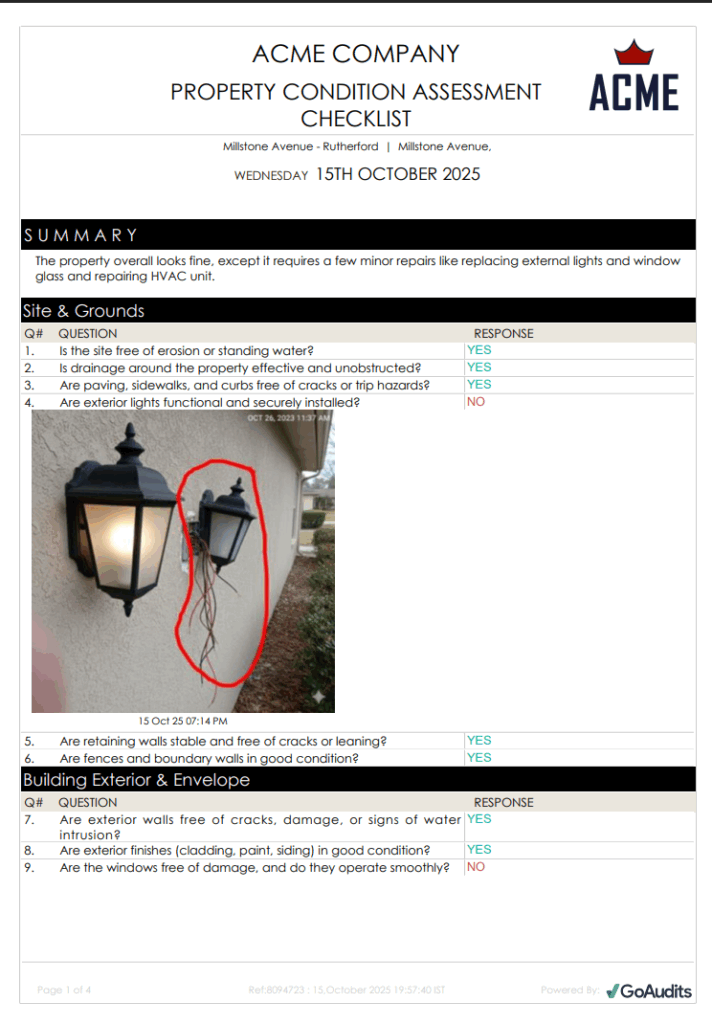
You can further customize this or any of your reports to include:
- A professional cover page with your company’s logo
- Numbered ratings for instant recognition of risk areas
- Embedded, annotated photos right next to the findings for clarity
- A dedicated section for recommended actions and CapEx items, and more
Inspection Report Samples: Explore types of reports you can generate and modify with GoAudits.
Free Property Condition Survey Checklists
Use our pre-built digital checklists to ensure you never miss a critical detail during your assessment.
- Building & Facility Maintenance Checklists
- Commercial Building Inspection Checklists
- Property Condition Assessment Checklist
- Facility Condition Assessment Template
- Property Damage Report Template
- Home Condition Survey Checklist
- Building Inspection Checklists
Essential Building & Property Inspection Checklists
If your client only needs a targeted evaluation, or if you want to focus your audit on high-risk areas, use these specific digital checklists:
- Building Exterior Maintenance Checklist
- Electrical Panel Maintenance Checklist
- Footing and Foundation Checklist
- Residential Plumbing Inspection Checklist
- HVAC Maintenance Checklists
- Chimney Inspection Checklist
- Termite Inspection Checklist
- Roof Inspection Checklists
- Pool Inspection Checklist
- Attic Inspection Checklist
- Checklists for other interior components, such as ceilings, floors, doors, and windows.

Draft Comprehensive Condition Reports in Minutes
For property managers and inspectors, the most time-consuming part of their job isn’t the inspection itself, but the manual reporting. Hours are often wasted back at the office, transcribing handwritten notes, organizing hundreds of photos, and wrestling with inconsistent Word or Excel templates. This manual approach is also prone to error, can lead to inconsistencies, and ultimately to costly delays in decision-making.
Use a property inspection software like GoAudits to bypass these challenges. GoAudits simplifies the entire workflow, allowing you to focus on a thorough assessment while the app handles the complex compilation, delivering a professional report instantly upon completion of the inspection.
Streamline Property and Building Condition Surveys With GoAudits
GoAudits is a property inspection software that enables real estate professionals to inspect and manage maintenance for all properties in their portfolio on a single platform. With features like customizable workflows, automated reporting, and notifications, businesses can keep their clientele updated.
With GoAudits, you can:
- Schedule regular building and maintenance inspections.
- Create checklists based on property type and tailor them to include local building codes.
- Allow your inspectors to generate and share reports with all stakeholders instantly.
- Stay on top of maintenance activities through features like corrective actions and workflow.
- Ensure all properties in your portfolio are in top condition.
With a rating of 4.8 stars on Capterra, GoAudits is trusted by some of the biggest names in the property management industry.
» GoAudits Reviews: Read how companies leverage GoAudits to meet operational and quality standards.
FAQs
A condition survey should be carried out by a qualified professional with proven expertise in building sciences. This is often:
– Residential: A state-licensed Home Inspector.
– Commercial (PCA): Often a professional engineer or architect with specialized experience in commercial buildings.
– Internal: Qualified in-house facility managers or maintenance engineers.
The duration depends heavily on the size and complexity of the property.
– A simple residential home condition report (like a Level 1) might take 1 to 2 hours.
– A comprehensive commercial PCA for a large property can take a team of inspectors 1 to 3 full days on-site, with report compilation taking an additional week.
A Level 1 condition report, as defined by RICS in the UK, is the most basic and least expensive type of property survey. It is suitable for conventional, newer properties in good condition. It focuses on a simple “traffic light” rating of the property’s condition, highlighting visible defects and risks, but it does not include advice on repairs or maintenance planning.
A photographic and written record of a property’s condition, attached to a lease at the point it is granted. It limits a tenant’s dilapidations liability at lease end to the condition recorded rather than to full repair, which is why it matters disproportionately to its length.
With a contemporaneous record: timestamped photographs, specific locations, and a signed acknowledgement from whoever granted access, produced at the time rather than reconstructed afterwards. This is the entire purpose of a pre-construction survey, and the reason a report assembled from notes weeks later carries less weight in a dispute.