Key Takeaways
- A home inspection report is a written record of a property’s condition across all major systems, from roof and structure to electrical, plumbing, and HVAC.
- Every professional report should include an executive summary, system-by-system findings, photo evidence, defect severity ratings, and repair recommendations.
- Buyers use reports to negotiate repairs before closing; sellers use pre-listing reports to avoid surprises; landlords use them to document move-in and move-out conditions.
- Property inspection apps generate reports automatically on-site, cutting post-inspection write-up time from hours to minutes.
A home inspection report is a detailed record of a property’s condition: essential for buyers, sellers, landlords, and property managers. Their weight in a transaction is rising. According to the National Association of REALTORS® Confidence Index, the share of buyers waiving the inspection contingency fell to 17% in May 2026 from 25% a year earlier, as market conditions gave buyers back the leverage to insist on one.
In this guide, you’ll learn how to write professional property inspection reports, see real-world examples, and download a free home inspection report template (PDF). We’ll also cover the key sections every report must include, different report types, and why digital checklist-based apps are the fastest way to generate reports that impress clients and reduce errors.
What is a Home Inspection Report?
A home inspection report is a detailed written document that records a property’s condition across all major systems, from foundation to roof, at a specific point in time. It’s a professional, non-invasive visual assessment of the property’s major systems and components, from the foundation to the roof.
While the term “home inspection” often evokes images of residential properties, the principles and reporting techniques apply to a wide range of real estate, including multi-unit buildings, condominiums, apartments, and even vacant lots. The core idea is to create a clear, documented record of a property’s condition.
Who Needs a House Inspection Report?
A wide range of stakeholders rely on home inspection reports for different reasons:
- Home Buyers: The most common user. A property inspection helps them understand the true condition of the home and identify any potential issues before finalizing a purchase. It provides crucial negotiation leverage.
- Home Sellers: Conducting a pre-listing inspection can help sellers identify and address issues before listing, leading to a smoother and faster sale and potentially a higher selling price.
- Lenders and Insurance Companies: These parties often require a home inspection report to ensure the property is a sound investment and doesn’t pose an undue risk.
- Real Estate Agents: A well-documented inspection report helps agents build trust with clients and navigate the negotiation process more effectively.
- Property Managers: They use property management inspection reports for move-in/move-out assessments, routine maintenance checks, and to document damages.
- Property Owners: Whether for a pre-purchase valuation or just to estimate a property’s value, an inspection report gives owners a clear picture of their asset’s health.
- Home Inspectors: For a working inspector, report quality is the product; it’s what the client actually receives and what referrals are based on. Inspector reports are judged on clarity and turnaround as much as thoroughness, which is why report writing rather than inspecting is where most of the time goes.
Case Study: How Woodside Homes leverages the GoAudits property inspection app to streamline reporting and corrective actions.
What are the Various Types of Home Inspection Reports?
The type of real estate inspection report you need depends on the purpose of the inspection.
Standard Home Inspection Report (Pre-Purchase)
This is the most well-known type, designed to give a potential buyer a comprehensive, non-invasive visual assessment of the home’s major systems and components before purchase. It typically covers the structural components, exterior, roof, plumbing, electrical, HVAC systems, and interior.
House Defect Report
Sometimes, the need for an inspection is driven by a single problem. A house defect report focuses on a specific issue—for example, a recurring leak, foundation cracks, or potential mold. The report provides a detailed analysis of the defect, determines its cause and extent, and recommends remediation steps.
Property Damage Checklist Template: Use this FREE template to conduct your next property damage assessment.
Inspection Summary Report
A summary report condenses a full inspection into one or two pages covering only the significant findings: major defects, safety hazards, and items needing immediate attention. It is not a replacement for the full report but a companion to it, produced for people who need the decision rather than the detail, typically agents, lenders, or a buyer’s solicitor.
The risk with summaries is what gets left out. A finding that seems minor in isolation can matter in combination, so a summary should always reference the section of the full report it draws from rather than standing alone.
Property Management Report (Rental/Portfolio)
This report is crucial for landlords and property managers. It’s used to document the condition of a rental property at various stages of a tenancy (move-in, mid-lease, move-out) or as part of routine maintenance checks for a portfolio of properties. It’s a key tool for avoiding tenant-landlord disputes over security deposits.
- Move-In Inspection Report: A move-in inspection report establishes the baseline condition of the property before a new tenant takes possession. It covers every room, notes existing damage with photos and descriptions, and should be signed by both the landlord and the tenant. This document is the primary evidence in any security deposit dispute at move-out.
- Routine or Periodic Inspection Report: Most landlords conduct inspections every 6–12 months to check for maintenance issues, unreported damage, and general upkeep. A routine property inspection report is typically shorter than a move-in report, focused on changes in condition rather than full baseline documentation. A property routine inspection report template should include date, inspector name, room-by-room condition notes, and any action items with assigned responsibility.
- Move-Out Inspection Report: The move-out report compares the property’s current condition against the move-in report. Any damage beyond normal wear and tear is documented with photos and repair cost estimates. This comparison is the legal basis for any deductions from the tenant’s security deposit.
Note: You may also come across the term residential inspection report. In practice, this is often used interchangeably with property management or rental inspection reports, especially when documenting the condition of apartments, condos, or multi-unit residential properties.
What a Property Management Inspection Report Template Should Include
A well-designed rental property inspection report template covers: property address and unit number, inspection date and inspector name, room-by-room condition checklist with condition ratings (Good / Fair / Poor), photo evidence with timestamps, damage notes with estimated repair costs, and tenant and landlord signatures.
Digital inspection apps like GoAudits generate this documentation automatically from a completed checklist, eliminating manual write-up and reducing the risk of disputes.

What are the Benefits of Property Inspection Reports?
A comprehensive real estate inspection report offers far more than just a list of problems.
- Identifying Defects: It uncovers hidden issues, from a leaky roof to faulty wiring, that might not be visible to the untrained eye.
- Negotiation Leverage: A detailed home inspection report provides concrete evidence to negotiate repairs, credits, or a lower sale price.
- Budgeting & Future Planning: It helps owners and property managers anticipate future costs, such as a major appliance replacement or a roof repair, allowing for better financial planning.
- Safety & Compliance: The real estate inspection report identifies potential safety hazards, ensuring the property is safe for its occupants. It also ensures compliance with local building codes.
- Legal Protection: For both buyers and sellers, a thorough report provides a record of the property’s condition at the time of the transaction, offering legal protection against future claims.
- Peace of Mind: A detailed residential inspection report gives everyone involved confidence in the transaction.
How to Write a Home Inspection Report and What It Must Include?
Creating a high-quality home inspection report is the final and most crucial step of the real estate inspection process. It’s where you formalize your raw field notes into a polished, professional, and easy-to-understand document for your client.
Home Inspection Report Format Explained
Here’s what the process of writing and the format of a home inspection report looks like:
- Start with the Executive Summary: Highlight the most critical findings, focusing on major defects and safety hazards. Your client will likely read this section first, so be clear, direct, and actionable.
- Organize Your Findings by System: Structure the body of the report by logical sections, following the systems of the property. Common headings include: Roof, Exterior, Foundation, Electrical, Plumbing, HVAC, and Interior.
- Write Detailed, Objective Descriptions: For each item on your checklist, write a description of its condition. Use professional, objective language and avoid emotional or subjective terms. Provide factual statements, such as “The roof shingles are curled and brittle, indicating they are nearing the end of their useful life,” rather than “The roof is in bad shape.”
- Categorize and Label Issues: Clearly label each finding as a major defect, a minor defect, or a safety hazard. This prioritization helps the client understand the severity and urgency of each issue. For example, a house defect report will prominently feature a major issue like a structural crack, while a minor one like a chipped tile can be noted without emphasis.
- Incorporate Visual Evidence: Embed the photos and videos you captured during the inspection directly next to the corresponding text. Annotate the images to draw attention to specific issues and ensure clarity. This visual proof is non-negotiable for a professional property inspection report.
- Provide Actionable Recommendations: For every issue you report, provide a clear and simple recommendation.
- Include a Glossary and Disclaimer: To enhance the report’s professionalism and clarity, include a glossary of technical terms. Additionally, add a disclaimer section that outlines the limitations of the inspection, such as its non-invasive nature, to protect yourself legally.
- Finalize the Report: Before sending the report, proofread it carefully for any grammatical errors, typos, or formatting issues. Ensure all photos are correctly placed, and the home inspection report PDF flows logically.
What Standards Define a Home Inspection Report?
Two bodies set the baseline. InterNACHI and ASHI each publish Standards of Practice that define what an inspector must examine and how they must report findings. Agents, attorneys, lenders, and insurers generally assume a report follows one of them.
Both require the report to identify, in writing, material defects observed in specified systems: roof, exterior, structure, electrical, plumbing, HVAC, insulation and ventilation, interior, and fireplaces. Both also require the report to state which systems were not inspected and why.
Equally important is what the standards exclude. An inspection is not technically exhaustive, will not reveal concealed or latent defects, and does not determine market value, insurability, purchase advisability, or the life expectancy of components. Stating those limits in the report is what protects the inspector.
ASHI approved a revised Standard of Practice in January 2026, superseding previous versions, with the earlier standard remaining current until the implementation date is confirmed. If you inspect under ASHI, check which version applies before updating your report template
Why Checklist-Based Home Report Templates are Better
Templates and checklists help you stay methodical, avoid overlooking defects, and maintain uniform standards across all inspections. However, for the best results, use digital property inspection checklists.
They enable real-time data capture, ensure nothing is overlooked, allow inspectors to capture photo evidence, and provide standardized inspection scoring. Here are important property inspection templates from the GoAudits library that you can use for FREE:
- Building Exterior Maintenance Checklist
- Electrical Panel Maintenance Checklist
- Footing and Foundation Checklist
- Residential Plumbing Inspection Checklist
- HVAC Maintenance Checklists
- Chimney Inspection Checklist
- Termite Inspection Checklist
- Roof Inspection Checklists
- Pool Inspection Checklist
- Attic Inspection Checklist
- Checklists for other interior components, such as ceilings, floors, doors, and windows.

Free Home Inspection Report Template PDF (Free Sample)
Here’s a free example of a house inspection report template for a condo generated using the condo inspection checklist. This comprehensive home inspection report example can be used as a professional property inspection report format or a checklist during your inspections.
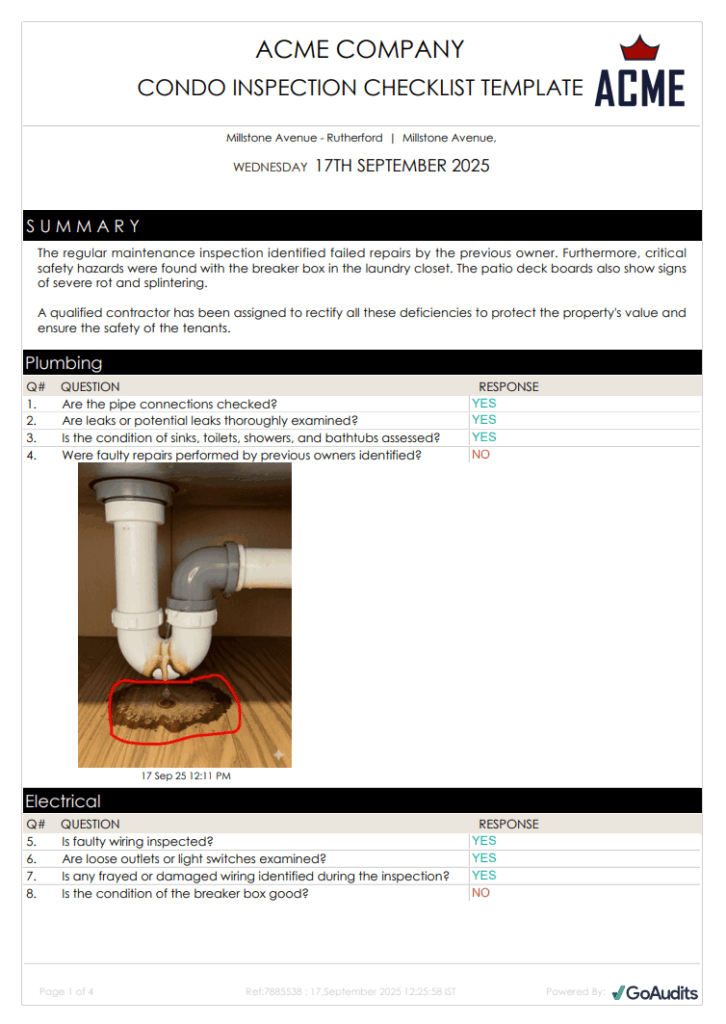
While a free property inspection report template PDF is a great starting point, you’ll quickly face limitations. It’s non-customizable, can’t include high-quality images, and requires a lot of manual data entry and organization.
Skip Manual Reporting, Generate Instant Home Inspection Reports
The biggest challenge for home inspectors and property managers is not the inspection itself, but the time-consuming process of writing the report. Hours spent back in the office, transcribing notes, organizing photos, and formatting documents are time that could be spent on new clients. Additionally,
- Manual reports can have variations in quality and formatting.
- Sifting through hundreds of photos and matching them to observations is a nightmare.
- Transcribing handwritten notes introduces errors and takes forever.
This is why property managers are ditching the clipboard and switching to property inspection apps. These tools allow you to perform inspections, take photos, add notes, and generate a prefilled, well-formatted professional report on the spot.
Streamline Property Inspections and Reporting With GoAudits
GoAudits is a popular property inspection mobile app that offers customizable inspection checklists, an advanced reporting and analytics dashboard, real-time collaboration with your team, and much more.
With GoAudits, you can perform regular inspections and maintenance to boost the value of the properties. You can perform as many inspections and for as many properties as you like because we do not charge based on the number of inspections.
With the GoAudits mobile app, you can:
- Conduct real estate inspections on the go.
- Capture every detail with photos and notes.
- Generate and distribute pre-filled professional reports instantly.
- Assign corrective actions to vendors and contractors.
- Monitor the condition of all your properties on a single Analytics dashboard.
With a rating of 4.8/5 stars on Capterra, GoAudits is trusted by some of the biggest names in the property management industry.
» Customer Success Story: Read how organizations leverage GoAudits to save time and improve standards.
FAQs
A typical home inspection report is 20–100 pages long, depending on the property’s size and the number of findings. It opens with a cover page and table of contents, followed by an executive summary. The body is organised by building system, with each section listing the component, its condition, any defects identified, accompanying photos, and a recommended action. Reports generated by digital inspection software have a consistent, professional layout with embedded photos and colour-coded severity ratings.
A home inspection report is a residential document typically used in real estate transactions, covering visible defects across the home’s major systems. A property condition report (PCR) is a more formal term used in commercial real estate, usually commissioned by lenders or investors and conducted by a licensed engineer or architect. Both documents serve to record a property’s condition, but they differ in scope, required credentials of the assessor, and audience.
A free home inspection report template PDF is a useful starting point for low-frequency inspectors, but it has significant practical limitations. PDF templates can’t automatically populate with field data, don’t embed photos cleanly, and require manual formatting after every inspection. For professional inspectors or property managers conducting regular inspections, a digital platform that generates reports from a completed checklist saves hours per report and produces more consistent output.
A house defect report is a focused inspection document that examines a specific problem in a property, such as a recurring leak, foundation movement, or suspected mould, rather than assessing the entire home. It is commissioned when a known issue requires deeper analysis to determine cause, extent, and remediation approach. A house defect report is more specialised and targeted than a standard pre-purchase home inspection report.
In HOA-governed properties, the HOA is typically responsible for the building exterior, roof, shared structural elements, and common areas. Interior elements such as plumbing fixtures, electrical panels, HVAC, and flooring are generally the homeowner’s or seller’s responsibility. When reviewing a home inspection report on an HOA property, cross-reference each major finding against the HOA’s CC&Rs to determine which party is responsible for repair before negotiating with the seller.
To document regular property inspections, use a consistent checklist for every visit and record condition ratings, defect descriptions, and timestamped photos for each area inspected. Assign any issues to a responsible party with a due date. Digital inspection apps like GoAudits generate a formatted report automatically on-site, keeping all records in one place.
Check four things. The inspector’s licence number should appear on the report and be verifiable against your state or provincial licensing board. The report should carry a date, the property address, and the inspector’s signature. Photographs should be embedded rather than attached separately, since loose images are easily substituted. The inspector should be willing to discuss the findings directly.