Key Takeaways
- A franchise operations manual defines how every location runs, from daily procedures to compliance standards.
- The most effective manuals are modular, so teams can quickly find and apply what they need.
- Writing the manual is only half the job. Its enforcement is what drives real consistency.
- Tools like GoAudits let franchise networks turn manual sections into digital checklists, run mobile inspections across locations, and track compliance scores from a single dashboard.
The IFA projects over 845,000 franchise establishments across the US in 2026, generating more than $936 billion in output. When you’re running dozens, or even hundreds, of franchise locations, inconsistency at a single site can quickly erode the trust your entire network depends on.
That’s why franchisors invest in detailed operations manuals. But too often, these manuals sit unused, because they aren’t translated into daily execution. Without systems like checklists, audits, and corrective actions, even the best manual fails to drive consistency.
This guide walks you through how to create a franchise operations manual from scratch, what to include in each section, and how to write one that frontline teams can actually use. It also covers how to enforce those standards across every location, along with a free, customizable franchise operations manual template you can download as a PDF.
- What is a Franchise Operations Manual?
- What Should a Franchise Operations Manual Include?
- Free Franchise Operations Manual Template PDF
- How to Write a Franchise Operations Manual Step by Step
- How Do You Enforce a Franchise Operating Manual Across Locations?
- Why Does Franchise Quality Control Start With the Manual?
- How to Keep Your Franchise Operations Manual Updated
- Turn Your Franchise Operations Manual into a Living System With GoAudits
- FAQs
What is a Franchise Operations Manual?
A franchise operations manual is a confidential document that details every procedure, standard, and requirement for running a franchise location. It serves as both a training tool for new franchisees and a legally enforceable quality control document that protects brand consistency across the entire network.
According to iFranchise Group, a typical franchise procedures manual runs 300 to 500 pages and can take over 2,000 hours to write from scratch. But page count matters less than usability. A 500-page manual nobody opens is worse than a 200-page one that teams reference daily.
The manual’s table of contents must appear in the Franchise Disclosure Document (FDD). This makes your manual’s structure visible to prospective franchisees before they sign, turning it into both a compliance requirement and a sales tool.
Most importantly, a franchise procedures manual is a living operational system that should evolve with every audit cycle, every new regulation, and every piece of feedback from the field.
Why Do Franchise Operating Manuals Matter
A franchise operating manual plays four critical roles in your franchise system:
- Legal Enforceability: The manual is referenced in (and incorporated by) the franchise agreement. Without documented standards, you have no basis to enforce compliance or terminate a noncompliant franchisee.
- Training Foundation: New franchisees use the manual as their primary reference for learning how to run the business.
- Quality Control Framework: Every audit, inspection, and corrective action traces back to the standards documented in the manual. If a procedure isn’t in the manual, you can’t hold a franchisee accountable for it.
- Independent Contractor Proof: The manual helps establish that franchisees are independent operators following a documented system, not employees of the franchisor. This distinction matters for managing joint employer risk.

What Should a Franchise Operations Manual Include?
A franchise operations manual should cover every procedure, standard, and policy a franchisee needs to open, run, and grow their location. The specific content varies by industry, but most manuals include these twelve core sections:
- Company Overview and Brand Identity: Mission, values, company history, brand guidelines, logo usage, and visual identity standards.
- Franchise Organizational Structure and Roles: Franchisor vs. franchisee responsibilities, reporting lines, key contacts, and escalation procedures.
- Site Selection and Pre-Opening Procedures: Location criteria, build-out specs, permits, equipment lists, and launch timeline.
- Daily Operations and Shift Procedures: Opening/closing checklists, shift handovers, equipment routines, and cash-handling procedures.
- Franchise Standard Operating Procedures (SOPs): Step-by-step instructions for every recurring task, written with measurable criteria
- Training and Onboarding. Initial franchisee training, staff onboarding by role, certification requirements, and ongoing education.
- Marketing and Advertising Guidelines: Approved materials, local marketing rules, social media policy, and co-op ad fund usage.
- Financial Management and Reporting. Bookkeeping requirements, royalty calculations, POS procedures, and reporting cadence.
- Health, Safety, and Regulatory Compliance: Industry-specific: food safety (HACCP, temperature logs) for restaurants, H&S standards for retail, infection control for healthcare.
- Technology, Systems, and Approved Vendors: Required software, POS systems, approved supplier list, and IT support protocols.
- Quality Control and Audit Procedures: How compliance is measured, audit types, scoring criteria, and the resolution process.
- Legal, IP, and Confidentiality: Trademark usage, territory rights, non-disclosure requirements, and termination procedures.
Sections 5, 9, and 11 carry the most operational risk and should be prioritized when compiling a franchise operations manual. The exact depth of each section depends on your industry.
- A food franchise manual will be heavy on food safety and kitchen SOPs
- A retail franchise will prioritize merchandising and customer service
- A hospitality franchise will focus on guest experience and housekeeping standards.
Free Franchise Operations Manual Template PDF
Use the following franchise operations manual sample as your starting outline, then customize it for your specific franchise model. This same structure becomes the foundation for your enforcement checklists later.
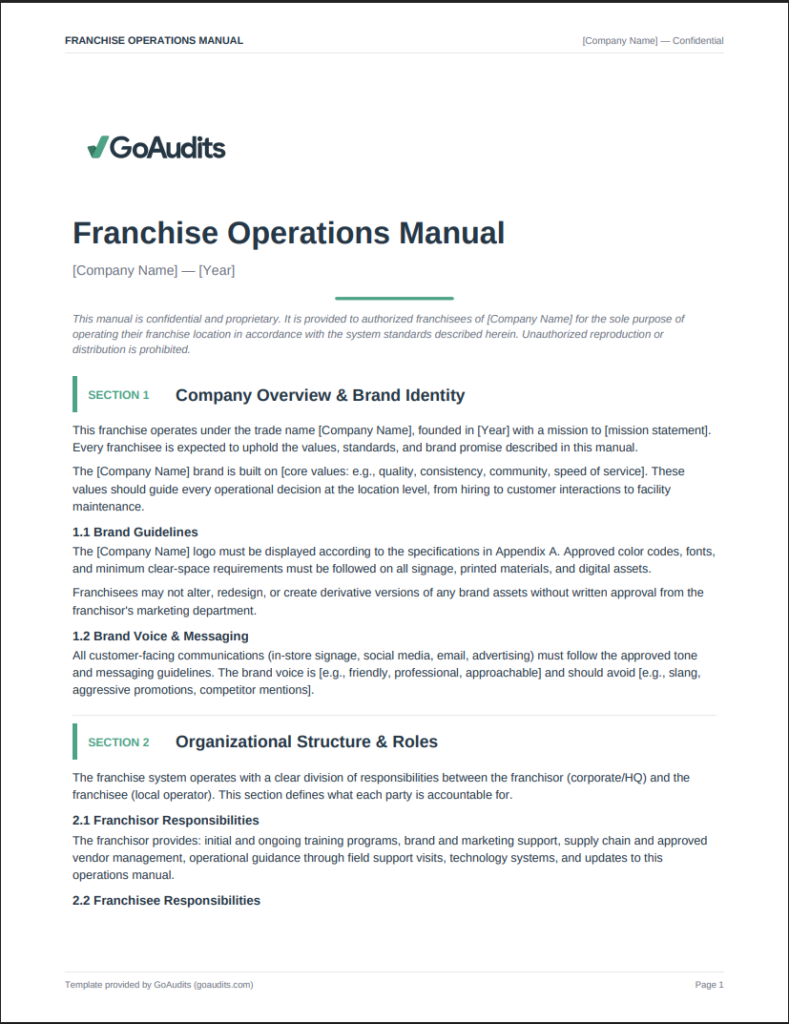
Once your manual is written, the next step is making it usable in day-to-day operations. This typically means converting key sections into digital checklists that teams can complete on mobile devices.

How to Write a Franchise Operations Manual Step by Step
Creating a franchise operations manual is a big project, and how you approach it matters as much as what you include. Whether you’re learning how to create a franchise manual for the first time or rewriting one that isn’t working, these seven steps will help you produce something both thorough and usable.
- Start With the Highest-Risk Procedures First: Food safety, health & safety, and regulatory compliance. These sections can shut down a location if they’re wrong. Writing them first also sets the level of detail and specificity that should carry through the rest of the manual.
- Interview Operators and Frontline Staff: The people doing the work every day know where procedures break down, which steps get skipped, and what instructions don’t make sense in practice.
- Write Measurable Criteria: Replace “Keep the store clean” with specific checkpoints that can be scored during an audit. We’ll cover exactly how to do this in the franchise quality control section below.
- Use Visual Aids: Photos of correct vs. incorrect setups, process flowcharts, and embedded video links for complex procedures all reduce ambiguity. Visual references make procedures clearer than text alone.
- Break the Manual into Modular Volumes: A single 500-page document is unusable during a shift. Split it by function: operations manual, training manual, food safety manual, marketing manual.
- Get a Legal Review: The manual must align with your franchise agreement and FDD. An experienced franchise attorney should review it for joint employer risk, IP protection, and enforceability.
- Build Audit Criteria into Every Section from the Start: If a procedure can’t be inspected and scored, it won’t be followed consistently. For every franchise standard operating procedure you write, ask: “How would an auditor verify this?” If you can’t answer clearly, rewrite the SOP until you can.
For industry-specific SOP examples, see our guides on restaurant SOPs and retail store SOPs. Refer to SOP documentation templates for further tips.
How Do You Enforce a Franchise Operating Manual Across Locations?
You enforce a franchise operations manual by converting its standards into digital checklists that frontline teams complete every shift, then verifying compliance through scheduled audits and closing every gap with corrective actions.
Writing the manual is half the work. Enforcement is the half that most franchise networks get wrong. Here’s a three-step model that works.
Step 1: Convert Manual Sections into Digital SOP Checklists
A 400-page franchise operations manual PDF doesn’t get opened during a busy lunch rush. Paper checklists get pencil-whipped without the actual checks.
Digital checklists break each manual section into specific, scored items that frontline staff complete in real time on a phone or tablet. Each item can require photo evidence, timestamps, and a manager’s sign-off before it’s marked complete.
Here’s how to convert your manual into enforceable checklists:
- Extract the measurable criteria from each SOP section and structure them as pass/fail or scored checklist items.
- Add photo evidence requirements for items where visual proof matters.
- Create different checklists for different cadences. Daily opening/closing checks. Weekly deep-clean inspections. Monthly compliance audits. Quarterly brand standards reviews.
- Assign checklists by role and location. A store manager’s checklist covers different items than a store visit checklist used by an area manager during a corporate audit.
With GoAudits, HQ sees compliance scores across every location in real time. No more waiting for the quarterly visit to discover a store has been falling short for months. Browse ready-to-use checklist templates by industry:
- Retail store audit checklists
- Restaurant and food audit checklists
- Hotel audit checklists
- Gym, fitness center, and spa checklists
- Health and safety audit checklists
Step 2. Run Frequent Audits Across Your Franchise Network
The strongest franchise networks use three layers of checks:
- Franchisee Self-audits: Daily or shift-level checks completed by store managers using digital checklists. These build discipline at the location level and catch issues before they become patterns.
- Corporate or Area Manager Audits: Monthly or quarterly formal inspections that verify daily self-audits are honest and complete. This is the “inspect what you expect” layer. See how retail audits and store visits work in practice.
- Mystery Shopping: Unannounced evaluations of the real customer experience. Mystery shops catch what self-audits miss because the location doesn’t know it’s being observed.
With GoAudits, schedule all types of audits by location, frequency, and type. Automated reminders make sure nothing slips. For a full breakdown of how to build an audit and monitoring program, see our franchisee monitoring and brand compliance monitoring guides.
👉 Case Study: How Goodwill Conducts 1,400+ Audits With GoAudits
After rolling out GoAudits, the Goodwill team’s reporting process changed completely: custom weekly summaries go out automatically, the dashboard tracks 470+ corrective actions per month, and managers can view performance trends by time period, area, or location type without manual compilation. The result: over 1,000 hours saved per year, with an estimated $20,000 in direct savings.
Here’s what Kartella Fuller, Director of Operations at Goodwill, had to say, “GoAudits gives us consistency in collecting data, setting up action plans, and driving their execution. Ultimately, we are much better equipped to improve results in our business operations!”
» Read Full Story: How Goodwill drives operational improvements across 100+ sites.
Step 3: Close the Loop With Corrective Actions
Audits without follow-through are just paperwork. When an inspection reveals a gap, the next step needs to happen right away: assign a corrective action with a clear owner, a deadline, and required evidence (like a photo proving the fix is done).
Here’s what closing the loop looks like in practice:
- A gap at one location gets a resolution assigned to the franchisee manager, with a deadline and photo proof requirement.
- The same gap at multiple locations signals a problem with the manual itself. If five stores fail the same checklist item, the SOP might be unclear, the training might be missing, or the standard might be unrealistic.
- Cross-location scoring and trend analytics let you compare locations, spot top and bottom performers, and identify systemic issues before they spread across the network.
GoAudits’ corrective action software tracks every action from assignment to resolution, with full audit trails. With the Analytics dashboard, you can monitor performance at each outlet, spot trends, and compare different locations.
Why Does Franchise Quality Control Start With the Manual?
Franchise quality control starts with the manual because every audit, inspection, and corrective action traces back to the standards you documented. If the manual is vague, audits become subjective. Scores lose credibility, and franchisees push back on findings because the criteria were never clear to begin with.
The fix: write every SOP as if it’s going to be audited. Because it should be.
Vague Franchise SOP vs. Audit-Ready SOP
The table below shows the difference between a franchise operations manual example that can’t be enforced and one that can.
| Area | ❌ Vague SOP | ✅ Audit-Ready SOP |
| Cleanliness | “Keep the store clean.” | “Floors swept and mopped before opening. No visible debris in aisles. Restrooms checked every 2 hours (signed log).” |
| Customer service | “Greet every customer.” | “Verbal greeting within 10 seconds of entry. Eye contact. Name badge visible.” |
| Food safety | “Check food temperatures.” | “Hot food held at 140°F+. Cold food at 40°F or below. Logged every 2 hours on the temperature sheet.” |
| Merchandising | “Follow the planogram.” | “Endcap displays match current planogram (photo reference attached). Shelf tags match pricing system. Checked weekly.” |
The difference is measurability. The vague versions sound reasonable, but give an auditor nothing to score against. The audit-ready versions provide clear pass/fail criteria that any location, any auditor, and any franchise quality control program can work with consistently.
When you redesign your SOPs this way, two things happen. First, audits become objective and defensible. Second, franchisees stop disputing subjective scores because the standard is documented in black and white.
Body Energy Club, a 17-store health food chain, converted paper SOPs into scored digital audits with GoAudits. Within six months, average audit scores climbed from 75% to above 90%, with increased task accountability and visibility across all stores.
Explore our guides on how to manage retail store operations and run audits across multiple store locations.
GoAudits brought us speed, efficiency, and helped us drive our own results. We cut our audit times in half, while increasing task accountability and overall insight to store operations.
Myles Blue, Area Manager, Body Energy Club
👉 Case Study: How Body Energy Club raised audit scores from 75% to 90%.
How to Keep Your Franchise Operations Manual Updated
A franchise operations manual is never finished. The best franchise networks treat it as a living document that improves with every audit cycle, every regulatory shift, and every round of field feedback.
What Triggers a Franchise Operating Manual Review
Not every update needs a full rewrite. But certain events should trigger an immediate review of the relevant sections:
- Regulatory or compliance changes in your industry (new food safety rules, updated labor laws, revised health codes)
- New product or service launches that change daily operations or training requirements
- Technology or vendor changes (new POS system, new approved suppliers, software updates)
- Audit data revealing recurring gaps across multiple locations. If the same checklist item fails at five stores, the problem is the SOP, not the people.
- Franchisee feedback and field observations. The people running locations daily often spot manual gaps before HQ does.
How to Manage Version Control of Your Franchise Manual Across Locations
Version control is one of the biggest headaches when updating a franchise manual. Whether it’s 10 or 100 locations, making sure every site has the current version and has actually read the changes requires a deliberate process.
Digital checklist platforms make this significantly easier. When you update a checklist in GoAudits, every location gets the new version instantly. The updated standard goes live in the next audit.
How Often Should You Update Your Franchise Manuals and SOPs
As a baseline: review high-risk sections (food safety, H&S, compliance) quarterly. Conduct a full manual review annually. Update immediately when a trigger event occurs.
The best approach is to let your audit data drive the timing. If a section’s compliance scores are consistently high across all locations, it probably doesn’t need a rewrite. If scores are declining or a specific checklist item keeps failing, that SOP needs attention now.
For more on keeping your franchise procedures manual current with SOP management software, see our guide.
Turn Your Franchise Operations Manual into a Living System With GoAudits
GoAudits is an all-in-one platform for monitoring, auditing, and SOP management that acts as a definitive system of record for franchisee compliance. By centralizing these functions, organizations can eliminate the fragmented data and move toward a unified digital strategy for protecting brand value.
With GoAudits, you can:
- Deliver top-notch services to customers across sites and locations.
- Ensure consistent execution and reputation by standardizing SOPs.
- Facilitate communication between HQ and frontline teams.
- Enhance health and safety standards across your entire network.
- Highlight problems and high-performing sites using data-driven analytics.
GoAudits provided us with a full picture of store performance and environment. We were able to roll out the app to all the area managers with ease. The GoAudits team was super engaged and adapted the platform to suit our needs.
Simon Daley, Head of Retail, Tommy Hilfiger – PVH
With a rating of 4.8 stars on Capterra, GoAudits is trusted by some of the biggest names in the industry to maintain meticulous operational standards.
» GoAudits Reviews: Read how companies leverage GoAudits to improve operational consistency and achieve brand standards.
FAQs
A typical franchise operations manual runs 300 to 500 pages. However, length matters less than usability. The best approach is to break the manual into modular volumes by function, so teams access only what they need. A single 500-page document that nobody opens provides less value than five focused volumes that get used daily.
Yes. Franchise agreements typically give the franchisor the right to update, modify, and revise the operations manual at any time, and franchisees are required to comply.
A franchise procedures manual is the complete reference document covering everything a franchisee needs to run the business: brand guidelines, organizational structure, legal obligations, financial procedures, and operational standards. Franchise SOPs are the individual step-by-step procedures within the manual that describe how to perform specific tasks. The manual is the book. The SOPs are the chapters. Both should be written with measurable, audit-ready criteria.
Two categories of tools serve different needs. Document and knowledge management platforms (like Whale or Trainual) help you host, organize, and distribute your franchise manual content. Audit and inspection tools (like GoAudits) help you enforce the standards in your manual by converting them into digital checklists, running scheduled audits across locations, and tracking corrective actions to resolution.
Top franchise brands structure their manuals as modular, function-specific volumes rather than a single monolithic document. They write the highest-risk sections first and build every procedure around measurable audit criteria. They also pair the manual with a digital enforcement system: checklists completed on mobile devices, scheduled corporate audits, corrective action tracking, and cross-location analytics. Brands like Domino’s, Krispy Kreme, Hilton, and Marriott use tools like GoAudits to bridge the gap between documentation and daily execution.
In the US, the Franchise Disclosure Document (FDD) must include the table of contents of your operations manual under Item 11. The full manual content stays confidential, but prospective franchisees can review it before signing. The manual is incorporated by reference into the franchise agreement, making it legally binding on both parties. Franchisees must follow it, and franchisors can enforce it, including as grounds for termination if a franchisee consistently fails to comply.