Key Takeaways
- LQA (Leading Quality Assurance) is an independent company whose assessments benchmark luxury hotels against the global luxury segment.
- An LQA audit covers over 1,000 standards across eight departments, conducted anonymously by LQA’s consultants over 1-3 nights on site.
- Performing well in an LQA assessment requires year-round operational consistency, not just preparation in the weeks before an inspector arrives. A digital hotel inspection app can help hotels run frequent internal quality audits to elevate day-to-day standards.
The difference between a 4-star hotel and a 5-star hotel isn’t the thread count or the marble. It’s whether the front desk remembers your name, whether the housekeeper notices you’ve moved the spare pillow to the chair, whether the room service waiter asks how the meeting went. Hundreds of those small moments, every day, across every department. That’s the bar to reach.
LQA provides one of the most established frameworks luxury hotels use to assess whether they are meeting this bar. This article covers what LQA is, what an LQA audit assesses, how scoring works, and how hotel teams maintain the highest standards through their own internal audit programs.
What are the LQA Standards for Hotels?
LQA standards are the luxury hospitality assessment framework operated by Leading Quality Assurance, an independent company that audits luxury hotels against over 1,000 criteria covering service, product, and operational excellence. The criteria include both quantitative measures (such as service times and facility specifications) and qualitative ones (such as personalization, emotional intelligence, and the consistency of the guest experience).
LQA designs and owns the methodology, employs its own assessor team, and produces its own reports. Hotels engage LQA voluntarily to be evaluated against its criteria and benchmarked against the global luxury segment, working with LQA the way they would work with a hotel quality assurance partner of their choice.
Beyond the assessment itself, working with LQA gives hotels access to training resources and an aggregated benchmarking database drawn from thousands of individual property assessments.
The framework is structured around three layers:
- Over 1,000 individual standards organized by department (Front of House, Food & Beverage, Housekeeping, Product, Spa & Fitness, Golf, Transport, and others)
- Eight performance criteria that measure what type of quality is being assessed (Service Excellence, Product, Emotional Intelligence, Efficiency, Cleanliness, Food Quality, Sales Opportunity, Sustainability)
- A five-level emotional engagement scale that captures how guests feel during interactions, ranging from Extremely Dissatisfied to Completely Engaged
Each layer is covered in the sections below.
How Does an LQA Audit Work?
An LQA audit is an on-site assessment conducted anonymously by an LQA consultant who stays at the hotel as a regular guest. Assessments typically run over 1-3 nights and cover every touchpoint of the guest journey, from reservation through check-out.
The consultant may capture audio recordings of interactions (such as reservation calls) and photographic evidence of physical conditions throughout the stay. The output is a detailed report combining quantitative scores against each standard, with qualitative written feedback and emotional engagement scoring, followed by a debrief session with the hotel management team.
How Often LQA Audits Happen
LQA recommends a minimum of two external assessments per year. A passing score is benchmarked at over 95%, which is difficult to achieve without sustained internal practice between visits.
Hotels typically run their own internal audits more frequently: often weekly for high-frequency areas like housekeeping and front office, monthly for slower-changing ones. The frequency of internal audits is what determines whether a hotel walks into an external assessment with confidence or hopes for the best.
What an LQA Audit Assesses
The 1,000+ standards are organized by department, then evaluated against the eight performance criteria and emotional engagement scale outlined above. Each department has its own set of standards reflecting the operational and service expectations specific to that area:
| Department | What’s assessed |
|---|---|
| Food & Beverage (379 standards) | Restaurant service flow, buffet presentation and replenishment, in-room dining order accuracy and timing, drinks service, menu execution, culinary consistency |
| Front of House (179 standards) | Reservations, arrival and departure, check-in and check-out, concierge interactions, porter and doorman service |
| Housekeeping (117 standards) | Arrival service, room servicing throughout the stay, turndown service, laundry and valet, attention to detail in room presentation |
| Product (109 standards) | Physical condition of the hotel: room and public area maintenance, amenities, accessibility, lighting, security infrastructure, design coherence |
| Spa & Fitness (53 standards) | Treatment quality and consistency, therapist conduct, facility cleanliness, equipment maintenance, member and guest journey |
| Golf (49 standards) | Course conditions, pro shop service, caddy and starter interactions, refreshment service on course |
| Transport (32 standards) | Airport transfers, valet service, drive quality, vehicle condition, driver presentation and conduct |
| Other | Guest security, digital services, and additional touchpoints across the property |
The same standards are also bucketed by performance criteria, measuring what kind of quality is being assessed. Eight criteria run across all departments:
- Service Excellence (up to 238 standards). How staff meet guest needs, provide personalized service, and maintain consistent hospitality across every touchpoint.
- Product (up to 180 standards). The physical attributes of the hotel: facilities, amenities, maintenance, accessibility, security.
- Emotional Intelligence (up to 272 standards). Staff ability to demonstrate empathy, adapt to individual guests, and create genuine connection rather than scripted interactions.
- Efficiency (up to 151 standards). Service delivery speed and operational flow: check-in, housekeeping turnaround, food service.
- Cleanliness (up to 69 standards). Guest rooms, public areas, dining facilities, and restrooms, with focus on maintaining a clean and hygienic environment throughout.
- Food Quality (up to 54 standards). Culinary excellence: taste, presentation, variety, and sourcing.
- Sales Opportunity (up to 25 standards). Proactive identification of upgrade or upsell opportunities that benefit both guest and hotel.
- Sustainability (up to 62 standards). Environmental and operational sustainability practices.
How LQA Measures Emotional Engagement
What makes LQA distinct from many other hospitality assessment frameworks is the emotional engagement layer. Beyond whether a service was delivered, LQA assesses how the guest felt during the interaction, on a five-level scale:
- Extremely Dissatisfied (Neglected, Stressed, Frustrated, Overlooked)
- Dissatisfied (Disinterested, Disconnected, Disappointed)
- Engaged (Respected, Understood, Content)
- Positively Engaged (Delighted, Appreciated, Valued)
- Completely Engaged (Pampered, Special, Indulged)
This is the layer luxury hotels find hardest to maintain consistently, because it cannot be solved with process design alone. It depends on individual staff behavior across hundreds of guest interactions every day.
LQA audits operate similarly to a hotel mystery shopper audit, with the difference that LQA assesses against its own framework rather than the hotel’s brand standards.
LQA vs Forbes Travel Guide Standards: Key Differences
Many luxury properties work with both, but for different purposes. An LQA assessment is an internal-facing quality assurance tool: a confidential report commissioned by the hotel itself, used behind the scenes to benchmark performance, guide staff training and drive operational improvement. Forbes standards are external-facing: a published star rating that signals quality to the market, earned through independent anonymous inspection.
> Forbes Standards: Read how luxury hotels prepare for external inspections to unlock top Forbes ratings.
Why Consider the LQA Standard for Your Hotel?
A five-star hotel begins as a set of capital expenditure decisions. The marble, the linen, the bathroom fixtures, the view, the location: specified and signed off before a single guest checks in.
What can’t be bought is the moment a server brings out a birthday cake nobody asked for, because the front desk passed on a detail mentioned at check-in. That’s the part luxury hospitality actually runs on, and the part no spec sheet accounts for.
An external standard like LQA’s gives hotels a way to assess whether they are delivering that day to day, across every guest interaction, or whether they are leaning on the facilities to carry the experience.
Benefits of Adhering to LQA Hotel Standards
For luxury hotels, working to a recognized assessment framework supports the operation in several ways:
- Prestige in the luxury segment. Strong performance in an LQA audit signals quality to discerning guests, travel agents, and corporate clients.
- Brand consistency across properties. For hotel groups, working to a shared external standard helps maintain a uniform guest satisfaction experience across the portfolio.
- Better guest experience that drives revenue. The criteria cover not only physical product and service times but also the qualitative elements (personalization, emotional intelligence, attentiveness) that that drive repeat bookings, positive reviews, and stronger pricing power.
- Actionable feedback. External assessment reports identify specific operational areas to improve, rather than leaving the hotel to diagnose its own gaps.
- Industry benchmarking. Access to peer data allows hotels to see where they sit against the global luxury segment, not just against their own previous performance.
- Foundation for an internal quality program. A recognized external framework gives the hotel’s own QA team a clear structure to audit against between visits.
Managing brand standards: How digital checklists helped Latour Hotels enforce standards across 30+ properties.
How to Prepare for an LQA Audit (7 tips)
Strong performance in an LQA audit depends on consistency between external visits, not on preparation in the weeks before one. Hotels achieve this through structured internal audit programs running across every department, covering the same operational areas LQA assesses on a recurring schedule.
Here’s a list of 7 practical preparation tips, each addressing a real challenge of working at LQA’s level of detail.
1. Map your internal audit calendar against LQA’s framework
The challenge: With 1,000+ standards across eight departments, no single audit can cover everything. Without a structured cadence, some areas get reviewed weekly while others go untouched for months.
Build a recurring schedule that mirrors the LQA departments, with frequency calibrated to how fast each area changes:
- Daily or shift-based: Front of House, housekeeping turnover, F&B service
- Weekly: Public area cleanliness, restaurant standards, in-room dining quality
- Monthly: Physical product, preventive maintenance, security
- Quarterly: Full department reviews, training refreshers, brand standards alignment
You will need checklists covering the operational areas assessed:
- Front of House: Reservations, Arrival/Departure, Check-in and Check-Out, Concierge, Porter/Doorman services
- Housekeeping: Arrival, Turndown, Servicing, Laundry
- Food & Beverage: Restaurant, Buffet, In-Room Dining, Drinks service
- Facilities: Rooms, Public Areas, Fitness & Wellness, Spa
- Other: Guest Security, Transport, Digital Services
👉 To run your internal audits between external assessments, browse our full library of audit checklists for hotels.
2. Audit against all your frameworks at once, not separately
The challenge: Few luxury hotels work against only one set of standards. The same property is typically held to brand SOPs (Marriott BSA, Hilton, Hyatt), an external assessment framework (e.g. LQA or Forbes), and its own internal benchmarks. When these are treated as separate audits, the same operational area might get reviewed three times in slightly different ways, with findings scattered across three different reports.
Consolidate the frameworks into single audits at the department level. A Front Office audit should cover brand SOPs, internal requirements, and the operational areas LQA or Forbes inspectors typically assess, in one pass with one set of findings.
Building one combined checklist takes more thought up front than maintaining three parallel ones, but that’s where the time saving compounds.
3. Train staff on the soft-skills dimension, and tie scores to recognition
The challenge: Around half of LQA’s standards measure Service Excellence and Emotional Intelligence — qualities that cannot be process-mapped. Staff turnover resets the soft-skills baseline with every new hire.
Hotel staff training needs to cover the qualitative side as much as the operational: guest recognition, anticipating needs, reading mood, handling complaints, personalization. Budget for ongoing refreshers, not just induction.
Tie internal audit scores to recognition. When staff see their effort reflected in scores, and those scores translate to praise, bonuses, or team rewards, the qualitative dimension stops being abstract. People work harder on things that get noticed.
4. Standardize across properties without flattening local character
The challenge: For hotel groups with multiple locations, uniform quality is harder than at a single site. Differences in management, local conditions, and staffing depth produce varying guest experiences across what is supposed to be one brand.
The fix is structural, not motivational. Run the same internal audits (with local adaptations as required), on the same schedule, with the same scoring methodology across every property. Centralized dashboards make this visible: a regional director can see which property is slipping on which criterion in real time, rather than waiting for the next external assessment.
5. Run your own mystery audits
The challenge: Scheduled internal audits, where staff know the auditor and the timing, never replicate the conditions of an external assessment.
A mystery shopper audit, conducted by someone the staff don’t recognize, replicates external assessment conditions far more closely than a scheduled review. Run them more often than the one or two external visits a year, and they do two jobs: they surface gaps before the LQA inspector arrives, and they confirm whether the fixes recommended at the last assessment have actually held. Use the findings to act on what surfaces, not as a performance review.
6. Address physical product before service tries to compensate
The challenge: Staff resistance often comes from being asked to compensate for product issues outside their control. A broken minibar fridge, a worn carpet, or an inconsistent lobby can’t be smiled away.
The Product criteria cover facilities, amenities, maintenance, accessibility, lighting, and security infrastructure, roughly 180 LQA standards. Run a preventive maintenance program on a fixed schedule, with public areas, guest rooms, and back-of-house treated as separate cycles. Product issues are visible to assessors immediately and impossible to hide.
7. Measure scores over time, not just at the point of audit
The challenge: A single audit score tells you what’s broken today, but not whether the program is moving in the right direction.
This is where the right tool makes the difference. Paper checklists and spreadsheets capture scores, but make them hard to compare over time. A hotel inspection app like GoAudits records every internal audit in a structured format, with automated scoring at the department, criterion, and overall hotel level. Smart scoring tracks whether quality is improving or slipping across each cycle, and reports are shared instantly with the relevant teams.
Track hotel KPIs tied to guest satisfaction (review scores, guest complaints, repeat bookings…) alongside internal audit scores. When the two move together, you are seeing the real picture. When they diverge, you have an early warning before it shows up in an external assessment.

An Inspection App for Efficient Internal Hotel Audits
All of this becomes hard to do well on paper. The checklists pile up, the scoring gets lost in spreadsheets, and the team ends up spending more time on admin than on actually fixing things. A digital audit app removes that overhead.
The GoAudits hotel inspection app, your hotel’s team can easily run frequent internal audits across each department, identify gaps early, and act on them before they appear in an external assessment.

- Frequent internal audits, on schedule. Run daily, weekly, monthly, and quarterly inspections across every department, on a mobile device, with offline capability.
- All your frameworks in one checklist. Brand SOPs, internal benchmarks, and the operational areas external inspectors typically assess, combined into a single audit per department.
- Automated scoring and reports. Quantitative scores at the department, criterion, and overall hotel level, generated instantly. Trend tracking across audit cycles to spot whether quality is improving or slipping.
- Closed-loop corrective actions. Issues flagged during an audit become assigned tasks with deadlines, followed up automatically until resolved.
- Multi-property visibility. Centralized dashboards let regional directors compare performance across properties on the same scoring methodology, in real time.
Luxury hotel groups including Rosewood Hotels, Radisson Hotels, or Fairmont use GoAudits for their internal quality and brand standards audits.
GoAudits helps our teams realise where they need to improve on the standards in order to achieve an excellent level of service. Managers can work on Action Plans using the reports generated by the platform.
Manon Lott, Quality Manager at Hôtel de Crillon, a Rosewood Hotel
Tracking Quality Scores Over Time
Internal audits only generate value if their results are measured, tracked, and acted on.
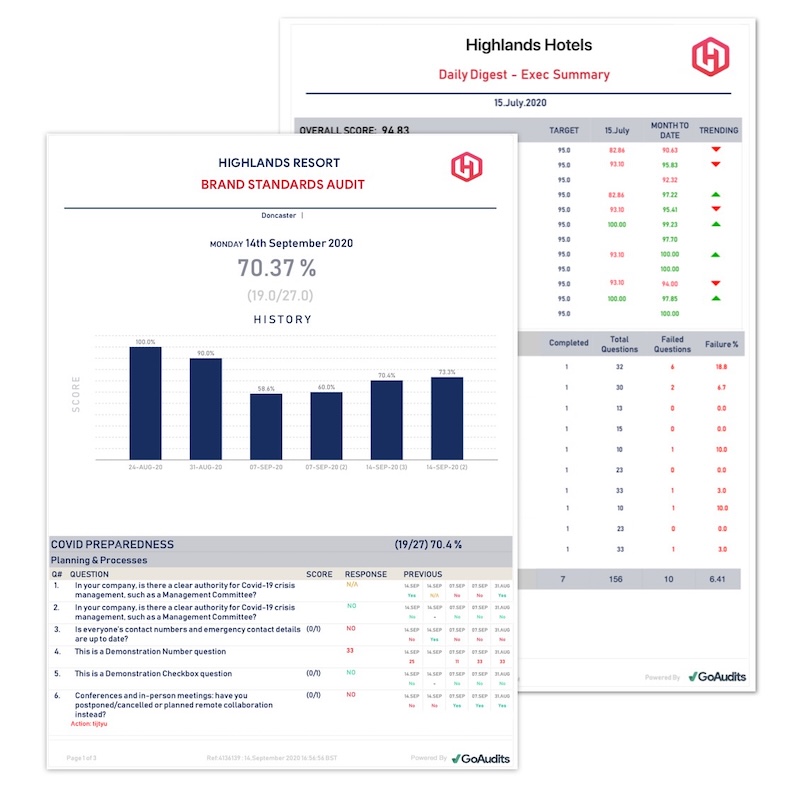
GoAudits handles the measurement and tracking layer automatically. Reports are generated in real time with automated scoring, shared instantly with the relevant teams, and stored in a structured format that makes trend analysis possible. You can choose Simple, Trends, or Summary report formats with customizable scoring by area or topic, and smart scoring tracks whether quality scores are improving or slipping across each audit.
This is how you spot the areas that need attention, act on them immediately, and move scores in the right direction over time.
For more on building a structured internal audit program, see How to track, measure & improve brand standards with a self-auditing app.
Internal Hotel Audit Checklists
External quality assessments happen once or twice a year. Day-to-day standards are maintained by your own teams running frequent internal audits across each area of operation. Below is a starting set of checklists hotels use to keep service consistent between external assessments:
Front office and guest journey
Housekeeping and rooms
- Hotel Housekeeping Checklists
- Hotel Room Cleaning Checklist
- Hotel Room Safety Checklist
- Turn Down Services Housekeeping
Food and beverage
Public areas and facilities
Guest experience and standards
- Guest Experience in Communal Areas
- Hotel Customer Satisfaction Survey Template
- Hotel Staff Grooming Checklist
Management oversight
Browse the full hotel audit checklist library for the complete set.
Frequently Asked Questions
Each standard in an LQA audit is scored as met, not met, or not applicable. Scores are aggregated to a percentage at the department, criterion, and overall hotel level. A passing score is typically above 95%. The report also includes qualitative written feedback and emotional engagement scoring on a five-level scale, which sit alongside the quantitative percentage.
An LQA audit typically takes one to three nights on site, depending on the size and complexity of the hotel.
LQA audits are conducted by LQA’s full-time consultants. Each consultant has a minimum of five years’ luxury hotel management experience before joining LQA and continues to operate as an anonymous guest on assignments. The assessor team represents 15 nationalities and averages eight years’ tenure with the company.
LQA recommends a minimum of two assessments per year. Hotels typically supplement these external audits with frequent internal inspections, either monthly or quarterly, to maintain standards between visits.
LQA is an independent assessment company focused exclusively on the luxury segment, evaluating over 1,000 standards with a strong emotional intelligence component. Forbes Travel Guide is the standards arm of the Forbes publication, awarding star ratings against 900 criteria. The two operate independently of one another. Many luxury hotels prepare for both. For more on Forbes specifically, see our guide to Forbes Travel Guide standards.
Yes. Luxury hotels typically use a hotel inspection app for internal audits between external LQA visits, covering brand standards, internal SOPs, and the operational areas LQA assesses, all in one checklist. The app does not replace the external LQA audit; it supports the internal audit program that keeps standards consistent year-round.
Yes. LQA operates exclusively in the luxury hospitality segment, working with individual luxury hotels, hotel groups (4–20 properties), and large hotel groups (21+ properties).