Key Takeaways
- An end-of-shift report is a structured record the outgoing shift leaves for the incoming one, covering what was completed, what is still open, any incidents or equipment faults, and what the next shift needs to act on first.
- Every end-of-shift report should carry six sections: shift details, work completed, open items, incidents, equipment status, and ranked priority actions.
- A shift report summarizes a shift. A shift handover transfers responsibility for it. They are related documents with different jobs.
- The section most shift report templates leave out is the one confirming that the incoming shift read the report and accepted what was in it.
- GoAudits turns end-of-shift checks into timestamped reports with photo evidence attached, so open items carry over to a named owner with a due date instead of a paragraph nobody reads.
An end-of-shift report tells the incoming team what happened on the shift before theirs: what got finished, what is still open, what broke, and what needs attention first. Most operations already produce one. The problem is what goes in it.
Hotel groups running 70 to 80 night shifts a night tell us their staff copy the previous night’s report forward and change the date, so a report exists for every shift, and almost none of it is true. The UK Health and Safety Executive records that many accidents have been caused by communication failure at shift handover, most of them during planned maintenance work.
Below you’ll find a free end-of-shift report template, two filled examples, the fields that change by industry, and the one handover step almost every template leaves out.
What is an End of Shift Report?
An end-of-shift report is a written summary of one complete shift, produced by the outgoing team and read by the incoming team, recording what happened, what remains open, and what needs attention next.
The outgoing shift supervisor, team lead, or duty manager writes it. In smaller operations, it falls to whoever closed the shift. Three groups read it, in this order: the incoming shift, who need it to start work; the site or operations manager, who reads it the next morning; and auditors or regulators, who read it only if something goes wrong and the report becomes evidence.
When Should You Write an End of Shift Report?
Write the end of shift report in the last 10 to 15 minutes of the shift, before the verbal changeover rather than after it.
A report written after the conversation records what two people remembered to discuss. A report written before it gives the conversation an agenda, and the gaps show up while both teams are still standing there.
Why Does an End of Shift Report Matter?
An end of shift report matters because responsibility for a site does not pause at a shift change, and the report is the mechanism that moves it from one team to the next.
Everything else the report does, from evidencing checks to feeding the morning meeting, is secondary to that transfer. When a report fails, what has actually failed is the handover of accountability, and the cost lands on whoever takes over.
What’s the Difference Between a Shift Report Form and a Shift Summary?
A shift report form is the blank structure you hand to supervisors, while the shift summary is the opening block of the completed report.
The completed version of the form is the report itself. The summary is the two or three sentences at the top that a manager reads if they read nothing else: how the shift went, and whether anything needs them. Teams looking for a shift summary report template usually want that block rather than a separate document.
How a Shift Report Differs From a Handover and a Shift Log
A shift report records what happened, a shift handover transfers responsibility for it, and a shift log captures events as they occur during the shift.
| Document | What it is | When it’s created | Who reads it | What it records |
| Shift report | A summary of one complete shift | In the last minutes of the shift | Incoming shift first, manager second | The whole shift, condensed |
| Shift handover | The act of transferring responsibility | At the changeover itself | Outgoing and incoming jointly | Confirmation that the next team has taken over |
| Shift log | A running record kept during the shift | Continuously, as events happen | Anyone on the unit, auditors later | Timestamped events in sequence |
| Shift passdown | US term for the handover note, common in manufacturing and maintenance | At the changeover | The incoming crew | Carry-over items and work in progress |
Most teams need two of these, not three. A shift log template plus a report covers almost every operation: the log catches detail in the moment, the report condenses it at the end. A separate shift change communication log template only earns its place where two teams work the same area inside one shift, such as operations and maintenance sharing a production line. In those cases, a shift turnover log template running alongside the report stops one team’s work from surprising the other.
What Should an End of Shift Report Include?
An end-of-shift report should include six sections: shift details, work completed, open items carried over, incidents and near misses, equipment and asset status, and priority actions for the next shift.
- Shift details. Date, shift, site or area, who worked it, and who is signing it off. Without this, the report cannot be traced to anyone, which makes it useless as evidence.
- Work completed. What was finished measured against what was planned. Output against target, rooms turned, checks signed, orders fulfilled. Raw volume tells the next shift nothing; the comparison tells them whether they are starting ahead or behind.
- Open items carried over. What was started and not finished, where exactly it stopped, and what the next shift needs to pick it up. “Batch 4417 unfinished” is not a handover. “Batch 4417 stopped at the seal station, 260 units staged” is.
- Incidents and near misses. What happened, who was told, and the reference number of the full incident report. The shift report flags the event. It does not replace the incident documentation.
- Equipment and asset status. Faults, downtime and its cause, isolations or lockouts still live, machines running outside spec, consumables below threshold. Anything left isolated at a changeover is a safety matter, not an admin one.
- Priority actions for the next shift. Ranked, each with an owner and a deadline. Three ranked actions beat ten unranked ones.
Section six is where reports fail. Buyers describe actions that live in the body of a report or an email thread with no owner and no expiry date, which one GoAudits customer called empty promises. The fix is structural rather than cultural: an action is not an action until a name and a date are attached to it, which is what corrective action software exists to enforce.

The supervisor version. Supervisor end-of-shift report examples add three things on top of the six sections: staffing and coverage for the shift, sign-off on actions the previous shift left open, and anything escalated above shift level. A supervisor is reporting on a team, not just a shift, so the report has to show whether the people as well as the work were covered.
Free End of Shift Report Template
Download this free shift report template PDF, with no sign-up.
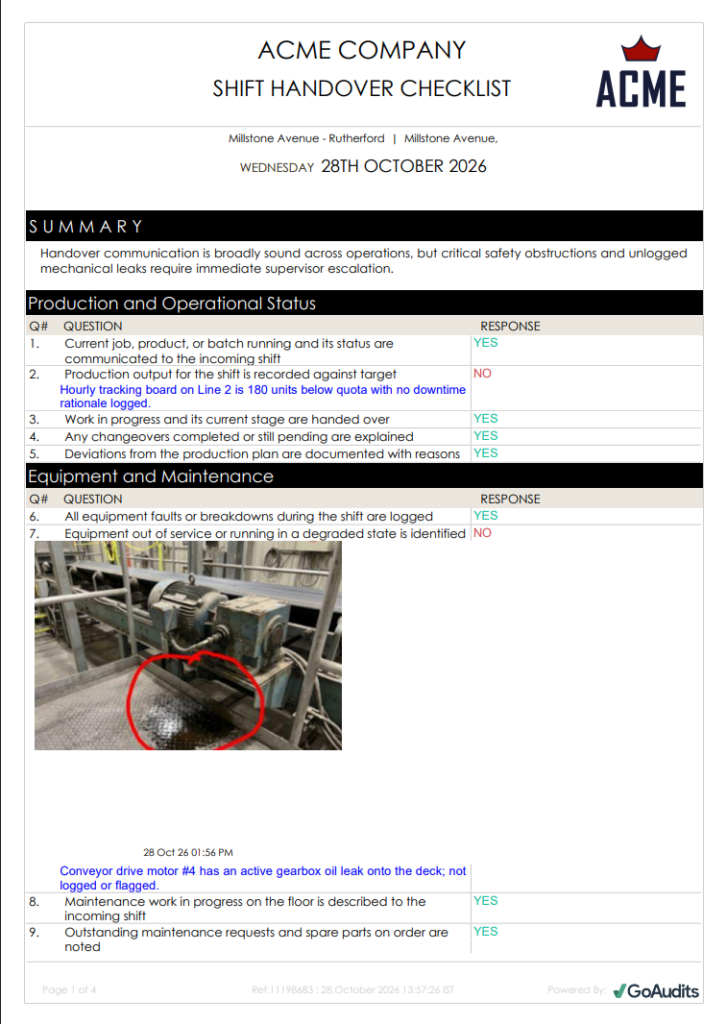
The PDF above is generated from a live Shift Handover Checklist in GoAudits. The same checklist runs on a phone at the end of a shift and produces the finished report automatically, with photos and timestamps already attached. Download the PDF and use it on paper, or run the checklist and let the report write itself.
Here are some end-of-shift report templates available in our library:
- Maintenance Shift Report Template
- Manufacturing End of Shift Report Template
- Restaurant End of Shift Report Template
- Hotel Shift Report Template

If you need a different structure, our inspection report template library covers the other report types teams run alongside this one.
The daily version. A daily shift report template runs the same structure on a 24-hour cycle rather than at every changeover. Single-shift operations use it as an end-of-day record. Three-shift sites run the full version per shift and roll all three into one daily summary for the morning management meeting.
End of Shift Report Sample for a Production Line
This end of shift report sample shows the template completed by a production supervisor for a night shift that finished behind target.
| Field | Entry |
| Shift details | Line 3, nights, 22:00 to 06:00, 4 operators, J. Okafor (supervisor) |
| Shift summary | Output 940 against a target of 1,200. Sealer fault from 02:40 cost roughly three hours. Line restarted at 05:20 at reduced speed. |
| Work completed | 940 units packed and palletized. All hourly QC checks signed. Changeover to SKU 22B completed at 23:40. |
| Open items carried over | Batch 4417 part-processed, stopped at the seal station, 260 units staged on the mezzanine. Needs re-seal before it can move to packing. |
| Incidents and near misses | None. One near miss logged at 01:15; operator slipped on coolant spill, NM-0914. |
| Equipment and asset status | Sealer head 2 fault; engineering informed at 02:40; machine still isolated at handover. Compressor running warm; monitor. |
| Priority actions for next shift | 1. Re-seal batch 4417 before 10:00 (A. Bell). 2. Chase engineering on sealer head 2 at shift start (shift lead). 3. Log compressor temp hourly (operator 3). |
The detail in the open items row is the whole point. A blank sample shift report cannot teach you how specific that line needs to be, and this is the row that costs money when it is vague. An example of shift report writing that says “sealer issue, see engineering” sends the next supervisor on a twenty-minute hunt before they can start work.
End of Shift Report Examples From a Hotel Front Desk
These end-of-shift report examples use the same six sections for an evening front desk shift, where the risk sits in unresolved guest issues rather than equipment.
| Field | Entry |
| Shift details | Front desk, evening, 15:00 to 23:00, 2 agents, M. Haines (duty manager) |
| Shift summary | 64 arrivals checked in, 3 late arrivals still expected. House at 91%. One unresolved complaint. |
| Work completed | Cash float reconciled and signed. Group block for Thursday pre-assigned. All departures posted. |
| Open items carried over | Room 412, guest complaint about noise, compensation agreed at one night’s rate but not yet applied to the folio. Guest departs Thursday. |
| Incidents and near misses | None. |
| Equipment and asset status | Key encoder 1 is intermittent, failing roughly one card in five. Reported to maintenance at 19:30; no response yet. |
| Priority actions for next shift | 1. Apply the 412 credit before the guest checks out (night audit). 2. Chase maintenance on key encoder at 07:00 (AM shift lead). 3. Pre-key the 3 late arrivals using encoder 2. |
Both reports run the same structure and carry their risk in different rows. The production report’s weight is in equipment status. The hotel report’s weight is in open items, because an unapplied credit becomes a complaint the moment the guest reaches the desk. Shift change report examples from any industry show the same pattern: the sections stay fixed, the weighting moves.
How Shift Reports Differ by Industry
The six sections hold in every industry. What changes is which section carries the risk, and therefore which one to check first when a report comes in thin.
| Industry | What the report must capture | Section carrying the risk |
| Manufacturing and production | Output against target, downtime and reason codes, scrap and rework, batches in progress | Equipment and asset status |
| Restaurants and food service | Till reconciliation, prep carried over, 86’d items, temperature log exceptions, open complaints | Open items carried over |
| Hotels | Occupancy, arrivals and departures pending, guest issues, out-of-order rooms | Open items carried over |
| Maintenance and facilities | Work order status, live isolations and permits, parts on order, equipment out of service | Equipment and asset status |
| Care | Checks completed per resident or unit, incidents, medication rounds, staffing cover | Incidents and near misses |
A few things worth knowing per sector:
- Manufacturing and production. Run a manufacturing shift report template per line, not per site, because a supervisor cannot speak for a line they did not watch. Build it from the Machine Operator Checklist and the Plant Manager Daily Checklist, or run the whole thing through manufacturing inspection software once the paper volume gets unmanageable. One prospect was running 1,516 paper check sheets, at which point pencil whipping is undetectable.
- Restaurants and food service. Separate prep carried over from prep wasted, because those two numbers drive different decisions the next morning. Add a line for 86’d items, the single most common thing that fails to reach the opening shift. The Restaurant Closing Checklist Template covers the task side.
- Hotels. Out-of-order rooms, guest issues mid-resolution, and arrivals still pending are what the next shift inherits. The Hotel Night Manager Checklist covers the overnight version, and the Hotel General Manager Handover Checklist the departmental one, both of which fold into a wider hotel audit program.
- Maintenance and facilities. Live isolations, permits still active, and jobs handed over mid-task are the lines that carry safety weight. See the Forklift Operator Shift Takeover Handover Checks for what a takeover check looks like at asset level, and facility maintenance software for keeping work orders and shift records in one place.
- Care. Incidents outrank everything, because one missed at handover becomes a safeguarding issue rather than an operational one. The Night Shift Audit covers overnight checks, and nursing home audit software keeps the record inspection-ready.
👉 Case study: Northern Healthcare
Northern Healthcare runs night shift checks across 15 locations and completed 46,000 audits in a single year, 150 to 200 of them daily, after moving off paper and spreadsheets onto GoAudits.
“This allowed us to reduce the time we spend on these checks, increase quality of care, and most importantly, reduce our response time if anything needs addressing,” says Danielle Ruane, Training, Compliance & IT Manager.
» Read Full Story: Northern Healthcare streamlines compliance checks with GoAudits.
What Goes in a Shift Handover Template?
A shift handover template covers the same ground as a shift report, plus one addition: a field confirming the incoming shift has read it, understood it, and accepted responsibility for what is in it.
The difference is in purpose. A report is written to be filed. A handover is written to be received. That distinction sounds academic until you look at what most templates actually capture.
Nearly every shift handover template available online ends at “Signed by [outgoing]”. That records who wrote the document, not who received it. An employee shift handover template should carry three sign-off fields instead of one: handed over by, received by, and questions raised. The third is the one that matters. If an incoming operator had no questions about a half-finished batch or an isolated machine, either the report was unusually good, or nobody read it.
A Simple Shift Handover Template for Daily Use
A simple shift handover template strips the full report to five fields, for teams changing shift two or three times a day who cannot spend fifteen minutes on paperwork each time.
The five fields that survive:
- Shift and people. Who is handing over, who is taking over, when.
- Carried over. Anything unfinished, with its exact stopping point.
- Live risks. Isolations, faults, permits, anything unsafe to touch without context.
- Top three actions. Ranked, with owners.
- Received by. Name, time, questions raised.
What gets cut is the summary narrative and the completed-work detail, both of which can be reconstructed from the system of record. What can never be cut is field three. A daily shift handover template that drops live risks to save time is not a shorter handover; it is an incomplete one, and the shift taking over has no way of knowing what it does not know.
The Three Parts of a Safe Shift Handover
HSE sets out three elements of effective handover: preparation by outgoing personnel, the handover itself where both parties exchange task-relevant information, and cross-checking by incoming personnel as they assume responsibility.
- Preparation. The outgoing shift writes the report before the conversation, not during it. The failure point is a report written from memory in the corridor, where whatever the supervisor forgot never existed.
- Handover. Both parties talk through the report, face to face, with both taking joint responsibility for the exchange. The failure point is a one-way briefing, with the incoming shift listening rather than interrogating.
- Cross-checking. The incoming shift verifies what they have been told before accepting the shift. The failure point is that nobody checks anything, and the first time an assumption gets tested is three hours into the shift.
Stage three is the one almost every template ignores and the one that turns a document into a transfer of responsibility. In GoAudits, the receiving signature is a required field, so a handover cannot be submitted as complete until someone has actually accepted it, and the timestamp on that signature is part of the audit trail.
Why Shift Reports Stop Getting Read
Shift reports fail for four reasons, and none of them is that the template was wrong.
- The copy-forward report. Yesterday’s text, re-dated, is common on night shifts where little changes are made, and nobody checks. Timestamped entries and required photo evidence make a duplicated report visible within seconds of it being submitted.
- The group chat is the record. Photos and updates go into WhatsApp because it is faster than filling in the form. The answer is not to ban the chat but to accept that speed was the real requirement, and make the structured version just as fast on a phone.
- Pencil whipping. Boxes get ticked without the check happening, and paper volume makes it almost undetectable. GPS and timestamped photos tie each entry to a specific place and moment, so an unperformed check stops looking like a performed one.
- The report nobody has time to read. Three pages at a changeover means the incoming shift skims the first paragraph and stops. Cutting it to one page and moving the top three actions above everything else fixes most of it.
Scale makes memory unreliable long before it makes process unreliable, and it does so at a smaller scale than most teams expect.
👉 Case Study: Noble House Hotels and Resorts
Noble House runs one audit program across 30 properties on GoAudits, after years of auditing every property on a single Excel sheet.
“If I or any of my counterparts visit 30 properties in a year, we’re not going to remember every single thing. It’s just not humanly possible,” says VP of Room Operations Steven Marais. Reports now generate from the walk-through itself, so the corporate team arrives already knowing how each property is tracking.
» Read Full Story: How Noble House Audits 30 Hotels For Multiple Brand Standards.
Should Shift Reports Be on Paper or Digital?
Paper works for a single-site, single-shift operation where the manager reads every report the next morning. The case for digital starts at the second shift or the second site, because that is where reports stop being read individually and start needing to be searched, compared, and trended.
Four things change when shift reports move off paper and spreadsheets:
- The report writes itself. Completing the check produces the report, so nothing is retyped after the shift ends. This is what inspection report software does at its most basic.
- Actions route to people. Instead of sitting in a paragraph, each action goes to a named owner with a due date and an escalation if it is missed.
- Evidence is captured at source. A photo taken at the machine is stronger than a description written twenty minutes later at a desk. A digital checklist app attaches it to the specific question rather than to the report as a whole.
- Patterns become visible. This is the part almost nobody does. Twenty shift reports in a drawer are twenty documents. Twenty in a system are a dataset showing that the same sealer has failed on four of the last nine night shifts, which is the difference between reacting and preventing. An inspection dashboard is where that comparison happens.
Heat Treating Services moved production checks across several facilities and shifts off paper entirely with GoAudits.
The operators are now able to take pictures of non-conformances, so the QA team sees the non-conformance as the operator does. This has helped with clarity and improved communication.
Katie Day, QA & Metallurgy Manager, HTS
How GoAudits Helps With Shift Reporting
GoAudits runs your existing end-of-shift and handover checks on a phone and turns each completed check into a finished report, so the record of a shift is a by-product of doing the shift rather than an extra task at the end of it.
- Reports generate on submission, with photos, scores, and timestamps already in place.
- Photo and GPS evidence on every entry, so copied or unperformed checks are visible rather than assumed.
- Actions with owners and due dates, and assignees can be added as free users.
- Offline capture on production floors, plant rooms, and overnight rounds, syncing when the device reconnects.
- Your checklists built for you, including paper forms, during onboarding.
With a rating of 4.8 stars on Capterra, GoAudits is trusted by some of the biggest names in the industry.
» GoAudits Reviews: Read how companies leverage GoAudits to meet standards in their operations and quality.
Frequently Asked Questions
One page. A shift report that cannot be read in under a minute at the start of a shift will not be read at all, and the sections at the bottom are the ones that get skipped. If a report runs longer than a page regularly, the detail belongs in a shift log, with the report carrying only what the next shift must act on.
The outgoing shift supervisor, team lead, or duty manager writes the end-of-shift report. In operations without a dedicated supervisor per shift, it falls to whoever closed the shift. The incoming shift is responsible for the other half: confirming they have read it and raising anything unclear before the outgoing team leaves.
Shift reports are not generally mandated by name in law, but in safety-critical and regulated operations the records they contain are expected evidence. HSE guidance treats shift handover as safety-critical communication and expects written as well as verbal handover, and inspectors in regulated sectors routinely ask to see shift-level records of checks, incidents, and equipment status.
A shift report summarizes a whole shift, while an incident report documents one event in detail. The shift report should flag that an incident occurred and reference the incident report number, not duplicate its contents. Keeping them separate matters because incident reports often have their own retention rules and reporting deadlines.
Yes, and standardizing on one is usually the right call for multi-site operations, because it makes reports comparable across locations. Keep the six core sections identical everywhere and allow site-specific items only within sections, so a regional manager reading five reports is reading the same structure five times rather than five different documents.
Yes, if the tool supports offline capture. Shift reports are often completed in plant rooms, basements, cold stores, and overnight rounds where signal is poor, so the ability to run offline inspections and sync later is a practical requirement rather than a nice-to-have. Paper never has this problem, which is one reason it persists in exactly those environments.