

Warehouse Safety Checklist Templates
Template Library > Safety Inspections > Warehouse Safety Checklist Templates
Run Consistent Safety Checks With Ready-to-Use Warehouse Safety Checklists
Warehouse safety checklist templates give inspectors a fixed set of checks to run across storage, handling, and movement areas, so nothing gets skipped between shifts or sites. Use them for routine floor checks, scheduled safety inspections, and getting ready for an external visit.
Use these templates to:
- Catch hazards before they cause an incident
- Apply the same standard across shifts, zones, and sites
- Score conditions the same way every time, so trends stay visible
- Leave a dated record of what was checked and by whom

With the GoAudits Safety Inspection App, you can:
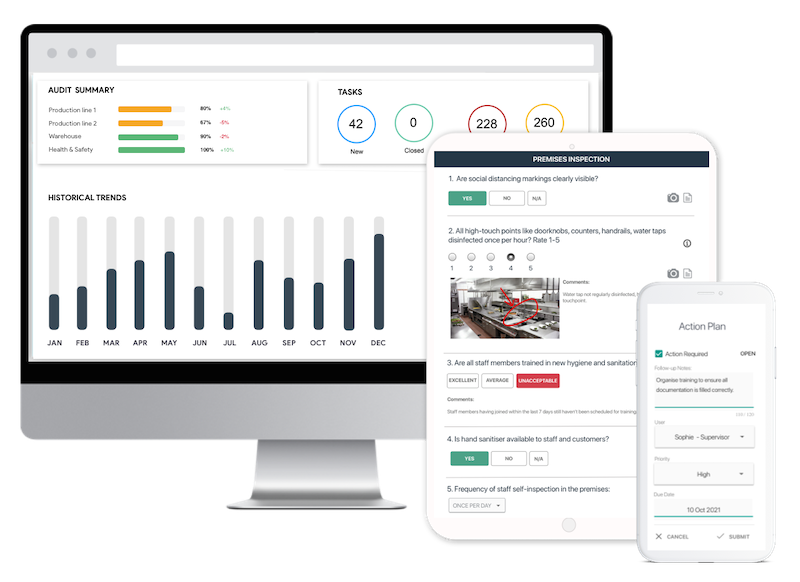
- Eliminate paperwork: conduct efficient digital audits, add photos from mobile device
- Customize this template or easily create your own
- Save time with instant reports & assign corrective actions
Emergency Evacuation
Electrical
Lighting And Passageways
Rubbish
Work Areas
Storage
Chemicals
First Aid
General Environment
Amenities
Emergency Evacuation
Electrical
Lighting And Passageways
Rubbish
Work Areas
Storage
Chemicals
First Aid
General Environment
Amenities
Save Time with Digital Inspections
- Easily capture & attach photos, directly on your mobile device.
- Instantly generate and share detailed reports after the inspection.
- Track corrective actions, view historical trends, improve standards.


What is a Warehouse Safety Checklist?
A warehouse safety checklist is a standardized list of safety conditions an inspector verifies on a warehouse floor. It covers storage and racking, material handling equipment, traffic routes, fire and emergency provision, electrical safety, chemical storage, PPE, signage, and housekeeping.
The reason to write it down is repeatability. Two inspectors working the same checklist on the same site should reach the same findings, which is what makes results comparable week to week and site to site.
A standardized checklist gives you:
- Hazards caught early, with a clear owner for each fix
- The same standard applied across shifts, zones, and sites
- A dated record of what was checked, by whom, and what was found

What Should a Warehouse Safety Checklist Include?
A warehouse safety checklist should cover ten areas: floors and walkways, racking and storage, material handling equipment, loading docks and traffic, fire and emergency provision, electrical safety, hazardous substances, PPE, signage, and training and supervision.
How Often Should a Warehouse Safety Checklist Be Completed?
Most warehouses run three tiers: a short check before each shift, a fuller weekly or monthly inspection, and an unscheduled check after any incident or layout change. OSHA sets no general frequency for warehouse safety inspections, so the schedule is yours to set. Forklifts are the exception.
OSHA requires every powered industrial truck to be examined before it is placed in service, at least daily, and after each shift where trucks run around the clock. If you run a 24-hour operation, that is a per-shift check rather than a daily one.
OSHA does not require you to document it. In two standard interpretation letters the agency confirmed that 1910.178(q)(7) mandates no written record and no particular checklist format. The examination is required; the paperwork is not. The distinction matters, because an inspector investigating an incident will still ask what evidence you have that the check happened.
Pre-Shift and Daily Checks
A daily check catches the conditions that change hour to hour: spills, blocked aisles, damaged pallets, a forklift with a hydraulic leak. Keep it to items an operator can verify in a few minutes before work starts. The warehouse safety walkthrough checklist is built for this.
Weekly and Monthly Inspections
Weekly and monthly checks cover what degrades slowly: racking uprights and load signage, floor surfaces, emergency lighting, extinguisher service dates, signage legibility. Racking is worth its own cycle, since damage accumulates from impacts that nobody reports.
Checks Triggered by an Event
Any incident, near miss, equipment failure, or racking impact should trigger a check before that area goes back into use. Layout changes count too. A new pick face or a re-routed forklift lane changes the traffic risk the last inspection assessed.
Key Areas Covered in a Warehouse Safety Audit Checklist
A warehouse safety audit checklist helps identify hazards across storage, handling, and movement areas. It ensures risks are controlled consistently and operations remain safe and compliant.
Floors, Aisles, and Walkways
- Spills, leaks, and slippery surfaces.
- Obstructions, loose materials, and trailing cables.
- Uneven flooring or damaged surfaces.
- Clear visibility, lighting, and marked walkways.
- Waste, packaging, and empty pallets cleared, following a warehouse cleaning checklist
Racking and Storage Systems
- Clearly displayed load limits.
- Damage, corrosion, or misalignment.
- Structural stability and secure fixing.
- Safe stacking practices, checked against a pallet racking inspection checklist.
Material Handling Equipment
- Forklifts, pallet jacks, and lifting aids in safe working order, verified with a forklift inspection template.
- Guarding and safety features on conveyors.
- Maintenance status and inspection records.
- Operator authorization and safe-use practices.
Loading Docks and Vehicle Movement
- Dock edges are protected with barriers or wheel chocks.
- Safe bay operations and traffic flow controls.
- Reversing procedures and spotter use where required.
- Warning signage and high-visibility markings.
Fire Safety and Emergency Preparedness
- Accessible and unobstructed emergency exits.
- Fire extinguishers are correctly placed and inspected.
- Functional alarms, detectors, and emergency lighting.
- Clearly marked evacuation routes and assembly points.
Electrical Safety
- Cables, plugs, and sockets are in good condition.
- Electrical panels are accessible and clearly labelled.
- No overloaded circuits or exposed wiring.
- Lockout and isolation procedures followed.
Hazardous Substances and Spill Control
- Proper storage and labelling of chemicals.
- Availability of spill kits and containment tools.
- Ventilation in areas handling hazardous materials.
- Staff trained in spill response procedures.
Personal Protective Equipment (PPE)
- Availability of required PPE for specific tasks.
- PPE is in good condition and correctly stored.
- Clear signage indicating mandatory PPE zones.
- Staff compliance with PPE requirements.
Signage, Markings, and Communication
- Safety signs are visible, legible, and up to date.
- Floor markings for pedestrian and vehicle routes.
- Warning labels on high-risk equipment and areas.
- Safety instructions are communicated clearly to workers.
Training, Behavior, and Supervision
- Workers trained for the tasks they perform, with 5S warehouse management habits reinforced on the floor.
- Safe manual handling practices followed.
- No unsafe shortcuts or rule bypassing observed.
- Adequate supervision in high-risk areas.
For a hazard-by-hazard view rather than an area-by-area one, use the warehouse hazards checklist, or read our warehouse safety tips for the practices behind each check.
How Often Should a Warehouse Safety Checklist Be Completed?
Most warehouses run three tiers: a short check before each shift, a fuller weekly or monthly inspection, and an unscheduled check after any incident or layout change. OSHA sets no general frequency for warehouse safety inspections, so the schedule is yours to set. Forklifts are the exception.
OSHA requires every powered industrial truck to be examined before it is placed in service, at least daily, and after each shift where trucks run around the clock. If you run a 24-hour operation, that is a per-shift check rather than a daily one.
OSHA does not require you to document it. In two standard interpretation letters the agency confirmed that 1910.178(q)(7) mandates no written record and no particular checklist format. The examination is required; the paperwork is not. The distinction matters, because an inspector investigating an incident will still ask what evidence you have that the check happened.
Pre-Shift and Daily Checks
A daily check catches the conditions that change hour to hour: spills, blocked aisles, damaged pallets, a forklift with a hydraulic leak. Keep it to items an operator can verify in a few minutes before work starts. The warehouse safety walkthrough checklist is built for this.
Weekly and Monthly Inspections
Weekly and monthly checks cover what degrades slowly: racking uprights and load signage, floor surfaces, emergency lighting, extinguisher service dates, signage legibility. Racking is worth its own cycle, since damage accumulates from impacts that nobody reports.
Checks Triggered by an Event
Any incident, near miss, equipment failure, or racking impact should trigger a check before that area goes back into use. Layout changes count too. A new pick face or a re-routed forklift lane changes the traffic risk the last inspection assessed.

👉 Beyond the floor walk: floor-level hazards show up on any walk of the site. Gaps in training records, contractor sign-in, and hazard reporting do not. The warehouse health and safety checklist covers those systems-level checks and suits a quarterly cycle.
How Warehouse Safety Checklists Support Compliance
A warehouse safety checklist turns scattered judgment calls into a documented, repeatable check. That matters most when someone external asks what you inspected and when.
OSHA Warehouse Requirements
OSHA publishes no single warehouse standard. Warehouse checks draw on several general industry standards, and knowing which is which makes an inspection defensible:
- 1910.176 covers aisle clearance, secure stacking, and housekeeping in storage areas
- 1910.178 covers forklift condition, operator training, and examination before use
- 1910.36 and 1910.37 cover exit routes: unobstructed, marked, and adequately lit
- 1910.132 covers PPE hazard assessment, provision, and correct use
- 1910.157(e) covers portable fire extinguishers: monthly visual inspection and an annual maintenance check with the date recorded
Warehouses are also under active enforcement focus. OSHA runs a National Emphasis Program on Warehousing and Distribution Center Operations, first issued in July 2023 and reissued in July 2026, with inspections beginning October 2023. OSHA reports that in the program’s first 18 months it identified more than 1,700 violations and removed roughly 37,410 workers from hazards. If you operate US sites, a programmed inspection is a realistic prospect rather than a remote one.
The OSHA warehouse safety checklist maps to these standards directly.
UK HSE Requirements
In the UK the duties sit in the Health and Safety at Work etc. Act 1974 and the regulations made under it, notably the Management of Health and Safety at Work Regulations 1999, which require employers to assess risks and review those assessments. The Health and Safety Executive enforces those rules rather than writing them. A checklist supports the duty by:
- Recording routine checks of floors, racking, fire exits, and equipment
- Surfacing hazards before they escalate into incidents
- Providing written evidence that risks are being managed actively
ISO 45001 Standards
ISO 45001 asks for a working occupational health and safety management system, not a one-off assessment. Warehouse safety checklists support certification by evidencing hazard identification, worker involvement in observations, and a traceable inspection history for internal and external audit.
Which File Formats Are These Warehouse Safety Checklists Available In?
Every checklist here is available as a free PDF and as a digital template you run in the GoAudits app. Completed inspections export as PDF reports or as Excel for analysis.
Which format you want depends on what happens after the inspection.
- PDF suits a fixed, printable copy: an audit pack, a contractor briefing, a clipboard check at the dock.
- Excel suits pivoting findings across sites or feeding an existing safety dashboard.
- The app suits inspections where the record matters as much as the check.
That last one is the difference worth understanding. A printed warehouse safety checklist template tells you what to look at. It will not timestamp the check, hold the photo of the damaged upright against the item that failed, assign the repair to the maintenance lead with a due date, or show you that the same aisle has failed four weeks running. Those come from completing the checklist digitally, which is why most multi-site teams use the PDF to agree the standard and the app to run against it.
👉 Evidence, not just checks: an inspection is only useful if someone can see what it found. GoAudits inspection report software generates the report the moment a checklist is submitted, with photos and scores attached to each item that failed.
How GoAudits Helps With Warehouse Safety Inspections
Built for EHS and operations teams running the same safety checks across shifts, zones, and multiple distribution centers.
- Score sections separately, so racking, traffic, and housekeeping trend on their own instead of averaging into one number that hides the problem
- Attach timestamped photo evidence against the specific item that failed, so a repair can be verified rather than just reported
- Assign corrective actions to named owners with due dates, and see what is still open across every site from one dashboard
- Work offline in racking aisles and cold storage where signal drops, syncing when the device reconnects
- Schedule daily, weekly, and post-incident inspections from the same template, so cadence is enforced rather than remembered
Frequently Asked Questions
Are These Warehouse Safety Checklists Available in Other Languages?
Yes. Checklists in GoAudits can be built or translated into other languages, and teams commonly run the same warehouse safety checklist in English alongside Spanish, French, or Italian. Each language version keeps the same structure and scoring, so results from different sites stay comparable in one dashboard.
What Is the Difference Between a Warehouse Safety Checklist and a Risk Assessment?
A warehouse safety checklist records whether specific conditions are acceptable on the day it is completed. A warehouse risk assessment is a broader exercise that identifies hazards, judges likelihood and severity, and sets the controls. The checklist verifies that those controls are still in place, which is why most sites keep both and review the risk assessment far less often.
Who Should Complete a Warehouse Safety Checklist?
Whoever can act on what they find. Pre-shift checks usually sit with supervisors or team leads, weekly and monthly inspections with the EHS officer or safety representative, and racking or equipment checks with maintenance. Assigning each tier to a named role is what stops findings going unclaimed, and it belongs in your warehouse SOPs.
Is There a Warehouse Safety Checklist for Chemical or Hazardous Goods Storage?
Yes. A chemical warehouse safety checklist adds checks on segregation of incompatible substances, secondary containment, ventilation, spill kit placement, and safety data sheet availability at the point of storage. Start from the general checklist and add those sections rather than replacing it.
Can the Same Warehouse Safety Checklist Be Used Across Multiple Sites?
Yes, and it is the main reason to standardize one. Running an identical checklist at every site makes scores comparable, so you can see which distribution center is drifting and on which section. Site-specific items can be added as an appended section without changing the shared core.

Other Popular Warehouse Checklists:

Digitize your Safety Inspections
- Easily perform audits anywhere on the site using a mobile device, even offline
- Attach photos to document issues or prove compliance
- Assign tasks, set deadlines and track progress - all within a single app
- Analyze data from audits to identify trends, pinpoint recurring issues, and assess compliance levels.