

Key Takeaways
- Implementing 5S creates a clean, organized warehouse that maximizes storage space, improves safety, and significantly speeds up picking operations.
- Most lean initiatives fail during the “Sustain” phase because maintaining consistent standards is difficult without clear accountability and regular oversight.
- Warehouse audit software digitize the process, replacing manual paperwork with automated checklists and instant reporting to ensure 5S standards never slip.
Managing the daily flow of goods while maximizing space, safety, and productivity is challenging for warehouses. By implementing the 5S warehouse management principles, businesses can convert cluttered, disorganized spaces into streamlined, safe, and highly functional environments.
Read on to discover the 5S warehousing principles, their benefits, and the steps to implement them. Furthermore, learn how software can streamline the 5S procedures in a warehouse.
- 5S Meaning in Warehouse: What is 5S in a Warehouse?
- What are the Principles of 5S Warehousing?
- Free 5S Checklist for Your Warehouse
- How to 5S a Warehouse: Implementing 5S in Warehouse Operations
- What 5S Looks Like Before and After in a Warehouse
- Implement 5S Principles in Your Warehouse With GoAudits
- FAQs
5S Meaning in Warehouse: What is 5S in a Warehouse?
5S warehouse is a lean management technique applied to improve organization, efficiency, and standardization in a workplace. It is based on the Japanese lean principles implemented to achieve a clean and efficient warehouse.
The 5 principles of 5S lean warehousing are:
- Sort (Seiri)
- Set in Order (Seiton)
- Shine (Seiso)
- Standardize (Seiketsu)
- Sustain (Shitsuke)
How 5S relates to Lean and Kaizen. 5S is often the entry point to lean warehousing rather than the whole of it. Lean addresses waste across the entire operation- travel, waiting, defects, excess inventory- while 5S concentrates on the workspace itself. Kaizen is the continuous improvement culture that keeps both alive after the initial project ends. Most warehouses start with 5S because it produces visible results quickly, then extend into lean warehousing and Kaizen once the habit holds.
We will review each of these 5 principles in more detail below.
5S principles allow warehouses to manage operations in such a way that they can do more using fewer resources. Furthermore, by achieving a cleaner and more efficient workplace, 5S in the warehouse allows staff to identify and address problems promptly.

Benefits of Adapting the 5S Methodology in Warehouse Management
Implementing the 5S methodology for lean warehouse management offers numerous benefits that can improve overall operations.
- Improved Safety: Warehouses are one of the most dangerous places to work. By maintaining a clean work environment and getting rid of potential hazards, the 5S warehouse system significantly reduces the chances of accidents and injuries.
- Enhanced Efficiency: 5S in warehouse management streamlines the workflow by ensuring all necessary materials, tools, supplies, machines, etc., are placed in easily visible and designated locations. This quickens access to required materials/tools, resulting in more efficient warehouse operations.
- Better Space Utilization: Every square foot in a warehouse has a cost. By implementing 5S warehouse principles, you can remove unnecessary materials and stockpiles, which leads to increased storage capacity within the existing infrastructure and eliminates the need for costly expansions.
- Reduced Costs: A streamlined and efficient workspace leads to reduced wastage of resources and time. It ensures unnecessary steps are eliminated and everything gets completed with precision, leading to significant savings over time.
- Consistency in Quality: 5S warehousing standardizes processes, which reduces variations and mistakes, helping warehouses deliver consistent quality output.
Case Study: How Miniclipper Logistics achieves high standards using warehouse audit software and checklists.
5S in Inventory & Store Management
Applying 5S in store management and material management is critical for high-turnover environments. By focusing on the store department, you ensure that raw materials and finished goods are never “lost” in the system.
Effective 5S inventory management involves:
- Visual Cues: Using color-coded bins for different material types.
- Inventory Accuracy: Implementing 5S in stores reduces the “search time” for pickers, which directly lowers labor costs.
- Stock Rotation: Ensuring that the “Shine” and “Sort” steps account for expiration dates and FIFO (First-In, First-Out) protocols.
A 5S store system works slightly differently from 5S on the warehouse floor. Store departments handle high-frequency, low-volume movements, so the cost of a misplaced item is measured in search time rather than storage space.
- Sort: identify obsolete, damaged, and duplicate stock. Most store departments carry items nobody has requisitioned in years.
- Set in order: every SKU gets one location, labelled, with the fastest-moving items nearest the issue point.
- Shine: clean shelving and bins reveal leaks, pest activity, and damaged packaging early.
- Standardize: fixed minimum and maximum levels, with a documented replenishment trigger rather than someone noticing a bin is empty.
- Sustain: cycle counts on a schedule, not when a discrepancy forces one.
This applies at any scale. Whether it is a 100,000 square foot distribution centre or a maintenance parts cage, the principles hold.
What are the Principles of 5S Warehousing?
5S principles can be applied to any type of operation (manufacturing, retail, distribution, etc.). Let’s see how it can be applied in a warehouse setting:
1. Sort
Sorting is the process of identifying necessary items and getting rid of things you don’t need. This warehouse sort/segregate phase is the first step in any warehouse organization with 5S. Some common examples of sorting in a warehouse include:
- Removing broken equipment, outdated products, boxes with old branding, or obsolete forms that workers do not need to fill out.
- Completing red/green tagging of things in the warehouse. This is the process where you go around putting green stickers on items that are used frequently and red stickers on materials that you no longer use.
Such strategies help access materials quickly, reduce the chances of getting distracted by unnecessary items, and increase the amount of available space in the warehouse.
2. Straighten
This is the practice of ensuring that everything is arranged in a logical and accessible fashion. A core part of this step is optimizing your 5S warehouse layout. If you are looking for how to organize a warehouse efficiently, start by mapping your “Golden Zone,” the area between a worker’s shoulders and knees, for your fastest-moving SKUs.
Some examples of 5S warehouse ideas for straightening:
- Assigning a fixed quantity of materials. For example, having space for only 6 rolls of tape, instead of 12. It also includes a replenishing strategy, i.e., having a system in place when workers are on their last roll of tape.
- Storing heavy items closer to the floor to avoid lifting them, or placing frequently used items at shoulder level- an ergonomic practice for safe storage.
This 5S warehouse principle ensures that workers do their work without excessive movements while maintaining good material storage.
Designing a 5S warehouse layout. Straighten is where layout decisions get made, and they compound. Map your fastest-moving SKUs into the Golden Zone (between shoulder and knee height) to cut travel time and reduce manual-handling risk.
Group by velocity using ABC analysis rather than by product family. Keep pedestrian routes physically separated from vehicle lanes, not just marked with paint. And leave the layout deliberately reviewable; warehouse organization with 5S is not a one-time project, since SKU velocity shifts seasonally.

3. Shine
As the name suggests, this component of the 5S system in a warehouse ensures the work area is free of debris, garbage, and dirt, facilitating easy identification of problems. Some common 5S warehouse examples of shine in a warehouse include:
- Keeping all the warehouse machines clean to prevent potential downtime caused by mechanical failures.
- Regularly dusting and cleaning the storage shelves and bins to avoid contamination of products and ensure that any spills or damages are promptly addressed.
Warehouse Housekeeping Checklist: Utilize this checklist to ensure cleanliness and safety standards in your warehouse.
4. Standardize
At this step, the warehouse management ensures they standardize all the improvements made throughout the 5S process. Managers can use methods like creating warehouse SOPs to implement standardization.
A good example is implementing visual management techniques, such as including pictures of what the workplace should look like towards the end of the day, or acceptable or unacceptable work.
The ultimate goal of this step of the 5S system in warehouse management is to maintain a consistent level of operation and identify and address any variance from the “normal” immediately.
Warehouse Checklists: Discover our library of free warehouse checklists.
5. Sustain
As the name suggests, this 5S methodology in warehouse management is about implementing habits and behaviors that help sustain the established standards.
Regular audits with elements of corrective action and root cause analysis, identifying newer avenues of continuous improvement, and leadership’s commitment to sustaining the 5S warehouse program are some of the strategies for sustaining.
5S and Warehouse Safety
Safety is not a separate exercise from 5S; each of the five steps removes a specific category of hazard.
- Sort removes the obstructions that cause most slips, trips, and falls: obsolete stock in walkways, broken pallets, and redundant equipment blocking access to extinguishers or exits.
- Set in order creates the marked pedestrian routes, defined forklift lanes, and clear aisle widths that prevent the struck-by incidents responsible for most serious warehouse injuries.
- Shine surfaces problems while they are still small: a hydraulic leak under a forklift, a cracked racking upright, a frayed cable. Dirt hides deterioration.
- Standardize turns safe practice into the default rather than something that depends on who is on shift.
- Sustain is what stops standards decaying between audits, which is where most safety programmes actually fail.
The sixth S. Many warehouses formalise this by adding Safety as a sixth step, calling it 6S or 5S+1. In practice, this means PPE requirements written into the standard, reflective tape on docks and vehicle routes, hazard identification built into the audit, and safe equipment operation verified rather than assumed.
This matters beyond good practice. OSHA renewed its National Emphasis Program for warehousing in August 2026, extending it to five years, and two of its seven inspection priorities are walking-working surfaces and means of egress. Both are direct outputs of Sort and Set in order, so a warehouse running 5S properly is already addressing what an inspector will look at first.
Reducing warehouse hazards with 5S works because it addresses causes rather than symptoms. A cluttered aisle is not just untidy; it is the reason someone walks into a forklift lane.
Warehouse Safety Checklist: free warehouse safety inspection checklist. See also our guides to 6S lean audits and warehouse safety.
The Role of 5S in Logistics and Supply Chain Management
The impact of these principles isn’t limited to the four walls of your building; it is a foundational pillar of 5S in supply chain management. By standardizing 5S in logistics, you can ensure that the transition of goods from the store department to the loading dock is seamless.
5S principles in logistics help in:
- Faster Turnaround: Reducing the time trucks spend at the loading dock.
- Better Documentation: Applying 5S for store management to the paperwork and digital files involved in shipping.
- Hazard Reduction: Reducing warehouse hazards with 5S ensures that the logistics chain isn’t interrupted by preventable workplace accidents.
Free 5S Checklist for Your Warehouse
Here’s a free 5S warehouse checklist to help you get started. Click the checklist below to start using it as it is, or customize it with a GoAudits 14-day free trial.
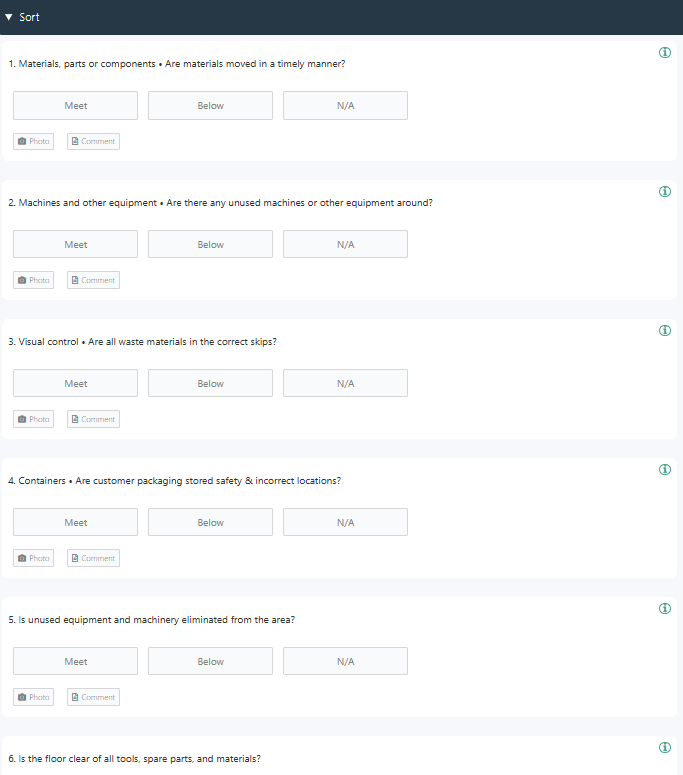
This checklist is for running 5S in your warehouse day to day. If you are looking specifically for a 5S audit checklist, with scoring, rating scales, and audit frequency guidance, see our dedicated guide to 5S audits.
How to 5S a Warehouse: Implementing 5S in Warehouse Operations
Enforcing 5S in a warehouse can be daunting, as it may involve potentially large changes. Here are the 5S implementation steps to help you get started.
Assessment
Conduct an initial warehouse audit to pinpoint areas that require improvement. Evaluate the current layout, inventory organization, and safety protocols. Identify cluttered zones, inefficient workflows, and potential hazards. Engage with staff to gather insights on operational challenges, ensuring a comprehensive understanding of the warehouse’s needs.
👉 Useful Resources: Free 5S Audit Checklist Templates
Here are free 5S audit and inspection checklists to help you get started:
→ 5S Audit Template
→ 5S Warehouse Checklist
→ 6S Audit Checklist
» Use These Checklists: Sign up for our 14-day free trial to have these checklists customized.
Create a Detailed 5S Warehouse Management Plan
Define the objectives of implementing 5S methodology in warehouse management, such as enhancing efficiency and safety. Outline specific steps for each of the principles, along with a timeline for 5S implementation in the warehouse. Create a clear roadmap that details the phases of the project and includes checklists for each stage to guide progress.
Training
Implement a training program for staff focused on 5S principles. Clearly articulate the ultimate goal of improving efficiency and safety within the warehouse. Use real-world examples to illustrate how 5S can streamline processes and foster a more organized and productive work environment.
Many warehouses build a 5S training deck for onboarding, using their own before-and-after photographs rather than stock imagery. The checklist above works as the practical companion to that: staff learn the principle in the session, then apply it against the same checklist on shift.
Implement 5S Ideas for Your Warehouse
Begin to implement the plan, starting with small, manageable changes. Incorporate visual cues such as labeling shelves and color coding items to enhance organization and accessibility. Encourage staff to provide regular feedback on the changes made, allowing for continuous updates and refinements to the processes.
Pro-Tips: How to Organize a Warehouse Inventory
If you’re struggling with warehouse organization, follow these best practices:
- Group by Velocity: Use ABC analysis to place “A” items (high-frequency) in the most accessible spots.
- Vertical Thinking: Use warehouse organization ideas like mezzanine flooring or high-reach racking to maximize your footprint.
- The ‘Daily 5S’ Rule: Use a daily 5S checklist staff to ensure that “Sort” and “Shine” happen every single shift, not just once a month.
Standardize
After implementing changes and gathering feedback, develop SOPs for 5S standards in the warehouse. Create comprehensive training materials for new employees to ensure they understand the established standards and know how to maintain consistency in applying 5S principles throughout their work.
Learn More: How to develop and implement warehouse SOPs?
Conduct Regular Audits
Establish a schedule for regular warehouse audits and inspections to evaluate adherence to 5S practices and identify opportunities for continuous improvement. These audits will help ensure standards are consistently met, and the warehouse environment remains organized, efficient, and safe over time.
What 5S Looks Like Before and After in a Warehouse
A useful way to brief staff is to show the contrast directly:
| Factors | Before 5S | After 5S |
|---|---|---|
| Aisles | Partially blocked by pallets and returns | Clear, marked, minimum width maintained |
| Tools | Searched for each shift | One labelled location, shadow boards |
| Stock | Obsolete items occupying prime locations | Red-tagged and removed, space reclaimed |
| Cleaning | Reactive, when it looks bad | Scheduled, with a named owner per zone |
| Standards | Vary by shift and supervisor | Documented, visual, audited |
Photographing your own before-and-after is more persuasive than any generic example, and it gives you the visual standard that the Standardize step depends on.
Implement 5S Principles in Your Warehouse With GoAudits
GoAudits is a digital tool designed to boost efficiency, productivity, and safety in warehouses. The platform has features that directly support the 5S principles that enable warehouses to create safe and clean working spaces while maximizing their bottom line.
Some of the ways to use GoAudits for applying 5S in warehousing include:
- Create custom checklists to standardize warehousing procedures
- Build workflows for consistent and efficient operations
- Train your staff on the 5S concept of warehousing and its applications
- Perform efficient 5S audits using the GoAudits mobile app
- Report inefficiencies and initiate their resolution within the app
- Analyze data on safety and efficiency to identify areas of improvement
With a rating of 4.8 stars on Capterra, GoAudits is trusted by leading names in manufacturing, retail, and logistics for their warehouse operations.
» GoAudits Reviews: Read how companies leverage GoAudits to meet standards in their warehouse operations.
FAQs
While all are vital, “Sustain” is often considered the hardest. Without a 5S audit checklist for the warehouse, most organizations slip back into old habits within 3 months.
5S in stores and inventory management reduces “dead stock” by identifying obsolete items during the “Sort” phase and ensuring that every item has a dedicated, labeled home.
Absolutely. 5S in store management is scale-agnostic. Whether it’s a 100,000 sq. ft. facility or a small parts closet, the 5s principles remain the same: simplify, organize, and maintain.
A comprehensive 5S audit warehouse tool should check for floor cleanliness, labeled aisles, updated SOPs, and the removal of “red-tagged” items.
The 5S checklist for warehousing provides a structured approach to organizing and maintaining a warehouse for increased productivity, safety, and efficiency. It includes five key steps: Sort, Set in order, Shine, Standardize, and Sustain.
4S in warehouse management refers to a simplified version of the 5S methodology, focusing on four principles: Sort, Set in order, Shine, and Standardize.
In warehouse management, 6S lean builds on the 5S methodology by adding Safety to the process, focusing on creating a secure work environment. This includes hazard identification, PPE use, and safe equipment operation, enhancing both productivity and worker protection.

