Key Takeaways
- A warehouse SOP documents how one specific task is performed, step by step, so it happens the same way regardless of shift, site, or who is doing it.
- Every SOP follows the same structure: purpose, scope, responsibilities, definitions, equipment, numbered procedure, verification, exceptions, and revision history.
- Most warehouses need 15 to 40 SOPs covering receiving, putaway, picking, packing, dispatch, cycle counting, stock adjustments, returns, equipment checks, and safety.
- Review SOPs annually as a minimum, and immediately after any layout change, new equipment, WMS change, or recurring error the current SOP failed to prevent.
- GoAudits turns warehouse SOPs into digital checklists your team completes on the floor, with photo evidence, timestamps, and an audit trail.
Do you find yourself overwhelmed by the complexity of your warehouse operations? What if you had a detailed roadmap that guides every operation, ensuring that tasks are performed efficiently, safely, and consistently
Warehouse standard operating procedures (SOPs) are essential documents for warehouse managers and employees to bring order and clarity to daily operations. This means fewer errors, faster turnaround times, and a more organized work environment. As for the staff directly working on the warehouse floor, warehouse SOPs eliminate guesswork and ensure uniformity in how each task is executed.
Let’s find out how warehouse SOPs streamline processes, improve safety, and ensure consistency across all operations in your warehouse.
- What are Warehouse Standard Operating Procedures (SOPs)?
- Types of Warehouse Standard Operating Procedures
- What Does a Warehouse SOP Template Look Like?
- Free Warehouse SOP Template PDF
- What are the Steps to Develop and Implement Warehouse SOPs?
- Leverage GoAudits for Warehouse SOP Management
- Download FREE & Customizable Warehouse Checklists
What are Warehouse Standard Operating Procedures (SOPs)?
Warehouse Standard Operating Procedures (SOPs) are written documents setting out exactly how a specific warehouse task should be performed, step by step, so that every employee does it the same way regardless of shift, site, or experience level.
The same principles apply across logistics and supply chain operations more broadly: an SOP in logistics documents how a repeatable process is carried out, whether that process sits in a warehouse, a distribution centre, or a transport operation.
Warehouse SOPs are formalized guidelines that outline how specific operations should be carried out. They provide a step-by-step approach to tasks such as inventory management, order fulfillment, and safety checks, ensuring that every employee follows the same procedures. The primary purpose of these SOPs is to minimize errors, improve efficiency, and maintain consistently high-quality standards across all warehouse operations.
Warehouse Policies vs Procedures vs SOPs
These three terms get used interchangeably, but they sit at different levels, and confusing them is why some warehouse documentation ends up unusable.
- Policy. States what your organisation requires and why. “All inbound deliveries must be inspected before acceptance.” A policy sets the rule; it does not explain how to follow it.
- Procedure. Describes the process at a high level, usually across roles or departments. “Inbound goods are checked against the purchase order, discrepancies are logged, and accepted stock is put away within 24 hours.”
- SOP. Gives the step-by-step detail for one specific task within that procedure, written for the person doing it. “Scan the ASN barcode, compare pallet count to the manifest, photograph any damage before unloading.”
A complete warehouse policies and procedures manual usually contains all three: policies setting the rules, procedures describing the flow, and SOPs covering individual tasks. If your documentation stops at the policy level, staff know what is expected but not how to do it, which is the most common reason SOP programmes fail to change anything on the floor.
What are the Benefits of Warehouse Standard Operating Procedures?
Warehouse SOPs offer numerous benefits that enhance efficiency, safety, and overall operational effectiveness. Here are the key advantages:
- They streamline warehouse processes by providing clear, step-by-step instructions, reducing guesswork and minimizing workflow interruptions.
- By standardizing tasks, SOPs for warehouse operations ensure that all employees perform their tasks uniformly, leading to consistent results and dependable service delivery.
- Comprehensive warehouse SOPs include safety protocols that help prevent accidents and injuries.
- Well-documented procedures assist in meeting industry regulations and standards, simplifying audits and inspections.
- By minimizing errors and inefficiencies, warehouse SOPs contribute to cost savings through optimized resource utilization and decreased waste.
- Warehouse SOPs are valuable training tools, helping new employees understand their responsibilities and perform tasks correctly from the outset.
- SOPs for warehouse inventory management help maintain accurate stock levels, reduce discrepancies, and improve order fulfillment accuracy.
- Regularly reviewed and updated warehouse SOPs encourage ongoing assessment and refinement of warehouse processes, leading to continuous operational enhancements.
- They allow tasks to be delegated confidently, ensuring that operations continue smoothly even in the absence of key personnel.
- Consistent and efficient warehouse operations lead to timely and accurate order fulfillment, enhancing customer trust and satisfaction.

Types of Warehouse Standard Operating Procedures
Here, we’ll explore different types of warehouse SOPs, including those for inventory management, receiving, picking, packing, and dispatch, as well as overall warehouse operations.
SOP for Warehouse Inventory Management
Effective inventory management is the backbone of warehouse operations. An SOP for inventory management typically includes procedures for inventory tracking, stock audits, and maintaining accurate records. It outlines the methods for receiving, storing, and issuing inventory, ensuring that stock levels are optimized to meet demand without overstocking or understocking. The SOP for warehouse inventory management also covers procedures for handling discrepancies, managing returns, and conducting regular physical inventories to verify accuracy.
An inventory control SOP programme usually breaks into several separate documents rather than one:
- Receiving and putaway, covering how stock enters the system and reaches its location
- Cycle counting, covering recurring partial counts
- Full physical inventory, covering the annual or biannual complete count
- Stock adjustments, covering who can authorise a change to system quantities and what evidence is required
- Damaged and obsolete stock, covering quarantine, write-off, and disposal
- Returns processing, covering inspection and disposition of returned goods
Splitting them this way keeps each SOP short enough to actually follow, and means updating one process does not require reissuing a single large document.
Warehouse Receiving SOP – Inbound
The warehouse receiving SOP focuses on the inbound process, detailing how to handle incoming shipments efficiently. This SOP includes steps for inspecting and verifying the received goods against purchase orders, documenting any discrepancies or damages, and updating the warehouse management system (WMS). The warehouse receiving SOP also outlines the proper procedures for unloading, unpacking, and storing items in designated locations within the warehouse.
👉 Use the GoAudits warehouse receiving process checklist to evaluate incoming goods, enhance accuracy, and ensure operational efficiency in your warehouse.
SOPs for Picking, Packing, and Dispatch – Outbound
The picking, packing, and dispatch SOPs are crucial for managing the outbound process in a warehouse. The SOP for receiving goods in a warehouse provides detailed instructions for order fulfillment, starting from picking items based on customer orders to packing them securely and dispatching them for delivery.
The warehouse picking SOP ensures that the correct items are selected and prepared for packing. The packing SOP includes guidelines for packaging materials, labeling, and quality checks to prevent shipping errors. Finally, the dispatch SOP outlines the steps for coordinating with logistics partners, generating shipping documentation, and updating the WMS to reflect the shipment status.
SOPs for Warehouse Operations
The SOP for warehouse operations includes a wide range of activities aimed at maintaining overall efficiency and safety. They cover areas such as waste control, quality assurance, and continuous improvement. They include procedures for maintaining cleanliness, ensuring safety protocols are followed, managing equipment and machinery, and conducting regular safety drills. Additionally, the SOP for warehouse operations often includes guidelines for handling emergencies, managing employee shifts, and ensuring compliance with legal and regulatory requirements.
Warehouse Returns and Reverse Logistics SOP
Returns are one of the most commonly undocumented warehouse processes, and one of the most error-prone. A returns SOP should cover receiving the returned item, inspecting and grading its condition, deciding disposition (restock, repair, dispose, return to vendor), updating inventory, and processing the customer credit. Without a documented process, returned stock either sits unprocessed or gets restocked without inspection.
Warehouse Safety and Housekeeping SOPs
Safety SOPs cover PPE requirements, forklift operation, manual handling, and emergency procedures. Housekeeping SOPs cover cleaning schedules, waste handling, and aisle clearance. For details on both, see our guides to warehouse safety and the warehouse cleaning checklist.
Equipment and Storage SOPs
Cover equipment inspection and maintenance schedules, racking inspection, temperature and humidity monitoring for climate-controlled zones, and safe storage practices including weight limits and stacking rules. See the warehouse racking checklist for racking specifically.
Which SOPs does OSHA look at?
In August 2026, OSHA renewed its National Emphasis Program for warehousing and distribution centres, extending it to five years. Under it, inspections focus on seven areas: powered industrial truck operations, material handling and storage, walking-working surfaces, means of egress and emergency exits, fire protection, heat hazards, and ergonomic risks. If you are deciding which SOPs to document first, these are the processes an inspector is most likely to ask about, and where a documented, dated, and followed procedure is the difference between demonstrating compliance and describing it. Full detail is in our guide to warehouse safety.
What Does a Warehouse SOP Template Look Like?
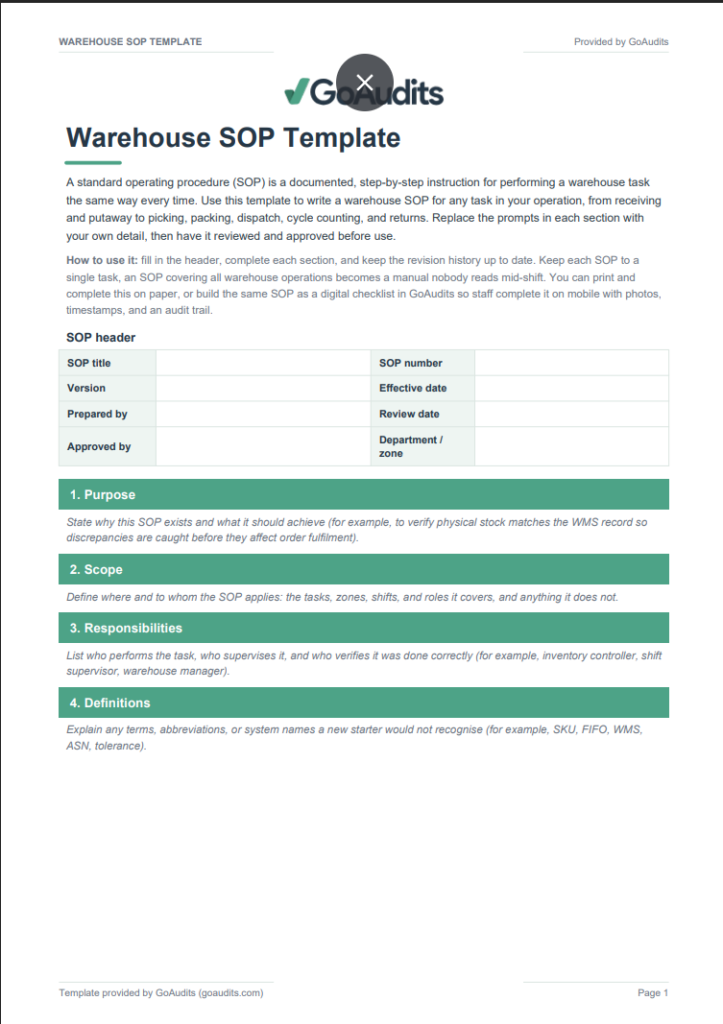
Every warehouse SOP, regardless of the task, uses the same structure. A consistent template is what makes SOPs quick to write and quick to follow.
Header block
- SOP title and reference number
- Version number and effective date
- Author, approver, and review date
- Department or area it applies to
- Purpose. One or two sentences stating why the procedure exists and what it should achieve.
- Scope. Which tasks, areas, shifts, and roles it covers, and anything it explicitly does not.
- Responsibilities. Who performs the task, who supervises it, and who verifies it was done correctly.
- Definitions. Any terms, abbreviations, or system names a new starter would not recognise, for example SKU, FIFO, WMS, ASN.
- Equipment and materials. Everything needed to perform the task: scanners, PPE, pallet trucks, labels, forms.
- Procedure. Numbered steps in the order they happen, written as instructions rather than descriptions. “Scan the pallet label before moving the pallet” rather than “pallets are scanned before movement.” Include a photo or diagram wherever a step is easier to show than describe. A picture of a correctly wrapped pallet removes more ambiguity than three sentences of description.
- Verification and records. What gets checked, by whom, and what record the task produces.
- Exceptions and escalation. What to do when something does not match the procedure, and who to tell.
- Revision history. Version, date, what changed, and who approved it.
Keep each SOP to a single task. An SOP covering “warehouse operations” is a manual, and nobody reads a manual mid-shift. An SOP covering “receiving a palletised delivery” gets used.
Warehouse SOP Example
Here is the template above applied to a common warehouse task.
SOP title: Cycle Counting, Bin Level SOP number: WH-INV-004 Version: 1.0 Effective date: [date] Applies to: Inventory control team, all storage zones
1. Purpose: To verify physical stock matches the WMS record at bin level, so discrepancies are identified and corrected before they affect order fulfilment.
2. Scope: Applies to all pick-face and reserve bins across zones A to D. Does not cover full physical inventory counts, which follow SOP WH-INV-007.
3. Responsibilities: Inventory controllers perform counts. The inventory supervisor reviews discrepancies above the tolerance threshold and authorises adjustments. The warehouse manager approves any adjustment above [value].
4. Definitions: Cycle count: a recurring count of a subset of locations rather than the whole warehouse. Tolerance: the variance permitted before escalation is required.
5. Equipment and materials: Handheld scanner, WMS access, count sheet or digital checklist, and PPE required for the zone.
6. Procedure
- Pull the day’s count list from the WMS. Do not select bins manually.
- Confirm the zone is not being picked during the count window.
- Scan the bin location barcode to open the count record.
- Count physical units. Count, do not estimate, including partial cases.
- Enter the counted quantity. Do not view the system quantity before entering.
- If the count matches, close the record and move to the next bin.
- If the count does not match, recount once before recording a variance.
- Record the variance with a photo of the bin as found.
- Escalate any variance above tolerance to the inventory supervisor before adjusting.
- Complete all bins on the list before closing the count session.
7. Verification and records: The supervisor reviews all variances daily. The count session produces a record showing bins counted, variances found, and adjustments authorised.
8. Exceptions and escalation: If a bin is inaccessible, blocked, or mislabelled, record it as an exception rather than skipping it, and notify the supervisor the same shift.
9. Revision history: 1.0, [date], initial version, approved by [name].
Free Warehouse SOP Template PDF
Prefer a document you can print or fill in by hand? Download our free Warehouse SOP template (PDF), which includes the blank structure above plus the cycle counting example filled in.
What are the Steps to Develop and Implement Warehouse SOPs?
Here’s a step-by-step guide on effectively developing and implementing these procedures.
1. Identify Essential Warehouse Processes
Start by identifying the key processes in your warehouse. This includes receiving goods, inventory management, order picking, packing, shipping, and safety protocols. Understanding these processes helps ensure that your warehouse SOPs cover all critical areas, minimizing errors and improving efficiency in your warehouse.
2. Define the Scope and Objectives
Clearly define the scope and objectives of each warehouse SOP. Determine what each procedure aims to achieve and which specific processes it will cover. This ensures that your SOPs are focused and relevant, addressing the unique needs of your warehouse operations.
3. Gather Detailed Input from Warehouse Staff
Your warehouse staff are experts in daily operations. Gather detailed input from them to understand the nuances of each process. Conduct interviews, surveys, and brainstorming sessions to collect their insights and suggestions. This ensures that your warehouse SOPs are practical and comprehensive.
4. Draft Clear, Step-by-Step Instructions
When drafting your warehouse SOPs, clarity is key. Write step-by-step instructions that are easy to understand and follow. Use simple language and short sentences. Include detailed descriptions, diagrams, and checklists to enhance comprehension and reduce ambiguity.
Begin by identifying and prioritizing key processes that require standardization. Collaborate with team members who are directly involved in these tasks to gather accurate and practical insights. Choose an appropriate format, whether it’s step-by-step instructions, flowcharts, or checklists, and ensure it’s easy to follow. Document every step in detail, including necessary resources and any potential exceptions.
Incorporate visual aids to enhance understanding and keep the language clear and concise. Regularly review and update the warehouse SOPs to reflect any changes in procedures or regulations. Training your staff on these procedures and using digital tools for version control and accessibility can further streamline the implementation and compliance with warehouse SOPs.
5. Review and Test the SOPs
Before finalizing your warehouse SOPs, conduct thorough reviews and tests. Involve key stakeholders, including managers and warehouse staff, to review the procedures for accuracy and completeness. Pilot the warehouse SOPs in real-world scenarios to identify any gaps or issues and make necessary adjustments based on feedback.
6. Implement and Train Your Employees
Once the warehouse SOPs are finalized, implement them across your warehouse. Conduct comprehensive training sessions for all employees to ensure they understand and can effectively follow the new procedures. Provide hands-on training and create opportunities for employees to ask questions and clarify doubts.
7. Monitor and Continuously Improve
The implementation of warehouse SOPs is not a one-time task. Continuously monitor their effectiveness and gather feedback from warehouse staff. Regularly review and update the procedures to incorporate new technologies, regulatory changes, and operational improvements. This ongoing refinement ensures that your SOPs remain relevant and effective over time.
Leverage GoAudits for Warehouse SOP Management
GoAudits is a comprehensive solution for inspections, audits, quality control, and compliance. Here’s how you can use it to streamline your warehouse SOP management, ensuring your operations run smoothly and efficiently.
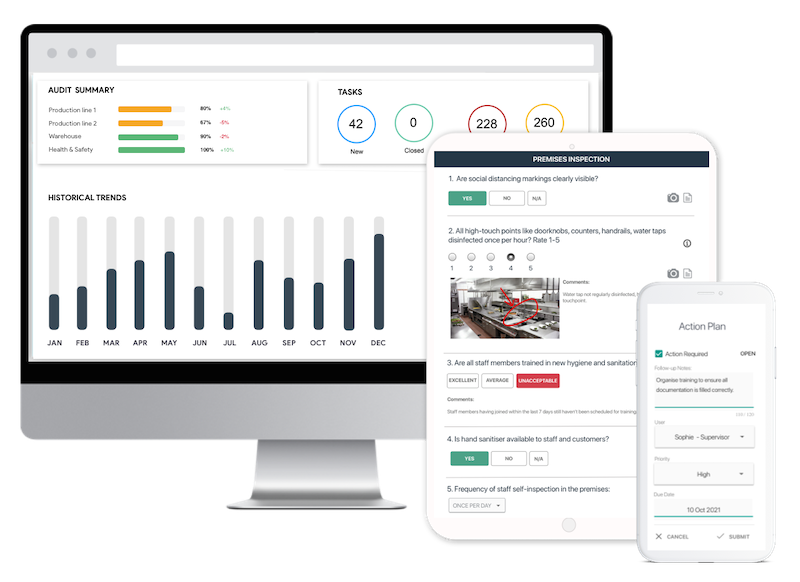
- GoAudits’ user-friendly interface makes it easy to create, edit, and update your warehouse SOP templates, even for non-technical users.
- Choose from a library of pre-built templates for common warehouse tasks, or build your own from scratch using a simple drag-and-drop interface.
- Collaborate with your team in real-time to review and finalize SOPs, ensuring everyone is involved and aligned.
- GoAudits automatically generates detailed reports with insights into your warehouse performance.
- Track key metrics and identify areas for improvement with interactive dashboards.
- Gain valuable insights into recurring issues, trends, and compliance gaps.
- Assign corrective actions and follow-up tasks to ensure issues are addressed promptly.
- Automate workflows to streamline processes and improve efficiency.
- Stay on top of tasks and deadlines with automated notifications and reminders.
Download FREE & Customizable Warehouse Checklists
Do you want to make your warehouse SOP documents easy to access and use? Digital checklists accessible on any device can help you implement warehouse SOPs for your teams. GoAudits offers a range of free warehouse SOP templates that you can customize to match your business requirements and industry standards.
- Good Warehouse Practices Checklist
- Warehouse Safety Inspection Checklist
- 5S Warehouse Checklist
- GMP Warehouse Audit Checklist
- GDP Audit Checklist
- Warehouse Inspection Daily Checklist
- Warehouse Storage Checklist
- Warehouse Inspection Checklist Template
- Warehouse Maintenance Checklist
- General Warehouse Safety Checklist
- Warehouse Housekeeping Checklist
- Warehouse Hazards Checklist
- Warehouse Food Safety Checklist
- Warehouse Health and Safety Checklist
- OSHA Warehouse Safety Checklist
- Forklift Pre-start Checklist
- Forklift Operator Shift Takeover / Handover Checks

FAQs
It depends on operation size and complexity, but most warehouses need between 15 and 40 covering the core processes: receiving, putaway, picking, packing, dispatch, cycle counting, stock adjustments, returns, equipment checks, and safety procedures. Start with the tasks where errors are most costly or most frequent, rather than trying to document everything at once.
Review annually as a minimum, and immediately after any layout change, new equipment, WMS change, process change, or recurring error that the current SOP failed to prevent. An SOP that no longer matches how the task is actually done is worse than no SOP, because staff learn to ignore the documentation.
A policy states what is required and why. An SOP gives the step-by-step detail of how to carry out one specific task. A warehouse policies and procedures manual typically contains both, plus higher-level procedures describing how processes flow across roles.