ISO 45001 Audit Checklist Templates
Template Library > Safety Inspections > ISO 45001 Audit Checklists
Simplify Workplace Safety Audits With ISO 45001 Audit Checklists
ISO 45001 audits help organizations verify compliance with international occupational health and safety standards defined by the ISO organization. Using a structured ISO 45001 requirements checklist keeps the internal audit process consistent, transparent, and action-oriented.
A well-designed ISO 45001 audit template helps teams:
- Evaluate the effectiveness of their OHSMS.
- Identify nonconformities and track corrective actions.
- Maintain reliable documentation for certification and management review.

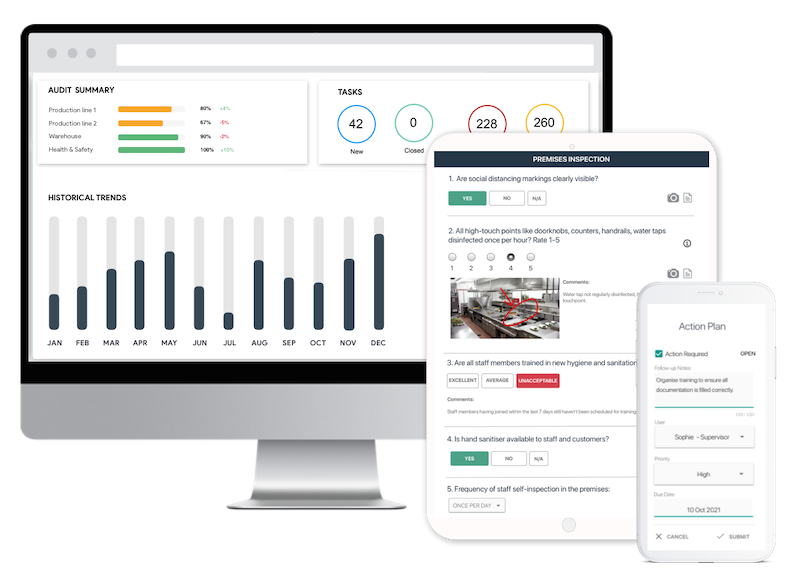
With the GoAudits Safety Inspection App, you can:
- Eliminate paperwork: conduct efficient digital audits, add photos from mobile device
- Customize this template or easily create your own
- Save time with instant reports & assign corrective actions
85 questions in 7 sectionsInteractive preview: try the answers
Section 1 of 7 · 3 questionsClause 4: Context Of The Organisation
Have external/internal issues affecting OHS outcomes been identified?
Have the needs and expectations of workers and other interested parties been comprehended?
When determining the scope of the OH&S management system, were the following considered: • The issues and requirements in the above questions. • The planned/performed work related to those activities.
Section 2 of 7 · 19 questionsClause 5: Leadership
Has external/internal issues that affect our OHS outcomes been determined?
Has responsibility and accountability for all workplace/health activities and OHS outcomes been taken?
Are OH&S policy/objectives aligned with our organization’s overall direction?
Are OH&S requirements integrated into day-to-day organizational processes?
Are the availability of all necessary resources readily available?
Is the importance of OHS management communicated to the whole organization?
Are direction and support provided for individuals to contribute?
Is continual improvement fostered?
Have other relevant management roles to display leadership been empowered?
Is an OH&S-focused culture developed, led, and promoted?
Are workers aware that they will be praised (not penalized) for reporting incidents/hazards/risks?
Are processes for worker consultation and participation established and implemented?
Have health and safety committees been established?
Are responsibilities assigned, communicated, and documented?
Is a feedback loop/reporting system set up to track success?
Are goals aligned with legal guidelines?
Have competence requirements and training needs been established by setting up training and evaluating those training programs on an ongoing basis?
Are control measures determined and implemented?
Have incidents/nonconformities been investigated and have corrective actions been determined?
Section 3 of 7 · 12 questionsClause 6: Planning
Has the success and continuous improvement of the OH&S management system been ensured?
Has a simple and scalable risk management and hazard ID system been developed?
Are responsibilities and accountabilities based on the person outlined and documented?
Are all policies and procedures up-to-date and easily accessible?
Are undesired effects prevented or minimized?
Are the risks and opportunities based on OH&S, operational, and legal requirements identified?
Is a system built for handling planned and unplanned changes in a controlled way?
Are ongoing and proactive processes established, implemented, and maintained for hazard identification?
Are social factors such as workload, work hours, victimization, harassment/bullying, leadership, and culture included in the above processes?
Are individuals with access to the workplace and their activities, including workers, contractors, visitors, and other persons identified?
Are those in the vicinity of the workplace who could be impacted by our activities identified?
Are all legal documents up-to-date and readily accessible?
Section 4 of 7 · 18 questionsClause 7: Support
Is the OHS management system established, implemented, and maintained through continuous improvement?
Are the necessary competencies for every role determined?
Is it ensured that workers are competent based on their education, training, or experience?
Are the necessary actions taken to provide and maintain the required training?
Are the appropriate documents retained and updated as evidence of competence?
Are workers aware of the OH&S policy and objectives?
Are workers aware of their role in the OH&S management system
Are workers aware of the benefits of improved OH&S performance
Are workers aware of the potential consequences of nonconformance?
Are workers aware of any incidents and the outcomes of investigations that are relevant to them?
Are workers aware of any hazards, risks, or actions that are relevant to them?
Are workers aware of their right to remove themselves from hazardous situations and the proper procedure to do so?
Is proper communication ensured by documenting all information required by ISO 45001?
Is proper communication ensured by creating, implementing, and maintaining processes needed for internal and external communications relevant to the OH&S management system?
Is proper communication ensured by clarifying and documenting the who, what, where, when, and how involved in those systems?
Is proper communication ensured by considering diversity aspects (e.g., gender, language, culture, literacy, disability) when mapping communication needs?
Are all required documents retained and ensured to be up-to-date and accessible?
Is the protection of these documents from loss of confidentiality, improper use, or loss of integrity ensured?
Section 5 of 7 · 13 questionsClause 8: Operation
Have the necessary documents been maintained to have confidence that these processes have been carried out as planned?
Is work adapted to suit the workers?
Is training provided for eliminating hazards?
Is training provided for substituting with less hazardous processes, operations, materials, or equipment?
Is training provided for using engineering controls and reorganization of work?
Is training provided for using administrative controls, including training?
Is training provided for and using adequate personal protective equipment?
Are processes documented to ensure changes (i.e. locations, conditions, equipment, personnel, legal requirements) are handled in a controlled way?
Is coordination of procurement processes done to identify hazards and assess and control OH&S risks associated with working with contractors?
Are outsourcing arrangements consistent with legal requirements and with achieving our OH&S goals ensured?
Are processes established, implemented, and maintained to respond to potential emergency situations?
Is training, uptraining, and testing of those procedures conducted?
Are documents related to these procedures maintained and retained?
Section 6 of 7 · 15 questionsClause 9: Performance Evaluation
Have the methods for monitoring, measurement, analysis, and performance evaluation been determined?
Have the criteria against which OH&S performance been evaluated?
Have the guidelines for calibrating the necessary equipment been determined?
Has the time for monitoring and measuring to be performed determined?
Has the data that will be analyzed, evaluated, and communicated been determined?
Has it been determined where the testing, certification, and verification documents will be stored?
Are processes and documents in place to determine the frequency and methods for the evaluation of compliance?
Are the processes and documents available to evaluate compliance and take action if needed?
Are the processes and documents available to understand compliance status with legal requirements at all times?
Are internal audits conducted at planned intervals, with objective and impartial auditors?
Are the results of all audits made available to stakeholders and all interested parties?
How is action taken to address any issues?
Are all audit documents retained and updated?
Is there a system created for top management to review our OH&S management system at planned intervals?
Are the audit findings communicated to workers and interested parties, including opportunities to improve?
Section 7 of 7 · 5 questionsClause 10: Improvement
Has the determination of opportunities for improvement and implementation of the necessary actions occurred?
Are processes in place to report, investigate, and take action on incidents and nonconformities?
When an incident or nonconformity occurs • Is timely and appropriate action taken? • Is learning and action to prevent recurrence ensured? • Is the measurement of the response and search for ways to improve undertaken?
Are documents retained for the following: • The nature of incidents or nonconformities. • Subsequent actions taken. • The results and effectiveness of any actions?
Is there continuous improvement of our OH&S management system through the following: • Enhancing OH&S performance • Promoting an OH&S-focused culture • Encouraging and rewarding worker participation • Communicating the relevant results of continual improvement to workers • Maintaining and retaining documents demonstrating continual improvement?
Checklist by GoAudits. This checklist is an example: we do not guarantee compliance with the laws applicable to your territory or industry. Seek professional advice to adapt it to your workplace or jurisdiction.
Save Time with Digital Inspections
- Easily capture & attach photos, directly on your mobile device.
- Instantly generate and share detailed reports after the inspection.
- Track corrective actions, view historical trends, improve standards.


What is an ISO 45001 Audit Checklist?
An ISO 45001 checklist is a structured tool that guides auditors through each clause of the ISO 45001 standard. It ensures that every part of your Occupational Health and Safety Management System (OHSSMS) is reviewed systematically, from risk assessment to leadership involvement. The checklist provides structured questions and criteria auditors can use to document findings and corrective actions.
This structured approach helps organizations maintain consistency, uncover hidden weaknesses, and demonstrate commitment to continual improvement.
🚨 Quick Tip: Preparing for ISO 45001 Audits?
For a smooth ISO 45001 certification, understand the standard, conduct a gap analysis, and engage your team. Learn more in our step-by-step guide.
Why Use an ISO 45001 Requirements Checklist?
An ISO 45001 checklist helps organize and streamline your safety audits, making certification prep and follow-up easier.
- Structured Audit Process: ensure every ISO 45001 requirement is reviewed systematically ahead of certification. Reduce the risk of missing key areas like leadership, worker participation, or risk assessments.
- Track and close corrective actions: systematically log non-conformities, assign responsibility, and monitor progress to closure.
- Consistent audits across sites: standardize inspections for reliable comparisons between departments or locations.
- Simplified documentation: keep findings, evidence, and notes in one place for quick reporting and management reviews.
- Driving ongoing improvement: use audit data to identify recurring issues, measure progress, and maintain compliance year-round.
Key Components of an ISO 45001 Audit Checklist
A thorough ISO 45001 Requirements Checklist covers all areas necessary to ensure a compliant, effective OHSMS:
- Organizational Context – Assess internal and external factors affecting health and safety.
- Leadership and Worker Participation – Check management commitment, defined roles, and worker involvement.
- Planning and Risk Assessment – Review hazard identification, risk evaluation, and measurable objectives.
- Support and Resources – Verify training, competence, documentation, and communication systems.
- Operational Control – Inspect safety procedures, emergency plans, and contractor management.
- Performance Evaluation – Evaluate the measurement of safety metrics, internal audits, and incident tracking.
- Improvement and Corrective Actions – Confirm processes for addressing nonconformities and driving continuous improvement.
- Compliance and Documentation – Ensure records, policies, and audit findings meet ISO 45001 and legal requirements.
The ISO 45001 checklist can also be divided into several checklists by theme, allowing teams to focus on one area at a time instead of tackling the entire system at once. This approach makes audits more manageable, supports ongoing compliance checks throughout the year, and ensures every part of the Occupational Health and Safety Management System is reviewed in depth.:
Why Use Digital Toolbox Talk Forms with GoAudits?
✅ No lost or incomplete forms: Every talk is logged properly, with required fields filled in.
✅ Instant accountability: Digital signatures show exactly who attended, no chasing paper sign-offs.
✅ Real-time visibility: Managers see toolbox talks across all sites, without waiting for paperwork.
✅ Audit & compliance ready: Automatic recordkeeping ensures compliance proof anytime.
Using the Checklist for Internal & External Audits
Internal Audits:
An ISO 45001 checklist gives structure to internal reviews, helping teams verify compliance, record findings, and track corrective actions consistently across sites. It supports proactive improvement by identifying issues early and maintaining reliable audit records for management review.
External Audit Preparation:
Before certification, the checklist helps confirm that all ISO 45001 requirements are met and documented. It ensures corrective actions are closed and evidence is ready for review, reducing stress and showing auditors a clear, organized approach to compliance.
👉 For practical guidance on conducting ISO 45001 audits, see our ISO 45001 Audits Guide for expert tips and best practices.
How Often Should You Use the ISO 45001 Checklist?
The ISO 45001 checklist can be used as often as needed to keep your health and safety system on track. The frequency of ISO 45001 audits depends on the size, risk profile, and complexity of your operations. Most organizations perform a full internal audit at least once a year, but many use the checklist quarterly or after major operational changes to stay proactive. Regular use helps teams verify corrective actions, track improvements, and stay prepared for certification. Since external certification audits occur every three years, using the checklist throughout the cycle ensures your OHSMS remains compliant and audit-ready at any time.
Common Gaps Found During ISO 45001 Audits
Audits often reveal recurring areas for improvement, including:
- Incomplete Risk Assessments – Outdated or generic assessments that overlook key hazards.
- Poor Documentation – Missing or inconsistent procedures, training records, or incident reports.
- Limited Worker Participation – Lack of staff involvement in hazard identification or safety planning.
- Weak Corrective Action Follow-up – Logged actions not tracked or resolved.
- Insufficient Internal Audits – Skipping audits or failing to act on findings.
- Training and Competence Gaps – Incomplete records or unclear evaluations.
- Lack of Performance Monitoring – No measurement of key safety metrics or trend analysis.

How ISO 45001 Links With Other ISO Management Systems
ISO 45001 is built to work seamlessly with other ISO standards, allowing businesses to manage safety, quality, and sustainability through a single, integrated framework.
ISO 9001, ISO 14001, and ISO 45001 audit checklists are some examples linking these management systems.
ISO 9001 Audits (Quality Management)
Integrating ISO 45001 with ISO 9001 ensures that both safety and quality goals move in the same direction. For example, when production processes are improved for efficiency, potential safety risks are also assessed. This alignment helps organizations deliver consistent quality products and services while maintaining safe working conditions.
ISO 14001 Audits (Environmental Management)
Safety and environmental management often overlap. Combining ISO 45001 and ISO 14001 allows businesses to manage issues such as chemical handling, waste disposal, and emissions control in a coordinated way. It supports sustainability while protecting workers from environmental risks.
ISO 27001 Audits (Information Security Management)
With more safety data stored digitally, information security has become critical to occupational health and safety. Integrating ISO 27001 with ISO 45001 ensures that sensitive information—like incident reports, training records, or audit findings—is protected from unauthorized access or cyber threats. This builds trust and ensures data integrity across systems.
ISO 50001 Audits (Energy Management)
Energy efficiency and workplace safety go hand in hand. By linking ISO 45001 with ISO 50001, organizations can reduce energy consumption, optimize equipment performance, and maintain safe operating conditions. This approach supports sustainable growth without compromising worker wellbeing.
The Value of Integration
Linking management systems provides better visibility across departments, reduces audit fatigue, and drives continuous improvement. With shared objectives and documentation, organizations can meet multiple ISO standards more efficiently while strengthening compliance and performance.
Digitize and Automate Your ISO 45001 Checklist With GoAudits
GoAudits is a smart auditor app that helps organizations manage all safety and quality inspections — including ISO 45001 audits — in one digital platform. Conduct inspections from any device, capture photos and notes on the spot, and flag non-compliances instantly. Each finding links to a corrective action with assigned owners, due dates, and real-time status tracking, ensuring that issues are followed up and resolved efficiently across all sites.
With GoAudits, you can:
- Track corrective actions end-to-end, ensuring accountability and faster issue resolution.
- Generate professional audit reports instantly, ready to share with management or auditors.
- Standardize inspections across all locations, from ISO SOPs and audits to daily safety walks.
Maintain continuous compliance with digital records, analytics, and automated reminders.

Other Popular Safety Checklists:

Digitize your Safety Inspections
- Easily perform audits anywhere on the site using a mobile device, even offline
- Attach photos to document issues or prove compliance
- Assign tasks, set deadlines and track progress - all within a single app
- Analyze data from audits to identify trends, pinpoint recurring issues, and assess compliance levels.