Forklift Inspection Templates - Daily, Weekly, Monthly Pre Start Checks
Template Library > Warehouse Checklists > Forklift Inspection Checklists
Ensure Safety & Efficiency with Forklift Inspection Checklist Templates
A forklift inspection checklist template helps verify that your forklifts are in optimal condition and safe to operate. It guides your team through a thorough examination, ensuring no critical components or checks are overlooked.
With this fork truck check sheet template, you can:
- Identify potential hazards before operation.
- Meet legal and industry standards for forklift use.
- Detect and address maintenance issues early on.
- Promote regular maintenance to extend forklift durability.

With the GoAudits Inspection App, you can:
- Eliminate paperwork: conduct efficient digital audits
- Customize this template or easily create your own
- Save time with instant reports & assign corrective actions
40 questions in 7 sectionsInteractive preview: try the answers
Section 1 of 7 · 2 questionsCompetency In Load Capacity
Does the operator match the load with the truck's capacity?
Does the operator check for stability after loading?
Section 2 of 7 · 4 questionsDaily Safety Inspection
Does the operator complete the pre-shift safety inspection correctly?
Does the operator fully understand the capacity information plate?
Does the operator fully understand the correct fault reporting procedures?
Does the operator perform daily takeover audits / checks on the forklift he operates?
Section 3 of 7 · 4 questionsManoeuvring & Transportation
Are the forks too low?
When operating in reverse, is the operator looking around appropriately?
Is the operator maintaining a speed consistent with the type of load and working conditions?
Is the operator manoeuvring safely with the lift truck and load?
Section 4 of 7 · 9 questionsOperator Safety & Observation
Does the operator mount or dismount the forklift correctly?
Does the operator use the seat belt correctly?
Does the operator keep his/her body parts within the confines of the vehicle?
Does the operator pay attention to the surroundings?
Does the operator look in the direction of travel without getting distracted?
Does the operator use the horn as and when required?
Does the operator follow the correct protocols in case of an unattended vehicle?
Is the operator’s all round safety observation satisfactory?
Is the operator’s all round safety observation satisfactory?
Section 5 of 7 · 6 questionsParking
Does the operator correctly apply the park brake?
Does the operator set the direction lever to the neutral position?
Does the operator correctly apply forward tilt?
Does the operator correctly lower the fork arms?
Does the operator manoeuvre the wheels so that they are in-line with the forklift?
Does the operator switch off the forklift and remove the key once parked up?
Section 6 of 7 · 8 questionsStacking & De-stacking
Does the operator use the parking brake when operating the hydraulics?
Does the operator use neutral gear when operating the hydraulics?
Are the fork arms central under the load?
Are the fork arms rubbing at any time?
Do the fork tips touch the load?
Are the forks level with the loads?
Is the load stacked correctly?
Are the fork arms not fully inserted (undercut)?
Section 7 of 7 · 7 questionsSteering & Operating Controls
Is the operator able to start and stop smoothly?
Does the operator use the assistor correctly?
Does the operator brake harshly / erratically?
Does the operator ensure the parking brake is released prior to moving off?
Does the operator ride the foot brake?
Does the operator operate the hydraulic controls when the lift truck is in motion?
Does the operator able to correctly operate and understands the controls of the forklift?
Checklist by GoAudits. This checklist is an example: we do not guarantee compliance with the laws applicable to your territory or industry. Seek professional advice to adapt it to your workplace or jurisdiction.
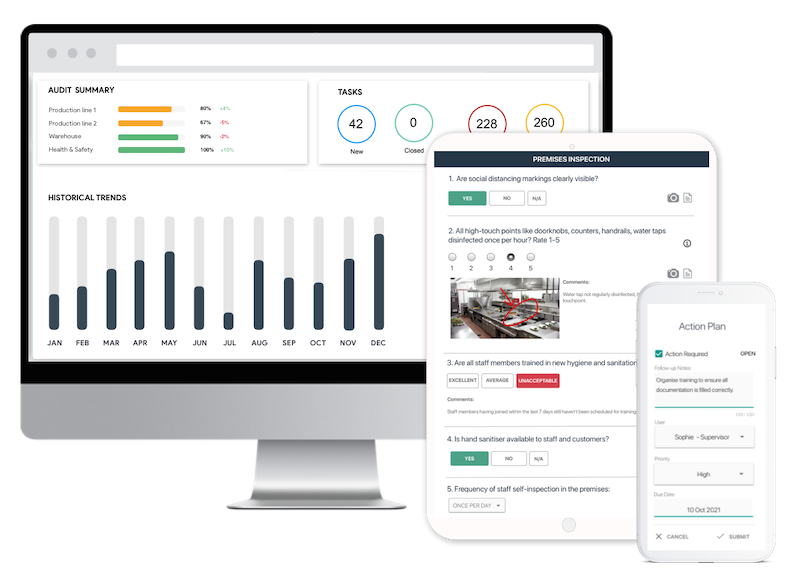
Save Time with Digital Inspections
- Easily capture & attach photos, directly on your mobile device.
- Instantly generate and share detailed reports after the inspection.
- Track corrective actions, view historical trends, improve standards.


What is a Forklift Inspection Checklist?
A forklift checklist is a structured document used to assess the condition and safety of a forklift before, during, or after its use. Forklift audit checklists help operators and maintenance teams identify potential hazards, malfunctions, or wear and tear systematically.
Importance of Using Forklift Inspection Template
Regular forklift inspections are not just a best practice but a necessity. Here’s why using a forklift checklist form is crucial:
- Operator Safety: Routine checks prevent accidents caused by malfunctioning equipment, such as brake failures or hydraulic leaks.
- Compliance: OSHA mandates regular forklift inspections to ensure safety in the workplace. Non-compliance can result in hefty fines and penalties.
- Reduced Downtime: Catching issues early reduces costly downtime and prevents operational delays.
- Cost Savings: Proactive maintenance minimizes expensive repairs or replacements.
- Accountability: A checklist creates a record of inspections, encouraging accountability among operators and maintenance personnel.
👉 Case Study: How Miniclipper Logistics uses digital checklists to achieve an audit response rate of 97%

OSHA Fork Truck Checklist Guidelines
The Occupational Safety and Health Administration (OSHA) sets clear guidelines for forklift safety and inspections under 29 CFR 1910.178(q)(7). These include:
- Conducting daily inspections before forklifts are placed into service.
- Removing forklifts with defects or unsafe conditions from service until repaired.
- Verifying that safety equipment such as horns, lights, and brakes are operational.
- Ensuring detailed record-keeping of inspections for compliance and review.
Which Six Parts of a Forklift Must be Inspected?
Forklift inspections focus on critical components to ensure safety and performance. Below are the six key areas that must be inspected:
- Forks: Check for cracks, bends, or wear that could compromise their load-bearing capacity. Ensure proper attachment to the mast and alignment with the carriage.
- Tires: Inspect for cuts, tears, or excessive wear on the tread. Confirm proper inflation for pneumatic tires or check the condition of solid ones.
- Hydraulic System: Look for leaks in hoses, cylinders, or reservoirs. Test the lifting and tilting functions for smooth operation.
- Mast: Examine the mast for bends, rust, or damage. Check that rollers and chains are in good condition and properly lubricated.
- Safety Features: Test the horn, lights, mirrors, seatbelt, and overhead guard. Ensure all warning labels and decals are legible and in place.
- Controls and Gauges: Verify that the steering, brakes, and clutch are responsive. Check that fuel, oil, and temperature gauges are functioning correctly.
Types of Forklift Inspection Templates – by Frequency
Below is a detailed guide to various forklift inspection templates, tailored by frequency, type, and specific scenarios.
Daily Forklift Inspection Form
Conducted before the forklift is operated each day, this checklist ensures immediate safety and functionality. Key points include:
- Check brakes, horns, and lights for proper operation.
- Inspect forks for cracks, bends, or wear.
- Verify the hydraulic system for leaks or malfunctions.
- Ensure fluid levels (fuel, oil, and coolant) are adequate.
- Test steering responsiveness and tire condition.
Weekly Forklift Inspection Template
More detailed than daily checks, this covers components that experience gradual wear over time.
- Examine tires for tread wear, pressure (if pneumatic), or damage.
- Inspect the mast assembly, including rollers and chains, for alignment and lubrication.
- Test the stability of the forks and carriage under load.
- Check battery terminals or propane tanks for corrosion or secure fittings.
- Inspect safety features like seatbelts and emergency stop mechanisms.
Monthly Forklift Inspection Checklist Template
A comprehensive inspection to address deeper mechanical and operational concerns.
- Inspect engine components, belts, and hoses for wear and leaks.
- Verify that all gauges and dashboard indicators function correctly.
- Assess the condition of hydraulic hoses and fittings for degradation.
- Perform load tests to ensure lifting capacity and stability.
- Check the overhead guard for structural integrity.
Annual Forklift Inspection Form
Annual forklift checklist templates involve an in-depth review conducted by certified technicians to ensure compliance and longevity.
- Conduct a full diagnostic scan of the forklift’s electrical and mechanical systems.
- Assess the condition of the transmission and drivetrain.
- Check all welds, bolts, and structural elements for stress or damage.
- Test the forklift under maximum load to verify performance.
- Review compliance with OSHA and manufacturer’s safety standards.
👉 Forklift Operator Daily Checklist: Here’s a free template to help you get started.
Specific Type Forklift Truck Inspection Checklist Templates
Electric Forklift Inspection Template
Tailored for electric forklifts to ensure battery and electrical systems are operational.
- Inspect battery electrolyte levels and ensure proper charging.
- Check the integrity of battery cables and connections.
- Test the electric motor for abnormal noise or overheating.
- Ensure all safety lights, horns, and alarms are functional.
- Assess brake performance and regenerative systems (if applicable).
Propane Forklift Inspection Checklist Template
Designed for propane-powered forklifts to ensure safe fuel usage.
- Verify that the propane tank is securely mounted and connections are leak-free.
- Check the condition of hoses and regulators for cracks or wear.
- Test engine start-up and idle for smooth operation.
- Inspect exhaust systems for carbon buildup or blockages.
- Confirm that the fuel gauge and safety shut-off valves are operational.
Yard Forklift Inspection Template
Focused on forklifts used in outdoor environments with rugged terrain.
- Inspect large, durable tires for cuts, damage, or low pressure.
- Assess weatherproofing features, such as sealed cab components.
- Check visibility aids like mirrors, cameras, or floodlights for clarity.
- Test performance on uneven terrain to ensure stability.
- Inspect hydraulic systems for debris or contamination.
Reach Truck Forklift Inspection Template
Specialized for forklifts used in narrow aisles and high-reach applications.
- Check the mast extension mechanism for smooth operation.
- Inspect load-handling attachments, such as clamps or forks, for wear.
- Verify stability and alignment when lifting to maximum height.
- Test the electrical systems, including the battery and regenerative braking.
- Ensure safety features like stability controls and alarms are functional.
👉 Templates by Forklift Type
- OSHA Electric Forklift Truck Inspection Checklist: Use this checklist to ensure forklifts adhere to OSHA guidelines.
- OSHA Propane Forklift Truck Inspection Checklist: Use it to conduct thorough checks for your propane forklift’s safety and operational features.
- OSHA Yard Forklift Truck Inspection Checklist: Employ it to perform a comprehensive inspection of your yard forklift’s operational components.
- OSHA Reach Trucks Inspection Checklist: Ensure compliance, regularly assessing and maintaining safety standards with daily inspections of reach trucks.
Pre-Shift and Post-Repair Forklift Inspection Sheets
Pre-Shift/Pre-Start Forklift Inspection Sheet
Conducted before each shift to ensure the forklift is ready for safe use.
- Inspect brakes, lights, and alarms for immediate functionality.
- Check fluid levels, including fuel, oil, and coolant.
- Verify the condition of tires, forks, and the mast.
- Test controls like the accelerator, steering, and lift mechanisms.
- Ensure the forklift is free from visible damage or debris.
👉 Forklift Pre-Start Checklist: Here’s a free template to get started.
Post-Repair Forklift Check Sheet
Used after repairs to confirm that the forklift is restored to safe operational standards.
- Test repaired components, such as brakes, hydraulics, or engines, for reliability.
- Inspect safety features like seatbelts and emergency stop mechanisms.
- Confirm that all bolts, nuts, and fittings related to repairs are secure.
- Perform a short operational test under load to verify performance.
- Document and sign off on the repair for record-keeping.
Forklift Training and Certification Checklists
These checklists ensure operators are trained and certified to operate forklifts safely and perform inspections.
- Verify that operators understand OSHA regulations and safety protocols.
- Check if trainees can identify forklift components and their functions.
- Assess operators’ ability to perform pre-operational and safety inspections.
- Include hands-on testing for safe forklift operation, including load handling.
👉 Forklift Operation Shift Takeover Checklist: Ensure safe and smooth handover between shifts with this checklist template.

What Should be Included in a Forklift Safety Inspection Checklist Template?
A forklift truck safety checklist template should cover the following key elements to ensure safe operation and compliance:
- Operational Safety Features: Check the functionality of brakes, horns, lights, and warning alarms.
- Battery or Fuel System: Inspect battery charge levels or fuel tanks for leaks, corrosion, or secure fittings.
- Forks and Load Handling: Verify that forks are undamaged and the load is securely positioned.
- Hydraulic System: Check for leaks, proper pressure, and smooth lifting functions.
- Tires and Wheels: Inspect tires for proper inflation and visible damage.
- Mast and Lift Mechanism: Ensure the mast is aligned, free from cracks, and operating smoothly.
- Controls and Gauges: Ensure steering, acceleration, and other controls respond properly.
- Safety Gear: Confirm that seatbelts, overhead guards, and safety barriers are in place.
- Visibility and Mirrors: Check for proper visibility from the operator’s seat and adjust mirrors for clarity.
- Operator’s Environment: Ensure the operator’s seat is clean, clear, and free from obstructions.
How to Use a Forklift Inspection App to Conduct Inspections?
Using a forklift inspection app simplifies the entire audit process while enhancing efficiency and accountability.
First, create custom checklists tailored to your specific forklift models and operational needs. These forklift thorough examination checklists can be adjusted based on the type of inspection (e.g., daily, weekly, or post-repair), ensuring that all essential components are reviewed.
The forklift inspection checklist app also allows you to schedule inspections in advance, setting reminders to ensure that checks occur regularly. This allows you to create a proactive maintenance schedule and minimize the risk of overlooking critical inspections.
Forklift checklist mobile apps like GoAudits, have offline functionality, meaning workers can complete inspections in areas with limited or no internet connectivity. As they conduct inspections, they can capture photos of any defects, making it easier to document issues visually for clarity.
Once the inspection is completed, the forklift maintenance software generates instant reports, which can be shared immediately with supervisors, maintenance teams, or safety officers. These reports provide a detailed overview of the forklift’s condition, highlighting any areas that need attention.
In case of defects, the app enables the assignment of corrective actions directly to responsible personnel, who can track the progress of repairs or maintenance tasks in real-time.
👉 Warehouse Audit Checklists: Explore our extensive library of checklists used to perform checks for various warehouse equipment.
Other Popular Inspection Checklists:

Digitize your inspections
- Tool for commercial vehicle drivers, fleet managers, and maintenance crews to efficiently manage safety and maintenance.
- Empower drivers & operators to conduct accurate inspections. Capture detailed information in the form of photos, comments, and e-signatures.
- Track inspection history and maintain a complete record for regulatory audits.
- Assign tasks, set deadlines, and track progress, all within a single app.