Key Takeaways
- Layered process audits go beyond final product inspection to identify and correct problems, leading to higher quality, reduced wastage, and improved efficiency.
- Paper-based LPAs can be cumbersome, time-consuming, and error-prone as they involve manual data collection and analysis.
- With audit software and checklists, manufacturers can eliminate paper-based inspections, improve collaboration, and conduct regular and effective audits.
Reduced wastage, improved uniformity, and a direct line of communication between management and the plant floor: these are the hallmarks of a successful Layered Process Audit (LPA) program. Whether you are aiming for automotive-grade compliance or simply looking to tighten your manufacturing efficiency, LPAs offer a proactive way to verify that your standard processes are being followed every single shift.
Read on to learn how to structure your audit layers, what to include in your checklists, and how digital software can slash your administrative burden by 90%.
LPA Meaning: What is a Layered Process Audit?
Layered process audits (LPAs) are a type of audit that focuses on observing and validating how products are made, rather than inspecting the finished products.
The primary benefit of an LPA check is that it allows process engineers to identify problems as well as pinpoint their root causes. Additionally, it ensures compliance and helps in enhancing performance over time.
Who Conducts LPA Audits?
LPAs involve not only the working level team members (e.g., team leader or shift supervisor) and internal auditors, but also department managers and ultimately the executive management. This demonstrates that compliance is everyone’s responsibility.
Manufacturing audit checklists are an integral part of LPA audits as they are used by different “layers,” or management levels, and production personnel to perform quick and frequent audits.
Why Conduct Layered Audits: Importance & Benefits
Largely, a layered process audit helps management teams continuously improve and strengthen their quality control plan: identifying recurring issues, correcting them right at the source, and standardizing processes to eliminate non-conformances.
An effective layered process audit will help you:
- increase product uniformity
- reduce wastage, rework, and scrap materials
- promote communication between working-level teams and management
- establish a roadmap for continuous improvement
LPA and the CQI-8 Guideline
While LPAs benefit any manufacturer, the structure and best practices are largely defined by the Automotive Industry Action Group’s (AIAG) CQI-8 Layered Process Audit Guideline. Understanding CQI-8 principles ensures your program is robust:
- Closed-Loop Corrective Action: A core CQI-8 principle is that every non-conformance (a “No” answer) must trigger a documented and verified corrective action. This process must ensure the root cause is addressed, not just the symptom.
- Frequent Verification: CQI-8 emphasizes that checks are more frequent closer to the shop floor. This high frequency is key to catching process drift before it results in a product defect.
- Compliance is Not the Goal: The primary purpose of CQI-8 is to drive continuous improvement, not merely compliance. The LPA data collected should be used by managers to identify systemic training or process standardization opportunities.
Layered Process Audit Procedure: How to Conduct Layered Process Audits?
Layered audits help process engineers ensure quality and efficiency in their organization. Here’s a step-by-step guide to conducting an LPA process audit:
Step 1: Define Objectives and Scope
Clearly define what you want to achieve with LPAs. Is it improving a specific process, reducing errors, or enhancing compliance? Determine which areas or processes will be audited based on risk and importance.
Step 2: Assemble Cross-Functional Teams
Define workflow and involve employees from different levels – frontline, supervisors, and management to conduct audits at all levels of the operations.
Step 3: Choose the Right LPA Process Auditor App
Look for features like customizable checklists, scheduling audits, efficient reporting, real-time collection, and defining workflow when shopping for an LPA software.

Step 4: Develop Layered Audit Checklists in Digital Format
The effectiveness of your LPA program hinges on the quality of your checklist questions. To drive results, LPA audit questions must be simple, factual, and based on process risk. Follow these guidelines:
- Focus on Process Inputs, Not Product: An LPA should verify a required step was taken, not inspect a finished product.
- ❌ Bad Question: “Is the final product free of defects?”
- ✅ Good Question: “Was the torque tool calibrated at the start of the shift?”
- Keep it Quick & Objective: Questions must be answerable with a simple “Yes,” “No,” or “N/A” within 10–15 seconds. Any question requiring complex calculation or data retrieval should be omitted.
- Tie Back to FMEA: Questions must target high-risk steps identified during your Failure Mode and Effects Analysis (FMEA) or detailed in the Control Plan. If a control is critical for safety or quality, it needs an LPA check.
Paper checklists can be cumbersome and prone to errors. Consider using an auditing app like GoAudits to create digital factory audit checklists. It offers features like pre-built templates, easy customization, and the ability to attach photos or notes. Also, you can easily update the checklists to ensure they remain relevant.
Step 5: Layered Process Audit Training
Successful LPA procedure implementation is 80% cultural. To avoid the program devolving into a dreaded “check-box exercise” (or “pencil whipping”), focus on these three behavioral pillars:
- Eliminate the Blame Game: Train auditors and operators that the LPA is a “process check, not a person check.” When a non-conformance is found, the audit should focus on why the process failed, not who made the mistake.
- Ensure Management Visibility: When Layer 2 and Layer 3 managers consistently conduct their audits, it shows the frontline team that quality is a business priority, driving buy-in and accountability across the organization.
- Prevent Pencil Whipping: Digital tools like GoAudits are critical here. Utilize features such as:
- Photo Evidence: Require a photo attachment for non-conformances.
- GPS/Time Stamps: Verify the auditor was physically at the correct location at the scheduled time.
- Checklist Randomization: Randomly rotate the order of questions to prevent auditors from completing checks from memory.
Step 6: Conduct Audits
Schedule daily, weekly, and monthly or quarterly audits. Equip auditors with digital checklists and require them to observe processes, verify adherence, and document deviations. Use a layered process audit platform like GoAudits to access checklists on your mobile device, even offline in remote factory locations.
Step 7: Reporting
Analyze audit data to identify trends and recurring issues. Generate reports that include findings, propose corrective actions, and track progress. Use GoAudits to assign corrective actions and send reports to external parties, like contractors or vendors, with no extra charges.
Free Layered Process Audit Checklist Template Form
Here’s our free LPA audit checklist template that you can use to conduct your next LPA audit:
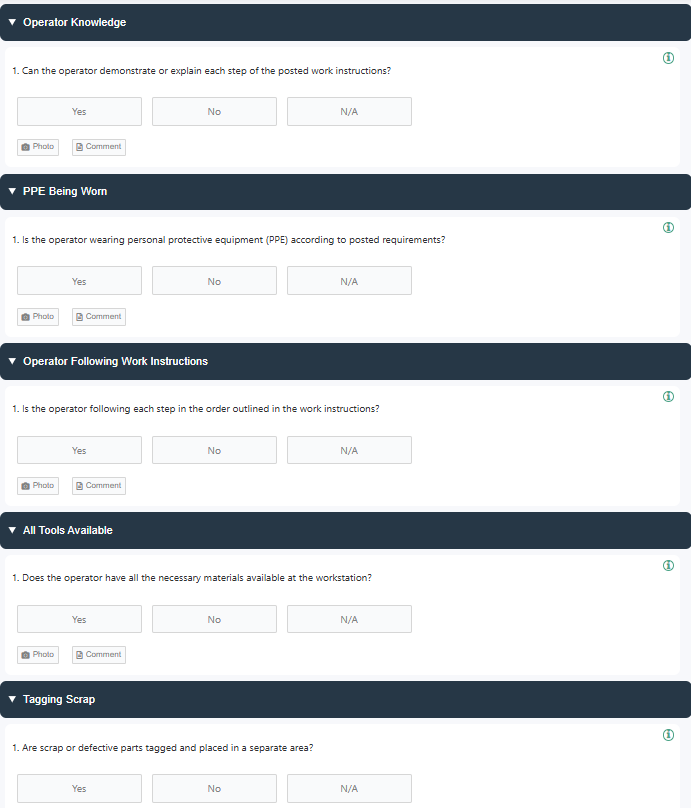
Either use the layered audit check sheet as is or customize it to include more layered process audit questions. Once configured, let your team use it to complete the audit through the GoAudits mobile app and generate an instant LPA audit report, which can be shared immediately with all the stakeholders.
Layered Process Audit Checklists & More
Other audit areas typically include daily, weekly, or monthly checks. We offer a library with 100s of checklist templates for different types of audits.
- Production Quality Control Checklist for Manufacturing
- Monthly Manufacturing Risk Assessment Checklist
- Pre-Start Safety Review (PSSR) Checklist
- Manufacturing Process Audit Checklist
- ISO 9001 Self-Assessment Checklist
- Process Safety Management Audit
- Industrial Housekeeping Checklist
- Permit to Work Checklist
- Manufacturing Audit Checklist
- General Gemba Walk Checklist
- Safety Walkthrough Checklist
- Cold Work Permit Template
- Hot Work Permit Checklist
- GMP Inspection Checklist
- Process Audit Template
- ISO 13485 Checklist
- 5S Audit Template
- 6S Audit Checklist
- New Miss Log

What is Audited During an LPA Audit?
The audit commences with an in-depth look at the work instructions for each production layer. After this initial assessment, the audit team evaluates the effectiveness of each layer. Furthermore, LPA audits also encompass:
- Talking to staff involved in production.
- Observing actual processes in action.
- Validating the correctness of records and paperwork.
- Checking the quality management systems.
- Scrutinizing inventory management and monitoring methods.
- Ensuring compliance with applicable regulations or standard manufacturing SOPS.
Layered Process Audit Schedule and Frequency
The frequency of LPA checks depends on the hierarchical level of personnel conducting the audits. A typical LPA audit plan includes 3 layers that total up to a relatively high number of regularly scheduled audits:
- Layer 1: Daily – supervisors or team leads who conduct audits at every shift.
- Layer 2: Weekly – middle management who performs weekly or bi-weekly audits.
- Layer 3: Monthly or Quarterly – plant managers or upper management/executives.
👉 Case Study: How HTS Digitized Process Audits
The supervising team at Heat Treating Services uses GoAudits for higher-level plant and manufacturing process checks. Real-time digital communication has helped put everyone on the same page for QA.
Additionally, GoAudits enabled them to get ahead of the trends before they become gross non-conformance. Their QA team considers GoAudits “a game-changer” and describes it to be the biggest no-brainer for their quality system.
Layered Process Audit (LPA) Example: Efficient Daily Quality Assurance on the Plant Floor
Many manufacturers have implemented a layered process audit solution for their layered audits, including daily production line checks, good manufacturing practice checks, plant walk-throughs, and more.
For example, Miniclipper Logistics relied on Excel sheets, fetching them basic results and no real follow-up or resulting action plans. Also, the team could perform audits only once every few months.
After switching to GoAudits, the audit responsiveness went from 65% to 97% through self-audits. The auditing time was drastically reduced, enabling the team to perform monthly inspections in more areas.
After trialing GoAudits in tandem with our selected audit system, we found rather quickly that GoAudits provided a far better system in terms of ease-of-use, template design options, layout, flow, functionality, actions, reporting, and excellent customer support.
Steve Blaydon, Business Process Manager, Miniclipper
Beyond LPA Audits: Streamline Quality and Safety Inspections
You can improve quality management and process performance through digital layered process audits.
Moreover, manufacturers use GoAudits not only for layered process audits and quality management but also for other internal manufacturing audits and inspections. The app can be easily customized for different manufacturing processes and locations.
Here’s what you can do with the GoAudits auditor app:
- Train employees about LPA guidelines and compliance
- Templatize LPA procedures in the form of checklists
- Schedule and track the status of the audit at each level
- Identify the root cause of a problem in the manufacturing process
- Assign corrective actions and follow-up progress through the inspection dashboard
With a rating of 4.8 stars on Capterra, GoAudits is trusted by some of the biggest names in the manufacturing industry.
» Customer Success Story: How businesses leverage GoAudits to save time and improve operations.
FAQs
Customizable LPA templates, including those highly relevant to food production, such as the GMP inspection checklist, are available on auditing software platforms, like GoAudits. Browse through the food production checklist library, and customize any of them with a free trial.
A Layered Process Audit (LPA) is a quality management technique in manufacturing that focuses on observing and validating how products are consistently made, rather than strictly inspecting the finished product.
CQI-8 is the Layered Process Audit Guideline published by the Automotive Industry Action Group (AIAG). It provides a structured, multi-level framework for automotive suppliers to implement or enhance LPAs, ensuring process compliance, promoting continuous improvement, and reducing costly errors in manufacturing.