Key Takeaways
- A coffee shop SOP is a step-by-step instruction for one repeatable task, written so anyone can follow it on their first shift.
- Most cafes need around eight categories of SOPs, covering everything from opening routines and drink prep to food safety and emergency procedures.
- An SOP only works once it becomes a checklist that staff completes on shift, not a document filed in a binder nobody opens.
- Tools like GoAudits turn your SOPs into mobile checklists with photo and timestamp proof, so you can confirm they were actually followed on every shift and across every site.
Your best-selling flat white tastes perfect on Tuesday and slightly off on Thursday. Same beans, same machine, different barista. That gap is what a coffee shop SOP exists to close.
A standard operating procedure for a coffee shop writes down exactly how each task is done, so anyone can hit the standard on their first shift. But here is the part most guides skip: writing the SOP is the easy 20%. Getting it followed when you are not behind the counter is the hard 80%.
This guide covers both what to write and which SOPs every cafe needs, as well as how to make sure they get followed on every shift and across every location.
What is a Coffee Shop SOP?
A coffee shop standard operating procedure (SOP) is a documented, step-by-step instruction for completing one specific task in your cafe the same way every time. It captures how a task is done, who is responsible, and what “correct” looks like, so the result does not depend on who happens to be working.
A single standard operating procedure of coffee shop operations usually covers one task: steaming milk, opening the till, and cleaning the espresso machine. Stack enough coffee shop SOPs together, and you have the operating system for your cafe, the documented backbone of your day-to-day cafe operations.
Why Does Your Cafe Need an SOP?
Your cafe needs SOPs because consistency is fragile in a business built on shift work and fast staff turnover. Since 2001, the accommodation and food services sector has averaged 75.6% annual turnover, against 43.4% across the broader economy. Even with rates easing to 65.5% in 2025, that still means the person making your signature drink in six months probably has not been hired yet. Without written standards, every new starter reinvents your cafe from scratch.
Strong SOPs pay off in ways owners feel directly:
- Consistent quality through turnover. New baristas hit your standard in days because the standard is well-documented.
- Faster, cheaper training. Onboarding follows a document instead of shadowing whoever is free.
- Freedom to step back. The cafe runs on standards when you are not there, so you are not chained to the counter.
- A second site without dilution. You cannot scale a recipe that only exists in your head. SOPs make a second location possible.
- Inspection readiness. Documented procedures are what an environmental health officer expects to see.
- Protected reputation. Consistent service turns a first visit into a regular, and a bad-day visit into a one-star review.
Coffee Shop SOP vs. Checklist vs. Operations Manual: What’s the Difference?
An SOP, a checklist, and an operations manual do different jobs. An SOP trains: it explains how to do a task and why it matters. A checklist executes: it is the short, daily confirmation that the task got done. An operations manual is the full reference that has every SOP and policy in one place.
Here is how the three compare:
| Document | What it does | When it’s used | Example |
| SOP | Trains: the full how and why | Learning a task, then as a reference | “How to steam milk for a flat white” |
| Checklist | Executes: confirms it got done | Every shift, in the moment | Opening checklist ticked at 7 am |
| Operations manual | Collects everything in one reference | Onboarding, audits, policy | The full cafe playbook |
Most cafes need all three, and they reinforce each other. The SOP teaches a new barista how to close the cafe properly. The closing checklist, pulled from that SOP, is what they tick off at 9 pm. The coffee shop operations manual is where both live, so a manager or a new hire can find them.
What Does an Effective Standard Operating Procedure for a Coffee Shop Look Like?
An effective coffee shop SOP has six parts: a title, a purpose, a scope, the procedure steps, the responsibilities, and a revision history. Every effective coffee shop SOP shares this backbone.
- Title. The task, named plainly: “Steam milk for a flat white.”
- Purpose. Why it matters, in one line.
- Scope. When and where it applies, and who it is for.
- Procedure steps. The numbered, measurable actions. This is the core.
- Responsibilities. Who owns the task and who signs off?
- Revision history. The date of the last update, the owner, and the version number. This is the part nearly every cafe skips, and it is exactly why SOPs go stale.
Good steps are measurable. “Steam milk to 60 to 65°C” can be checked; “steam milk until hot” cannot. The same goes for “18g dose, 25 to 30 second extraction” versus “pull a good shot.” If a step cannot be verified, it is not finished.
What are the Essential SOPs that Every Coffee Shop Needs?
Every coffee shop needs SOPs across eight areas: opening and closing, drink prep, food safety, cleaning and equipment, customer service, inventory, staff and training, and health and safety. Together, they cover everything that happens in your cafe, from the moment the first person arrives to the moment the alarm is set at night.
You do not need to write all of them at once. Map the full picture first, then build in order of risk and frequency. Here is the complete set.
Opening and Closing SOPs
Opening and closing SOPs set out the exact routine for starting and ending the trading day. They are the highest-frequency procedures in any cafe and the easiest place to start. Cover:
- Unlocking and disarming the alarm
- Switching on and warming up the espresso machine and grinders
- Calibrating the first grind
- Stocking the station and pastry case
- Counting the cash float
- The closing clean-down
- Cashing up and banking
- Setting the alarm
A clear shift handover note bridges the two, so the closing team sets up the opening team for success.
For a tested starting structure, use the following checklists:

Barista and Drink-Prep SOPs
A barista’s standard operating procedure defines how every drink is made, to the gram and the second. This is where cafe consistency is won or lost, so it deserves the most detail. A barista SOP should leave nothing to memory.
Cover each of these:
- Dialing in and grinder calibration. Target dose, yield, and shot time; recalibrate at open and after any grind change. Example standard: 18g in, 36g out, 25 to 30 seconds.
- Espresso extraction. The dose, yield, and time for your house espresso, plus how to read and fix a shot that runs too fast or too slow.
- Milk steaming. Texture and temperature targets for dairy and each alternative, since oat, soy, and almond all steam differently. 60 to 65°C as standard.
- Batch brew and filter. Recipe, brew ratio, and a freshness or dump time, so nobody serves coffee that has sat for two hours.
- Pour-over and cold brew. Method, ratio, and steep time for each.
- Recipe cards. One per drink on your menu, including seasonal specials, so a new hire can make any item correctly.
- Machine startup and shutdown. The safe, correct sequence at each end of the day.
Specialty coffee adds a layer. If you run single-origin or rotating guest beans, your SOPs need a dial-in record per coffee rather than one fixed house standard, since each origin and roast behaves differently. Document the target recipe for each bean as it comes on, and note who signed off the dial-in, so the standard travels with the coffee rather than living in one barista’s head.
👉 Free Resource: For training and sign-off, pair these with our barista training checks and a barista evaluation form, so you can confirm a new starter actually meets the standard before they work solo.
Food Handling, Safety, and Hygiene SOPs
These SOPs in coffee shops keep the food safe and legal, and they matter even if all you serve is pastries and toasties. Cafes’ operators may assume their risk is low because they are “not really cooking,” but allergen cross-contact, chilled storage, and date control still apply.
This SOP for the cafe must cover:
- Prep and portion control. How each food item is made and portioned.
- Pastry case and grab-and-go handling. Display times, covering, and rotation.
- Allergen management. Labeling, separate utensils, and how staff answer an allergen question accurately. A nut-containing cake stored next to nut-free items is a genuine cafe hazard.
- Cross-contamination control. Separate boards, cleaning between tasks, and handwashing points.
- Temperature checks. Fridges, hot holding and deliveries, with recorded readings (chilled below 5°C, hot holding above 63°C).
- Date labeling and FIFO. Label and date everything; first in, first out.
- Personal hygiene. Handwashing, illness reporting, and uniform standards.
- Due diligence records. The daily logs that prove compliance to an inspector.
In the UK, this is not optional. The Food Standards Agency requires every food business to put in place documented food safety procedures based on HACCP principles. Rules vary by country, so check your local food authority. Many cafes move these logs off paper into a food safety app so records are timestamped and searchable.
Build this layer with the following checklists:
Further, read our guides to hygiene inspections and kitchen inspections to see what an inspector looks for.
Cleaning and Equipment Maintenance SOPs
Cleaning and equipment maintenance SOPs protect both hygiene and your most expensive kit. They split into a cleaning schedule and a maintenance schedule.
Cleaning, by frequency and zone:
- Daily: counters, tables, floors, restrooms, steam wands, drip trays, milk fridges.
- Weekly: deeper cleans of grinders, hoppers, shelving, and behind equipment.
- Monthly: descaling, fixture deep-cleans, extraction.
Equipment maintenance, the part most cafes under-document:
- Espresso machine: backflush with water every few hours and with detergent at close; descale on schedule.
- Grinders: brush out daily, clean the burrs weekly, check calibration.
- Steam wands and portafilters: purge and wipe after every use; soak portafilters regularly.
Our cafe cleaning checklist and coffee machine maintenance checklist give you daily, weekly, and monthly structures to run from day one.
Customer Service and Front-of-House SOPs
They define the experience every customer gets, regardless of who is serving. They turn “be friendly” into something you can actually train and check.
Cover each of these:
- Greeting standard. A specific, checkable trigger: greet within 10 seconds of a customer reaching the counter, with eye contact and a name badge visible.
- Order taking. Confirm the order back, enter it accurately at the POS, and give a realistic wait time rather than an optimistic one.
- Mobile and online orders. The pickup workflow: where orders are staged, how they are labelled, and how a customer collects without queuing twice.
- Upselling and specials. What to offer, when, and the wording, so it reads as helpful rather than scripted.
- Complaint handling and service recovery. Who owns a complaint, what they can resolve without a manager, and when to escalate.
- Table clearing and turnover. The target time for clearing and wiping, plus who checks the floor and restrooms during a shift.
- Customer-facing rules. Wifi time limits, laptop policy at peak, or minimum spend, written down so every barista enforces them the same way rather than improvising.
To check service objectively, run our coffee shop mystery shopper checklist and borrow from our guide to restaurant service standards for the front-of-house principles that carry across hospitality.
Inventory, Ordering, and Supplier SOPs
Inventory and supplier SOPs cover stock counts and par levels for every item, the ordering routine and reorder points, receiving and checking deliveries (temperature, quality, quantity), supplier approval and review, and waste logging so you can see what you are losing and why.
👉 Free Resource: Use our food inventory checklist for counts and a supplier self-assessment form to vet new suppliers.
Staff, Training, and Admin SOPs
In a sector with high churn, this is the layer that keeps quality from collapsing every time someone leaves. Cover onboarding and barista training, skills sign-off before solo shifts, uniform and conduct standards, scheduling and shift handover, and the daily reporting routine (sales, waste, incidents, and notes for the next shift).
Health, Safety, and Emergency SOPs
These cafe SOPs cover emergency preparedness for a coffee shop: what to do when something goes wrong, from a minor burn to a full evacuation. They are easy to skip because they are rarely needed, which is exactly why they have to be written before you need them.
Cover first aid for burns, slips, and cuts; fire safety and evacuation; accident and incident reporting; safe chemical handling and storage (COSHH); pest control; and contingency plans for a power outage, a refrigeration failure, an equipment breakdown, and a security incident. A fridge failing overnight is a stock and safety decision your closing staff needs a rule for, not a guess.
Together with your food safety records, these form the health and safety policy an inspector or insurer will expect to see documented, not just described.
Where should you start?
Begin with the highest-risk, highest-frequency tasks, not the full set. For most cafes, that means opening and closing, espresso and milk standards, food safety, and cash handling. Get those four solid over a few weeks, then add the rest.
If you would rather not start from a blank page, build from a free food audit checklist library and adapt one, or create templates from scratch in a tool like GoAudits food safety software and pull the rest from its template library.

How to Write Coffee Shop SOPs?
To write a standard operating procedure for a coffee shop, document one task at a time by watching how it is done well, then write the steps so precisely that a new hire could follow them without help. Here is the process:
- List every recurring task. Walk a full day and note everything that happens more than once.
- Watch your best barista do it. Document the actual best-practice method, not the theory.
- Write measurable steps. Numbers, times, and temperatures, not adjectives.
- Assign an owner and a frequency. Who does it, who checks it, and how often?
- Choose a format. Text, photos, video, or a laminated station card (see below).
- Test it with a new hire. If they can follow it without asking questions, it works. If not, rewrite the step that tripped them.
- Turn it into a checklist. The daily, on-shift version of the SOP. For what these look like in practice, see our restaurant checklists guide.
- Roll out in stages. A few SOPs at a time, not a 40-page manual dropped on the team at once.
- Schedule a review. Set the next review date when you publish.
How to Write a Step that isn’t Ambiguous?
Write steps that can be measured or verified, so two people reading them do exactly the same thing. The classic failure is the ambiguous instruction: “add two scoops of coffee” means nothing if scoops vary, but “18g, leveled” is exact.
Replace every vague verb with a number, a time, a temperature, or a visible result:
- “Steam the milk until hot” becomes “steam to 60 to 65°C.”
- “Clean the machine regularly” becomes “backflush with detergent at close.”
- “Greet customers promptly” becomes “greet within 10 seconds of them reaching the counter.”
If a step cannot be checked, a manager cannot tell whether it was followed. Write for verification.
What Format Should Coffee Shop SOPs be in?
The best format is whichever one the staff will actually use at the moment they need it. The options, and where each works:
- Short text: fine for simple, familiar tasks.
- Photos: strong for plating, latte art standards, and showing what “correct” looks like.
- Short video: best for technique-heavy tasks like milk steaming.
- Laminated station cards: handy right at the espresso bar for quick reference during a rush.
The problem with all of these is that they are static. A laminated card cannot tell you whether the task was done, a binder gets coffee-stained and ignored, and a video on a shared drive is forgotten by week two. Format helps people learn a task; it does nothing to confirm they followed it. That gap is the whole reason SOPs fail in practice, and it is what the next section is about.
How Do You Make Cafe SOPs Accessible for Staff?
Make cafe SOPs accessible by putting them where the work happens: on the floor, on a phone, not in a binder in the back office. An SOP nobody can find during a shift might as well not exist.
In practice, that means a digital format staff can open on the device in their pocket. A coffee shop SOP software like GoAudits lets you create, update, and distribute SOP-based checklists that any team member can pull up on their phone at the station, so the current version is always one tap away, and an update reaches every site the moment you publish it.
How Often Should Standard Operating Procedures for Coffee Shops Be Reviewed and Updated?
Review coffee shop SOPs at least quarterly, and immediately whenever something changes: a new menu item, a new machine, a supplier switch, a recurring mistake, or updated food-safety rules.
Put the next review date and an owner on every SOP, so review is somebody’s job rather than an afterthought. A ten-minute quarterly check with your shift leads catches drift before it becomes a habit.
Free Coffee Shop SOP PDF Sample
Want a head start? Download our free coffee shop SOP PDF. It works as both an SOP manual and a coffee shop checklist PDF you can print for the station or run digitally on a phone.
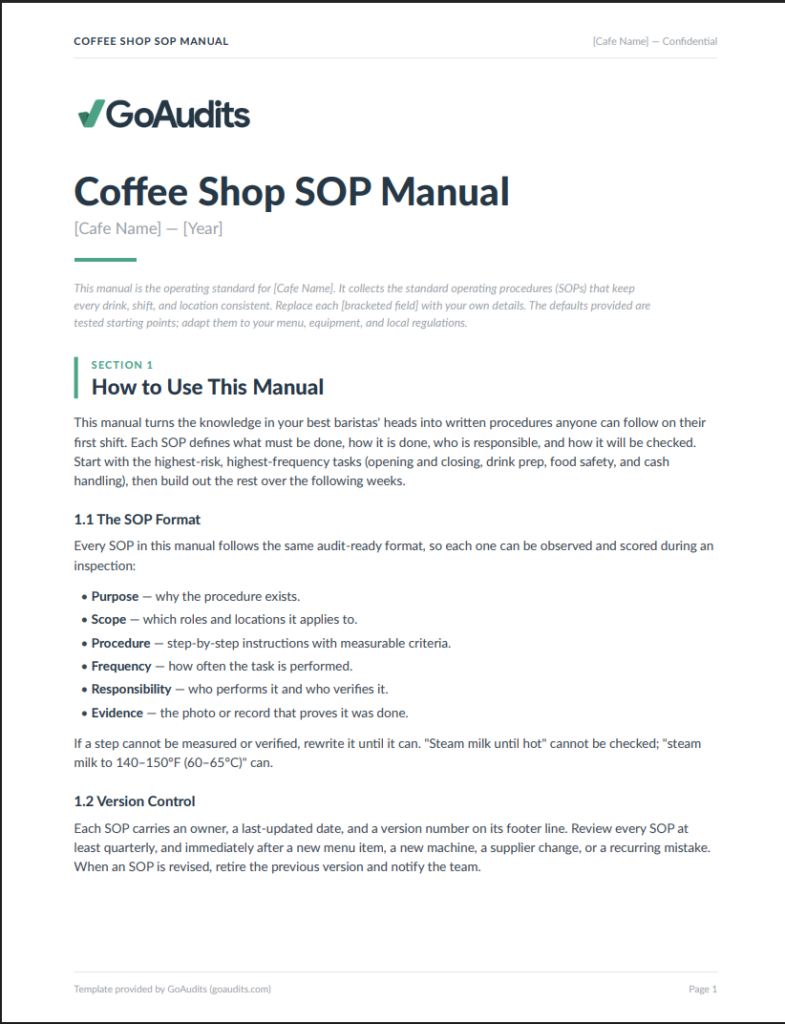
Use this as your starting point. You can copy the format for every drink and task in your cafe, or download our free coffee shop SOP PDF and fill in your own recipes and standards.
How to Get Baristas to Actually Follow Coffee Shop SOPs?
Baristas follow SOPs when each one becomes a checklist they complete on shift, with some form of verification. Writing the procedure is necessary. It is nowhere near sufficient.
You close that gap with verification built into the task:
- Live digital checklists. Staff completes the checklist on a phone during the shift, not from memory afterwards.
- Photo proof. A quick photo of the cleaned station or the stocked case turns “done” into evidence.
- Timestamps and location. A checklist completed at the cafe at 9:05 pm is real; one filled in from the car park is not.
- Spot audits. Periodic manager checks against the same SOP keep everyone honest.
- Action plans with owners. When something fails, it is assigned to a person with a due date, not lost in a group chat.
This is the difference between hoping SOPs are followed and knowing they are.
How to Keep Standards Consistent Across Multiple Coffee Shop Locations?
You keep standards consistent across multiple coffee shop locations by working every site from one central set of SOPs, then measuring each location against them on the same schedule. Consistency across sites is a measurement problem as much as a documentation one: if you cannot see how each cafe is performing, you cannot hold the line.
Four things make multi-site consistency work:
- Central template control. Every location runs the same SOP-based checklists, updated once and pushed everywhere, so no cafe drifts onto its own version.
- Per-site scoring. Each location’s audits produce a score, so a dip shows up as a number before it shows up in reviews.
- Cross-location benchmarking. Comparing sites surfaces your struggling location and your best-practice one.
- Centralized corrective actions. Head office assigns fixes with owners and deadlines, then sees them through to closure.
👉 Case Study: Independent Food Company Manages Standards Across 25+ Locations
Independent Food Company, a multi-site food and beverage group whose locations include coffee shops, runs quality across 25+ sites. By moving audits onto the GoAudits restaurant inspection app workflow, the teams file reports immediately after each visit and action 90% of issues within one to two days, rather than letting them sit.
According to Eliane, Quality Hygiene Manager, “as management, we are able to review branches’ performance and analyse our audit findings much better than before. It is clear that the QA and Food Safety team’s efficiency improved tremendously!“
» Read Full Story: How Independent Food Company 4x their audit turnaround.
How Do Coffee Shop SOPs Change as You Scale?
Coffee shop SOPs change in depth and structure as you grow, from a light personal reference to a full brand standard:
- Solo or owner-operated: Keep them light. They are mostly for your own consistency and to make your first hire painless.
- Small team: The training and handover layer becomes the priority, because you are now relying on people who do not carry your standards in their heads.
- Multiple sites: SOPs become brand standards with central oversight and version control, so every location delivers the same experience.
What are the Most Common Coffee Shop SOP Mistakes and How to Fix Them?
The most common coffee shop SOP mistakes share one root: treating the document as the goal instead of the result it is meant to produce. Here are the five that derail cafes most often, and how to fix each.
- Writing SOPs that are too long or too vague to use on shift. A three-page essay nobody reads at 7 am is not an SOP; it is just a document. Keep each SOP to one task with measurable steps, then compress it into a checklist your team can actually run during service.
- Leaving SOPs without a named owner. When everyone owns a procedure, no one does, and it quietly stops being followed. Assign every SOP to a specific role so there is always one person accountable for keeping it current and enforced.
- Treating SOPs as set-and-forget. SOPs that are written once and never revisited drift out of date and end up training bad habits with full confidence. Give each one a review date and an owner so it gets checked before it goes stale.
- Underestimating food-safety risk. Thinking “we only do coffee and cake” leads cafes to skip the allergen and temperature procedures they are legally required to keep. Treat the food side as a food business in its own right, not an afterthought to the coffee.
- Treating the written SOP as the finish line. This is the biggest mistake of all, because a perfect SOP that nobody follows changes nothing. Turn each one into an on-shift checklist with built-in verification, so the standard is confirmed on the floor and not just filed away.
GoAudits App for Coffee Shop Operations and SOPs
GoAudits turns your coffee shop SOPs from documents into checklists your team completes, and you can verify them on every shift and across every site. It works alongside your POS, not instead of it: the POS runs the transaction, and GoAudits runs the standard.
With GoAudits coffee shop SOP software and app, you can:
- Turn any procedure into a mobile checklist that staff completes on shift.
- Capture a photo and timestamp proof to see that the close-down actually happened, with evidence and a time.
- Assign action plans to owners, with deadlines.
- Track every location’s performance and spot drift before customers do.
- Run checks in a basement stockroom with no signal; everything syncs later.
- Use ready-made cafe checklists for opening, cleaning, and food safety, or build your own.
With a rating of 4.8 stars on Capterra, GoAudits is trusted by some of the biggest restaurant and cafe brands in the F&B industry.
» GoAudits Reviews: Read how companies leverage GoAudits to meet standards and deliver consistent services across locations.
FAQs
Coffee shops use a mix of tools to create and manage SOPs, and the right one depends on whether you want to write procedures, run them, or both. The main categories are SOP and checklist or audit apps (which turn SOPs into checklists staff complete and managers verify, like GoAudits), POS systems, and all-in-one cafe operations platforms. For most independent cafes and small groups, an audit and checklist app does the job that actually matters: making sure SOPs are followed, not just stored. GoAudits is built around inspections, photo proof, and multi-site scoring; tools like Jolt and Trail lean more toward shift task management. For a fuller comparison, see our guides to SOP management software and restaurant checklist apps.
Yes, and a ready-made template is a smart starting point, but you will always need to adapt it to your cafe. A bought cafe SOP template gives you the structure and a sensible default for common tasks. But it cannot match your exact recipes, equipment, menu, and layout. The fastest route for most cafes is to start from a free template or a checklist library, then customize the steps, standards, and owners to your shop.
Coffee shop SOPs center on drink consistency, counter service, and espresso equipment, while restaurant SOPs center on a full kitchen, table service, and a broader menu. A cafe lives or dies on barista technique, machine maintenance, and speed during the morning rush, so its SOPs go deep on grind, extraction, and milk. A restaurant carries more food-prep, line, and table-service procedures.
Yes, AI can draft a solid first version of a coffee shop SOP from a description of the task, which beats staring at a blank page. A practical workflow: let AI draft the steps, correct them to your cafe’s real method, then turn the result into a checklist your team completes on shift. Our AI checklist generator does exactly this, building ready-to-use checklists you can edit and deploy in minutes.