Achieving consistency in food service quality delivery requires detailed protocols. However, the foundation for establishing these protocols is having well-thought-out restaurant standards. Restaurant standards are the basis for every activity in a food company, and they significantly influence a dining place’s growth and reputation.
In this article, we discuss the potential benefits of having high-quality restaurant standards. We also outline how food service businesses can upgrade their existing operational guidelines and list free checklists.
What are Restaurant Service Standards?
Restaurant standards are a blueprint that defines what your guests can expect when they visit your eatery. In other words, these brand standards are a core part of the business identity of a food service business and a necessity for promoting customer loyalty. Without clearly stated corporate ideals, establishments may struggle to build a reputation and retain their customers. Hence, top brands in the food and hospitality sector use checklists and other tools to guarantee that these standards are maintained across all their branches.
Why Restaurant Service Standards Matter?
Here are some reasons why restaurant service standards are important:
- Ensure consistent guest experience across shifts, teams, and locations
- Reduce service errors, delays, and complaints
- Strengthen brand reputation and trust
- Improve staff accountability and clarity of expectations
- Support faster onboarding and smoother training
- Increase repeat visits and customer lifetime value
- Protect margins by minimizing food waste and inefficiencies
- Provide measurable benchmarks for performance improvement

Restaurant Service Standard Examples
Restaurant service standards address several issues, including customer safety, staff hygiene, ambiance, and food preservation. Adopting a bespoke approach to each of these areas of service can be enough to tip the scales in your favor and give you an edge in the restaurant industry. If you are unsure where to focus when outlining your brand standards, here are some areas you should consider.
Customer Service Standards
Customer service standards primarily focus on employee behavior while interacting with guests. Apart from the delicious meals and stunning decor, another significant determinant of restaurant ratings is how staff interact with guests. Your eatery must have guiding principles on how to treat visitors and maximum response times. To examine the state of your customer service, you can use a restaurant mystery shopper checklist.
General Safety Standards
Safety is a non-negotiable requirement for any restaurant. In 2021, the United States recorded over 1.3 million fire incidents, with cooking being the leading cause of these fires. General safety standards guarantee that your staff and visitors are protected from any avoidable accidents due to fire, electricity, or other means. Furthermore, they also address intervention measures in the event of an unpreventable mishap.
Food Storage and Preservation Standards
Food storage and preservation standards help you save resources by eliminating wastage. They are also valuable for ensuring that all meals prepared by your kitchen staff taste fresh. Restaurants that don’t have brand standards or quality control measures to guarantee adequate storage of food items are at risk of losing revenue to their competitors.
Environmental Hygiene Standards
A well-kempt, germ-free environment will ensure the well-being of the visitors to your food service business. However, this is only achievable with distinct environmental hygiene standards. These protocols direct a restaurant’s standard operating procedures for the sanitation of the dining area and other surrounding spaces. With this type of restaurant standard, employees know the minimum acceptable requirement for cleanliness in an establishment and are expected to comply with this expectation.
Decor and Furnishing Standards
Top restaurants know their ambiance and aesthetics cannot be left to chance. Hence, decor and furnishing standards guide their activities across all branches. Decor and furnishing standards define how your indoor and outdoor surroundings look. It typically covers even minute details such as the kind of furniture, paintings, curtains, and other often overlooked aspects of an eatery’s design.
How Can Restaurants Improve Service Quality Quickly?
Although having brand standards is excellent, restaurateurs must also vet the quality of these standards to ensure they yield the best customer retention and profitability results. For food service businesses that maintain poor evaluation metrics despite having brand standards, you can follow these steps to improve your existing operational blueprint.
1. Use Digital Checklists & Templates to Standardize Processes
Restaurant checklist templates are valuable for implementing brand standards across multiple departments and branches. Instead of following the cumbersome process of creating standard operating procedures from scratch, you can download and modify any of these restaurant checklists for free. You can also use the GoAudits restaurant checklist app to digitize your restaurant SOPs at no additional cost.
- Restaurant Cleaning Templates
- Restaurant Opening Checklists
- Restaurant Closing Checklists
- Restaurant Inspection Checklist
- Restaurant Employee Training Checklist
- Restaurant Operations Checklist
- Restaurant Manager Duties Checklist
- Restaurant Safety Checklist
- Restaurant Kitchen Cleaning Checklist
- OSHA Restaurant Inspection Checklist
- Personal Hygiene Checklist
- Food Receiving Checklist
- Forbes Dining Checklist
- LQA Restaurant Service Checklist

2. Perform Internal Audits & Evaluations Regularly
Restaurants can improve service quickly when they combine operational audits with staff performance reviews. Internal audits reveal how restaurant service actually unfolds during the guest journey, while evaluations help identify whether employees have the skills, clarity, or support needed to meet expectations.
When both insights are reviewed together, managers can detect whether problems stem from unclear processes, training gaps, or execution issues. This allows restaurants to address root causes quickly, reinforce strong performance, and maintain consistent service quality across teams and shifts.
3. Engage with Customers to Receive Feedback
Your customers are the most reliable source of feedback. Understanding what guests expect to see when they visit your restaurant can help you discover the necessary changes to upgrade your service quality. Rather than work based on assumptions, you can tailor your standard operating procedures to your visitors’ needs and improve your ratings.
4. Implement Top-rated External Brand Standards
Several third-party organizations can help you identify the current industry best practices. Reputable bodies, such as Forbes, ISO, and LQA, have brand standards that are proven to enhance the quality of service in food service businesses. You can use checklists, such as the ISO 22000 Food Safety Checklist, to guarantee that your visitors enjoy the best experience.
5. Train Staff Frequently
Staff training is a compulsory requirement for any thriving business, including restaurants. New and existing employees must be equipped to adequately manage guests and carry out their responsibilities as stated in your restaurant’s standard operating procedures.
After you have spotted aspects of your service to improve, you can create a training manual to prepare staff to execute your refined operational guidelines. For example, you can download and modify this restaurant employee training checklist to begin implementing your revised food service standards.
6. Track Key Restaurant Service Standard Metrics
Service quality becomes manageable only when restaurants track both guest perception and operational performance. Customer satisfaction scores, review sentiment, and complaint frequency provide insight into how guests feel about their experience, while timing data such as seating delays, order accuracy, and food delivery speed reveal where service execution breaks down.
Financial indicators also reflect service performance. Metrics like repeat visit rates, average spend per guest, and revenue generated per available seat help operators understand whether service quality supports profitability. When these restaurant KPIs are reviewed together rather than in isolation, they provide a clearer picture of how well restaurant standards are followed.
Enforce & Improve Restaurant Service Standards with GoAudits
Exceptional restaurant standards are one of the vital tools for success in the food service industry. Fortunately, technology simplifies the process of creating and implementing an operational blueprint for your eatery. With the GoAudits inspection app, several businesses have maintained consistent standards, improved their staff performance, and grown their profit margins exponentially.
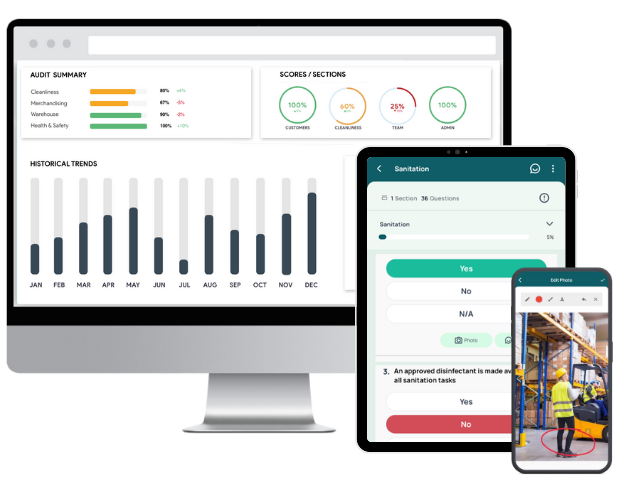
Leon Conditors is one of the many companies that have seen the massive impacts of technology on business growth. The food service company increased its inspection scores by at least 20%, from 70% to 90 – 100%. You, too, can reap the rewards of adopting a more innovative approach to your restaurant standards. Download the GoAudits inspection app and book a demo today.
👉 GoAudits helped the Independent Food Company digitize its food safety and quality audits, eliminating manual paperwork and enabling instant reporting after site visits. This reduced audit turnaround from several days to about one, improved team responsiveness, and significantly boosted overall restaurant QA efficiency.
FAQs
Service standards define what level of quality is expected, while standard operating procedures (SOPs) explain how to achieve it. For example, a service standard may state that guests must be greeted within 60 seconds, while the SOP explains how hosts should monitor arrivals and respond. Both are required for consistent restaurant performance.
Digital checklists translate standards into daily actions. They help staff follow procedures, reduce errors, and provide managers with measurable performance data. Restaurant audit checklists by GoAudits allow restaurants to track compliance trends, identify training gaps, standardize operations across locations, and maintain audit-ready records. This makes them one of the most effective tools for scaling service quality.
Restaurants often align with external benchmarks such as ISO food safety frameworks (e.g., ISO 22000), hospitality evaluation models from Forbes Travel Guide, service quality assessments from Leading Quality Assurance, etc. These frameworks help businesses benchmark performance against global best practices.
Digital inspection platforms like GoAudits automate audits, training validation, and compliance monitoring. They allow restaurants to identify operational gaps quickly and ensure standards are followed in every location. For multi-site operators, technology makes it possible to maintain brand consistency without increasing management overhead.
Use a mix of guest feedback scores, review analysis, service timing data, and operational KPIs like order accuracy and complaint rates. Combining perception metrics with real performance numbers gives the most accurate view of service quality.
Most restaurants should review their service standards every 6-12 months, or immediately after new menu or concept changes, major staffing shifts, customer satisfaction declines, and expansion to new locations. Regular reviews ensure standards stay realistic, enforceable, and aligned with evolving guest expectations.
Most standards fail because they are too vague (‘deliver great service’), not measurable, not linked to training, not monitored consistently, and not supported by management. Restaurant service standards only improve performance when they are specific, observable, and tracked regularly.
Multi-location restaurants typically rely on digital tools like GoAudits that offer standardized inspection checklists, centralized reporting dashboards, scheduled audits, structured SOPs for training staff, and more. Digital tools enable leadership teams to identify compliance gaps quickly and maintain consistent guest experiences across branches.