Key Takeaways
- Food handling procedures cover every stage food passes through, from delivery to disposal.
- The FDA names three practices restaurants control worst: cold holding, employee handwashing, and cooling.
- Sick food handlers are among the most common contributing factors in restaurant outbreaks, and most procedures never address them.
- US and UK temperature rules differ at every stage, so a procedure written for one market will fail an inspection in the other.
- Food safety auditing software like GoAudits turn each stage into a check with photo and timestamp evidence, so managers can see what was actually done rather than what was reported.
The FDA studied fast food and full-service restaurants across the US and found that the ones with a well-developed food safety management system had less than half as many practices out of compliance as the ones with no system at all. Full-service restaurants averaged 5.3 out-of-compliance items with nothing in place, and 2.2 with a system that worked.
The detail worth sitting with is how the FDA defines that system. Three parts: procedures, training, and monitoring. Writing the procedure is one-third of the job. The other two-thirds are teaching it and checking that it happens.
This guide covers all three. What the food handling procedures actually are at each stage food moves through your kitchen, with US and UK figures side by side, and the record that proves each one was followed.
- What are Food Handling Procedures?
- What are the Safe Food Handling Procedures at Each Stage of the Food Flow?
- Download Safe Food Handling Practices and Procedures PDF
- Which Food Handling Hygiene Practices Are Required At Every Stage?
- How Do You Know Your Food Handling Procedures are Being Followed?
- How GoAudits Helps With Food Handling Procedures
- FAQs
What are Food Handling Procedures?
Food handling procedures are the documented practices a food business follows at each stage food passes through, from receiving a delivery to disposing of waste, to keep it safe to eat.
Three terms are used interchangeably and shouldn’t be.
- A food handling procedure is the practice itself, such as probing a delivery before you sign for it.
- A food SOP is the document that records that practice so anyone can follow it.
- A HACCP plan is the hazard analysis system the procedures sit inside, identifying where the risks are and which controls are critical.
Most kitchens need all three, and a HACCP checklist is usually where the third one starts.
What Does a Food Safety Management System Require?
The FDA breaks a food safety management system into procedures, training, and monitoring, defining monitoring as routine observation and measurement to confirm the procedures are being carried out.
UK operators face a firmer version of the same idea: food businesses are legally required to have a documented food safety management system based on HACCP principles, so this is a duty rather than a recommendation.
Who Counts as a Food Handler?
A food handler is anyone who touches open food or surfaces likely to come into contact with food. That pulls in porters carrying trays, bar staff cutting garnish, and delivery drivers handling open containers, not just the chefs. Food handling policies and procedures that only cover the kitchen brigade leave a gap on the floor.
👉 Did You Know?
The FDA’s restaurant study found that fast food outlets with no food safety management system averaged 4.5 data items out of compliance, against 1.5 for those with a well-developed one. In full-service restaurants, the gap was wider, 5.3 against 2.2. Restaurants with a Certified Food Protection Manager on site also had fewer items out of compliance, and those where the CFPM was the person in charge scored significantly better overall.
Why Do Proper Food Handling Practices Fail in Busy Kitchens?
Food handling practices fail at the point of execution, not the point of writing, which is why kitchens with a full procedure manual still fail on the same handful of items year after year.
The CDC groups the causes into five risk factors:
- Food from unsafe sources
- Time and temperature abuse
- Inadequate cooking
- Poor personal hygiene
- Contaminated equipment
Time and temperature abuse means food sitting in the danger zone, and the danger zone is not the same number everywhere. Under the FDA Food Code, it runs from 41°F to 135°F (5°C to 57°C). Under UK guidance, it runs from 8°C to 63°C. If you have seen 40°F to 140°F quoted, that is USDA consumer advice for home kitchens, and it is not the foodservice standard.
The FDA found restaurants control:
- The three worst practices are cold holding of foods that need refrigeration, employee handwashing (both when and how), and proper cooling of TCS foods.
- Two they control well: no bare hand contact with ready-to-eat foods, and cooking raw animal foods to required temperatures.
- Inadequate cooking was among the best-controlled practices in the study.
The failures occur in the stages nobody watches, and not where the chef stands with a probe in hand. Unlike cooking, which has obvious checks, cold holding, handwashing, and cooling all depend on something happening consistently over hours, unobserved. Unsafe food handling practices are rarely a knowledge problem. They are a consistency problem, and consistency is what nobody measures.
What are the Safe Food Handling Procedures at Each Stage of the Food Flow?
Food handling procedures are easiest to run when they follow the food rather than the textbook. Eight stages, in the order food actually moves: receiving, storage, thawing, preparation, cooking, cooling and reheating, holding, and service and waste.
A note on the US figures: states adopt different versions of the Food Code, and a few still run older language such as 140°F for hot holding. Always follow the stricter of the model code and your local health authority.
Receiving Deliveries
Probe chilled and frozen goods before signing, and check packaging, date codes, and the state of the vehicle. Chilled should arrive at 41°F or below in the US, 8°C or below in England, Wales and Northern Ireland. Frozen should arrive frozen solid, with no ice crystals suggesting a thaw and refreeze.
Deliveries get signed for before anything is probed, usually when the dock is busy, and a breach that should have been caught at goods-in surfaces at service instead. Hold a delivery record with supplier, date, product temperature, and an explicit accept or reject decision. A food receiving checklist gives you that in a form a manager will actually complete.
👉 Case Study: How Independent Food Company Streamlines Auditing, Quality and Supplier Standards
The Independent Food Company runs more than 25 sites across restaurants, food trucks, and coffee shops, and cut audit turnaround from four days to one after moving these checks off paper to GoAudits.
As their Quality & Hygiene Manager, Eliane E., put it: “We are now able to submit reports immediately after the visit, and the Operations team is able to respond to 90% of the action plans within 1-2 days.”
» Read Full Story: How Independent Food Company achieved audit turnaround 4x faster.
Storage, Date Marking and Stock Rotation
Raw goes below ready-to-eat, always, and every opened container carries a date. That one rule of vertical order prevents more contamination than any amount of color coding.
In the UK, 8°C is the legal maximum for chilled storage, though the FSA recommends running fridges at 5°C to leave room for door openings. Freezers run at -18°C, or 0°F in the US.
Two things turn up on almost every storage audit: unlabeled containers nobody can date, and raw meat stored above ready-to-eat items because the correct shelf was full. Catch both by pairing a storage walk-through with fridge and freezer logs at set intervals. A food storage checklist covers the two together in one pass.
Thawing and Defrosting
There are four approved ways to thaw food, and the kitchen bench is not one of them:
- Under refrigeration
- Under cold running water
- In a microwave, with cooking to follow immediately
- As part of the cooking process
Most breaches here come down to space. Product gets left at ambient temperature when the fridge is full, and thaw containers end up above ready-to-eat food with nothing to catch the drip. Both are storage problems that surface as thawing problems. Label the container with the time thawing started and who started it.
Preparation and Cross-contamination
Separate boards, knives, and surfaces for raw and ready-to-eat, with hands washed in between. No bare hand contact with ready-to-eat food. Color coding helps, but only where it is enforced.
Cross-contamination at this stage usually comes from a single board or knife crossing between raw and ready-to-eat mid-service, which undoes every control upstream of it. Inspect the prep area during service, not before it.
A kitchen that is spotless at 9 am tells you very little about 8 pm, which is why a good hygiene SOP specifies when checks happen, not just what they cover.
GoAudits turns a hygiene SOP into a checklist your team runs on a set schedule, so the mid-service prep check becomes a scheduled item rather than something a supervisor has to remember during a rush. Each completed item carries a timestamp, the name of the person who ran it, and a photo where the finding is visual.

Cooking
Core temperature targets vary by protein and by market, so a single number on a wall chart will be wrong somewhere.
| Food (US, FDA Food Code) | Minimum internal temperature |
| Poultry, stuffed meats and stuffing | 165°F, instantaneous |
| Ground meats, injected or tenderized meats, ground seafood | 155°F for 17 seconds |
| Whole cuts of beef, pork, lamb, fish, eggs for immediate service | 145°F for 15 seconds |
| Whole roasts of beef and pork | 145°F for 4 minutes |
| Fruit, vegetables and grains that will be hot held | 135°F |
UK FSA guidance sets a core of 70°C for 2 minutes, or an equivalent such as 75°C for 30 seconds.
The temperature is rarely what goes wrong. What slips is probe placement, sampling one piece and treating it as representative of a full batch, and probes that have not been calibrated in months. Keep a cooking temperature log, and keep a calibration record beside it. The FDA found cooking to be among the best-controlled practices in restaurants, so the effort here belongs on calibration rather than on reteaching the targets.
Cooling and Reheating
Cooked food must cool from 135°F to 70°F within two hours, then to 41°F within four more hours. Miss the two-hour mark, and you reheat and restart, or discard. UK guidance asks for 8°C or below, ideally within 90 minutes.
Reheat to 165°F in the US, or until steaming hot throughout in England, Wales and Northern Ireland. Scotland sets 82°C as a legal minimum. Reheat once only.
Large volumes cooled in deep, covered containers are the most common cooling failure. Surface temperature drops fast enough to pass a spot check while the core stays in the danger zone for hours. A cooling log only works with a timestamp at each stage. One entry at the end tells you the food got cold, not how long it took.
Hot and Cold Holding
Hot holding runs at 135°F or 63°C and above. Cold holding runs at 41°F or 8°C and below. Cold holding is among the three practices the FDA found restaurants control worst.
Both markets let time replace temperature as the control. In the US, food held at 135°F or above, or 41°F or below, can come off temperature control with a four-hour discard label. In the UK, hot food can sit below 63°C for up to two hours and chilled food above 8°C for up to four hours, once; then it gets reheated, chilled, or discarded.
Equipment causes most of the trouble at this stage. Service units that were not brought up to temperature before food went in, and cold wells filled above the chill line, where the top of the pan sits in ambient air while the reading at the bottom looks fine. To prevent this, take a reading at fixed intervals through service and record the time with it.
Service and Waste
Clean utensil per dish, handle above the rim, swapped at least every four hours in continuous use. No bare hand contact with ready-to-eat items. Display covered.
Topping up is the failure most likely to pass unnoticed. Adding fresh product to a depleted tray buries the oldest food under the newest and extends its time in the unit, and the tray looks full throughout.
Waste segregated, bins away from prep, cleaning on a schedule someone signs. Sanitation SOPs cover what gets cleaned, with what, and how often. Close the stage with line checks taken during service and a signed cleaning schedule.
How Should Food Handling Practices Change For Different Food Types?
The stage procedures apply to everything. Food type changes the storage temperature, the shelf life, and the specific failure to watch for.
| Food type | Key handling rule | Cold storage (US / UK) | Most common failure |
| Dairy | Keep sealed and away from strong odors; milk may be received at 45°F but stored at 41°F | 41°F / 8°C | Left out during prep and returned to the fridge |
| Meat, fish and poultry | Store below all ready-to-eat items; poultry lowest of all | 41°F / 8°C | Poultry stored above other proteins, and one cooking temperature applied to all three |
| Eggs | Shell eggs may arrive at 45°F, stored at 41°F; pooled eggs treated as high risk | 41°F / 8°C | Pooled eggs held at room temperature through a service |
| Fruit and vegetables | Wash before cutting; cut leafy greens and cut melon are TCS foods | 41°F / 8°C | Treated as low risk after cutting |
| Frozen goods | Accept frozen solid; never refreeze after thawing | 0°F / -18°C | Ice crystals accepted at delivery |
| Dried goods | Sealed, off the floor, rotated first in, first out | Ambient, dry | Decanted into unlabeled containers with no date |
Good food handling practices for dairy, eggs, and cut produce all rest on the same point: these are time and temperature control for safety foods, and the clock on them starts earlier than most teams assume.
Safe Food Handling Tips
Eight safe food handling tips, one for each stage:
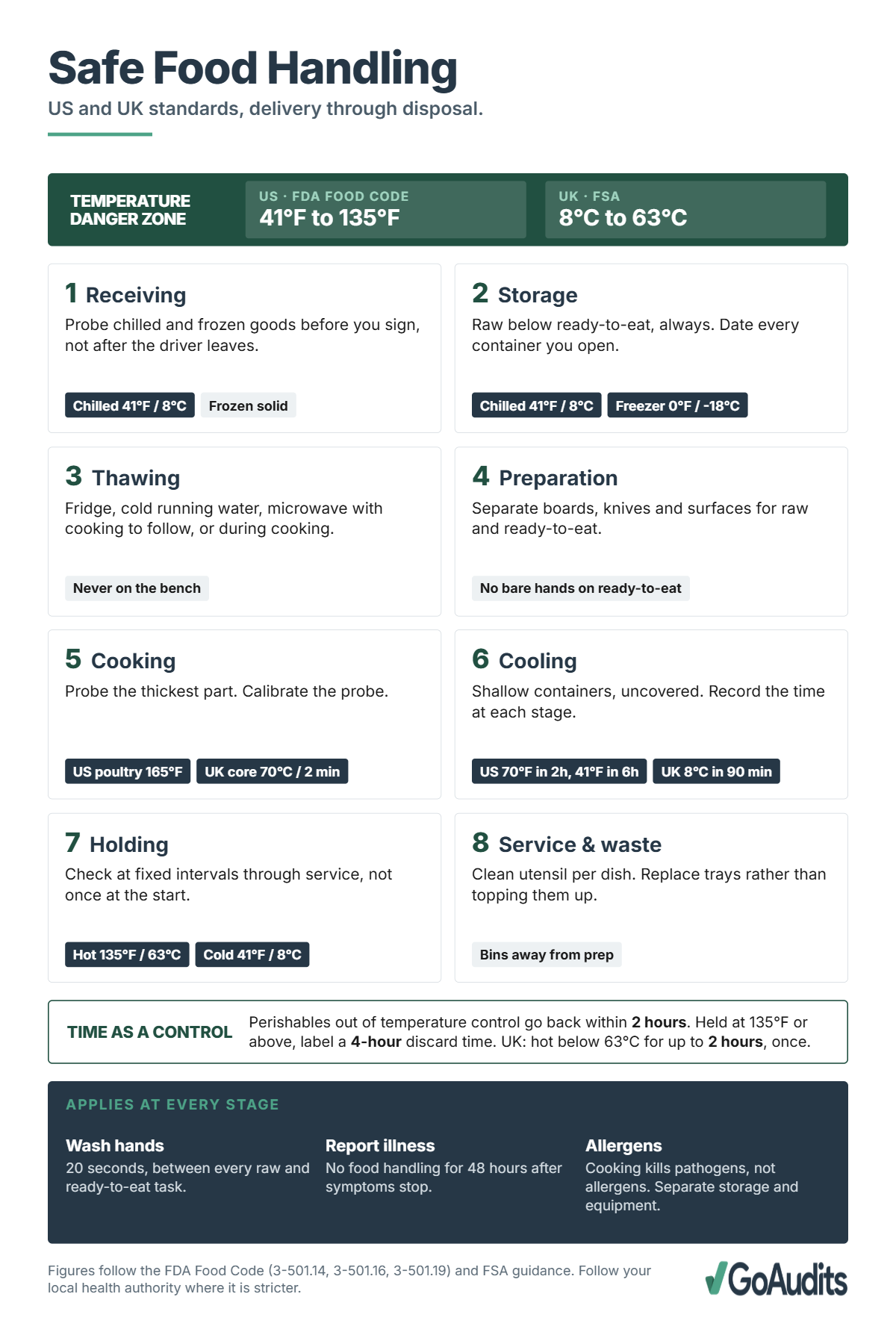
- Receiving. Probe before you sign, not after the driver leaves.
- Storage. Raw below ready-to-eat, and date every container you open.
- Thawing. Fridge, cold running water, microwave, or during cooking. Never the bench.
- Preparation. Separate boards and surfaces, and wash hands between raw and ready-to-eat.
- Cooking. Probe the thickest part, and calibrate the probe.
- Cooling. Shallow containers, uncovered, with the time recorded at each stage.
- Holding. Check at intervals through service, not once at the start.
- Service and waste. Replace trays, never top them up.
Every stage above maps to a food audit checklist you can run today:

Download Safe Food Handling Practices and Procedures PDF
A 10-page working document that covers all eight stages with US and UK figures side by side, then gives you eight blank record forms to print: goods-in, fridge and freezer, cooking temperatures, two-stage cooling, holding checks, probe calibration, corrective actions, and fitness to work.
There’s also a one-page setup sheet for the decisions only you can make, like who receives deliveries, how often temperatures get logged, and whether exclusion is paid.
Which Food Handling Hygiene Practices Are Required At Every Stage?
Three controls apply at every stage rather than at one: handwashing, staff illness reporting, and allergen separation. Food handling hygiene practices fail differently from stage procedures, because there is no single moment where someone is supposed to check them.
Handwashing
Hands get washed after raw food, after waste, after breaks, after touching a face or phone, and before any ready-to-eat task. Twenty seconds with soap and warm water, dried properly.
Everyone knows that. The gap between knowing and doing is why the FDA lists handwashing among the three worst-controlled practices in restaurants. A CDC study of 321 restaurant workers found they performed around 8.6 activities per hour requiring a handwash, and washed correctly in 27% of them.
Gloves make it worse, not better. Workers wearing them attempted handwashing less often than those without, 18% against 37%. A glove policy introduced without a handwashing policy can move you backwards.
Staff Illness and Fitness to Work
The CDC names sick food workers among the most common contributing factors in restaurant outbreaks, which makes staff illness the highest-impact procedure most kitchens have never written down.
In the US, the Food Code requires employees to report five symptoms to the person in charge: vomiting, diarrhea, jaundice, sore throat with fever, and an infected wound with pus on hands, wrists, or exposed arms. Six pathogens trigger exclusion or restriction, and a written employee health policy is required. In the UK, staff must report illness immediately, and anyone with diarrhea or vomiting is excluded for 48 hours from when symptoms stop naturally.
The FSA adds a point almost nobody builds into a procedure: penalizing staff for sickness absence, including not paying them while excluded, pushes them to work while ill. Incentives rewarding fewer sick days do the same.
Allergen Control
Allergen cross-contact is not the same as microbiological cross-contamination. Cooking destroys pathogens but not allergens, so a surface that is microbiologically clean can still carry enough protein to cause a reaction.
The controls are separate storage, separate equipment or dedicated prep time, and ingredient information that stays accurate when a supplier substitutes or a recipe changes. The UK requires information on 14 named allergens.
Two failures recur: treating a wash-down as sufficient when it clears bacteria rather than protein, and an allergen matrix that nobody owns the review for.
» Useful Resource: The personal hygiene checklist captures both as part of a routine shift check rather than as a separate piece of admin.
How Do You Know Your Food Handling Procedures are Being Followed?
You know a procedure is being followed when you hold a record of it happening, with a time, a named person, and evidence attached. A completed checkbox is not that record.
Three things turn a completed checklist into proof: evidence that stands up on its own, verification that does not rely on the person being checked, and a response when a check fails.
Evidence That Stands Up on Its Own
Four properties separate evidence from paperwork:
- Timestamped, so you know when the check happened, not just that it was signed off at some point that day
- Attributable, so you know who did it
- Photographic, where the finding is a visual state such as a storage layout or a prep surface
- Linked to a corrective action with an owner and a due date
In the GoAudits food safety app, each check carries its own timestamp and the name of the person who completed it, with photos attached to the finding rather than emailed separately afterwards.
Verification That Does Not Rely on Self-Reporting
A signed-off checklist tells you a manager says the check happened. Where sites audit themselves and head office verifies, the distance between those two statements is the entire control, and it is where multi-site standards quietly drift.
Paper cannot close that distance, because nothing on a paper form distinguishes a check that was done from a check that was recorded.
This matters most for UK operators, where the Food Hygiene Rating Scheme score is displayed publicly, and inspections run from roughly every six months for high-risk premises to two years or more for low-risk ones. An inspector sees your kitchen for a few hours. The records you keep between visits are what the rating is built on, and a food hygiene daily checklist is the simplest way to build them.
👉 Case Study: How Castle Food Health & Safety evidences compliance for EHO visits
Castle Food Health & Safety is a UK consultancy working with hotels, resorts, and restaurants. Their clients use GoAudits to log non-conformances, assign fixes, and hold the evidence for inspection.
As Director Stephanie Collyer put it: “Our clients have been very positive about this tool, as their teams now use the system to address the non-conformances, record resolution, and evidence for the EHO.”
» Read Full Story: How Castle Food, Health & Safety saves time with efficient digital audits.
A Response When a Check Fails
A finding with a designated owner and a closure date is what separates a useful kitchen inspection from a filing exercise, and it is why a restaurant SOP should say who acts on a failed check, not just who performs it.
What the failure pattern tells you:
- One location failing the same check three weeks running is a training signal aimed at one team, not a case for a company-wide refresher
- Every site failing the same item points at the procedure, not the people
- Training records sit alongside cooling logs and cleaning schedules in the evidence a regulator asks for
Digital checklists help on the way in, too. An item that reads “chilled at or below 41°F / 8°C, reject above” teaches the standard at the moment someone applies it, which a slide deck from six months ago does not. Checks like that reinforce training and show where it is not holding. EHO inspections reward operations that can produce evidence on request rather than reconstruct it.
How GoAudits Helps With Food Handling Procedures
GoAudits food safety software turns each stage of the food flow into a check your team completes on a phone or tablet, with evidence attached and corrective actions tracked to closure. It sits on the monitoring third of the FDA’s framework, the part that tells you whether the procedures you wrote are being followed.
With GoAudits, you can:
- Create stage-by-stage digital checklists for every step, from receiving to service
- Take photo and timestamp evidence attached to individual checks
- Capture data for cold rooms, basements, central kitchens, and mobile units offline
- Assign corrective actions with owners and due dates within the app, and track them to closure
- Compare sites, teams, and time periods with a multi-site dashboard
With a rating of 4.8 stars on Capterra, GoAudits is trusted by some of the biggest names in the food and restaurant industry.
» GoAudits Reviews: How food businesses leverage GoAudits to strengthen quality control processes.
FAQs
The food business operator in the UK, and the person in charge under the US Food Code. Responsibility does not transfer downward: a head chef running the procedures does not relieve the operator of liability if those procedures are inadequate or unenforced. In a multi-site group, the operator is usually the company, which is why head office verification of site-level checks matters legally as well as operationally.
There is no legal requirement for a formal certificate in the UK, but operators must ensure training proportionate to the role. Level 2 Food Safety is the convention for general staff, Level 3 for supervisors. In the US, requirements vary by state and local jurisdiction, and many require a Certified Food Protection Manager on site. Check with the health authority that inspects you.
Whenever something they depend on changes, and at least annually. Four triggers should force an immediate review: a menu change introducing a new process or allergen, new or replaced equipment, a regulatory change, and any incident, complaint, or failed inspection. Procedures reviewed only on a calendar fall out of step with the kitchen well before the year is up.
Make the food safe first, then find out why the procedure failed. Isolate or discard affected product, record what happened, and assign a corrective action with a named owner and a deadline. Most operations skip the root cause. A gap in the procedure needs the procedure rewritten; a trained person ignoring a clear procedure is a supervision problem, and retraining will not fix it.
The core procedures stay the same, but delivery adds a handover you no longer control. Hot food must leave at or above 135°F or 63°C and stay there in transit, which means insulated bags and realistic delivery radii. Cold travels separately from hot. Packaging should be tamper-evident and carry allergen information. The real risk is completed food sitting on a pass waiting for a driver, unrecorded time in the danger zone.
Temperature control, because it is fast to verify and hard to fake. Expect fridge and freezer readings, hot holding checks, and a look at your logs within the first few minutes. Handwashing facilities come next, including whether sinks are accessible, stocked, and used for handwashing rather than storage. Then storage layout, then records. Inspectors check the things that leave evidence.