

Mystery Shopping Checklist Templates: Free PDF and Examples
Template Library > Retail Checklists > Mystery Shopping Checklists
Standardize Mystery Shopping Audits with Ready-to-Use Checklists
A mystery shopping checklist structures the observations a secret shopper or guest records during an anonymous visit. The templates below cover formats used in retail, restaurants, hotels, cafes, healthcare, banking, and property management.
Use them to:
- Standardize secret shopper audits across locations, regions, and shoppers
- Capture objective evidence of staff service, store standards, and customer experience
- Score visits consistently using yes/no items, rating scales, or weighted sections
- Cover the full customer journey from entry to checkout in one record
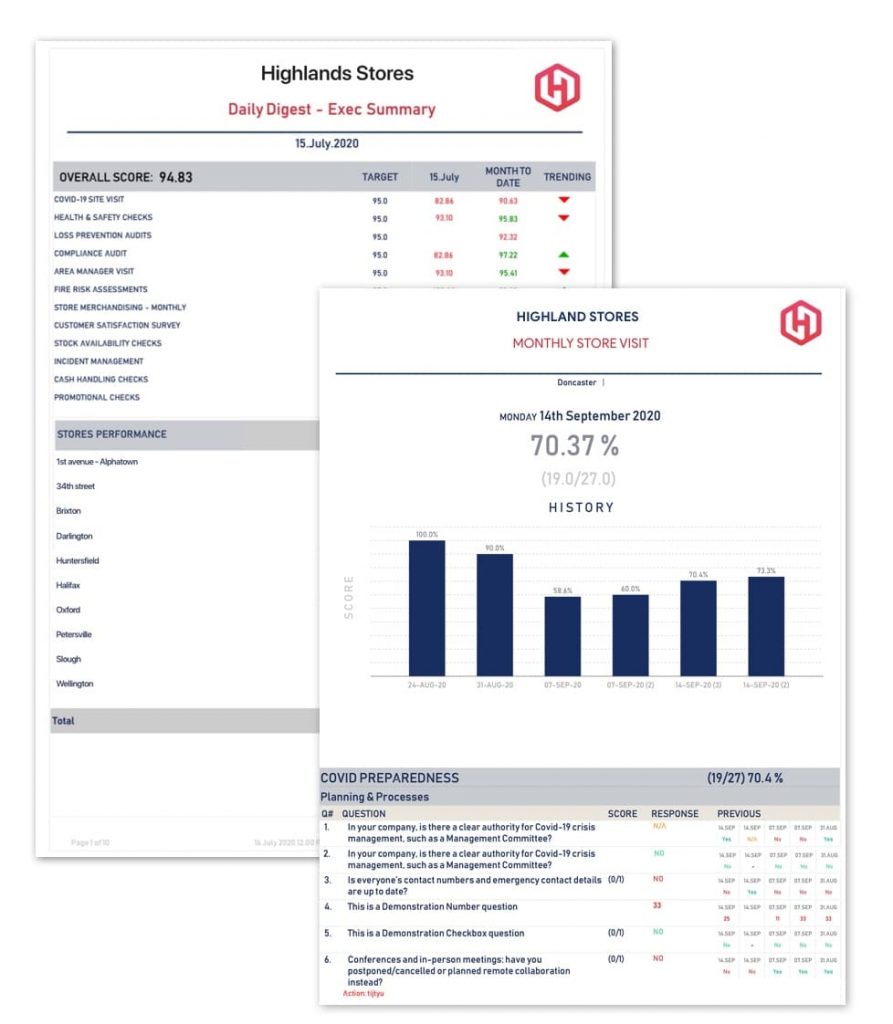
With the GoAudits Mystery Shopper App, you can:
- Eliminate paperwork: conduct discreet digital audits, capture photos right on a mobile device
- Customize this template or easily build your own secret shopper survey or evaluation form
- Save time with instant reports and track performance over time
General Questions
Reception
Rate The Staff Member/s
Services At The Store
Environment
General Questions
Reception
Rate The Staff Member/s
Services At The Store
Environment
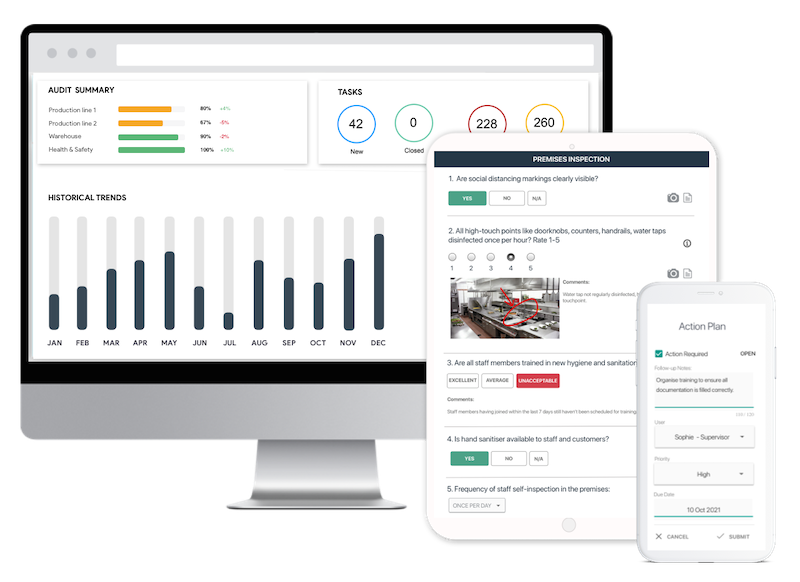
Save Time with Digital Inspections
- Easily capture & attach photos, directly on your mobile device.
- Instantly generate and share detailed reports after the inspection.
- Track corrective actions, view historical trends, improve standards.


What is a Mystery Shopping Checklist?
A mystery shopping checklist (also called a secret shopper checklist) is the structured document a shopper carries into a business and uses to record observations during an anonymous visit. The artifact goes by several names depending on the industry: mystery shopping checklist, secret shopper checklist, mystery shopper checklist template, mystery shopper survey, or mystery shopper form. All describe the same thing: a form that defines exactly what to evaluate, what to ask, and how to score what the shopper sees.
These checklists are used across retail, hospitality, food service, banking, fitness, healthcare, apartments and any multi-location business that wants to measure how their standards are actually delivered, not how they’re supposed to be. The Mystery Shopping Providers Association (MSPA), the trade body that sets industry standards, frames mystery shopping as a process for measuring adherence to defined standards of staff performance and quality of service. The checklist is what makes that measurement repeatable across visits, locations, and shoppers.
GoAudits Mystery Shopper Software: GoAudits helps retail, hospitality, and financial services brands run secret shopper audits on mobile, with photo capture, instant PDF reports, and corrective action tracking built in. Explore mystery shopper software.
What a Mystery Shopping Checklist Should Include
A complete mystery shopping checklist covers six core areas of the customer experience, from the moment the shopper arrives to the moment they leave. The hero template above aligns with these sections and is broad enough to adapt to any service business.
- Physical environment and first impressions. Exterior, signage, parking, entrance, interior cleanliness, lighting, temperature, music, restroom condition.
- Reception and greeting. Time to acknowledgment, eye contact, warmth of greeting, offer of help. Many service-quality programs use the first 30 seconds as the benchmark.
- Staff behavior and product knowledge. Visibility on the floor, willingness to assist, product or menu knowledge, uniform and name tag compliance, exit thank-you.
- Service quality and transaction. Wait time, product or service accuracy, upsell or loyalty mentions, checkout smoothness, receipt accuracy.
- Cleanliness, hygiene, and compliance. Brand-standard items the shopper can observe, food handling visibility, display compliance, pricing accuracy, stock levels, visible safety hazards.
- Digital and remote channel experience (where relevant). Phone enquiries, live chat, email responses, and online pre-visit touchpoints (website accuracy, booking flow, response time).
- Overall impression and recommendation. Subjective summary captured at the end: would the shopper recommend the location, what stood out, what was the biggest service gap, overall rating (1-5 or 1-10).
A mystery shopper questionnaire used for richer experience capture usually adds rating scales and open-text fields to these same six sections. The structure stays the same.
Types of Mystery Shopping Checklists by Industry
Different industries adapt the six core sections to their customer journey. The mistake most teams make is forcing a generic checklist onto a specialized journey: a hotel mystery guest checklist that lacks a pre-arrival section misses booking-experience issues, a QSR checklist without speed-of-service KPIs misses the most important benchmark. Match the template to the vertical.
Retail mystery shopper checklist. For chain stores, franchises, or single locations. Focus on store appearance, employee behavior, the path to purchase, and checkout. Sometimes called a retail secret shopper checklist. Use the retail mystery shopper checklist as a starting point.
Restaurant mystery shopper checklist. Covers atmosphere, food and service quality, staff behavior, management presence, and overall visit. Add timing benchmarks (drinks within 5 minutes, food within 15-20) and a tip/check accuracy section. Start with the restaurant mystery shopper checklist.
Hotel mystery shopper checklist (mystery guest). Covers the full guest journey: booking, arrival, check-in, room, F&B, housekeeping, departure. Also called a mystery guest checklist. The hotel mystery shopper checklist covers all sections, and the hotel mystery audits guide shows how hospitality groups use it to maintain brand compliance across multiple properties.
Coffee shop and cafe mystery shopper checklist. For independents, chains, and quick-service venues. Focus on exterior appearance, ambience, beverage and food quality, queue speed, restroom condition, and staff awareness. The coffee shop mystery shopper checklist works for most cafe formats.
Bank and financial services mystery shopping questionnaire. For branch banks, credit unions, and financial services locations. Covers reception speed, teller and advisor knowledge, wait times, compliance disclosures, and overall service quality. The general mystery shopping checklist adapts well, and GoAudits is used for banking and insurance customer audits by mystery shopping consultancies.
Healthcare mystery shopper questionnaire. For clinics, urgent care, dental practices, and hospital outpatient services. Covers patient reception, wait time, clinical staff communication, privacy at intake, and discharge experience. Most healthcare programs use a questionnaire format (mixed scaled and open-text) rather than a simple checklist because patient experience needs richer narrative capture.
Apartment mystery shopping report template. For property management companies running shopper visits on leasing offices and tour experiences. Covers initial inquiry response, leasing agent follow-up, tour quality, apartment unit presentation, and application/close handling. Multifamily shops typically produce a formal report that gets shared with property owners, so the artifact is structured as a report template rather than a simple checklist.
Fast food and QSR mystery shopper checklist. For drive-thru, counter service, and dine-in QSR. Speed of service is the defining KPI: time from order to handover, drive-thru lane time, order accuracy, food temperature at pickup. Adapt the restaurant checklist by replacing the dining-room section with speed-of-service items.
Gym and fitness mystery shopper checklist. For health clubs, boutique studios, and chain gyms. Covers the joining/tour experience, front-desk service, cleanliness, equipment availability, and class quality. The GoAudits gym inspection software supports custom mystery shopper checklists alongside operational gym inspections.
Salon, spa, dealership, telephone, and other verticals. Salon and spa shops focus on consultation quality, treatment standards, and hygiene. Car dealership shops cover arrival, sales staff, test drive, and finance handover. Telephone (mystery caller) shops drop the physical environment section entirely and expand call-handling and scripting items. The general checklist adapts to all of these.
Don’t see your industry? The general mystery shopping checklist adapts to any service business. Send your existing checklist (in any format) to GoAudits and the team will digitize it at no cost.
Checklist, Questionnaire, Survey, or Evaluation Form: Which Format?
The same core content can be packaged several ways, and the names overlap in confusing ways across the industry. The format you pick depends on whether you want fast compliance data, richer experience data, or scored performance data.
- Mystery shopper checklist (yes/no items). Simplest form. Each item is a binary observation. Fast to complete, easy to aggregate, ideal for compliance measurement across many locations.
- Mystery shopper questionnaire (mixed open and scaled). A mystery shopper questionnaire mixes yes/no items with rating scales, multiple-choice, and short open-text fields. Used when you want both compliance data and qualitative colour. A mystery shopper questionnaire template typically lives alongside the checklist in the library.
- Mystery shopper survey or secret shopper survey (scaled, experience-focused). A mystery shopper survey and a secret shopper survey are the same artifact under different names. Both lean more heavily on rating scales and open-text response than a checklist does, prioritizing the experience narrative.
- Mystery shopper evaluation form or assessment form (weighted and scored). An evaluation form (sometimes called a mystery shopper assessment form) adds a scoring layer. Each section carries a weight and items roll up to section scores, then to a total. Used for performance benchmarking across locations.
Most established mystery shopping programs use a hybrid. The GoAudits app supports all formats in a single checklist, so you can mix question types in the same audit.

Common Mystery Shopping Findings and What to Watch For
Every mystery shopping checklist exists to catch the same recurring gaps. Knowing what these checklists are designed to flag helps decide what’s worth investigating when an item fails.
- Slow or absent greeting beyond the 30-second benchmark, especially at low-staffed times
- Inconsistent product knowledge across staff on the same shift
- Missed upsell or loyalty mentions at checkout, which drive measurable revenue when consistent
- Wait times outside published benchmarks for service, food delivery, or checkout
- Visible compliance gaps in pricing accuracy, promotional display, or food handling
- Uniform and name tag non-compliance, especially during shift changeover
- Receipts that are missing, inaccurate, or not offered
- No exit acknowledgment from staff as the shopper leaves
- Restroom and back-of-house cleanliness issues that customers notice but don’t report
The global mystery shopping services market reached $2.31 billion in 2025 and is projected to hit $3.61 billion by 2034 (CAGR 5.12%), driven by retail and hospitality brands investing in customer-experience measurement to defend share. North America accounts for around 44% of that spend. The growth isn’t in more shoppers per visit; it’s in standardized, technology-enabled programs that run consistent audits across more locations more often.
How to Use These Mystery Shopping Checklist Templates
Pick the right template, capture observations on a mobile device discreetly, and let the system produce the report. Five steps make up the workflow most service businesses settle on.
Step 1. Pick the Right Template for Your Industry and Format
Match the template to the visit. A QSR drive-thru shop uses a different checklist than a luxury hotel mystery guest visit. A compliance-heavy banking shop uses a mystery shopper checklist (yes/no items); an experience-focused boutique-hotel shop uses a mystery shopper survey or evaluation form. Running the wrong format wastes the visit.
Step 2. Download as PDF or Open in the GoAudits App and Customize
Use our templates as a starting point, and customize them to your specific setting. Every template on this page is available as a free mystery shopper template PDF for printing, and as a customizable digital version in the GoAudits app. The PDF works for one-off audits. The digital version is better for anything you’ll repeat: it stores results, attaches photos to specific items, applies weighted scoring automatically, and produces an audit-ready report the moment the shop closes.
Step 3. Capture Photo Evidence and Timestamp Each Observation
Attach a photo to any failed item and a comment to anything borderline. Photo evidence and timestamps protect against memory bias (mystery shoppers writing reports hours after the visit notoriously misremember timing) and let manager reviews compare current visits against previous ones. The mobile app handles capture discreetly without breaking the shopper’s cover.
Step 4. Assign Corrective Actions for Any Failed Items
Every failed item should generate a corrective action with an owner, priority, and due date. Without that step, the same finding shows up on the next visit. The mystery shopping report is what management actually reads, and a well-structured report packages findings with assigned next steps rather than just listing observations.
Step 5. Aggregate Results Across Visits and Locations
A single shop captures one moment. The value comes from aggregating shops across locations, shoppers, and time to spot patterns: which locations consistently miss the greeting benchmark, which menu items get inaccurately described, which times of day have the biggest service gaps. Multi-location reporting is where digital mystery shopping pays back the platform cost.

Why Use GoAudits for Your Mystery Shopping Audits
Most mystery shopping programs generate reports, but few drive operational change. The gap is almost always the same: findings stay in a document rather than becoming tasks someone owns.
GoAudits is built around the improvement loop, not just the report:
- Findings become assigned actions. Every failed item triggers a corrective action with an owner and a deadline the moment the audit closes. No manual follow-up, no chasing by email.
- Completion is tracked. Outstanding actions stay visible on a dashboard until resolved. Nothing gets buried.
- Scores trend over time. Compare locations visit-on-visit, by section, or by shopper. The programme becomes a continuous performance signal, not a series of one-off snapshots.
- Photo evidence attached at the point of observation. Storefront condition, uniform compliance, food presentation: photos link directly to the checklist item, with context intact when the action is assigned.
- Multi-site visibility in one place. Brands running shops across multiple locations get a single dashboard view by site, region, or period. No re-entering data, no spreadsheet consolidation.
- Auto-generated reports. Every shop produces a formatted, photo-rich report the moment it closes.
- All question types in one checklist. Yes/no, rating scales, weighted scoring, open text: no need to choose between checklist and questionnaire upfront.
“We conduct mystery shopping surveys for our customers in banking & insurance, retail and other sectors. We have clearly gained efficiency in the implementation, analysis and evaluation of the audits.”
👉 Tobias Müller, Managing Partner, Nuance Advisory
The platform sits alongside the retail audit software and hospitality audit software workflows, so mystery shopping fits into the same toolset as scheduled QA audits and brand-compliance inspections.
FAQs
What should a mystery shopping checklist include?
A mystery shopping checklist should cover six core sections: physical environment and first impressions, reception and greeting, staff behavior and product knowledge, service quality and transaction, cleanliness and compliance, and overall impression. Where applicable, an extra section should cover phone or online interactions. Each section contains 5-15 specific observation items to be answered objectively, ideally with timing or behavior benchmarks rather than subjective adjectives.
How is a mystery shopping checklist different from a mystery shopper questionnaire or survey?
A mystery shopping checklist uses mostly yes/no items focused on whether specific standards were met. A mystery shopper questionnaire mixes yes/no items with rating scales and open-text questions for richer experience data. A mystery shopper survey (or secret shopper survey) leans even more heavily on scaled responses and narrative. All three cover the same six core sections; the difference is how the questions are framed and scored.
How many questions should a mystery shopping checklist have?
A typical mystery shopping checklist runs 40-80 items across the six core sections. Shorter checklists (under 30 items) miss too much; longer ones (over 100) are hard for the shopper to complete discreetly during a normal visit. Prioritize items that test specific, observable standards your business actually cares about, and cut anything generic.
Can a mystery guest checklist be used as a mystery shopping checklist for hotels?
Yes. “Mystery guest checklist” is the hospitality industry’s preferred term for the same artifact: a mystery shopping checklist adapted to the hotel customer journey (booking, arrival, check-in, room, F&B, departure). The structure and scoring approach are identical to retail or restaurant mystery shopping; only the sections and items change.
Is a free mystery shopper template enough for a multi-location program?
A free mystery shopper template in PDF form works for one-off audits or small businesses. For multi-location programs running audits regularly, the limitations show up fast: paper forms can’t capture photos or GPS, scoring has to be done manually in spreadsheets, reports arrive days late, and comparing locations means re-typing data. A digital mystery shopping checklist on a mobile app removes all of that overhead while keeping the underlying checklist structure identical.
Other Popular Mystery Shopping Checklists:

Retail Operations Checklist App
- Easily perform audits anywhere in the facility using a mobile device.
- Capture and attach photos as proof of compliance or areas needing attention.
- Assign tasks, set deadlines, and track progress, all within a single app
- Analyze data from audits to identify trends, pinpoint recurring issues, and assess compliance levels.