ISO 19011:2018 is the international guideline for auditing management systems, covering how to plan, conduct, and improve internal and external audits for standards such as ISO 9001, ISO 14001, ISO 45001, ISO 15189, and others. It is guidance (not a certifiable standard) and focuses on the principles of auditing, managing audit programs, planning & conducting audits, and defining & evaluating the competence of everyone involved in audits. It builds on classic audit principles and adds a risk-based approach, treats the audit program like a managed process, and describes a PDCA-like sequence for each audit.
This article will explore the ISO 19011 audit guidelines in detail, covering their importance, steps to conduct audits based on these requirements, and free audit checklists.
- Understanding ISO 19011 Guidelines for Auditing Management Systems
- Key Changes in ISO 19011:2018 Compared to 2011
- Key ISO 19011 Audit Principles & Requirements
- How to Conduct Audits According to ISO 19011 Audit Guidelines?
- Perform Internal Audits to Strengthen Your Audit Management System
- Free & Customizable ISO Checklists
- FAQs
Understanding ISO 19011 Guidelines for Auditing Management Systems
This standard gives general guidance on how to create a risk-based audit program.
Principles of Auditing
ISO 19011 defines key principles that make audits reliable, objective, and useful for management. These typically include integrity, fair presentation, due professional care, confidentiality, independence, and evidence‑based, risk‑based, and objective approaches. They ensure that audit results are trustworthy and can support decision‑making and continual improvement.
Managing an Audit Program
An audit program is a set of one or more audits planned for a specific time frame and purpose. ISO 19011 guides organizations to:
- Define objectives, scope, criteria, and methods for the audit program.
- Consider areas of higher risks, complexity, performance issues, and opportunities when planning.
- Establish roles, responsibilities, and resources for program management.
- Implement, monitor, review, and improve the audit program so it remains aligned with business priorities and changes in the management system.
Conducting an Audit
ISO 19011 treats an individual audit as a process with clear stages. Typical steps include:
- Initiating the audit: appointing the team, confirming feasibility, defining audit objectives, scope, and criteria, and agreeing on dates.
- Preparing for the audit: reviewing documents, preparing the audit plan, assigning work to team members, and preparing working documents/checklists.
- Conducting on‑site or remote activities: opening meeting, collecting and verifying evidence through interviews, observation, and document/record review, and identifying findings (conformities, nonconformities, and opportunities for improvement).
- Reporting and closing: holding a closing meeting, agreeing on reported findings, issuing the audit report, and defining follow‑up actions, including verification of corrective actions where applicable.
Competence and Evaluation of Auditors
ISO 19011 emphasizes that audit effectiveness depends heavily on auditor competence. Organizations should:
- Define competence requirements based on the audit scope and management systems involved (knowledge of the relevant standards, regulatory requirements, and organizational processes).
- Ensure auditors have appropriate personal attributes (ethical behavior, open‑mindedness, diplomacy, tenacity, and the ability to communicate and work in a team).
- Develop and maintain competence through training, mentoring, supervised audits, and continual professional development.
- Systematically evaluate auditors and audit team leaders using defined criteria (observed performance on audits, feedback from auditees and audit clients, results of previous audits) and use this to determine approval, maintenance, or withdrawal of auditor status.
What are the Benefits of Following ISO 19011 Audit Guidelines?
Following ISO 19011 audit guidelines offers practical, measurable advantages for organizations seeking stronger governance, efficient operations, and sustained compliance. The framework clarifies expectations, aligns auditors, and embeds consistency across every stage of the audit cycle.
- Ensures every audit follows the same disciplined process and produces comparable, reliable insights across all functions.
- Standardized expectations for auditor skills strengthen audit accuracy and build organizational confidence in findings, and reinforce trust among regulators, customers, and internal stakeholders.
- Audits help systematically identify weaknesses early, enabling organizations to address root causes before they escalate into operational, financial, or compliance failures.
- Cost reduction and management improve as structured audits help eliminate inefficiencies, reduce rework, streamline corrective actions, and optimize resource allocation across the audit cycle.
- Better performance and regulatory ISO compliance result from consistent evaluation of processes, ensuring that operations meet legal requirements while driving measurable improvements in quality, efficiency, and governance.

Key Changes in ISO 19011:2018 Compared to 2011
The main changes in ISO 19011:2018 versus ISO 19011:2011 include updates to terminology and annex structure, to align with the modern generation of ISO standards, as well as three key areas of update:
Principles and Risk-Based Approach
A seventh principle, ‘risk-based approach’, was added, making consideration of risks and opportunities mandatory throughout audit planning, execution, reporting, and follow‑up. This principle is now woven into guidance on audit programme design, audit objectives, sampling, and prioritization, so that audits focus more on areas of higher risk and performance impact.
Audit Program and Conduct
Guidance on managing the audit programme was expanded, including how to identify and manage risks and opportunities within the audit programme itself (e.g., auditor availability, complexity, regulatory exposure, and use of remote audits).
Guidance on conducting audits was strengthened, particularly around audit planning, use of information and communication technologies, virtual/remote auditing, supply chain audits, and focusing audits on performance and effectiveness rather than only conformity.
Auditor Competence
Generic competence requirements for auditors and audit team leaders were expanded, emphasizing process‐based auditing, risk-based thinking, understanding of context and interested parties, and the ability to discuss strategic issues with top management.
Key ISO 19011 Audit Principles & Requirements
Here are the key audit principles and guidelines on ISO 119011.
Integrity
Integrity is the foundation of professionalism in auditing. It means auditors act ethically, with honesty and responsibility, avoid conflicts of interest, and are sensitive to any influence that could bias their judgment. Integrity underpins stakeholder trust in the audit process and conclusions.
Objectivity or Fair presentation
Fair presentation (objectivity) is the obligation to report truthfully and accurately. Audit findings, conclusions, and reports must reflect the audit evidence without distortion, including significant obstacles and unresolved differences of opinion, and communication must be clear, complete, timely, and unbiased.
Professional Diligence
Due professional care means applying appropriate diligence and judgment in all audit activities. Auditors are expected to be competent, understand the importance of the task and the reliance placed on their work, and make reasoned judgments in complex or uncertain situations.
Confidentiality
Confidentiality is the security of information obtained during the audit. Auditors must protect sensitive and confidential information from misuse, avoid using it for personal gain or in ways harmful to the auditee, and handle all records and discussions discreetly.
Independence
Independence is the basis for impartial audits and objective conclusions. Auditors should be free from bias and conflicts of interest, and independent of the activities they audit. Where full structural independence is impossible, safeguards should be used to minimize bias.
Evidence-Based Approach
The evidence-based approach is a rational method for reaching reliable, reproducible conclusions. Conclusions are based on verifiable evidence gathered using appropriate sampling within finite time and resources. They recognize that the confidence in audit results depends on the quality and representativeness of the samples taken.
Risk-Based Approach
The risk-based approach requires audits to consider risks and opportunities throughout planning, conducting, and reporting. Audit scope, depth, and sampling are focused on areas significant to the audit client and audit programme objectives. Resources are directed where nonconformities or failures would have the greatest impact.
👉 GoAudits streamlines ISO-aligned audits by eliminating paperwork and offering clear, structured checklists that reduce errors and bias. Captured evidence instantly through photos, timestamps, and geolocation, and actionable reports help teams focus on findings, risks, and improvements instead of admin work.

How to Conduct Audits According to ISO 19011 Audit Guidelines?
ISO 19011 provides a structured, principles-based framework for auditing management systems. When aligned with the Plan-Do-Check-Act (PDCA) methodology, it becomes a disciplined framework for consistency, repeatability, and continuous improvement. The guidelines strengthen audit outcomes by defining clear planning activities, evidence-gathering practices, and post-audit follow-through.
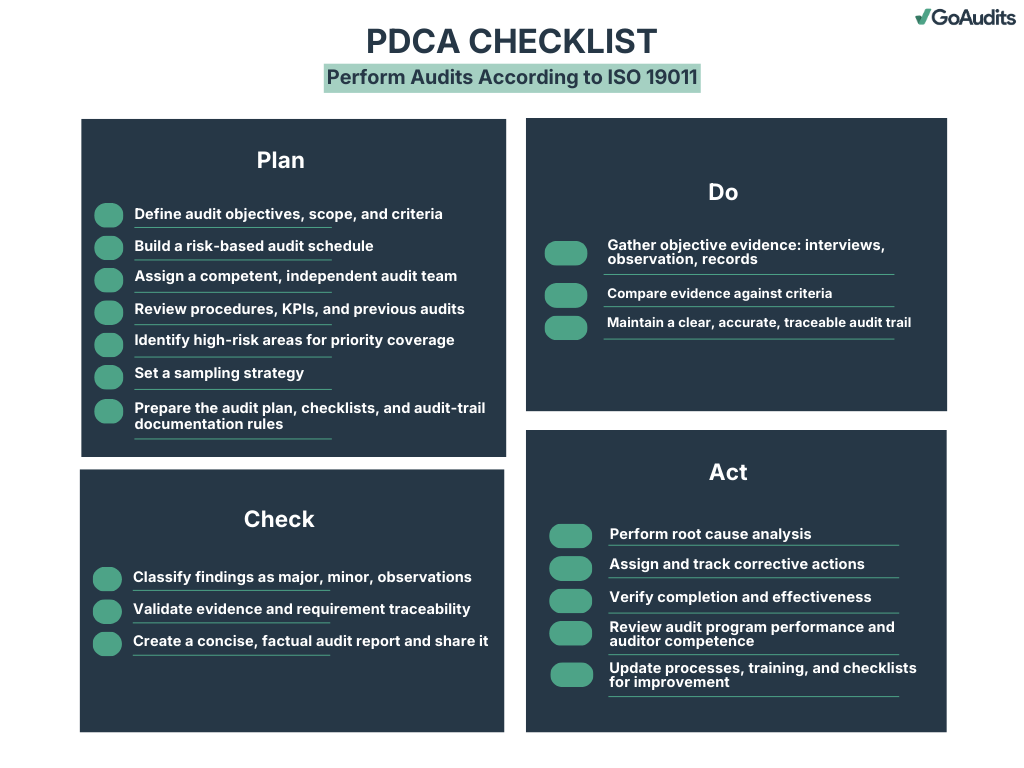
The points below outline how to conduct audits according to ISO 19011 using the PDCA methodology.
PLAN: Prepare and Design the Audit
Effective audits begin with intentional planning. ISO 19011 emphasizes risk-based prioritization, auditor competence, and defined audit criteria.
- Define objectives, scope, and criteria so auditors know exactly what they are assessing.
- Build a risk-based audit schedule using risk level, performance data, recent process changes, and past nonconformities.
- Assign a competent, independent audit team.
- Review procedures, KPIs, process maps, and previous audit results to understand context.
- Identify high-risk areas that require deeper sampling.
- Set a sampling strategy and draft the audit plan, checklists, and documentation rules to maintain a reliable audit trail.
DO: Perform the Audit
ISO 19011 requires disciplined execution and objective evidence collection. Collect objective evidence through interviews, observation, and record review. Compare evidence to the criteria and note where requirements are met or missed. Keep the audit trail factual, complete, and traceable.
CHECK: Evaluate Findings & Report Results
ISO 19011’s evaluation phase centers on classification, evidence validation, and structured reporting. Classify findings as major nonconformities, minor nonconformities, or observations. Validate all evidence and confirm that every finding links to a specific requirement. Produce a concise, factual report that summarizes scope, methods, and results, then share it with the responsible owners.
ACT: Corrective Actions & Continuous Improvement
This stage integrates audit results into the organization’s improvement cycle. Identify root causes using structured methods such as 5 Whys or fishbone analysis. Assign corrective actions, verify completion, and confirm effectiveness. Review audit program performance and auditor competence, then update processes, training, and checklists to improve future audits.
Perform Internal Audits to Strengthen Your Audit Management System
With GoAudits ISO compliance software, you can capture field data, generate instant reports, and trigger corrective actions. It enhances transparency and accountability. Real-time visibility into performance, trends, and recurring issues enables you to make data-backed decisions that elevate compliance and operational standards.
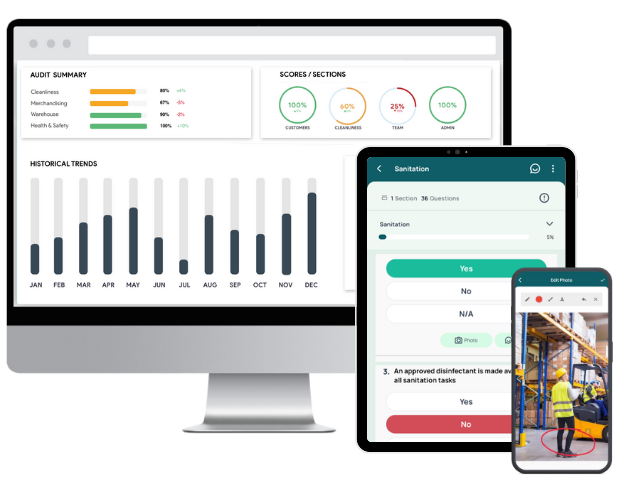
- Access a library of audit templates, customize them, build your own with a simple drag-and-drop interface, or let us digitize your existing forms at no additional cost.
- Perform inspections up to 5X faster on any device, online or offline, using intuitive mobile forms that eliminate paperwork and reduce errors.
- Generate inspection reports instantly, complete with photos, timestamps, geolocation, and assigned actions.
- Drive accountability with corrective-action workflows; assign owners, set priorities and deadlines, and track progress.
- Improve oversight with automated notifications, approvals, and escalations that follow your organizational hierarchy.
- Gain real-time visibility through dashboards that show audit scores, historical trends, recurring issues, and task completion.
Free & Customizable ISO Checklists
You can sign up for free and start using these ISO audit checklists & templates, or you can digitize your ISO SOPs into actionable checklists.
- ISO 9001 2015 Audit Checklist
- ISO 37301 Checklist
- ISO 37000:2021 Checklist
- ISO 13485 Checklist
- ISO 14001 Internal Audit Checklist
- ISO 50001 Internal Audit Checklist
- ISO 22000 Internal Audit Checklist
- ISO 45001 Audit Checklist

FAQs
ISO 19011 is not a certifiable standard and does not lead to certification for organizations. It serves as a guideline that helps organizations conduct effective and credible audits of their management systems. Organizations may adopt ISO 19011 to enhance their audit programs and demonstrate auditing best practices, but formal certification only applies to management systems standards such as ISO 9001 or ISO 14001, not to ISO 19011 itself.
ISO 19011 is not mandatory and does not impose legal or regulatory requirements. Its use is voluntary and recommended to achieve consistent, quality-driven audit processes. It offers internationally recognized guidance for auditing management systems. However, some organizations and sectors may require adherence to ISO 19011 as part of their contractual or regulatory commitments, especially when conducting audits aligned to certifiable ISO standards.
ISO 9001 and ISO 19011 address different aspects of organizational processes: ISO 9001 is a certifiable standard that defines requirements for establishing, implementing, and maintaining a quality management system, aiming to improve product/service consistency and customer satisfaction. ISO 19011 is a guideline standard that provides methods and principles for auditing management systems.
Auditor competence under ISO 19011 is assessed with a focus on several key criteria: auditors must demonstrate knowledge of relevant management system standards, possess personal attributes needed for impartial and effective auditing, and have practical auditing experience. Organizations typically evaluate candidates through formal training, education, work history in auditing, and the ability to apply audit principles and techniques, as recommended by ISO 19011 audit guidelines.