
Key Takeaways
- A method statement in construction sets out how a specific task will be carried out safely: the sequence, the people and plant, and the control at each stage.
- UK law does not name the method statement, but CDM 2015 requires contractors to plan, manage and monitor the work, and many clients demand it before site access.
- Australia is the exception. A safe work method statement is legally required for defined high-risk construction work, and the work must be carried out in accordance with it.
- The document only becomes a control once the crew has been briefed and has signed the briefing record.
- Most sites skip the last step: someone walking the task against the document. GoAudits gives site teams a structured way to run that check and prove it happened.
A method statement in construction is a written document that sets out how a specific task will be carried out safely, covering the sequence of work, the people and plant involved, and the control measures at each stage.
The Health and Safety Executive recorded 25 fatal injuries to construction workers in 2025/26, and across the five years to 2025/26 the sector’s fatal injury rate ran at 1.78 per 100,000 workers, around 4.6 times the all-industry rate.
Yet many contractors describe the same pattern to us: paper risk assessments and method statements that field staff do not complete consistently, filed and forgotten once the client has accepted them.
- What is a Method Statement in Construction?
- What Goes Into a Method Statement?
- Free Construction Method Statement Template
- Who Writes a Method Statement, and Who Signs It Off?
- How Do You Check the Work is Following the Method Statement?
- How GoAudits Helps You Verify Method Statement Compliance
- Frequently Asked Questions
What is a Method Statement in Construction?
A method statement turns the findings of a risk assessment into the sequence someone will follow on site. The risk assessment identifies what could go wrong. The method statement says how the job will be done so that it does not go wrong.
In the UK, the two are usually submitted together as RAMS, short for risk assessment and method statement. RAMS is not a legal term or a single document, just shorthand for the pair.
It helps to be clear which document does what:
| Document | What it does | Who it is for |
| Risk assessment | Identifies hazards, who might be harmed, and the controls | The employer, as a legal duty under the Management of Health and Safety at Work Regulations 1999 |
| Method statement | Sets out the sequence of work and the controls at each step | The crew doing the task |
| SOP | Describes a repeatable routine task the same way every time | Anyone performing that task |
| ITP | Sets the inspection and test points a stage must pass | QA and the client |
| Permit to work | Authorises a specific high-risk activity for a set window | The permit issuer and holder |
A method statement is task-specific and time-bound. If what you are writing will apply unchanged on the next project, you are writing a construction SOP or one of your health and safety SOPs, not a method statement.
When Do You Need a Method Statement?
In most markets, a method statement is a client and contract requirement rather than a legal one. In Australia, it is law. Three situations trigger one:
- A high-risk or non-routine task. Work at height, excavation, confined space entry, lifting operations, demolition, or anything the crew has not done on this site before.
- A client or principal contractor demands it. Many will not grant site access without accepted RAMS, and many specify their own format.
- A tender submission. Buyers use it to judge whether you understand the job before they award it.
UK law does not require a document called a method statement. Under CDM 2015, contractors must “plan, manage and monitor construction work” under their control so that, so far as is reasonably practicable, it is carried out without risks to health and safety.
The document the regulations name is the construction phase plan, covering the whole project. The method statement is how one task inside that plan gets delivered, which is why clients ask for it even though no regulation does. It sits alongside your HSE audits and, on design-led projects, your Safety in Design Checklist.
👉 Did you know? HSE’s position is that effort should be proportionate to the risk, and that you should “not rely purely on paperwork, as your main priority should be to control the risks in practice”. A forty-page boilerplate nobody reads is worse than a two-page document the crew understands.
Where is a Method Statement Legally Required?
Australia is the clearest example of a market where the document and its use are both written into regulation.
| Country | Document | Legal status |
| Australia | Safe work method statement (SWMS) | ✅ Required by regulation. Under the model WHS Regulations, regulation 291 defines high-risk construction work, regulation 299 requires a SWMS for it, and regulation 300 requires the work to follow it. Victoria sets the same duties under its OHS Regulations 2017. |
| UK | Method statement, paired with a risk assessment as RAMS | ⚠️ Not named in legislation. Expected by clients and principal contractors, and used to evidence CDM 2015 duties |
| US | Job hazard analysis (JHA) or job safety analysis (JSA) | ⚠️ Recommended practice. OSHA publishes guidance but does not mandate one |
The Australian wording is the clearest regulatory statement we’ve found that the paperwork is not the control. Safe Work Australia’s model Construction Work Code of Practice (2024) requires businesses doing high-risk construction work to “put in place arrangements to ensure the work is carried out in accordance with the SWMS”. Writing it is half the duty.
Working across markets, see our guide to job hazard assessment for the US approach, plus our ready-made SWMS form and JSA form.
What Goes Into a Method Statement?
Our template splits a complete method statement into 17 sections in five groups:
- Document control and scope: who wrote and approved it, which revision this is, what it covers and what it does not
- People and plant: named operatives with competencies, plant with inspection status, materials with COSHH references
- The work itself: site set-up and access, the numbered sequence, PPE by stage, permits
- Risk and emergencies: the paired risk assessment reference, environmental controls, a rescue plan for height or confined space work
- Control of the document: monitoring arrangements, the briefing record, review triggers and version history, approvals
That last group is where method statements fail. Monitoring and review triggers are the sections that are easiest to leave blank, and without them nobody is named to check the work and nothing obliges you to reissue the document when the job changes.
Where your sequence includes hold points, keep them consistent with how you handle quality control in construction, so the same stage gate is not signed off twice under two systems.
Free Construction Method Statement Template
Our free construction method statement template covers all 17 sections as a fill-in grid, with a note in each row for what you enter.
| # | Section | What you enter |
| 1 | Document control | Project, reference, revision number, date, author, reviewer, approver |
| 2 | Scope of works | The task this covers, and what it does not |
| 3 | Programme | Start date, duration, working hours, position in the sequence |
| 4 | Associated risk assessment | Reference number of the paired assessment |
| 5 | Personnel | Names, roles, competencies, card or certification numbers |
| 6 | Plant and equipment | Each item plus inspection or certification status |
| 7 | Materials and substances | With COSHH references and safety data sheets |
| 8 | Site set-up and access | Exclusion zones, traffic management, temporary works |
| 9 | Sequence of work | Numbered steps, each with its control measure |
| 10 | PPE | Specified per stage |
| 11 | Permits | Hot work, confined space, lockout/tagout, dig permits |
| 12 | Environmental controls | Dust, noise, waste, spill containment |
| 13 | Emergency arrangements | First aid, rescue plan, fire, contacts, nearest A&E |
| 14 | Monitoring and supervision | Who checks, how often, what they record |
| 15 | Briefing and sign-on | Every operative briefed, with signature and date |
| 16 | Review triggers | What forces a reissue, plus the version log |
| 17 | Approvals | Author, reviewer, principal contractor acceptance |
Free Construction Method Statement Template PDF
Download and print our free construction method statement template PDF, which includes a blank statement structure. You can also build the same as a digital checklist in GoAudits.
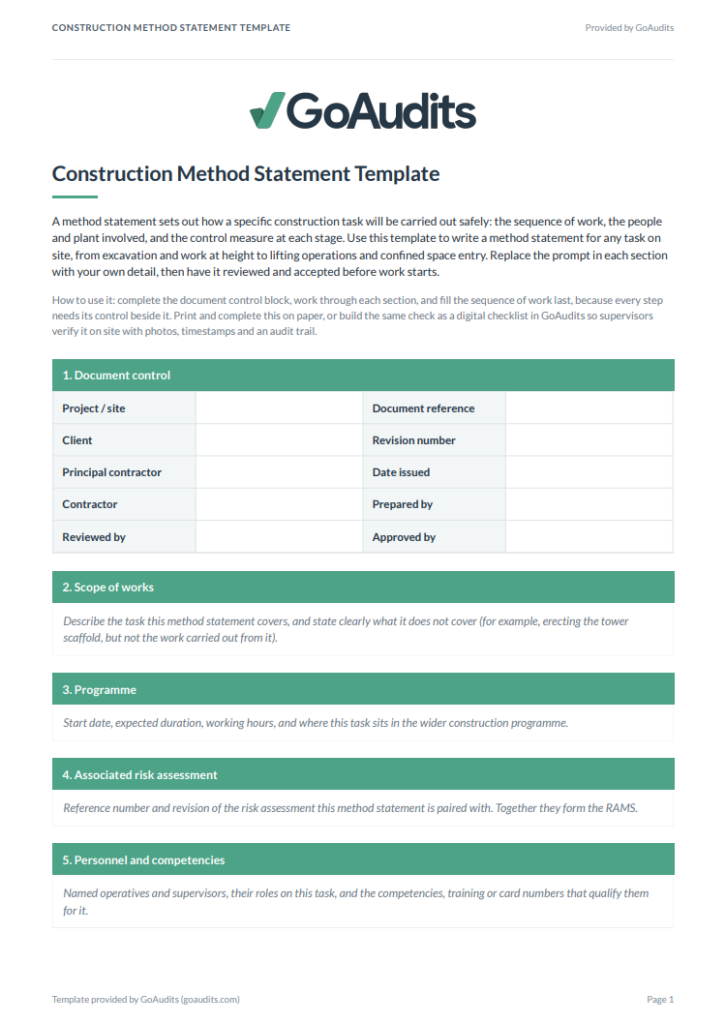
Fill the sequence column last. You cannot judge what control a step needs until the rest of the document tells you who is doing it, with what, and in what conditions.

What Does a Method Statement Work Sequence Look Like?
A method statement example is most useful at section 9, because that is where most documents go wrong. Here is a method statement construction example for erecting a mobile tower scaffold:
| Step | Activity | Control at this step |
| 1 | Deliver and offload components to the set-down area | Banksman in place, exclusion zone set, delivery outside peak pedestrian hours |
| 2 | Inspect all components before assembly | Visual check against the manufacturer’s inventory; damaged components quarantined and tagged |
| 3 | Erect to first lift using the advance guardrail method | Trained operatives only; no operative above a lift without guardrail in place |
| 4 | Fit platform, toe boards and guardrails | Platform fully boarded before work begins, gaps measured and closed |
| 5 | Inspect and tag the completed tower | Inspection tag applied by a competent person and recorded in the register |
The right-hand column is never empty. A sequence of steps with no control against each one is a work plan, and a client reviewer will send it straight back. Where a step needs authorisation, cross-reference it to your Permit to Work Checklist.
Who Writes a Method Statement, and Who Signs It Off?
A competent person who understands the task writes it, the contractor reviews it, and the principal contractor or client accepts it before work starts. Competent means having the skills, knowledge, and experience for the task: in practice, someone who has done or supervised the work, not someone who owns the template.
The chain has four links and only closes at the fourth:
- Author. Drafts the sequence and the controls from hands-on knowledge of the task.
- Reviewer. Checks it against the risk assessment and the actual site conditions.
- Approver. The principal contractor or client accepts it. No acceptance, no site access.
- The crew. Briefed on it, and signed to confirm they have read and understood it.
Most guidance stops at step three. Step four is where the document either becomes a control or stays a filing exercise, because an unbriefed method statement controls nothing, however well written it is.
📌 How Woodside Homes holds trade partners to the same criteria
Woodside Homes, one of the top homebuilders in the US, runs quality control checks across multiple construction sites and trade partners. Moving those checks onto GoAudits gave every installer the same written criteria and a photo record against each one, and scores now sit consistently above 95%.
Here’s what their Customer Care Manager has to say about GoAudits: “We really appreciate the ease of using the mobile app for our Quality Control checks, adding photos and auto-emailing results to all necessary parties.”
» Read More: How Woodside Homes streamlines construction quality control.
The briefing itself happens as a toolbox talk before the task starts and produces a record: who was briefed, when, against which revision, signed by each person. Our toolbox talk form and Toolbox Talk Format Checklist structure the briefing, and the Toolbox Meeting Form Checklist captures attendance. For new operatives, it sits on top of the construction site induction rather than replacing it.
Learning how to write a method statement is the easy half. Getting a signed briefing record from every operative on a changing crew is the half that fails, and contractors tell us why: no proof the work was done the way the document says when nobody is watching.
A digital sign-on fixes the proof rather than the paperwork. Mandatory fields stop a half-finished record from being submitted, signatures are captured on the spot, and the revision the crew signed against is recorded rather than assumed.

How Do You Check the Work is Following the Method Statement?
Someone walks the task against the document, item by item, and records what they find with evidence. That is the whole of it, and almost nobody writes it down.
The Australian Code treats this as a duty rather than good practice. Where work is not being carried out in accordance with the SWMS, “the work must stop immediately or as soon as it is safe to do so”, and “work must not resume until the work can be carried out in accordance with the SWMS”. The logic holds everywhere: a control you have not verified is an assumption.
Responsibility splits two ways. The subcontractor’s supervisor checks their own crew as the work happens; the principal contractor checks across the site as part of monitoring the construction phase. We recommend weekly checks for a routine task, daily for high-risk work, and a check at every hold point regardless. It is the same discipline as any other construction site inspection, pointed at a document instead of a condition.
What Should the Check Look For?
Six things, in this order:
- The right revision is on site. Not a revision. The current one, matching the number on the briefing record.
- Everyone on the briefing record is present, and everyone present is on the record. A crew member who joined on Tuesday and never signed is the most common gap.
- Plant, access equipment, and PPE match the document. Substitutions happen quietly and invalidate the controls.
- The controls for the current stage are in place. Edge protection up, exclusion zone marked, permit issued.
- The sequence has not been skipped or reordered. Crews under programme pressure do this first.
- Hold points were signed before the next stage started. Signed afterwards is not signed.
The check only has value if it produces four things on anything that fails: a photograph, a timestamp, a named owner, and a due date. Without those, you have an observation, and observations do not close.
This is where paper breaks down. Buyers describe it in their own words: “pencil whipping” in the US, “tick and flick” in the UK and Australia, checklists completed at someone’s convenience rather than at the task. As one put it, a time clock proves presence, not completion. We have written separately on pencil whipping and how to design it out.
👉 Quick Tip: Findings that never close are the other half of the problem. Give every failed item an owner and a date at the moment you raise it, on site, rather than compiling a list to distribute later.
📌 How Paladin Risk Management closes findings while the work is still open
Paladin Risk Management, a loss-control consultancy, runs in-process construction stage inspections at foundations, framing, and close-in. Each inspection now produces annotated, timestamped photo records with corrective actions assigned to named owners, so findings reach crews before they move on.
According to the Vice President of Quality Assurance Services at Paladin, “The instantaneous inspection reports from the field cut our processing time by up to 75%.”
» Read Full Story: How Paladin Cut Construction QA Report Time by up to 75%.
Build the check as a standing checklist rather than something a supervisor improvises. A construction inspection checklist or construction safety checklist gives you the site-wide view, and the method statement check sits inside the same library so findings land in one place.
When to Stop Work and Reissue a Method Statement
Five things invalidate a method statement mid-job:
- The task changes, or the scope grows
- The sequence changes, including reordering under programme pressure
- New plant arrives, or a new crew takes over
- A near miss or accident happens on that task
- A hazard appears that the document does not cover, such as unexpected services or weather
HSE’s guidance on managing risk names accidents, near misses, and changes to staff, process, or equipment as review triggers. The response is the same each time: stop, revise, re-brief, keep every version. Superseded versions matter, because if something goes wrong months later, the question will be which revision the crew was working to on the day.
Three habits turn a method statement into a paper exercise, and a single check exposes all three: a generic template whose hazards could belong to any project, a current revision nobody on site has read, and controls listed in the document but never verified in the field.
How GoAudits Helps You Verify Method Statement Compliance
GoAudits does not write your method statements. It gives site teams a structured way to check that the work matches them and to prove it afterwards, which is the step paper processes keep dropping.
With GoAudits construction inspection software, you can:
- Make the awkward questions mandatory so nobody submits a half-finished check.
- Capture timestamped, GPS-tagged photos at the task rather than writing it up later.
- Assign every failed item an owner and a due date before you leave the site.
- Keep inspecting where there is no signal and sync when you are back in coverage.
- Send the finished report from the site, ready for the principal contractor or client.
With a rating of 4.8 stars on Capterra, GoAudits is trusted by some of the biggest names in the construction management industry.
» GoAudits Reviews: Read how companies leverage GoAudits to meet standards in their construction operations.
Frequently Asked Questions
No. The construction phase plan is the project-level document CDM 2015 requires, covering site rules and arrangements for the whole construction phase. A method statement covers one task inside that plan. A project has one construction phase plan and many method statements.
Usually yes. Each contractor plans and manages the work under its own control, so subcontractors normally produce one for their own scope and submit it for acceptance. Working to someone else’s document only holds up where the task, crew, and equipment are genuinely covered by it.
Yes. A template filled in without the actual access routes, site conditions, named plant, and named operatives describes a generic job rather than yours.
Long enough to cover the sequence and the controls, and no longer. HSE’s position is that effort should be proportionate to the risk. A two-page document the crew can be briefed on in ten minutes controls more risk than a forty-page one signed unread.
It can where the tasks share a crew, a location and a hazard profile, such as several similar lifts in one area. It should not where the risks differ, because a combined document then hides which control belongs to which activity.
No. A point-of-work risk assessment is the dynamic check an operative makes at the task face, immediately before starting, to confirm conditions match what was planned. It catches what changed since the document was written, but does not replace the planned sequence.
Keep them, with every superseded revision and the signed briefing records, for as long as your insurance and limitation periods require, which on most projects means years rather than months. If a claim follows, the evidence that matters is which revision the crew signed against on the day.