Key Takeaways
- BRC and BRCGS refer to the same certification, originally developed by the British Retail Consortium and rebranded as BRCGS in 2019; both names are used interchangeably today.
- BRCGS audits are graded from AA (best) down to Uncertified, based on the number and severity of non-conformities found, with a “+” added for unannounced audits.
- A BRC certificate is valid for 12 months, and sites must have at least 1 in every 3 audits unannounced, within a four-month window before their re-audit is due.
- Issue 9 remains the current standard, though BRCGS has already started developing Issue 10 and has separate updates taking effect from 10 August 2026.
- GoAudits audit software helps you prepare for and manage BRCGS audits with digital checklists, instant reports, and corrective action tracking.
Food safety compliance directly affects a food business’s ability to trade, retain customers, and meet retailer expectations. For manufacturers, retailers, and suppliers, meeting BRCGS audit requirements is a widely accepted benchmark for demonstrating control over food safety, quality, and compliance across the supply chain.
The BRCGS audit framework provides a structured way to measure performance through defined audit grades, ratings, and scores. Businesses can demonstrate credibility and consistency to buyers worldwide. As food safety risks, regulatory scrutiny, and customer expectations continue to increase, understanding how BRCGS audits influence certification outcomes has become essential for long-term operational and commercial success.
This blog explains how BRCGS audits work, what auditors look for, grade calculations, and how businesses can prepare to meet certification expectations with confidence.
BRC Global Standards (BRCGS) and Issue 9
BRC stands for British Retail Consortium, the UK trade association that originally developed these food safety standards. BRC Global Standards (BRCGS) is the globally recognised food safety and quality certification framework built on that foundation, used by manufacturers, processors, and suppliers across the food supply chain. The British Retail Consortium standards were acquired by the LGC Group in 2016 and rebranded as BRCGS in 2019, so BRC and BRCGS refer to the same certification lineage under two different names.
Today, BRCGS is adopted by over 36,000 certified sites in more than 130 countries, making it one of the most widely accepted food safety certification programs worldwide. It was also the first standard to introduce formal food safety culture requirements, define food fraud controls, and achieve GFSI certification.
BRCGS provides a comprehensive framework covering food safety management systems, product safety, packaging, storage, distribution, legality, and operational controls, helping organisations identify and address approximately 185,000 non-conformities each year.

BRCGS Issue 9
The BRC’s Issue 9 was published on August 1, 2022, and is effective for audits from February 1, 2023.
BRC Issue 9 has two core themes: developing a food safety culture and building core competencies.
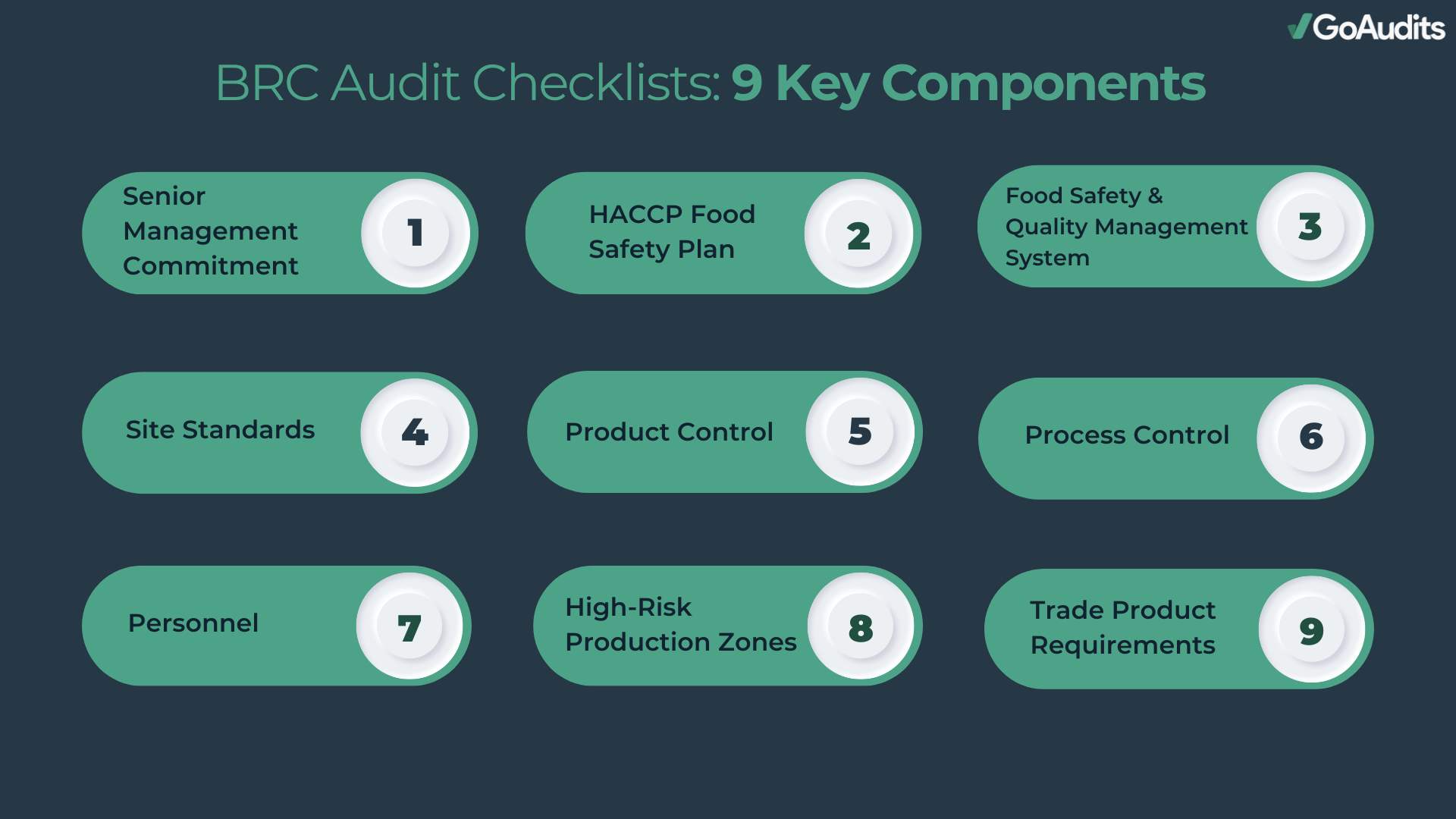
The updated standards are structured around nine core sections. These 9 sections represent the series of requirements for the BRC audit certification:
1. Senior Management Commitment
It emphasizes the crucial role of top leadership in fostering a culture of food safety throughout the organization.
2. The Food Safety Plan – HACCP
The updated HACCP requirements focus on a more preventative and risk-based approach, aligning with the Codex Alimentarius principles.
👉 Also Read
3. Food Safety and Quality Management System
It reinforces the importance of integrating food safety into the core business management system.
4. Site Standards
Hygiene and sanitation requirements are enhanced, with stricter guidelines for pest control, cleaning validation, and temperature control.
5. Product Control
Product specifications, traceability, and recall procedures are given greater emphasis to ensure product safety at every stage.
6. Process Control
Process validation and monitoring are strengthened to minimize the risk of contamination and ensure product consistency.
7. Personnel
Training and competency requirements for food handlers are expanded, promoting a knowledgeable and responsible workforce.
8. Production Risk Zones
Specific controls are outlined for production areas, including high-risk, high-care, and ambient high-care, handling particularly vulnerable or sensitive products.
9. Requirements for Traded Products
It addresses the growing complexity of global food chains, ensuring the safety of traded products.
If you’re still working from Issue 8 checklists or documentation, note that Issue 8 was retired when Issue 9 took effect in 2023, so any Issue 8-based materials should be replaced. Looking ahead, BRCGS has already begun developing Issue 10: a public consultation closed in February 2026, and a Technical Working Group has been meeting since April 2026.
No publication date has been confirmed, so Issue 9 remains the standard to certify against for now. Separately, BRCGS also runs START!, a simplified entry-level scheme for sites not yet ready for full Issue 9 certification, worth knowing about if your business is earlier in its food safety journey.
BRCGS has also published updated position statements affecting several of its Global Standards, effective for audits from 10 August 2026, including changes to risk analysis and prerequisite programme requirements. If your next audit falls after that date, it’s worth checking whether the update applies to your certification before you’re assessed against it.
BRC Traceability Requirements (Clause 3.9)
Clause 3.9 requires sites to demonstrate full traceability of raw materials, including primary packaging, both forward and backward through the supply chain, from supplier to finished product and back again, including a mass balance (quantity reconciliation) at each stage.
This isn’t just a documented procedure. Sites must actually test it: BRCGS requires a traceability test at least annually, and the test must demonstrate that full forward-and-backward traceability, including the mass balance check, can be completed within 4 hours. Auditors expect this to be evidenced with real records, not a description of how it would theoretically work.
What is a BRCGS Audit?
A BRC audit evaluates a company’s compliance with the BRC Global Standards. It is an assessment of the food safety management system, processes, and procedures for the organization. It is conducted by an independent BRC-accredited certification body to ensure that the company meets the requirements of the BRC Global Standard for food safety.
BRCGS audit is relevant for companies that:
- Process or work with open food
- Ingredient suppliers that supply retailers with ingredients and other food products
- Manufacture consumer products and handle non-food items
- Buy, sell, or facilitate the trade of products, but do not manufacture, process, or store the products
There are two main types of BRC audits:
- Full (Announced) BRC audit: scheduled in advance, giving the site notice of the exact audit date.
- Unannounced audit: the certification body arrives without advance warning, so the site is assessed exactly as it operates day to day.
Both types result in an official grade, with a ‘+’ suffix added to unannounced grades (for example, AA+). Under BRCGS protocol, a newly certified site’s first audit is announced, its first unannounced audit must happen within 2 years, and from then on, at least 1 in every 3 audits must be unannounced, occurring within the four-month window before the site’s re-audit due date.
Sites generally can’t switch certification bodies during that same four-month window without formal approval from BRCGS.
BRC Grades: An Overview
BRCGS audits are graded based on the number and severity of non-conformances identified during the audit process.
Non-conformances are categorised as minor, major, or critical:
- Minor non-conformance: A small deviation from the standard where the requirement is not fully met but does not directly threaten product safety or legality.
- Major non-conformance: A significant deviation that raises doubt about the conformity of the product or the effectiveness of the management system.
- Critical non-conformance: A serious failure that poses an immediate food safety risk or breaches legal requirements. Any critical non-conformance typically results in certification failure (Uncertified).
👉 The BRCGS grading scale runs from AA (highest) to Uncertified (lowest). If the audit is unannounced, a ‘+’ suffix is added to the grade (e.g., A+, B+).
The BRC grades are based on the company’s performance in the following areas:
- Food safety
- Quality management
- Compliance with legal requirements
- Continuous improvement
| Announced | Unannounced | Non-Conformances |
| AA | AA+ | Lesser than 5 errors |
| A | A+ | 5 to 10 errors |
| B | B+ | 11 to 16 minors, or 1 major, and up to 10 minors |
| C | C+ | 17 to 24 minors, or 1 major and up to 16 minors, or 2 majors and up to 10 minors |
| D | D+ | 25 and 30 minors, or 1 major and up to 24 minors, or 2 majors and up to 16 minors |
| Uncertified | Uncertified | 1 or more critical, 31 or more minors, 1 major and 25 or more minors, 2 majors and 17 or more minors, or 3 or more majors |
BRC grades help buyers and specifiers understand how well a company manages its food safety systems and are often used to determine audit frequency and commercial acceptance.
Once an audit identifies non-conformities, the site has 28 calendar days to submit documented corrective action, with supporting evidence, before the certification body finalises the grade.
How to Prepare For a BRCGS Audit?
Here’s a comprehensive guide on conducting a BRCGS audit:
1. Understand BRC Audit Requirements
There are four key components of every BRCGS audit, including the following:
- Documentation review: This involves reviewing the company’s food safety documentation to ensure that it is complete and accurate. This documentation includes the company’s food safety manual, procedures, and records.
- Site inspection: This involves conducting a thorough inspection of the company’s production facilities, equipment, and premises. It includes identifying any conditions that could pose a risk to food safety, such as poor sanitation, inadequate pest control, or improper storage of food.
- Employee interviews: Employees are interviewed to assess their understanding and adherence to food safety practices. It also included reviewing their roles and responsibilities, their training, and their knowledge of food safety procedures.
- Product testing: This includes testing finished products to verify their safety and quality. Microbiological testing, chemical testing, and sensory testing are some common types of product testing that form part of BRC audits.
2. Perform BRC Internal Audit
- Gather comprehensive documentation: Assemble all necessary documents demonstrating consistent food safety management, including policies, procedures, records, plans, reports, certificates, licenses, and training materials. Make sure your documents are accurate, traceable, and easily available.
- Conduct thorough internal audits: Identify potential gaps and areas for improvement before the official audit. You can do so by conducting thorough internal audits. For internal audits, your team should be comprised of members who have in-depth knowledge and experience in BRC standards and the overall food industry.
- Use BRC audit checklists: Use BRC internal audit checklists to ensure thorough coverage of all audit criteria and track progress.
- Train personnel: Educate your staff on BRC standards and audit procedures to ensure preparedness and compliance. The audit procedures can include assessment, testing, sampling, verification, reporting, and more.
3. External BRC Audit Execution
- Pre-audit briefing: Holding a pre-audit briefing with the auditor will help you establish the expectations, scope, and timelines of the audit.
- Documentation review: The auditor examines documentation for compliance with BRC standards. Documentation review will also enable the auditor to assess your company’s other documentation, including food safety plans, quality manuals, procedures, and records.
- On-site inspection: The auditor will conduct an on-site inspection of your premises, including production areas, storage facilities, and equipment. A thorough walkthrough of the facility will enable the auditor to observe practices, conditions, and potential risks.
- Evidence evaluation: The auditor will evaluate the evidence gathered during the documentation review and on-site inspection to assess compliance with BRC standards.
4. Report Audit Findings and Follow-up
- Document audit findings: The auditor documents all audit findings, including non-conformities and areas for improvement, in the non-conformance report.
- Root cause analysis: It involves identifying the underlying causes of non-conformities. Conducting a thorough investigation to identify the underlying causes of non-conformities will prevent them from recurring.
- Corrective action plan: It outlines the steps to address and prevent the non-conformities from happening again. The corrective plan should also include clear timelines, accountable parties, and verification techniques.
- Continuous improvement suggestions: The auditor may offer recommendations for continuous improvement to enhance your food safety and quality, and food safety management system.
- Post-audit activities: You must implement the corrective actions as per the agreed timelines. Monitor the effectiveness of the corrective actions and make necessary adjustments. Continuously review and improve your food safety and quality management systems to maintain compliance with BRC standards.
Though the above process might look daunting, BRC audit software can help you prepare for and conduct a successful BRCGS audit. It can provide you with a structured approach to assessing compliance with the BRC standard and help you identify areas for improvement.
Perform BRC Internal Audits Up To 5X Faster with GoAudits
GoAudits’ all-in-one food safety audit software enables you to conduct self-assessments and audits more efficiently and effectively, using digital BRC audit checklists. GoAudits works on any electronic device, such as laptops, tablets, and smartphones (iOS or Android), saving valuable time and reducing the risk of errors and inconsistencies.
With GoAudits, you get:
- Efficient mobile inspections
- Instant reports and analytics
- Issue and task tracking
- 5x faster inspections
Digital inspections with GoAudits BRC software also increase transparency and accountability. All results, images, and comments are automatically bundled in a digital report. Auditors can provide real-time updates and communicate with the team and management more easily.
This can help to build trust and confidence in the audit process and ensure that all parties have access to the same information.
“Spend time where it matters. GoAudits has allowed us to spend 95% of our time where it matters – watching the floor and coaching the team, rather than filling forms and preparing reports. Seeing historical data without digging out and comparing past reports has helped us spot trends & issues.” – Jason Hunt, Domino’s
Free Food & Safety Inspection Checklists
Access GoAudits’ library of free and customizable BRC audit checklists.
- BRC Management Commitment Checklist (Clause 1)
- BRC Food Safety Plan HACCP Checklist (Clause 2)
- BRC Food Safety & Quality Management System Checklist (Clause 3)
- BRC Audit Site Standards Checklist (Clause 4)
- BRC Audit Product Control Checklist (Clause 5)
- BRC Audit Process Control Checklist (Clause 6)
- BRC Personnel Checklist (Clause 7)
- BRC Production Risk Zones Checklist (Clause 8)
- BRC Audit Traded Products Checklist (Clause 9)
In our checklist template library, you will also find dozens of food safety checklists, some examples include:
- Food Safety & Hygiene Checklist
- Hygiene Standard Checklist
- Food Allergen Checklist
- Hygiene Checklist for the Food Industry
- Food Hygiene Audit Checklist

BRC Audit Certification
BRC audit certification shows that a food business adheres to the BRC Global Standards of food safety and quality management system, and is committed to providing safe food to consumers. In addition to guaranteed food safety, other benefits of BRC certification include operational efficiency, access to global markets, and increased customer confidence.
Who Issues BRC Audit Certification?
A BRC audit certificate is issued by a BRCGS-approved certification body.
Auditors who issue a certificate against any global food standard must work for a certification body. BRC certification bodies are independent organizations that are accredited to conduct audits and issue certificates against the BRC Global Standards. They are responsible for assessing whether your business’s food safety, quality, and operational management systems meet the requirements of the relevant BRC Standard.
An independent auditor cannot issue a BRCGS audit certificate. The auditor writes a full report once the BRC audit is complete. The certification body then reviews the audit report and the actions taken by your company to correct identified non-conformities. Eventually, it approves or declines the BRC audit certification.
BRC Audit Certification Requirements
The requirements for BRC audit certification vary depending on the type of food business. However, some of the general requirements include:
- Food safety management system: You must have a documented food safety management system that is based on the principles of HACCP (Hazard Analysis and Critical Control Points).
- HACCP plan: You must have a HACCP plan that identifies and controls food safety hazards. HACCP software can help automate and streamline the process of creating and managing HACCP plans, while HACCP checklists can be used to verify that critical control points are being met.
- Internal audits: You must conduct regular internal audits to verify that the food safety management system is effective.
- Continuous review: You must conduct regular management reviews to assess the effectiveness of the food safety management system.
BRC Audit Certification Requirements Process
The BRC audit certification process involves the following steps:
- Application: A food business must submit an application to a BRC-approved certification body.
- Assessment: The certification body will conduct an assessment of the food business to verify that it meets the requirements of the BRC Global Standard for Food Safety.
- Certification: If your food business meets the requirements of the standard, it will be issued a BRC certificate.
What are the Benefits of BRC Audit Certification?
Adopting BRC Standards offers several benefits, including the following:
- Ensures compliance with food safety laws, reducing legal and regulatory risk.
- Strengthens credibility with retailers and suppliers through proven food safety standards.
- Builds consumer confidence by demonstrating a strong commitment to food safety and quality.
- Reduces the likelihood of contamination, recalls, and non-conformances.
- Minimizes waste, rework, and recall costs through standardized, efficient processes.
With GoAudits, you can streamline your BRCGS audit processes, improve efficiency, and enhance compliance. With GoAudits, you can effectively manage audit schedules, assign tasks, collaborate with team members, and generate detailed reports.

FAQs
There isn’t one; they’re the same certification body under two names. The standards were originally developed by the British Retail Consortium (BRC) and rebranded in 2019 as BRCGS (Brand Reputation through Compliance of Global Standards) after LGC Group acquired them in 2016. “BRC” and “BRCGS” are used interchangeably to refer to the same standards today.
Use the official BRCGS Directory, the authoritative database of every audit conducted against a BRCGS Standard. It lets you confirm a site’s current certification status, grade, and audit date directly, without relying on a supplier to share their certificate with you.
A BRC certificate is valid for 12 months from the date of the audit. Certification is maintained through annual re-audits; sites with lower grades or in higher-risk categories may face a shorter recertification cycle.
There’s no fixed price. Cost depends on the certification body you choose, the size and complexity of your site, and the scope of the audit (2-pillar-style limited scope versus full certification). Get a quote directly from a BRCGS-approved certification body before budgeting for certification.
Certification bodies generally look for candidates with relevant food industry experience (often several years in food safety, quality, or technical roles) alongside formal auditor training and a recognised qualification, such as a HACCP or lead auditor course. Once qualified, auditors typically progress from shadowing experienced auditors to conducting supervised audits before being signed off to audit independently.