Key Takeaways
- Brand consistency requires a structured system of standardized SOPs, daily monitoring, regular audits, and enforced corrective actions.
- Scaling this system across multiple locations is complex due to geographic gaps, staff turnover, manual processes, and limited real-time visibility.
- Auditing software digitize SOPs, automates scoring, and centralize data to make brand compliance measurable, scalable, and easy to manage.
In a multi-location business, brand compliance is not just about logos or creative approvals. It is about the physical execution of standards, like cleanliness, safety, and customer service, that protects the company’s long-term value.
As brands expand, they face the scale dilemma: the distance between headquarters and frontline teams grows, leading to a blurring of the original operational vision. Standards that were once clear and consistently enforced begin to vary by location. This slow erosion, often invisible at first, is what we call brand drift.
When a customer experiences inconsistent service across a growing network, brand trust weakens. This inconsistency creates financial risk, as regaining a disillusioned customer costs far more than maintaining disciplined execution from the start.
- What’s Brand Compliance Monitoring and Auditing?
- How to Maintain Brand Consistency Across Multiple Teams and Locations With Compliance Monitoring and Audits
- How to Manage Brand Standards Across Multiple Teams: Challenges & Best Practices
- Maintain Brand Consistency Across Locations & Teams With GoAudits
- FAQs
What’s Brand Compliance Monitoring and Auditing?
Brand compliance monitoring is the frequent, proactive tracking of daily standards by site-level teams, while a brand compliance audit is a formal, periodic verification of those standards by head office or third-party reviewers.
Monitoring builds discipline. Audits protect accountability. To protect brand value at scale, leadership must utilize both functions:
- Monitoring (The Pulse): These are daily or shift-based checks performed by the “doers.” In a gym franchise, this might be an hourly equipment safety check. In a casual-dining group, it is the line check before the lunch rush.
- Audit (The Checkup): These are defined, formal verifications by “auditors” (such as Area Managers). An audit determines whether the daily monitoring routines are actually being conducted and whether they are effective.
You cannot have a successful audit without a daily monitoring habit; without the daily data, an audit is merely a snapshot in time rather than a true reflection of what’s really happening on the floor.
How to Maintain Brand Consistency Across Multiple Teams and Locations With Compliance Monitoring and Audits
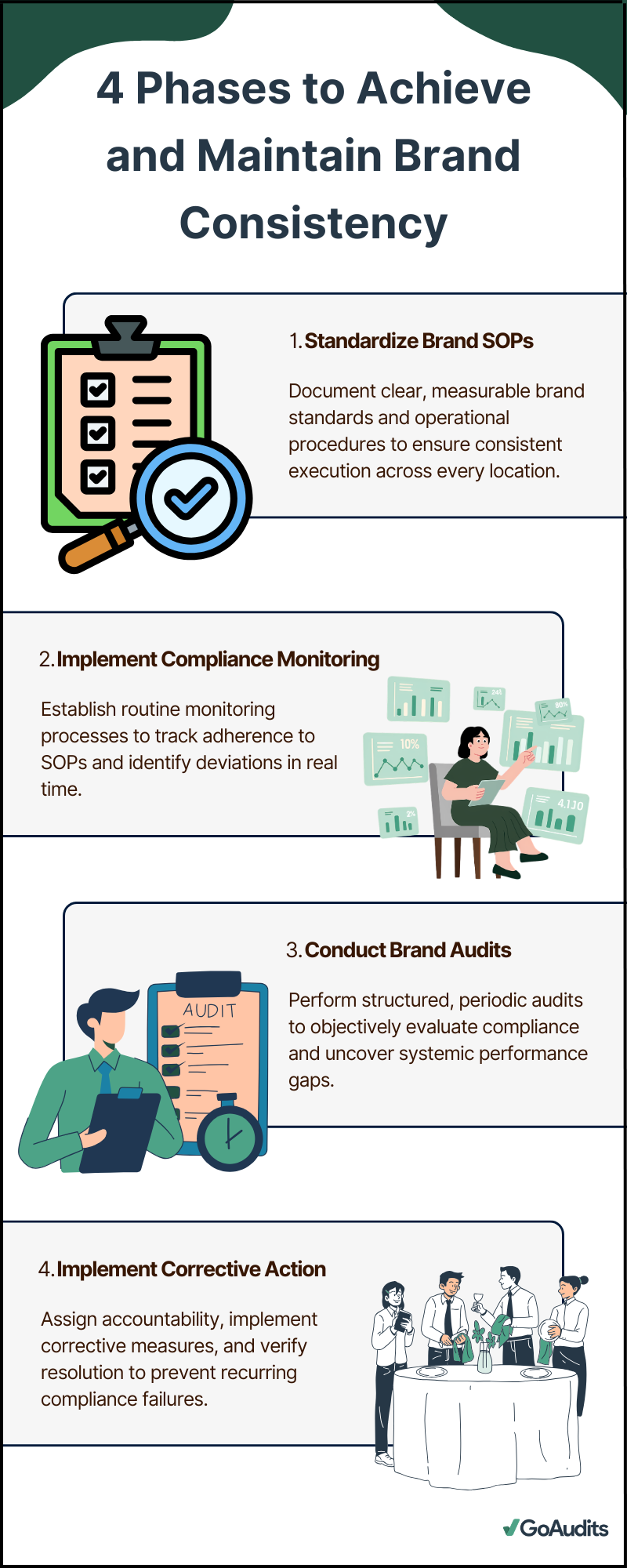
To maintain brand adherence across multiple teams, organizations must standardize brand SOPs, embed daily compliance monitoring, conduct structured audits, and enforce corrective actions through measurable scoring systems.
This four-phase operational process helps maintain brand consistency and ensures execution remains aligned with the original operational vision.
Phase 1: Standardize Brand SOPs
To standardize brand SOPs, convert them into measurable, objective, and scalable procedures. Without clearly defined operational criteria, audits become subjective, and compliance scores lose credibility across locations.
A brand SOP is a documented set of instructions that defines exactly how a task must be performed to meet company standards. In multi-unit operations, SOPs ensure that quality and service remain identical across all locations.
I think that you can be a five-star operation if you set and document the standards properly, you’re managing expectations, and really inspecting what you expect.
Kristin Ingram, Regional Director, LaTour Hotels
While creating an SOP for your brand:
- Eliminate vague language
- Define measurable criteria
- Assign ownership
- Specify frequency
- Include visual references
Avoid subjective questions like: Is the store clean? Replace it with:
- Are all tables wiped and dry?
- Are floors free of visible debris?
- Are trash bins less than 50 percent full?
- Is promotional signage displayed as per the planogram?
Objective language ensures that “passing” means the same thing across 10 or 200 locations. Explore our guides on SOP documentation and how to implement SOPs internally.
However, traditional SOPs stored in paper manuals or static PDF files are difficult to scale. They are often outdated, inaccessible to front-line staff, and offer zero visibility to the head office teams.
👉 How to Build Scalable Brand SOPs
Implement digital SOPs with software like GoAudits to create and distribute them across teams and locations. Digitizing your SOPs offers several benefits:
– Real-time Updates: When a standard changes, you can update the master template and push it to every location instantly.
– Accessibility: Staff can access instructions directly on their mobile devices while on the floor.
– Compliance Tracking: The head office can see exactly which locations are following procedures and where additional training is needed.
👉 Case Study: How LaTour Hotels leverages GoAudits to streamline SOPs and manage brand standards across 30+ locations.
Phase 2: Implement Brand Compliance Monitoring
To implement brand compliance monitoring, HQs must identify non-negotiables: high-stakes items that directly impact brand reputation or safety. Spell out the criteria in the form of clearly defined binary questions to remove ambiguity.
Brand compliance monitoring must integrate into daily operations, like opening routine verification, mid-shift checks, and closing safety and hygiene review. This ensures it doesn’t feel like an “extra” task.
👉 Show, Don’t Tell: Modern compliance platforms allow you to attach reference photos to checklist items so staff can clearly see what correct execution looks like.

Phase 3: Conduct Regular Brand Standards Audit
A brand standards audit is a formal evaluation of how well a location or team is adhering to the specific quality, service, and operational requirements defined by the brand.
To conduct a successful brand standards audit, move beyond simple “pass/fail” checks. Use historical monitoring data to focus on high-risk areas. This allows the brand compliance audit to become a coaching opportunity rather than just a reporting exercise.
Use the Perimeter-to-Core method to ensure you view the location exactly as a customer would, moving from the outside in. The Perimeter-to-Core brand compliance audit sequence looks something like this:
- The Perimeter: Begin with the exterior (signage, parking lot, and lighting). This “curb appeal” defines the customer’s first impression.
- The Entry: Evaluate the immediate atmosphere (smell, temperature, and staff greeting).
- The Core: Inspect high-impact operational areas. Is the equipment maintained? Is the staff in the correct uniform? Are the hygiene standards met in the back-of-house?
Use an auditing software to create customizable audit checklists aligned with your brand SOP. Each response automatically generates an objective compliance score. These scores are benchmarked against your standards to measure adherence, compare performance across locations, and pinpoint exactly where brand consistency is starting to slip.
Here are a couple of industry-specific audit checklists to help you get started:
- Gym, fitness centers, & spa audit checklists
- Restaurant & food audit checklists
- Healthcare audit checklists
- Retail store audit checklists
- Hotel audit checklists

Phase 4: Follow-Up and Corrective Action
To implement corrective actions, assign clear ownership, set deadlines, track issue resolution digitally, and analyze repeat failures to eliminate systemic compliance gaps.
Build a corrective action system that allows HQ teams (or even auditors) to initiate resolution with a firm deadline as soon as a non-compliant item is found. Minimize manual intervention with corrective action software like GoAudits.
It not only allows head office and field teams to assign corrective actions (to both internal employees and external vendors) and set deadlines, but also automates follow-up in case of delays. The assigned task is considered “closed” only when the responsible party uploads a photo or comment proving the issue has been resolved.
How to Control Brand Usage by Franchisees and Third-Parties
Maintaining brand standards with franchisees requires governance through objective scoring systems tied to contractual obligations, rather than subjective enforcement. Many franchisors link compliance scores to renewal thresholds to ensure standards are applied consistently and fairly across the network.
- Shift from “Policing” to Standardized Scoring: Avoid vague feedback that can lead to disputes. Use a standardized digital scoring system to move the conversation from “I think your store looks messy” to “Your location has a brand health score of 72%, which is below the 85% requirement in your agreement.”
- Verify Reality with Unannounced Site Visits: Surprise checks are the ultimate tool for verifying the true daily state of operations. When criteria are pre-loaded into the GoAudits mobile app, the evaluation remains objective and fair, ensuring the franchisee cannot argue that the auditor was biased or inconsistent.
- Prevent Cost-Cutting “Operational Drift”: It is common for partners to try to save costs by using unapproved local vendors for supplies or skipping scheduled maintenance on specialized equipment. Standardized digital audits make these violations impossible to hide by requiring mandatory photos of specific equipment serial numbers or uploads of approved vendor invoices. Explore our complete guide on franchisee monitoring for best practices and tips.
How to Manage Brand Standards Across Multiple Teams: Challenges & Best Practices
Maintaining brand consistency across 50 or more locations requires a shift from scrutiny to a culture of accountability. When teams know their performance is visible in real-time, compliance becomes a daily habit rather than a panicked reaction to a scheduled visit.
Below are the four most common challenges operational leaders face and the best practices for managing brand across multiple teams.
Challenge #1: The Geographic Gap
The geographic gap in this context refers to the visibility loss that occurs when HQ cannot physically observe daily operations across distributed locations. Without real-time data, leadership decisions rely on outdated snapshots rather than current performance metrics.
Solution: Real-Time Performance Dashboards
A centralized dashboard from GoAudits with monitoring and audit data bridges the distance between HQ and the front line. By digitizing the process, the head office gains immediate visibility into every location’s performance without needing to be physically present.
GoAudits has allowed us to spend 95% of our time where it matters – watching the floor and coaching the team, rather than filling forms and preparing reports.
Jason Hunt, Operations Manager, Domino’s
Challenge #2: Inconsistent Execution
High staff turnover is a persistent struggle for multi-location businesses, especially retail. According to McKinsey, the attrition rate in the frontline retail sector has been ‘over 60% for a long time.’ Explore our guides on managing multi-site operations in retail and retail monitoring.
When new employees join the team every month, maintaining operational brand alignment becomes a training nightmare. Without clear guidance, the “original vision” is lost through word-of-mouth instructions, accelerating ‘Brand Drift.’
Solution: Mobile SOPs with Photo Aids
Provide well-documented, easy-to-follow SOPs that are accessible on the floor. GoAudits digitizes these procedures, allowing staff to view “Gold Standard” photos directly on their mobile devices. If a new hire is unsure how to set up a display or sanitize a workstation, they have a visual reference in their pocket, ensuring execution remains identical regardless of tenure.
Challenge #3: Accountability with Teams & Franchisees
In many cases, third-party operators prioritize local, short-term profit over global brand standards. Without a sense of shared ownership, the quality of the customer experience becomes a variable rather than a constant.
Solution: Transparency and Motivation
- Transparency through Shared Dashboards: Provide partners with a shared dashboard where they can see their “Health Score” in real-time. This allows them to self-correct before a formal brand compliance audit occurs.
- The Improvement Loop: Use audit data as a coaching tool. Instead of just highlighting failures, use the reporting to provide constructive feedback that shows the partner how meeting brand standards actually drives higher local footfall and revenue.
Performance-Based Recognition: Link employee rewards and franchisee accolades to these scores. For example, a hospitality group leveraged audit data from GoAudits to run their performance-based recognition program.
For us, GoAudits has been a phenomenal resource to develop a performance-based recognition program for associates and departments. These and other measures, as well as frequent hygiene inspections with GoAudits, have become part of our ways of working and are here to stay in the medium to long term.
Regional Talent Development Manager, 5-Star Hotel
👉 Case Study: How TMS manages compliance across 11+ properties under different Hilton, Marriott, and Choice Hotels brands.
Challenge #4: The Data Disconnect
When information is trapped on physical clipboards, it is essentially invisible to leadership until it is manually transcribed into a report. By the time this data reaches HQ, the information is often weeks old, meaning you are making strategic decisions based on outdated “snapshots” rather than current reality.
Solution: Advanced Analytics
Brand compliance audit software like GoAudits solves the data disconnect by providing real-time analytics that automatically aggregate scores across your entire network. This high-level visibility allows you to move from reactive panic to proactive brand management.
- Spot Systemic Failures: If a single location fails a cleanliness check, it is a local issue. However, if 40% of your locations are failing the same check, real-time analytics reveal a systemic training gap or a supply chain failure that requires an HQ-level solution.
- Pinpoint Trends: Use data to track performance over time. You can identify if standards slip during specific shifts, holiday seasons, or following a change in local management.
- Predictive Protection: By identifying downward trends early, you can intervene with targeted coaching before a minor lapse in standards evolves into a public-facing brand crisis.
Maintain Brand Consistency Across Locations & Teams With GoAudits
GoAudits is an all-in-one platform for monitoring, auditing, and SOP management that acts as a definitive system of record for brand compliance. By centralizing these functions, organizations can eliminate the fragmented data and move toward a unified digital strategy for protecting brand value.
With GoAudits, you can:
- Deliver top-notch services to customers across sites and locations.
- Ensure consistent execution and reputation by standardizing SOPs.
- Facilitate communication between HQ and frontline teams.
- Enhance health and safety standards across your entire network.
- Highlight problems and high-performing sites using data-driven analytics.
GoAudits provided us with a full picture of store performance and environment. We were able to roll out the app to all the area managers with ease. The GoAudits team was super engaged and adapted the platform to suit our needs.”
Simon Daley, Head of Retail, Tommy Hilfiger – PVH
With a rating of 4.8 stars on Capterra, GoAudits is trusted by some of the biggest names in the industry to maintain meticulous operational standards.
» GoAudits Reviews: Read how companies leverage GoAudits to improve operational consistency and achieve brand standards.
FAQs
To maintain consistency during expansion, you must digitize your SOPs and implement a daily monitoring system. This ensures new locations have the same guidance as established ones and allows HQ to monitor performance remotely. Real-time dashboards provide the visibility needed to scale without compromising your operational standards.
An example is a hotel chain where every room across 100 locations features the same layout, amenity placement, and greeting protocol. This ensures a predictable, high-quality experience for the guest every time they check in, regardless of the city or country, protecting the brand’s long-term market value and trust.
Brand consistency builds customer trust and loyalty by reducing uncertainty. When a brand delivers the same high-quality experience at every touchpoint, it reinforces the brand promise and drives repeat business. Inconsistent execution, however, leads to “brand drift,” which quietly devalues your company and pushes customers toward more reliable competitors.
A brand compliance audit typically focuses on “hard” regulatory or legal requirements (like health and safety or fire codes), whereas a brand standards audit focuses on the “soft” elements of the customer experience, such as the exact placement of marketing materials, staff greeting protocols, or the specific “look and feel” of a property.