Is your food business ready to adapt to the latest changes in the International Featured Standards (IFS)? The IFS Food Version 8 addresses the increasing demands for food quality, safety, effective management systems, and transparency in global supply chains. This internationally recognized standard evaluates food manufacturers and processors on their ability to produce products that meet the highest levels of hygiene, safety, and quality. Upholding the IFS Food standard is crucial for maintaining consumer trust and ensuring that manufacturers consistently operate with excellence.
This blog will explore the key changes made to the IFS food safety standard, their timelines, and how you can implement the latest version effectively.
- What is the IFS Standard for Food Safety?
- What is IFS Food Version 8?
- Structure of IFS Food Version 8
- Key Changes in IFS Food Version 8
- Key IFS Food Version 8 Requirements
- How to Implement IFS Food Version 8?
- Ensure Compliance with IFS Food Version 8 with GoAudits
- Free & Customizable Food Safety Checklists
- What are the Benefits of Implementing IFS Food Version 8?
- FAQs
What is the IFS Standard for Food Safety?
IFS Food standard is a globally recognized and GFSI-benchmarked standard for assessing food safety and the quality of processes and products. Developed by key stakeholders in the food supply chain, including retailers, manufacturers, and certification bodies, it aims to ensure that companies are producing safe, legal, and high-quality food products. It applies to all stages of food processing and handling, except for the primary production of agricultural products. The IFS food standard is particularly focused on reducing food safety risks, maintaining food authenticity, and meeting customer requirements.
The IFS certification process involves rigorous audits that assess various aspects of a company’s food safety management systems, including HACCP principles, traceability, and product specifications. It is designed to help businesses improve their processes, meet regulatory requirements, and gain market access by demonstrating their commitment to food safety and quality. Achieving IFS certification not only enhances consumer confidence but also opens doors to global markets by complying with international food safety standards.
What is IFS Food Version 8?
IFS Food version 8 is the latest update to the IFS food safety standard. Released on April 18, 2023, it introduces enhanced requirements that align with evolving industry expectations and regulatory demands. IFS audits are mandatory for all certified companies starting January 1, 2024, with some exceptions.
It brings significant updates, including a stronger emphasis on the product and process approach and revised scoring systems for audits. The updates aim to better align with the latest Codex Alimentarius guidelines and the upcoming ISO 22003-2 standard.
Why was the IFS Food Standard Updated?
One of the primary reasons for the update to IFS Food version 8 was the need to align with the latest global food safety requirements, including those from the Global Food Safety Initiative (GFSI).
Another key reason was the integration of new risk-based approaches and increased focus on food fraud prevention. IFS version 8 also emphasizes greater flexibility in auditing processes, allowing for a more customized approach depending on the size and complexity of the company being audited.
Moreover, the update was intended to enhance the usability and accessibility of the IFS food standard. This includes clearer language and improved guidance for companies undergoing certification, making it easier to implement and maintain compliance.

IFS Food Version 8 Timeline
October 1, 2023, marked the beginning of when audits under IFS Food Version 8 became possible. Companies had the option to undergo audits based on this updated version starting from this date.
However, the use of IFS Food Version 8 has become mandatory for all certified companies from January 1, 2024. From this date forward, all IFS audits must comply with the requirements of version 8, with version 7 no longer being the default standard.
December 31, 2023, marks the final cutoff for any exceptional use of IFS Food Version 7. After this date, all audits, regardless of any previous conditions, must be conducted under Version 8.
Despite the general transition to Version 8, there are specific scenarios where IFS Food Version 7 may still be applicable:
- Unannounced Audits: If the audit window begins on or after October 1, 2023, IFS version 8 will apply to unannounced audits. Companies must prepare for this transition to ensure compliance during these audits.
- Multi-Site Audits: In cases where multi-site audits are conducted, both the individual sites and the head office must be audited using the same version. After January 1, 2024, all audits performed at the head office must comply with IFS version 8.
- Follow-Up Audits: If the main audit occurred according to IFS version 7 before January 1, 2024, then it will still apply for any necessary follow-up audits. This provision ensures continuity and consistency in the audit process.
- Extension Audits: Similar to follow-up audits, if the main audit was conducted according to Version 7 before January 1, 2024, then IFS Version 7 remains applicable for any subsequent extension audits.
Structure of IFS Food Version 8
IFS Food Version 8 organizes its requirements into five main chapters. Each chapter focuses on a specific area of food safety management, and together they form a comprehensive system that covers governance, production processes, and continuous improvement.
Chapter 1: Senior Management Responsibility
This chapter emphasizes the role of leadership in ensuring food safety and quality within the organization. Senior management must establish clear company policies, define responsibilities, and promote a strong food safety culture across all departments. It also requires management to allocate adequate resources, monitor system performance, and ensure that food safety objectives are effectively communicated and implemented throughout the company.
Chapter 2: Quality and Food Safety Management System
This section focuses on building a structured management system that ensures consistent food safety and quality control. It includes requirements for proper documentation, record keeping, and the implementation of a Hazard Analysis and Critical Control Point (HACCP) plan. Companies must also establish procedures to ensure legal compliance, product authenticity, and system verification through internal audits and regular reviews.
Chapter 3: Resource Management
Resource management addresses the people, facilities, and infrastructure needed to maintain safe food production. Organizations must ensure that employees are properly trained, competent, and aware of hygiene and food safety requirements. This chapter also covers facility design, maintenance, and sanitation procedures to prevent contamination and support efficient production processes.
Chapter 4: Planning and Production Process
This chapter focuses on controlling production activities to ensure product safety and quality. It includes requirements for production planning, allergen management, foreign matter prevention, and product specifications. Companies must also ensure that raw materials, packaging materials, and manufacturing procedures meet both regulatory requirements and customer expectations.
Chapter 5: Measurements, Analyses, and Improvements
The final chapter focuses on monitoring performance and continuously improving the food safety management system. It requires companies to conduct internal audits, analyze process data, monitor product quality, and implement corrective actions when issues occur. These activities help organizations identify risks, prevent recurring problems, and maintain consistent compliance with food safety standards.

Key Changes in IFS Food Version 8
Here are the most important changes and improvements in IFS Food version 8:
- The B-score has been redefined and is now once again considered a deviation, emphasizing the need for corrective actions in audits.
👉 The B-score in IFS Food Version 8 is classified as a ‘deviation’ and is a part of the standard scoring system. This score indicates non-conformities that, while not critical, still require corrective actions. It reflects areas where a company’s processes are not fully aligned with the requirements but are not severe enough to threaten food safety or compliance.
The IFS uses a scoring system (A, B, C, D) to assess compliance, with A representing full compliance and B signifying areas needing improvement. C represents major deviations, but the company still meets the requirement, while D means non-compliance.
- A new feature, the IFS Star status, has been introduced to highlight audits that are conducted unannounced, enhancing the credibility and transparency of the certification process.
- Companies can now include EU PDO (Protected Designation of Origin) or PGI (Protected Geographical Indication) designations on their IFS Certificates, accompanied by a disclaimer, allowing for greater recognition of geographical and quality standards.
- Organizations are now required to set clear objectives across all four dimensions of food safety culture, ensuring a holistic approach to food safety management.
- The reporting time and number of doctrine rules have been significantly reduced, aligning with GFSI benchmarking requirements while minimizing the administrative burden on companies.
- The audit checklist has been restructured to better follow the audit process, increasing both the efficiency and effectiveness of audits.
- The IFS food safety standard has been updated to align with Codex Alimentarius, ISO 22003-2, and GFSI Benchmarking Requirements, ensuring global applicability and compliance with the latest food safety protocols.
- The wording on the checklist has been made more consistent and clear to clarify the intention of the requirements better. Additionally, the term ‘assessment’ has been reverted to ‘audit,’ aligning it with ISO 22003-2. These changes reduce ambiguity and ensure a clearer understanding of the audit requirements.
These revisions aim to streamline processes, reduce complexity, and align more closely with international food safety standards, enhancing the efficiency and credibility of IFS Food Version 8.
Key IFS Food Version 8 Requirements
Beyond the chapters, IFS Food Version 8 highlights several core requirements that organizations must implement to achieve certification.
Food Safety Culture
IFS Food Version 8 reinforces the need for a structured food safety culture across the organization. Companies must define objectives and activities that strengthen leadership commitment, employee communication, training, and performance monitoring. By encouraging employee feedback and continuous improvement, businesses can ensure food safety practices are consistently followed and integrated into daily operations.
Food Defense and Food Fraud Controls
IFS Food Version 8 strengthens requirements to protect products from intentional contamination and fraud. Companies must conduct a food fraud vulnerability assessment for ingredients, packaging, and suppliers, and implement mitigation measures such as monitoring, verification, and testing. The standard also requires a documented food defense plan that identifies critical areas, controls facility access, and defines procedures for managing visitors and inspections to reduce risks of tampering across the supply chain.
Operational Risk Controls
IFS Food Version 8 emphasizes stronger risk-based operational controls to minimize contamination and maintain product safety. Organizations must perform hygiene audits, environmental monitoring, and preventive controls throughout production. This includes validated cleaning procedures, contamination prevention measures, and hygiene zoning that separates high-risk and low-risk areas, helping manufacturers detect hazards early and maintain consistent food safety performance.
Crisis Management
Companies must establish a structured crisis management system to respond effectively to food safety incidents or operational disruptions. This includes defining responsibilities, creating communication plans, and preparing procedures that allow organizations to quickly manage emergencies and minimize potential risks to consumers and the business.
Documentation
Accurate and well-maintained documentation is essential for demonstrating compliance with IFS requirements. Businesses must maintain updated procedures, records, and work instructions that clearly describe operational processes and provide evidence that food safety controls are consistently implemented.
Allergen Management
Effective allergen management is essential for protecting consumers with food allergies. Organizations must identify allergenic ingredients, prevent cross-contamination during production, ensure proper labeling, and train employees to handle allergen-related risks appropriately.
Traceability and Product Recall
IFS Food Version 8 requires companies to implement food traceability systems that allow them to track raw materials, ingredients, packaging, and finished products throughout the supply chain. In case of safety concerns, businesses must also have clear product recall and withdrawal procedures to remove affected products quickly and efficiently.
Supplier and Raw Material Control
Organizations must establish a supplier approval and monitoring system to ensure that all raw materials and packaging materials meet defined safety and quality standards. This typically includes supplier evaluations, performance reviews, and verification that suppliers comply with regulatory and contractual requirements.
Product Specifications and Customer Agreements
Clear product specifications are essential for maintaining consistency and meeting customer expectations. Companies must document detailed specifications for raw materials, packaging materials, and finished products while ensuring that these specifications comply with legal regulations and agreed customer requirements.
How to Implement IFS Food Version 8?
Here’s a step-by-step guide to help you with the implementation process of IFS food safety standards effectively:
1. Understand the IFS Food Standard and Its Requirements
Begin by thoroughly understanding the IFS Food Version 8 standard, focusing on the updated requirements and changes. This includes new elements such as enhanced food safety culture, food fraud prevention, and updated protocols for food defense.
2. Update Your Food Safety Management System (FSMS)
Next, align your FSMS with the IFS Food Version 8 requirements. This involves revising existing protocols and introducing new ones to cover all aspects of the standard, such as risk-based hygiene practices, employee training, and documentation updates.
3. Conduct a Gap Analysis
Perform a gap analysis to identify discrepancies between your current practices and the requirements of IFS Food Version 8. This step is critical as it highlights areas needing improvement and ensures that no aspect of the standard is overlooked.
4. Perform Internal Audits
Conduct internal audits to evaluate the effectiveness of your updated FSMS. Internal audits should focus on key areas such as food safety culture, documentation, and adherence to hygiene practices. They help identify potential non-conformities and areas where further improvements are needed before the official certification audit.
5. Implement Corrective Actions
Based on the findings from your internal audits and gap analysis, implement corrective actions. These actions should address identified non-conformities and improve your processes to meet IFS Food Version 8 standards. Ensure that all corrective measures are documented, and follow-up audits are conducted to verify their effectiveness.
6. Update and Document Procedures
Documentation is a cornerstone of IFS Food Version 8 compliance. Ensure that all procedures, from hazard analysis to critical control points (CCPs), are thoroughly documented and kept up-to-date, which will be essential during the certification audit.
7. Prepare for Certification
Finally, prepare for the certification audit by reviewing all aspects of your FSMS. During the audit, the certification body will assess your compliance with IFS Food Version 8, so thorough preparation is key to achieving certification.
Ensure Compliance with IFS Food Version 8 with GoAudits
GoAudits is an all-in-one food safety software that can help you simplify and streamline inspections, audits, and compliance with IFS Food Version 8 and other food safety and quality standards. With GoAudits, you can ensure that your operations align with the latest requirements of the food safety standard efficiently and effectively, saving time while improving accuracy and consistency across all your audits.
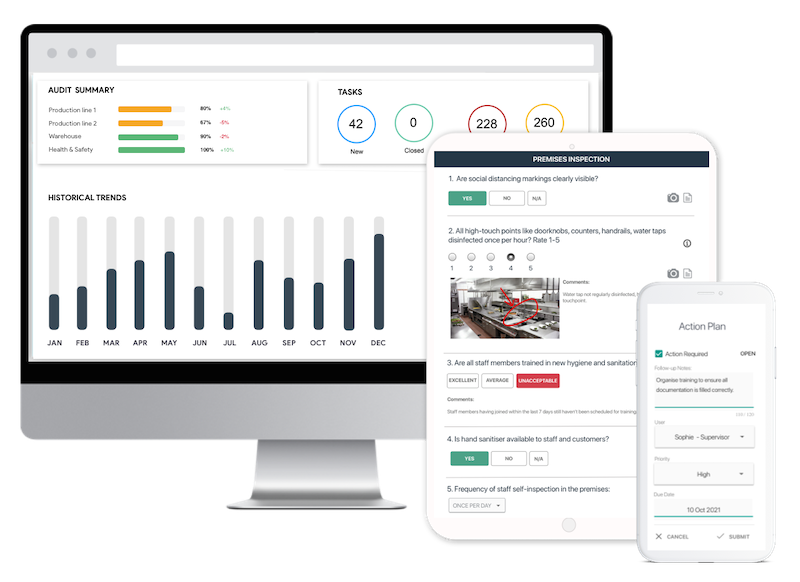
- Access a library of food safety checklists or customize them to ensure every aspect of your operations is covered.
- Conduct internal audits up to 5 times faster with any mobile device, capturing data and photos, even offline.
- Generate professional and insightful reports automatically after each audit, and customize them to suit your organization’s reporting requirements.
- Export reports in various formats, including PDF and Excel, to facilitate easy sharing with stakeholders or for record-keeping purposes.
- Directly assign tasks, set deadlines, and track progress within the food safety app. Keep your team informed with automated notifications for upcoming audits, task deadlines, and identified issues.
- Facilitate communication between field teams and management.
- Analyze trends over time and identify recurring issues and their root causes.
- Benchmark your audit results against industry standards or internal metrics, providing a clear view of where your organization stands and where improvements are needed.
Free & Customizable Food Safety Checklists
Use this IFS Food Version 8 audit checklist to conduct internal audits and ensure compliance with the IFS Food version 8 requirements.
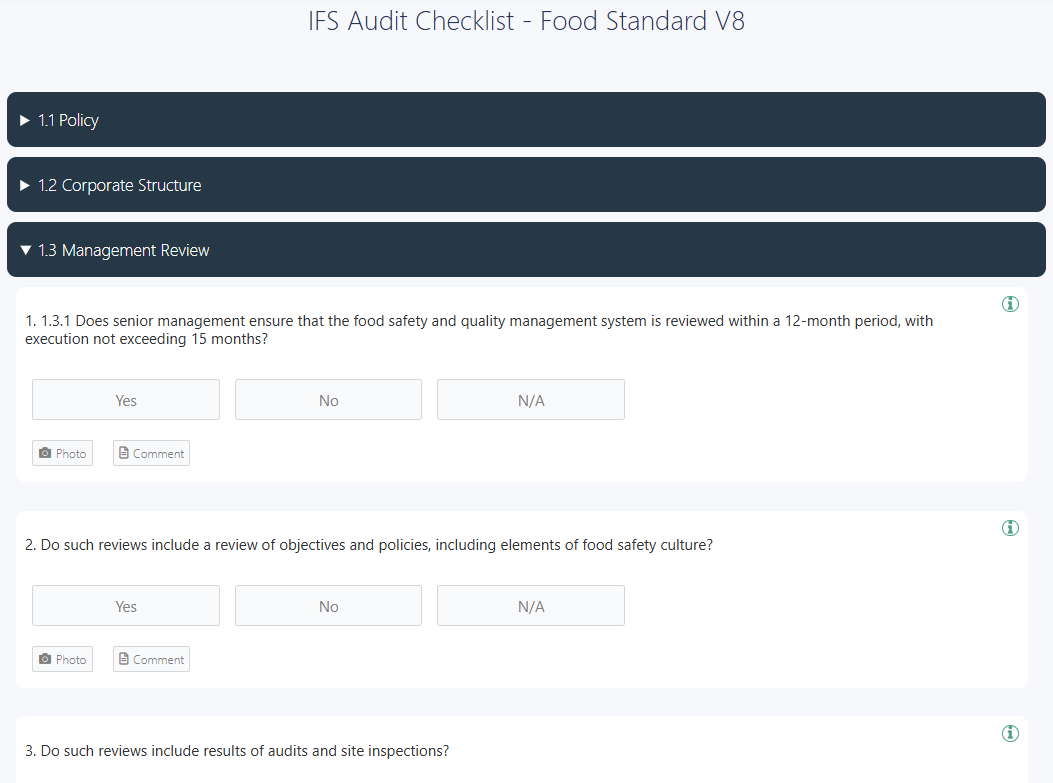
GoAudits offers the following food safety checklists. You can sign up for free and start using these checklists to conduct inspections effectively and ensure compliance with food safety standards.
- Food Safety & Hygiene Checklist
- ISO 22000 Food Safety Checklist (FSMS)
- ISO 9001:2015 Supplier Audit Checklist – Manufacturing
- HACCP-Based SOP Templates
- Food Manufacturing Hygiene Audit
- Food Manufacturing SOP
- Hygiene Checklist for the Food Industry
- Food Hygiene Inspection Checklist
- Food Facility Inspection Checklist
- Food Safety Self-Inspection Checklist
- Food Safety Inspection Checklist

What are the Benefits of Implementing IFS Food Version 8?
IFS Food Version 8 ensures that your food safety management systems align more closely with global standards, which can help your business maintain a competitive edge in the global market. It facilitates smoother international trade and builds trust with global partners and customers.
- One of the key updates in IFS Food Version 8 is its focus on strengthening the food safety culture within organizations. It emphasizes the importance of communication, training, and feedback mechanisms, ensuring that all employees are engaged and aware of their roles in maintaining high standards.
- The new IFS version 8 places a higher emphasis on food safety and quality. By implementing IFS Food Version 8, your business demonstrates a stronger commitment to maintaining these standards.
- IFS Food Version 8 simplifies the reporting and compliance processes. This can reduce the administrative burden on your team, allowing them to focus more on core activities rather than paperwork. Moreover, it reduces the chances of misinterpretation, ensuring that your compliance efforts are both effective and efficient.
- IFS Food Version 8 fosters a culture of continuous improvement. It encourages businesses to regularly assess and refine their food safety practices. It helps maintain compliance and drives innovation and operational excellence.
FAQs
The IFS Star Status is a new feature introduced in IFS Food Version 8 that indicates an audit was conducted unannounced. It serves as a mark of excellence, showing that the company consistently adheres to high food safety standards without prior preparation for an audit. A star is recorded in the IFS database and appears on the IFS certificate, demonstrating the company’s commitment to maintaining high standards at all times. It aims to increase the credibility and transparency of the audit process.
Yes. Using audit management software such as GoAudits, companies can digitize internal audits, collect inspection data in real time, track non-conformities, and generate structured audit reports aligned with IFS Food Version 8 requirements.
Digital audit platforms like GoAudits help organizations manage IFS Food Version 8 audits by offering checklists, conducting inspections on mobile devices, tracking corrective actions, and generating automated compliance reports.
IFS Food Version 8 requires management reviews to be conducted at least once annually, though organizations may perform them more frequently. Reviews evaluate audit results, corrective actions, complaints, and system performance to ensure the food safety management system remains effective.
Clause 1.4 defines the management review requirements. It requires senior management to review food safety objectives, audit findings, complaints, corrective actions, and operational performance to ensure continuous improvement of the food safety management system.
An IFS Food Version 8 checklist helps companies conduct internal audits before certification. It covers HACCP implementation, traceability, supplier approval, sanitation programs, pest control monitoring, and corrective actions to identify compliance gaps.
IFS Food Version 8 requires a documented pest control program including monitoring procedures, inspection records, defined responsibilities, and corrective actions. The program must prevent contamination risks and ensure pests are detected and controlled effectively.