Key Takeaways
- A construction handover transfers the completed asset, its documentation, and responsibility from contractor to client, formalised by a handover letter that establishes the transfer date.
- The handover file typically includes as-built drawings, O&M manuals, warranties, compliance certificates, commissioning records, and the health and safety file.
- Plan the handover 8 to 12 weeks out. Most handovers slip on documentation and outstanding defects, not on physical completion.
- Construction inspection software supports punch list management, real-time documentation, and automated handover reports.
The construction handover is a critical milestone that signifies the successful completion of a project. A well-executed building handover not only ensures that the project meets all agreed-upon specifications and standards but also minimizes future disputes and enhances client satisfaction.
Read on to learn the intricacies of handing over a construction project, highlighting its key components, common challenges, best practices, and how digital tools can streamline this crucial phase.
- What is a Construction Handover?
- Construction Handover Process: Key Components of a Project Handover
- Free Construction Handover Checklists, Report Template, & Letter Sample
- Common Challenges in Building Handover
- Best Practices for a Successful Building Handover Process
- How GoAudits Helps Manage Quality & Safety in Construction Projects
- FAQs
What is a Construction Handover?
A construction handover is a formal process of transferring ownership of the project from the contractor to the client or the owner. It is an important step wherein the contractor conducts the final inspections to ensure the project meets all the specifications and quality standards agreed upon in the contract.
At the handover stage in construction, the builder relinquishes all responsibilities to the owner. While it signifies the end of the builder’s role, it also denotes the beginning of the owner’s responsibility for maintaining and using the property.
You may also see this called handing over and taking over, or HOTO, particularly in facility management and industrial projects, where it describes the same transfer of assets and responsibility between two parties.
👉 Construction Project Handover Checklist: Here’s a free template that you can use to efficiently standardize your project handovers, making sure that nothing important is missed.
Project Closeout vs. Project Handover: Understanding the Distinction
While often used interchangeably, these two terms refer to different phases of a project’s end-of-life cycle.
- Project Closeout is the overarching, administrative process of wrapping up all aspects of a project. It is about “tying up all loose ends.” This includes financial reconciliation, contract finalization, team demobilization, and archiving project data. It’s the end of the project for the general contractor.
- Project Handover is a key component of the closeout process. It is the formal transfer of the completed physical asset and its associated documentation from the construction team to the owner or end-user. The handover is the moment the client takes physical and operational ownership of the building.
Site Handover to Contractor vs Handover to Client
Handover happens twice on most projects, in opposite directions.
- Site handover to the contractor takes place at the start. The client or principal gives the contractor possession of the site, along with access arrangements, existing surveys, service locations, and any restrictions on working hours or routes. This transfer establishes when the contractor becomes responsible for site security, safety, and welfare, so the date matters contractually.
- Handover to the client takes place at completion and is what the rest of this guide covers: the contractor transfers the finished asset, its documentation, and responsibility for it back to the owner.
Why Proper Handing Over of a Construction Project is Crucial
The handover process in construction officially denotes that the project is completed and the space is ready for the client to use.
A successful building handover involves passing over documentation such as warranties, compliance certificates, user manuals, keys, and access details to the new owners, ensuring they are equipped with all the necessary items to manage the property. This is crucial to minimizing the chances of disputes in the future.
Furthermore, it allows contractors to identify and address minor issues before marking the project as done. Whereas for new owners or clients, a construction handover provides an opportunity to familiarize themselves with the newly built space and get all their questions answered.

Construction Handover Process: Key Components of a Project Handover
Irrespective of the nature of the project, most construction handovers require contractors to fulfill the following requirements:
Documentation
The first step in handing over a construction project is gathering all the essential documents to facilitate a smooth transition. This typically includes compliance certificates, engineering plans, architectural drawings, permits, contracts, maintenance manuals, and any other relevant paperwork that the client or the owner might require to operate and maintain the facility in the future.
Here is a concise list of the critical documents required during construction handover:
- As-Built Drawings: A final, updated set of drawings that show the facility as it was actually built, including any on-site modifications.
- Operations & Maintenance (O&M) Manuals: Comprehensive guides for all building equipment and systems. They contain instructions, maintenance schedules, and manufacturer specifications.
- Warranties & Certificates: A consolidated file of all warranties for materials and equipment, along with any compliance certificates or permits required by law.
- Health and Safety File: A critical document that compiles all health and safety information for the building, essential for future maintenance, repairs, or demolition.
- Legal Contracts & Permits: Copies of all finalized contracts, subcontracts, and official building permits.
Commissioning
Commissioning is the process of testing that building systems work as designed before handover: HVAC, electrical, fire alarms and suppression, lifts, water systems, and building management controls. It is distinct from inspection; an inspection confirms something was installed correctly, while commissioning confirms it performs under operating conditions.
Commissioning records are part of the handover file. Clients and facility managers typically expect test certificates for each system, along with the settings each system was commissioned to, since those become the baseline for future maintenance.
Final Site Inspections
Before handing over the construction project to the client, the contractor must conduct a final site inspection to make sure all systems function correctly per the agreed-upon standards.
This includes structural checks, electrical and plumbing inspections, fire safety tests, etc. The final inspection is crucial as it assures that the project meets all the compliance requirements and is free of any safety hazards.
👉 Useful Resource: Free Construction Inspection Checklists
Here are free templates that you can customize to your specific project requirements:
→ Construction Quality Control Checklist
→ Building Inspection Checklists
→ Roof Inspection Checklist
→ Residential Plumbing Inspection Checklist
→ Residential Fuel Gas Piping Checklist
» Use These Checklists: Sign up with our 14-day free trial to have these checklists customized.
Punch List Items
A Punch List Form – Construction is a list of issues or repairs that need to be addressed before the project is handed over. It is usually compiled during the final inspections, and the contractor must ensure all issues are resolved before declaring the project complete.
Warranties
Some warranties come into effect immediately after project completion, whereas others are valid only after submitting the closing-out documents. Regardless of the warranty type, building handover is the time for the future owners to receive warranties and learn about the coverage.
Utilities
At times, the contractor may take over managing and paying for utilities such as electricity, water, and gas while the project is in progress. In such cases, the utility accounts must be transferred back to the client during the building handover. This ensures a smooth transition of utility services and billing responsibilities from the contractor to the owner.
Jobsite and Material Management
The construction team is responsible for clearing the project site of debris, materials, and tools before declaring it ready for use. This includes returning rented equipment or other temporary tools. The contractors often give leftover materials to the owners or maintenance teams for future use.
👉 Post Construction Cleaning Checklist: Here’s a free template to systematically inspect & clean all property areas.
Retainage
It is a common practice for contractors to demand the final payment and retainage only after completing the project substantially. Construction project handover is the time to release the final payments and retainage and settle the account.
Handover Requirements Under the Building Safety Act (UK Higher-Risk Buildings)
For higher-risk buildings in England, generally those at least 18 metres tall or with 7 or more storeys containing two or more residential units, handover is now a statutory gateway, not just a contractual milestone.
Two requirements affect handover directly:
- The golden thread. Under Section 88 of the Building Safety Act 2022, a digital record of safety-critical building information must be maintained throughout design and construction, then transferred to the accountable person at handover.
- Gateway 3. The Building Safety Regulator must issue a completion certificate before the building can be occupied. The application requires confirmation that golden thread information has been handed over, and assessment takes around eight weeks.
The practical implication: the record has to be built continuously rather than assembled at the end, so capturing inspections and defects digitally as work happens is what makes the handover file complete when Gateway 3 arrives.
Full guidance is available from the Building Safety Regulator on GOV.UK, and the underlying duty is set out in Section 88 of the Building Safety Act 2022.
Construction Project Handover Plan
A handover plan is the schedule of who does what, and by when, in the weeks before transfer. Handovers fail on timing far more often than on quality, and the difference between a smooth transfer and a scramble is usually whether a plan existed eight weeks out or eight days out.
A typical handover plan works backwards from the target date:
- 8-12 weeks out: confirm the handover date with the client, start assembling the handover file, and identify any long-lead documents such as certificates requiring third-party sign-off.
- 6-8 weeks out: begin pre-handover inspections by trade. Finding defects now leaves time to fix them without delaying transfer.
- 4 weeks out: compile the snag list from those inspections and issue rectification tasks with named owners and deadlines.
- 2 weeks out: verify O&M manuals, warranties, and as-built drawings are complete. Chase anything missing, this is where handovers usually slip.
- 1 week out: conduct the joint inspection with the client, agree any remaining items in writing, and confirm utility transfer dates.
- Handover day: final walkthrough, key and access transfer, signed handover letter, and the client’s acknowledgement of the handover file.
- Post-handover: confirm the Defects Liability Period start date and give the client a single point of contact for reporting defects.
Assign an owner to each stage. The most common failure is assuming the documentation will assemble itself while everyone focuses on physical completion.
Free Construction Handover Checklists, Report Template, & Letter Sample
To help you get started, here’s a comprehensive construction handover checklist and a project handover report template based on best practices. These resources will help you standardize your procedures and ensure nothing is missed.
Free Construction Handover Checklists
Here are free project handover checklists and handover forms from the GoAudits construction inspection template library. Each works as a building handover form you complete on site, with the completed report generating automatically in a consistent format:
- Construction Project Handover Checklist
- Building Handover Inspection Checklist
- New Build Handover Checklist
Prefer a Word or Excel handover form? Most teams start there, then hit the same problem: the form gets completed on paper, transcribed later, and the photos live somewhere else entirely. These checklists are completed on a phone at the site, with photos and timestamps attached to each item, and the formatted handover report generates itself. If you already have a handover form or format you want to keep, send it over, and the team will build the digital version at no cost.

Free Handover Report Template (Sample PDF)
Here’s a free new home handover report template generated using GoAudits inspection software and a construction handover checklist:
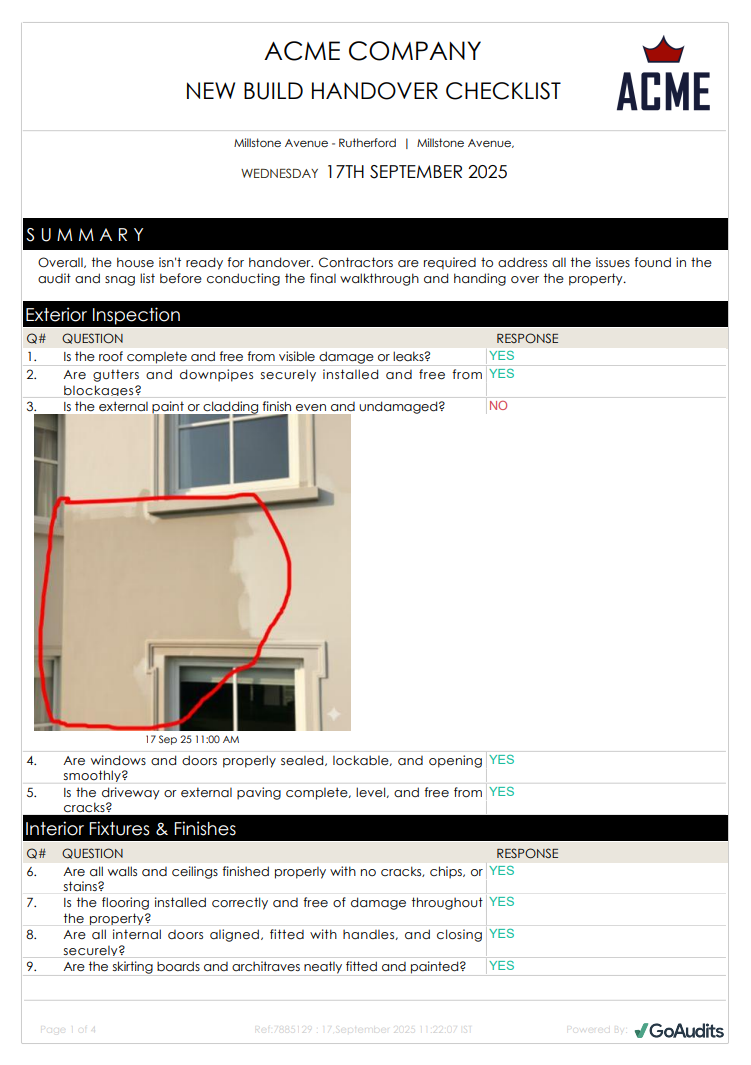
The report doubles as a handover checklist and defect report: any item marked as failed appears in the report with its photo, location, and assigned owner, so the client receives one document covering both what was inspected and what remains outstanding.
How to Write a Handover Report
A handover report records the condition of the completed works at the moment of transfer. It is the document both parties refer back to if a dispute arises, so it needs to be specific enough to be evidence rather than a summary.
- Inspect against a checklist, not from memory. Walk the building room by room or system by system using a structured handover checklist. This is what stops the report from reflecting whatever you happened to notice.
- Record condition, not just completion. “Installed” tells the client nothing they can act on. “Installed, tested, operating correctly on [date]” does.
- Photograph everything, including what passed. Photos of defects are obvious. Photos of correctly finished work are what protect you when damage appears three months later, and its origin is disputed.
- List outstanding items separately. Anything not complete at handover belongs in its own section, with an agreed rectification date and a named owner. Burying incomplete items in the body is how disputes start.
- Record what was physically transferred. Keys and how many sets, access codes, passes, spare materials, and the handover file itself.
- State the DLP dates explicitly. Start date, end date, and how the client reports defects during it.
- Get it signed by both parties. An unsigned handover report is a record of one party’s opinion. A signed one is an agreed position.
Digital construction inspection tools generate most of this automatically: you complete the checklist on site, and the report assembles itself with photos, timestamps, and location data already attached, which removes the transcription step where detail usually gets lost.
What is Defects Liability Period (DLP) and Why It is Important
The Defects Liability Period (DLP) is predefined, typically 12 to 24 months, and begins upon the formal handover of the project. During this time, the contractor remains responsible for rectifying any defects or “snags” that appear.
Properly managing the handover process is crucial for a smooth DLP. A comprehensive handover ensures that all initial defects are addressed and documented, minimizing potential disputes and call-backs later.
GoAudits can be a powerful tool during this phase, as it allows for clear, time-stamped documentation of all defects, their assigned rectification tasks, and their completion status. This transparent process protects both the contractor and the client.
Construction Handover Letter: What to Include (+ Sample)
A handover letter is the formal written notice that the contractor has completed the works and is transferring the asset to the client. It sits alongside the handover checklist rather than replacing it: the checklist records what was inspected, the letter records that the transfer formally happened and on what date.
That date matters more than the letter’s length. It usually starts the Defects Liability Period, ends the contractor’s responsibility for site security and insurance, and often triggers the release of retainage.
What a construction handover letter should include:
- Project details: project name, site address, and contract reference
- Parties: contractor and client names, with the individuals signing on each side
- Date of handover, stated explicitly as the effective transfer date
- Confirmation of practical completion, referencing the certificate if one has been issued
- What is being handed over: the building or specific sections, plus keys, access codes, and passes
- Documents transferred, listed rather than described: as-built drawings, O&M manuals, warranties, certificates, health and safety file
- Outstanding items, if any, with agreed rectification dates
- Defects Liability Period, with start and end dates and how the client reports defects
- Signature blocks for both parties, with printed names, roles, and dates
Sample Wording:
Dear [Client name],

We confirm that the works at [project name, site address], carried out under contract [reference], reached practical completion on [date]. This letter serves as formal handover of the property to [client company] with effect from that date.

Handed over with this letter: [number] sets of keys, access codes for [systems], and the project handover file containing as-built drawings, operations and maintenance manuals, warranties and guarantees, compliance certificates, and the health and safety file.

The Defects Liability Period runs for [12/24] months from the date above, expiring on [date]. During this period, please report any defects to [contact name and details], and we will arrange rectification.

[Outstanding items, if applicable, with agreed completion dates.]

Please countersign below to acknowledge receipt.
Keep the letter short. Its job is to establish the date and confirm what changed hands, and the detail belongs in the attached checklist and handover file.
Common Challenges in Building Handover
Contractors and builders face the following challenges when handing over construction projects:
Defect Identification and Rectification
Identifying and addressing defects is a significant challenge during handover. Discrepancies between as-built drawings and actual site conditions can lead to overlooked issues.
For instance, defects may go unnoticed if field personnel use outdated drawings or fail to update revisions accurately. It’s crucial for contractors to thoroughly inspect and rectify any defects before handover to ensure the building meets the required standards.
Coordination Between Parties
Effective collaboration among subcontractors, engineers, suppliers, and clients is essential during handover. Miscommunication or lack of coordination can result in rework, delays, and increased costs.
Time Constraints
Tight deadlines are common in construction projects, especially as clients are often eager to occupy the new building. Rushed handovers can lead to incomplete documentation, overlooked defects, and inadequate training for the facility’s management team. In some cases, delayed handovers can lead to financial penalties or legal actions from the clients.
Meeting Regulatory Requirements
Compliance checks with building codes, safety regulations, and environmental standards are mandatory during handover. Failing to comply with any regulatory requirement can result in legal issues, fines, or delays in obtaining occupancy permits.
👉 Customer Story: How Woodside Homes Overcame the Challenges of Construction Handover
Woodside Homes, a leading homebuilding company in the US, offers various solutions, including fully equipped and personalized housing. However, due to a lack of a formalized and systematic approach, the team found it challenging to inspect critical checkpoints and communicate the identified issues with trade partners, impacting the overall handover Quality Control.
The company adopted GoAudits’ construction QC software to streamline its property quality control process. Custom digital checklists, an intuitive app, and automated building inspection reports helped teams enhance coordination with trade partners, improve overall quality, and simplify the general superintendent’s role, leading to significant efficiencies and time savings.
Best Practices for a Successful Building Handover Process
Planning and organization are key ingredients of a successful handover. Here are some tips to ensure your next construction handover is smooth and efficient.
- Plan Early: Start planning the handover at the beginning of the project. Collect and organize documents to ensure a clear understanding of contract specifications and avoid last-minute chaos.
- Ensure Thorough Final Walkthroughs: Conduct comprehensive inspections to identify and address any last-minute defects or incomplete work so that all issues are resolved before the handover, preventing future complications.
- Communicate Effectively: Establish clear communication channels among all stakeholders, including contractors, clients, and facility managers. Make sure everyone on the team is regularly updated on progress, all concerns are addressed promptly, and everyone is aligned.
- Take a Systematic Approach: Implement a structured construction project handover procedure to bring consistency and thoroughness, minimizing the chances of overlooking critical tasks. One of the ways to stay organized is by using building handover checklist templates that outline every item of the handover.
- Use an Audit Management and Collaboration Tool: The best building inspection software facilitates automated reporting, real-time information sharing, tracking timelines, effective collaboration, and more, making the building process more efficient.
How GoAudits Helps Manage Quality & Safety in Construction Projects
GoAudits is a construction inspection software that allows contractors to do their best work while meeting the safest and highest quality standards. Its scalable features allow builders to streamline processes, eliminate communication bottlenecks, enhance resource utilization, and handle multiple projects.
With GoAudits, you can:
- Create custom construction inspection checklists.
- Schedule regular inspections before the handover.
- Perform final walkthroughs, even in locations with limited internet connectivity.
- Build a punch list and assign corrective actions to the team.
- Make sure all stakeholders stay updated through instant reporting.
- Hand over projects on time by ensuring last-minute repairs and fixes are addressed promptly.
With a rating of 4.8 stars on Capterra, GoAudits is trusted by some of the biggest names in the construction management industry.
» GoAudits Reviews: Read how companies leverage GoAudits to meet standards in their construction operations.
FAQs
Common concerns during a property handover include incomplete or faulty work, like unfinished installations or non-functional systems. Buyers also worry about a lack of crucial documents, such as warranties and certificates, and potential discrepancies between the property’s final state and the initial contract.
Facilities management (FM) companies facilitate handover by providing a structured plan for operations. They conduct pre-handover inspections, verify asset inventories, and ensure all building systems are operational.
The standard process for handover of a new build involves several key steps: a practical completion inspection (or snagging) to identify defects, the creation of a snag list, and a final joint inspection with the client. Once all issues are rectified, essential documents such as as-built drawings, warranties, and certificates are transferred, and the property’s keys are handed over.
Real estate agencies manage handovers by acting as a liaison between the buyer and the seller or developer. They coordinate inspections, ensure all legal and financial obligations are met, and facilitate the transfer of keys and possession.
Builders support clients after handover through the defects liability period (DLP), typically lasting 12-24 months. During this time, builders are responsible for fixing any latent defects that emerge. They also provide access to warranties for installed systems and often offer a dedicated point of contact for any post-handover issues.
To create a handover document, start with a comprehensive checklist of all inclusions and exclusions. The document should contain as-built drawings, operation manuals for all equipment, and a list of all warranties and contact details for suppliers. Ensure it includes a signed and dated confirmation from both the client and the builder to mark the official transfer.
HOTO stands for Handover Takeover. It describes the formal transfer of assets and responsibility from one party to another, most commonly used in facility management and industrial projects. Functionally, it is the same process as a construction handover, with the terminology emphasising both sides of the transfer rather than just the handing over.
Commissioning is the testing phase that confirms building systems perform as designed. Handover is the formal transfer of the completed asset to the client. Commissioning happens first, and its test certificates form part of the documentation transferred at handover.