

Key Takeaways
- A catering SOP is a written, step-by-step instruction for a single catering task, from prep through breakdown.
- Catering differs from restaurant work because execution happens off-site, in transit, and at venues you do not control.
- The highest-risk stages are transport, holding, and on-site setup, so those SOPs carry the most weight.
- Writing the SOP is the easy part. The hard part is adoption and confirming it was followed at the event.
- GoAudits turns catering SOPs into mobile checklists with photo and timestamp proof, so standards can be verified at any site without being there.
The standard you set in your kitchen has to survive a van, a venue with no kitchen, and a crew you cannot see. That is the catering problem in one sentence. A dish plated perfectly at the commissary can arrive two hours later held at the wrong temperature, set up by an agency worker who has never read your prep notes, and served to 300 guests before anyone spots the issue.
A catering SOP is how you close that gap. Written well and followed on the day, it keeps food safe and service consistent whether you run one wedding or fifteen corporate lunches across a city. Written and then filed in a binder nobody opens, it does nothing.
This guide covers what a catering SOP is, the SOPs you actually need across a job, how to write one that reads clearly, and the part most guides skip: how to get your team to follow it and how to check that they did.
- What is a Catering SOP?
- What SOPs Does a Catering Business Need?
- How to Write a Standard Operating Procedure for Catering Services (+ Free Template)
- How to Implement Catering SOPs and Monitor Compliance
- How to Manage Catering SOPs Across Multiple Sites
- Create and Implement Digital Catering SOPs With GoAudits
- FAQs
What is a Catering SOP?
A catering standard operating procedure (SOP) is a written, step-by-step instruction for completing one catering task the same way every time, from prep through breakdown. It documents how a task should be done, who is responsible, and what “correct” looks like, so the result does not depend on who is working that shift.
Catering standard operating procedures differ from most food SOPs in one way: the work happens off-site. A restaurant controls its own kitchen and dining room.
A caterer prepares food in a commissary, packs it, drives it, and finishes it at a venue with no permanent kitchen, often with temporary staff. That is why an SOP for catering services has to account for transport, holding without mechanical refrigeration, and setup in a space you do not control.
How is an SOP for Catering Services Different From a Restaurant SOP?
The core difference is control. A restaurant runs continuous service in a fixed kitchen it owns. A caterer runs one-off events in venues it borrows, with food that has already traveled. That shifts where the risk sits and what the SOP must spell out.
| Factor | Restaurant SOP | Catering SOP |
| Kitchen | Fixed and familiar | Temporary or none on-site |
| Food holding | Line equipment, short holds | Extended holds, transport, chafing dishes |
| Service pattern | Continuous, all day | Event-based, one peak, no second chance |
| Staff | Trained regulars | Mix of regulars and agency crew |
| Supervision | Manager on the floor | Owner often not at the venue |
The supervision factor matters most. In a restaurant, a manager sees the standard slipping and corrects it. At an off-site event, the person who wrote the SOP is usually somewhere else, which is why catering standard operating procedures live or die on how well they are built to be followed without supervision.
Why Do Caterers Need SOPs?
Caterers need SOPs for four reasons: consistency, food safety, faster onboarding, and provable compliance. Each maps to a risk that off-site work makes worse.
- Consistency: Every event matches the tasting, whichever crew runs it.
- Food Safety: Documented temperature and hygiene steps cut the risk of an outbreak that could end your business.
- Faster Onboarding: A new starter follows a clear SOP on day one instead of shadowing for a week.
- Provable Compliance: A completed record shows a client or inspector the standard was actually met.
Food safety is the sharpest. In a widely cited review of 816 outbreaks linked to food workers, catered events ranked among the top settings, second only to food-service facilities themselves. According to the CDC’s analysis of outbreak data from 2014 to 2022, the leading contributing factors were improper holding temperature, sick food workers, and cross-contamination, all three harder to control once food leaves your building.
What SOPs Does a Catering Business Need?
A catering business needs SOPs for every stage of a job, from the first inquiry to the last piece of equipment returned. The clearest way to build your set is to follow the lifecycle of a real event, because that is the order in which the standard breaks down.
Pre-event SOPs
Pre-event SOPs standardize how you turn a booking into a plan the kitchen can execute. A missed dietary requirement or wrong guest count gets baked in before anyone starts cooking.
- Capture event details: date, venue, guest count, service style, and timings.
- Record dietary requirements and allergens at booking, in writing.
- Sign off the final menu so it gets confirmed and locked.
- Run supplier ordering and goods-in checks, including temperature on delivery.
Commissary and Kitchen Prep SOPs
Good catering prep SOPs make sure food leaves your building safe, labeled, and made to the same recipe every time. The commissary is your one controlled environment, so build food safety in before the food moves.
- Standardize recipes and portioning so quantities and quality do not drift.
- Set batch prep sequences and cooking steps with target core temperatures.
- Label and date-mark every prepped item, including allergen information.
- Enforce prep hygiene: handwashing, cleaning, and raw/ready-to-eat separation.
Free Resource: Adapt ready-made templates for the checks, including HACCP-Based SOPs and a Food Safety Kitchen Inspection Checklist.
Food Safety and Temperature Control SOPs
Catering food safety SOPs dictate temperature and contamination rules to keep food out of the danger zone. These are the non-negotiable core, and the exact thresholds depend on where you operate.
Under the US FDA Food Code, hold hot food at 135°F (57°C) or above and cold food at 41°F (5°C) or below. Under UK Food Standards Agency rules, hot holding is 63°C or above and cold holding is 8°C or below. State the figures your jurisdiction requires rather than a vague “keep food hot.”
- Write in cook, cool, and reheat temperatures with target figures.
- Check and log hot and cold holding with a probe thermometer.
- Control cross-contamination: separate equipment, color-coded boards, storage rules.
- Set the time limit for food held out of temperature control, and what to do at it.
A HACCP internal audit checklist and HACCP-based SOP templates give you a structure for the monitoring side.
Allergen Management SOPs
Allergen SOPs control how you record, separate, and communicate allergen information so a guest with an allergy is not put at risk. For caterers serving schools, hospitals, or the public, this is a safety issue and a legal one.
In the UK, Natasha’s Law requires full ingredient and allergen labeling on food prepacked for direct sale, and the FSA allergen guidance sets out how to provide allergen information for food that is not prepacked. The rules differ by how food is packaged, so your SOP has to reflect how you actually deliver food.
The FSA also publishes separate guidance for institutional caterers, so multi-site and contract operators should check which rules apply to each service they run.
- Keep ingredient records for every dish updated when recipes change.
- Prevent cross-contact during prep, transport, and service.
- Label prepacked items and give clear allergen information for served items.
- Define how staff answers allergen questions, and who they escalate to.
Use our allergen checklist for on-the-ground verification.
Transport and Holding SOPs
Transport and holding SOPs control food safety during the journey.
- Set cold-chain and hot-holding methods for transit, with target temperatures.
- Use time as a control: how long food can be in transit before it must be used or discarded.
- Define packing and load order so cold and hot items stay separated and stable.
- Cover vehicle hygiene and the arrival temperature check at the venue.
Because vehicles and distribution are part of your food safety chain, a SALSA Audit Checklist covering vehicle and storage controls is a useful reference.
On-site Setup and Service SOPs
Catering on-site SOPs cover how your crew turns a borrowed space into a working service area and holds the standard through the event.
- Setup: station layout, catering equipment checks, and power or gas safety.
- Check buffet and chafing-line holding temperatures before service opens.
- Define service standards: portioning, presentation, and replenishment.
- Build in last-minute temperature checks and what to do if a dish is out of range.
Breakdown, Cleaning, and Post-event SOPs
Catering event breakdown SOPs cover teardown, cleaning, and the review that feeds lessons back into your procedures. The standard applies right through to a clean van and a closed-out job.
- Tear down and pack equipment safely.
- Handle and dispose of waste at the venue.
- Return and sanitize equipment back at base.
- Run a short post-event review so problems become SOP updates.
Your cleaning steps can draw on your hygiene SOPs for the detail.
Free Resource: GoAudits has a free food and hospitality checklist library you can access to turn each SOP stage into a check your team completes on-site. Also, check out our guide to catering safety for practical tips and best practices.

How to Write a Standard Operating Procedure for Catering Services (+ Free Template)
To write a catering SOP, describe one task in clear steps, assign responsibility, and set a measurable standard for success. The best SOPs are specific enough that a new starter could follow them without asking questions, and short enough that they actually get read.
What to Include in a Catering SOP
Every catering SOP should include five parts: purpose, scope, procedure steps, responsibilities, and a review date.
- Purpose: One line on what the SOP is for and why it matters.
- Scope: Where and when it applies, for example “all off-site events with hot food.”
- Procedure Steps: The task in numbered steps with measurable detail. Write “hold at 63°C or above, checked every 30 minutes,” not “keep hot.”
- Responsibilities: Who does each step and who signs off.
- Review date: When the SOP will be checked and updated.
A short worked example, a catering SOP for hot-holding during transport:
- Purpose: Keep hot food safe from commissary to venue.
- Scope: All events needing hot food transport over 20 minutes.
- Steps: 1) Confirm food is at 75°C before packing. 2) Load into pre-heated hot boxes. 3) Record departure time. 4) On arrival, probe one item per box and record the temperature. 5) If any item is below 63°C, apply the time-control rule and notify the event lead.
- Responsible: Kitchen lead packs and records; event lead checks on arrival.
- Review: Every 12 months, or after any temperature failure.
Free Downloadable Catering SOP Manual Template
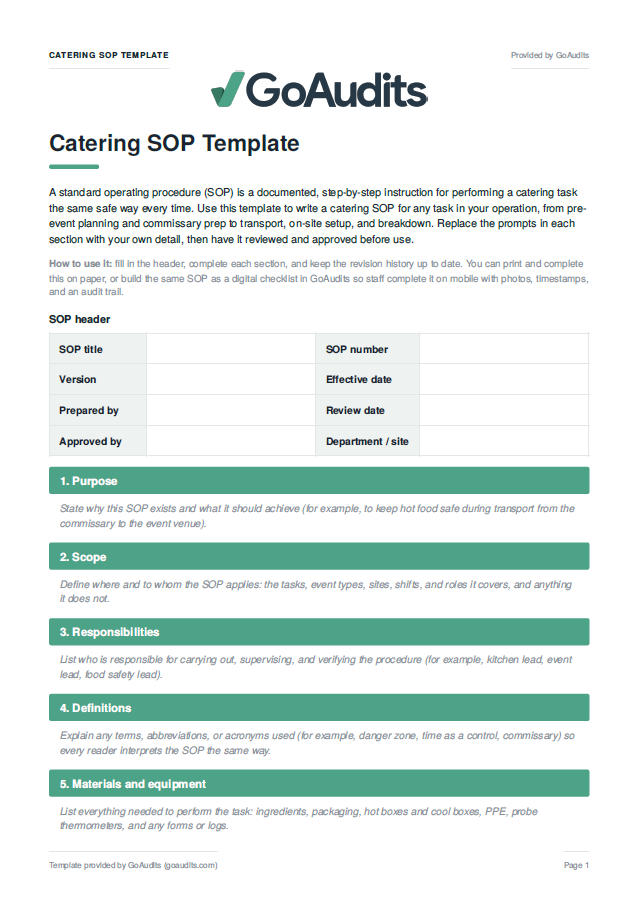
A catering SOP template provides a ready-made structure, so you are not writing every procedure from scratch. Our free template follows the five-part structure above and includes ready-to-use SOP examples you can adapt, including procedures for event setup so your crew has a clear routine on arrival.
Free Downloadable Catering SOPs
A catering SOP manual is the full set: every SOP your operation uses, collected in one place and kept current. Start with the highest-risk tasks (transport, holding, allergens), build a template for each, then gather them into a manual as your library grows. Our SOP documentation templates show how to organize and version the full set.
GoAudits’ AI Checklist Generator drafts a first version of a procedure for you to correct to your real method, and existing SOPs in Word or PDF can be digitized into usable checklists for free. That turns a static manual into something your crew completes on the job.

How to Implement Catering SOPs and Monitor Compliance
A catering SOP only works once it is a checklist your staff completes on shift and someone can verify it was followed. Writing the procedure is roughly 20% of the work. The other 80% is adoption and monitoring, and off-site catering makes it harder because the person responsible for the standard is rarely at the venue.
Turn Each SOP Into a Checklist Staff Actually Use
The most reliable way to get an SOP followed is to convert it into a short checklist your team completes at the point of work. A prose SOP describes the standard; a checklist makes it something people tick off, in order, while they do the task.
Mobile food checklists have the edge over station cards because the standard travels to the venue with the crew. A tool like GoAudits lets a crew run a checklist on a phone, even offline, so the SOP is in their hand at the event.
Train Staff and Drive Adoption
Adoption depends on training people on the SOP and giving each SOP an owner. Onboard new starters and agency crew with a training checklist that covers the SOPs for their role before their first event. Beyond onboarding:
- Run short refreshers before high-risk or high-profile events.
- Give each SOP a named owner responsible for keeping it current.
- Take feedback from the crew, since the people doing the task spot the gaps first.
High turnover is a fact of catering, so aim for a system that gets a new person to standard quickly.
How to Monitor Catering SOP Compliance
You monitor catering SOP compliance by auditing events, capturing evidence, and tracking a few clear metrics over time. Monitoring answers the question a client or inspector will eventually ask: can you prove the standard was followed?
- Event audits and spot checks: Scheduled and surprise checks at live events.
- Photo and timestamp evidence: A buffet-line photo or temperature reading tied to a time and place.
- Completion rates: What percentage of required checks were actually done.
- Temperature and safety logs: The recorded readings for holding, transport, and service.
Reviewing these by event, site, and crew shows where standards hold and where they slip, so you can act before a client complaint or a failed inspection does.
👉 Case Study: How Independent Food Company 4X’d Their Audit Turnaround
After moving its quality and food safety audits off paper, The Independent Food Company team cut its audit turnaround from around four days to one, and its operations team now responds to 90% of action plans within one to two days, according to quality and hygiene manager Eliane E. The gain came from capturing findings and photos on site and getting them to the right person immediately, instead of waiting days to compile a report.
» Read Full Story: How Independent Food Company implements efficient food safety audits with GoAudits.
Corrective Actions and Continuous Review
Corrective actions close the loop by turning a failed check into a fix with an owner and a deadline. When a temperature log shows a breach or an audit flags a gap, log it, assign the fix, and confirm it was done.
If the same issue keeps appearing, the procedure, the training, or the equipment needs to change. Review your SOPs on a set cadence and whenever a menu, a piece of equipment, or a regulation changes, so the manual keeps pace with how you operate.
Allow event teams to use a food safety audit app like GoAudits to report issues and assign corrective actions instantly. As a manager, you can monitor the status through a dashboard across all event locations and sites.
How to Manage Catering SOPs Across Multiple Sites
Managing catering SOPs across multiple sites means enforcing one core set of standards while allowing controlled local adaptation. For a contract caterer or a multi-crew operation, every site has to deliver the same standard, but no two sites are identical, and the person who owns the standard cannot be at all of them at once.
The workable model is core-plus-local. You hold a single set of core SOPs every site must follow, covering food safety, allergens, and the non-negotiables. Individual sites adapt the operational detail, such as layout, local suppliers, and venue quirks, within that frame. The hard part is not writing the core SOPs. It is knowing, across dozens of sites and one-off events, whether each one actually followed them.
Catering audit software like GoAudits holds your SOPs as live checklists that every site opens on a phone, so there is one current version in circulation instead of emailed copies drifting out of date.
Each completed checklist becomes a timestamped, photo-backed record tied to a site and a crew, which gives you the audit trail that enterprise and institutional clients ask for when they award a contract. A multi-site dashboard then shows performance by site, so you can see which location is slipping before a client complaint or a failed inspection tells you.
Create and Implement Digital Catering SOPs With GoAudits
GoAudits food safety audit software closes the gap between writing a catering SOP and knowing it was followed at the event. It turns your procedures into mobile checklists your crew completes on site, with proof attached, so you can hold one standard across every job and location without being there in person.
For catering and multi-site food operations, that means:
- Run SOPs on a phone at any venue, even with no signal, and sync later.
- Capture photo evidence tied to a time and place, so compliance is provable.
- Assign a fix the moment a check fails and track it to closure.
- See performance by event, site, and crew, and spot where standards slip.
- Send your existing Word or PDF SOPs and have them turned into usable checklists at no cost.
With a rating of 4.8 stars on Capterra, GoAudits is trusted by some of the biggest brands in the F&B industry.
» GoAudits Reviews: Read how companies leverage GoAudits to meet standards and deliver consistent services across locations.
FAQs
No. A permit SOP is a form you submit to a regulator to describe your operation and get a license. Many US county health departments require a catering operation SOP form covering your commissary, transport, and handling before they issue a permit. An operational catering SOP is different: it is the internal, working procedure your team follows day to day. You often need both.
A catering SOP covers one task. A catering SOP manual is the complete collection of your SOPs, gathered into a single document or system. Think of each SOP as a page and the manual as the binder. You build the manual over time by writing individual SOPs and organizing them together, then keeping the whole set current.
Yes. Even a solo caterer benefits from written SOPs, because they protect food safety and consistency when you are tired, busy, or scaling up for a big event. You do not need dozens. Start with the highest-risk tasks: transport, holding, and allergen handling, and add more as you grow or hire.
Yes, AI can draft a solid first version of a catering SOP that you then correct to match how you actually work. A tool like GoAudits’ AI Checklist Generator gives you a structured starting point in seconds rather than a blank page. The important step is human review, because an AI draft will not know your recipes, equipment, or local rules. Treat it as a first draft, not a final procedure.
Catering SOPs are not usually mandated by name, but the food safety management they document often is. Both the US FDA Food Code and the UK Food Standards Agency require food businesses to control hazards, and a documented, HACCP-based system is the standard way to show you do. In practice, SOPs are how you meet those obligations and prove it during an inspection.
Building a full set takes a few weeks of focused effort, but you can protect your operation in a day by starting with the highest-risk tasks first. Begin with food safety, transport and holding, and allergen management. Write one SOP per task using a simple template, get your team using them, then expand into prep, service, and breakdown. A working set of ten good SOPs beats a perfect manual you never finish.
Inspection and checklist apps are the most practical software for managing catering SOPs, because they turn procedures into checks staff complete on site with proof. GoAudits is built for this in food and hospitality, with offline mobile checklists, photo evidence, corrective actions, and multi-site dashboards. Other tools in the space include SafetyCulture and FoodDocs. The right choice depends on how many sites you run and whether you need proof-of-completion across events, so trial one before committing.

