

Lockout Tagout Procedures Templates
Template Library > Safety Inspections > Lockout Tagout Inspections
Standardize Maintenance Safety With Lockout Tagout Checklists
Lockout Tagout procedures are critical for protecting workers during maintenance and repair of machinery. A LOTO checklist standardizes the process, helps prevent accidents, and ensures compliance with OSHA regulations.
With a standardized LOTO checklist, you can:
- Ensure worker safety by controlling hazardous energy.
- Standardize safety inspections for consistent compliance.
- Document and track procedures for audits and training.

With the GoAudits Safety Inspection App, you can:
- Eliminate paperwork: conduct efficient digital audits, add photos from mobile device
- Customize this template or easily create your own
- Save time with instant reports & assign corrective actions
Equipment, Machinery, And Personnel
Energy Control Program
2. Does the written program state the following methods of compliance: •Intended use of procedures •Steps for shutdown, isolating, blocking, and securing energy? •Steps for placement, removal, and transfer of lockout/tagout devices? •Requirements for testing to verify the effectiveness of lockout/tagout?
|
Photo
Comment
|
Training Requirements
Equipment, Machinery, And Personnel
Energy Control Program
2. Does the written program state the following methods of compliance: •Intended use of procedures •Steps for shutdown, isolating, blocking, and securing energy? •Steps for placement, removal, and transfer of lockout/tagout devices? •Requirements for testing to verify the effectiveness of lockout/tagout?
|
Photo
Comment
|
Training Requirements
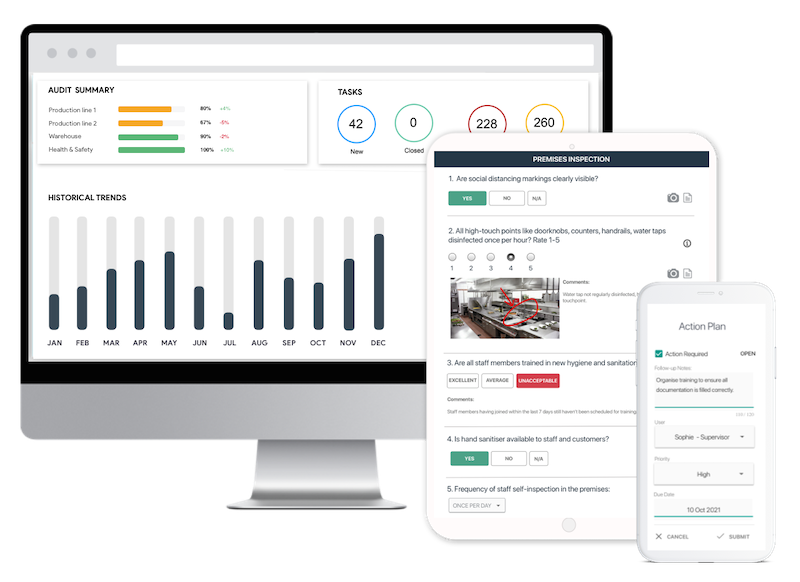
Save Time with Digital Inspections
- Easily capture & attach photos, directly on your mobile device.
- Instantly generate and share detailed reports after the inspection.
- Track corrective actions, view historical trends, improve standards.


What is a Lock Out Tag Out (LOTO) Checklist?
LOTO checklists are based on OSHA Standard 29 CFR 1910.147, which requires employers to establish procedures for the control of hazardous energy. The checklist is what turns that procedure into a record: which machine was isolated, on what date, by which named person, and whether the zero-energy state was verified before work started.

Why Are LOTO Procedures So Important?
These incidents can result from unexpected machine startup, release of stored energy, or failure to properly isolate equipment. Implementing standardized LOTO procedures helps organizations:
- Maintain detailed records for accountability and continuous improvement.
- Force a recorded verification step before any work begins, rather than a reminder to do one
- Show the correct sequence was followed if an incident is later investigated
- Cover contractors and second-shift crews who did not apply the original lock
- Give the annual periodic inspection something concrete to verify against
What Should a Lockout Tagout Checklist Include?
A well-designed Lock Out Tag Out checklist usually includes the following sections:
- Essential Information: Verifies the date and time of lockout tagout procedures, equipment types, ID, location, names of authorized personnel, and the purpose of lockout.
- Energy Source Identification – Includes the list of all energy sources from electrical, mechanical, hydraulic, pneumatic, chemical, thermal, etc. to confirm energy isolation points.
- Notification – Records that affected employees were told before the lockout was applied and again before it was removed, with times for both.
- Shutdown Procedures – Sets out the stopping sequence for that specific machine and confirms it was brought to a complete stop using the normal controls, not an emergency stop.
- Isolation Procedures – Ensures methods used to isolate energy consisting of circuit breakers, valves, disconnect switches, etc.
- Stored Energy Control: Steps to release or restrain stored energy from bleed lines, discharge capacitors, block moving parts, etc.
- Maintenance/Service Work: Specifies description of work performed and the names of personnel involved in LOTO inspections.
What Sequence Should a LOTO Checklist Follow?
A LOTO checklist should follow the six-step sequence OSHA sets out for applying energy control, so the order on paper matches the order on the floor.
- Prepare for shutdown – Identify every energy source on the equipment and confirm who needs to be notified.
- Shut down the equipment – Use the normal stopping procedure, not an emergency stop.
- Isolate the energy sources – Operate each disconnect, valve, or breaker listed for that machine.
- Apply the locks and tags – Every authorized employee attaches their own lock, with a tag identifying who applied it.
- Release or restrain stored energy – Bleed hydraulic and pneumatic lines, discharge capacitors, and block parts that can move under gravity or spring tension.
- Verify the zero-energy state – Attempt to start the equipment and test that it stays de-energized before any work begins.
Step six is the one most often skipped and the one an auditor will ask you to evidence.
Regulatory Standards and Compliance for Lock Out Tag Out Audit Checklists
Energy isolation is a legal requirement in most major markets, not just good practice. The regulations differ in wording but converge on the same four duties: a written procedure per machine, trained employees, verification before work, and a documented periodic review.
OSHA LOTO Standard – 29 CFR 1910.147 (United States)
In the U.S., the Occupational Safety and Health Administration (OSHA) outlines the requirements for controlling hazardous energy under 29 CFR 1910.147. This regulation mandates that employers:
- Develop and enforce an energy control program
- Provide proper lockout/tagout devices
- Train employees on LOTO procedures
- Conduct periodic inspections to ensure ongoing compliance
Lockout tagout is one of OSHA’s most frequently cited standards, and the agency estimates that compliance with 29 CFR 1910.147 prevents roughly 120 fatalities and 50,000 injuries a year.s
Most citations trace back to documentation rather than intent: no written procedure for a specific machine, no training records, or no certificate for the annual inspection.
👉 Discover free OSHA Checklist Templates in the GoAudits library.
International Equivalents
Outside the U.S., similar standards exist in many other countries:
United Kingdom:
The Health and Safety Executive requires safe isolation of energy under PUWER and the Electricity at Work Regulations. A PUWER inspection checklist covers the equipment inspection side of the same duty.
European Union: The EU Machinery Directive and national health & safety laws support similar LOTO principles.
Canada: Provincial agencies enforce LOTO through regulations like CSA Z460 (Control of Hazardous Energy).
Australia: Safe Work Australia mandates energy isolation procedures under the WHS Model Regulations.
What Goes on a Lockout Tagout Tag?
A lockout tagout tag must warn that the equipment is unsafe to operate, identify who applied it, and state when it was applied. OSHA specifies the warning wording under 29 CFR 1910.147, using legends such as Do Not Start, Do Not Open, Do Not Close, Do Not Energize, and Do Not Operate.
A usable tag template captures five things:
- The warning legend, legible from a distance
- The name of the authorized employee who applied the lock
- The date and time the lockout began
- The equipment or asset ID the tag belongs to
- A contact number or department for anyone who needs the equipment released
Tags are warning devices only. They do not physically hold anything shut, which is why a tag on its own is permitted only where an energy-isolating device cannot accept a lock. Where you do run tagout, OSHA expects employees to be trained on those limits: a tag must never be bypassed, ignored, or removed by anyone other than the person who applied it.
Out-of-service tags and equipment placards
An out-of-service tag marks equipment as unavailable for use, which is a different job from a LOTO tag isolating energy for maintenance. Faulty machinery awaiting repair, a ladder pulled from service, or a vehicle grounded after a defect check all need this second type of tag, and it does not require an accompanying lock.
Keeping the two types visually distinct stops the most common floor-level mix-up, where an out-of-service placard gets read as a lockout and someone assumes energy has been isolated when it has not. The tag on the machine only says the equipment is locked, so the detail sits in the record behind it. Capture the tag type, who applied it, and the asset ID as fields on the machine guarding checklist or preventive maintenance checklist your team already runs, and the tag and the record point to each other.
What to Watch Out For When Filling in a LOTO Checklist
Three gaps account for most LOTO checklist failures, and all three are fixable in how the checklist is written rather than how the audit is run.
Energy sources left off the equipment line
A checklist built around a generic energy list will miss sources that only exist on specific machines: a gravity-loaded ram, a pressurized accumulator, a capacitor bank, residual steam in a jacketed vessel. Build the energy source list per asset rather than per site, and require a recorded answer for each one instead of a single “all sources isolated” tick. Teams keeping equipment inspection records per asset usually already have the source data to do this.
Group lockout and shift handover
Group lockout breaks down when the checklist has one signature line. Every authorized employee needs their own lock and their own recorded entry, and the shift-change handover needs its own prompt covering who is taking custody of the lock box and who confirmed continuity. A checklist that cannot show a second shift verified isolation before starting work will not survive a periodic inspection.
One procedure reused across different machines
Reusing a single procedure across a line of similar machines is one of the most commonly cited LOTO failures. Isolation points differ even between two presses of the same model once one has been retrofitted. Version the checklist per asset and note the date of the last equipment change, so a modification triggers a procedure review rather than being discovered mid-lockout. Where the underlying written procedure needs rewriting rather than the checklist, our guide to safe operating procedures covers the document itself.

How to Perform Lockout Tagout Checks Using a LOTO Audit Checklist
A LOTO audit checks whether the energy control procedure is being followed, which is a separate exercise from performing the lockout itself. The person auditing must be an authorized employee who is not one of the people using the procedure being inspected.
Prepare and Customize Your LOTO Checklist
Begin by customizing the checklist to match your equipment, facility layout, and specific energy sources. A good digital tool, like GoAudits, lets you define checklist items for:
- Identifying all hazardous energy sources
- Verifying proper shutdown of equipment
- Applying lockout/tagout devices correctly
- Communicating with affected employees
- Performing verification steps before starting work
Conduct the LOTO Audit On-Site
Use a mobile device or tablet to perform the audit directly on the floor. Walk through each step with the checklist in hand, inspecting for:
- Proper use of locks and tags
- Visibility and accuracy of warning labels
- Compliance with company-specific procedures
- Employee adherence to safety protocols
If you spot any non-compliance, note it immediately in the checklist, assign corrective actions, and document any follow-up steps.
Review and Share the Audit Report
Once the checklist is complete, generate a digital report instantly. This report should include inspection results, photos (if applicable), corrective actions, and timestamps.
Corrective Action Tracking: OSHA requires deficiencies found during a periodic inspection to be corrected, not just recorded. GoAudits assigns each finding to a named owner with a due date and keeps it open until someone closes it, so the correction is evidenced alongside the inspection.
A structured LOTO audit checklist prevents injuries from uncontrolled energy and keeps your records ready when an inspector asks for them. Teams running scheduled servicing on the same assets usually pair it with an electrical maintenance checklist , so isolation and maintenance evidence live in one place.
How GoAudits Helps With Lockout Tagout Inspections
GoAudits gives EHS and maintenance teams one mobile workflow for isolation checks, periodic inspections, and the records that prove both.
- Run isolation checks offline anywhere on the plant floor, attaching a photo to each energy source as you confirm it
- Schedule the annual periodic inspection for every energy control procedure, with reminders so no machine lapses past its certification date
- Assign each deficiency to a named owner with a due date and track it to closure instead of chasing it by email
- Keep a timestamped, e-signed record of who inspected which machine and when, ready to produce on request
- Compare LOTO compliance across plants on the dashboard to see which sites keep failing the verification step
Lockout Tagout Template FAQs
When can a tag be used instead of a lock?
A tag alone is permitted only where the energy-isolating device cannot physically accept a lock. In that case OSHA requires the tagout program to provide protection equal to lockout, which usually means additional measures such as removing an isolating circuit element, blocking a control switch, or opening an extra disconnect. Everywhere a device can be locked, a lock is required.
Can I download these lock out tag out procedures templates in Excel or PDF?
Yes. Every template on this page downloads as a PDF, and a free account also lets you export to Excel. Most teams end up running the checklist in the app rather than working from the file, because the app records who completed each step and when, attaches photos to each energy source as it is verified, and turns any failed item into a corrective action with an owner and a due date. The finished record then generates itself, with nothing to rekey before it goes in your inspection file.
How often does a LOTO periodic inspection need to be completed
At least once a year for every energy control procedure, under OSHA 29 CFR 1910.147(c)(6). It must be carried out by an authorized employee who is not one of the people using the procedure being inspected. The employer then has to certify it, recording the machine, the date, the employees included, and who performed the inspection. Our LOTO periodic inspection form captures those certification fields.
Do I need a separate LOTO log or register?
A log is not required by OSHA, but most multi-site operators keep one because it answers what a periodic inspection cannot: which machines were locked out this month, by whom, and for how long. If your lockouts are recorded digitally, the log builds itself from completed checklists, so there is nothing separate to maintain.
Other Popular Safety Checklists:

Digitize your Safety Inspections
- Easily perform audits anywhere on the site using a mobile device, even offline
- Attach photos to document issues or prove compliance
- Assign tasks, set deadlines and track progress - all within a single app
- Analyze data from audits to identify trends, pinpoint recurring issues, and assess compliance levels.