

CQC Inspection Checklists | Free Templates
Template Library > Care Home Audits > CQC Inspection Checklists
What’s on this page:
- 5 free CQC self-assessment templates, one per SAF quality question
- Each template is aligned to CQC’s Single Assessment Framework as of 2026
- Available as free PDF downloads or as digital checklists in the GoAudits app
- Use them for mock inspections, bi-annual self-assessments, or ongoing compliance monitoring
5 CQC Mock Inspection Templates
GoAudits developed these CQC inspection checklists with UK care compliance experts in response to the rollout of CQC Single Assessment Framework (SAF).
They are in line with CQC’s latest guidance as of 2026 and cover all five quality questions: Safe, Effective, Caring, Responsive, and Well-led. Use them individually as a focused CQC compliance audit, or run all five as a full mock inspection.
What these CQC inspection checklists help you do
Each of the 5 templates is built around CQC’s SAF quality statements — the same framework inspectors use. Together they give care homes a structured way to:
- Conduct internal CQC compliance audits and identify gaps before an inspection.
- Familiarise staff with the Single Assessment Framework and what inspectors look for.
- Record evidence of good practices and continuous improvement for your governance file.
- Prepare CQC visits by working through each quality question systematically.
CQC Compliance Checklist – SAFE
The Safe checklist covers the area CQC scrutinises most heavily, and where most care homes lose ratings. Use it to audit your safeguarding practices, infection prevention and control measures, medicines management, safe staffing levels, and risk management processes.
Each question asks for documented evidence, not just policy confirmation. If your team can’t produce the evidence, this checklist finds the gap before an inspector does.
CQC Compliance Checklist – EFFECTIVE
The Effective checklist helps care homes demonstrate that care planning, treatment, and outcomes are based on residents’ assessed needs, not assumptions.
It covers needs assessment, evidence-based care delivery, consent under the Mental Capacity Act, monitoring of resident outcomes, and how well your teams share information across services.
Use it to build the documented evidence trail that shows inspectors care is continuously reviewed, personalised, and achieving measurable results.
CQC Compliance Checklist – CARING
The Caring checklist covers what CQC inspectors often assess through direct conversation with residents, families, and staff.
It asks for evidence that people are treated with dignity and respect, that care reflects each person’s identity, culture, and protected characteristics, that residents have genuine choice and control over their daily lives, and that staff wellbeing is actively supported.
Because inspectors assess this through observation and resident feedback, not just documentation, this checklist prompts your team to gather and record that feedback before inspection day.
Beyond the 5 SAF Templates: A Complete Care Home Audit Schedule
👉 In addition to these 5 CQC compliance checklists, we have worked with industry experts to develop a comprehensive care home audit schedule with 30+ weekly, monthly or quarterly audits.
These cover critical aspects like patient safety, infection control, and overall compliance. You can use these checklists to monitor and assess all other aspects of care, ensuring that no area is overlooked.
Sign up now to access the full Care Home Audit Schedule.
CQC Compliance Checklist – RESPONSIVE
The Responsive checklist covers whether your service genuinely adapts to each person’s changing needs, and whether residents can access care equitably regardless of their background.
It addresses person-centred care planning, complaints handling, how well your service listens to and acts on resident feedback, compliance with the Accessible Information Standards, equitable access to care for people most at risk of unequal outcomes, and end-of-life planning.
This is the checklist that catches the gaps between your policies and what residents actually experience.
CQC Compliance Checklist – WELL-LED
The Well-led checklist is built around CQC Regulation 17, the governance regulation that underpins every other rating.
It covers the evidence inspectors need to see that your service has clear accountability structures, an effective audit cycle, inclusive leadership, a genuine freedom-to-speak-up culture, and systems that drive continuous improvement rather than just document it.
Care homes rated “Requires Improvement” almost always have Well-led as the weakest area. This checklist identifies exactly where your governance record falls short.
👉 CASE STUDY: How UK Care Homes Use GoAudits to Maintain CQC Compliance
Northern Healthcare, an independent specialist provider of residential care and supported living services across 15 UK locations, uses GoAudits to run 150 to 200 daily audits. In their first year they logged and resolved over 1,100 quality improvement actions.
“With GoAudits, we concentrated various compliance checks and audits in one single app that works online and offline,” said Danielle Ruane, Training, Compliance and IT Manager. “This allowed us to reduce the time we spend on these checks, increase quality of care, and most importantly, reduce our response time if anything needs addressing.”
“Regulation 17 of the Health and Social Care Act draws attention to good governance. With GoAudits, we meet and surpass the requirements of this regulation — making sure our systems and processes meet the requirements of all other regulations, meaning that we operate a safe service.”

Digitise your Internal Audits
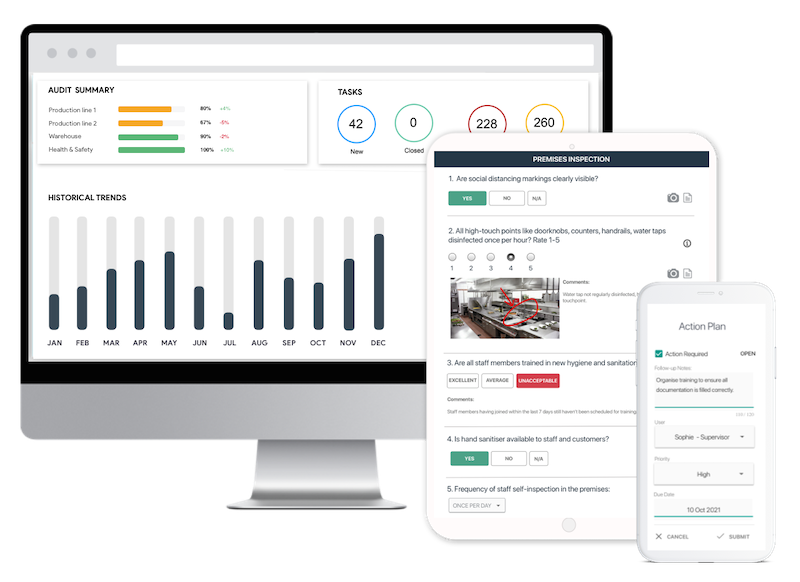
- Capture photos as proof of compliance or areas needing attention.
- Instantly generate and share detailed reports after the inspections.
- Assign & track follow-up tasks, view historical trends on a centralised dashboard. Improve quality, safety & compliance.


What Is a CQC Self-Assessment Checklist?
A CQC self-assessment checklist is a structured internal audit tool that lets care providers evaluate their own compliance against the Care Quality Commission’s quality statements before a formal inspection. It maps directly to the SAF quality statements CQC inspectors use, so providers can assess themselves against the same criteria — not just complete a generic operational audit.
CQC now operates under the Single Assessment Framework, which replaced the previous Key Lines of Enquiry (KLOE) structure. The five templates on this page are built to reflect this updated framework.
How to Use These CQC Inspection Checklists and How Often
Each checklist is designed to be run bi-annually as a standing self-assessment, or more frequently when issues are identified in a specific area. They can be used independently — running only the Well-led checklist before a governance review, for example — or together as a full five-part CQC mock inspection cycle.
Each question asks for documented evidence, not a yes/no answer. That evidence is what CQC inspectors look for: observation records, resident and staff feedback, care plan reviews, medicines audit trails. If you work through a section and can’t produce the evidence, that gap needs to be addressed before an inspection.
Running all five templates quarterly creates the continuous compliance record CQC expects to see under the Well-led quality question. Under the SAF, “continuous improvement” is not a phrase, it’s a documented requirement.
Why Should Care Homes use CQC Mock Inspection Templates?
We have created these CQC inspection checklists in collaboration with care industry experts. These checklists are free all-in-one resources your care home can use to deliver high-quality, personalised care, maintain CQC compliance, and prepare for your next CQC inspection.
- Prepare for CQC Inspections
These checklists enable you to conduct mock CQC inspections and simulate the real inspection process, helping to identify gaps and address them before a real inspection takes place.
Regular use of these checklists allows care homes to self-assess and evaluate their compliance with the CQC SAF and align with fundamental standards, such as safety, dignity, and effective care.
- Improve CQC Ratings
A strong emphasis on governance and evidence-based practices ensures your care home meets Regulation 17 of the Health and Social Care Act 2008 (Regulated Activities) Regulations 2014. This is central to achieving a ‘Good’ or ‘Outstanding’ rating. Addressing common pitfalls, including inadequate governance or unclear evidence, these CQC checklists help care homes boost overall performance and ensure compliance.
- Streamline Compliance Processes
Our CQC inspection checklists can help care homes save time by consolidating evidence-gathering, documentation, and compliance reporting. They further enhance this by automating records and generating detailed reports. It allows managers to focus on implementing improvements rather than struggling with administrative overhead.
- Enhance Safety and Care Quality
These CQC checklists cover essential aspects of care, including infection control, safeguarding, and risk management, ensuring a safer environment for residents, staff, and visitors. They also ensure that personalised care plans are updated and reflective of residents’ needs, promoting person-centred care.
- Train and Engage Staff
They act as training resources, helping staff understand CQC expectations and their role in achieving compliance. They create a culture of accountability and prepare teams for inspection day. They also encourage staff involvement, making it easier for managers to align team efforts with operational goals.
- Support Leadership and Governance
By focusing on leadership accountability, our CQC compliance checklists integrate governance processes across all operations. This promotes transparency and ensures all stakeholders—from staff to residents—are engaged in maintaining high standards. Regular use reinforces leadership’s ability to implement corrective actions and foster a culture of continuous improvement.
CQC Inspection Checklists for Different Care Settings
Care homes (residential and nursing)
All five self-assessment templates apply directly. Run them bi-annually as a minimum alongside the weekly and monthly operational checklists in the audit schedule above.
Domiciliary care
The five SAF templates apply to home care providers. Domiciliary care inspections have additional focus on care planning, risk management for isolated service users, and lone worker safety. Checkout our domiciliary-care specific audit templates, including care plan audit, safeguarding audit, or medication competency checklist.
Dental practices
The Well-led and Safe templates are relevant for CQC-regulated dental practices. For decontamination, clinical waste, and dental-specific patient safety protocols, use the CQC dental inspection checklist.
Other Care Home Audits

Simplify CQC Compliance with Mobile Audits
- Easily perform audits anywhere in the facility using a mobile device.
- Capture and attach photos as proof of compliance or areas needing attention.
- Instantly generate and share detailed reports after the inspections, simplifying documentation and action planning.
- Receive alerts for upcoming inspections and tasks, keeping everyone informed.