

Construction Punch List Templates: Free Checklists for Project Closeout
Template Library > Construction Inspections > Construction Punch Lists
What These Construction Punch List Templates Cover
Construction punch list templates give your team a structured way to identify, assign, and close out every defect or incomplete item before handing a project over to the owner. Our templates are trade-organized, so every discipline from structural through to final sign-off has a defined place in the closeout process.
Use these construction punchlist templates to:
- Document defects and incomplete work items by trade, with photos and comments attached
- Assign corrective actions to the right subcontractor, with due dates and accountability
- Generate an instant PDF punch list report to share with owners, architects, or project managers
- Track resolution progress in real time across the site, from any device
We offer different punch list formats for every project type: general construction, residential new builds, commercial properties, quality control walkthroughs, and project handover.

With the GoAudits Construction Inspection App, you can:
- Eliminate paperwork: conduct efficient digital audits, add photos from mobile device
- Customize this template or easily create your own
- Save time with instant reports & assign corrective actions
Site, Structure & Building Envelope
Internal Surfaces & Finishes
Openings: Doors & Windows
Mechanical, Electrical & Plumbing (MEP)
Fire, Life Safety & Regulatory
Handover Readiness & Utilities
Site, Structure & Building Envelope
Internal Surfaces & Finishes
Openings: Doors & Windows
Mechanical, Electrical & Plumbing (MEP)
Fire, Life Safety & Regulatory
Handover Readiness & Utilities
Save Time with Digital Inspections
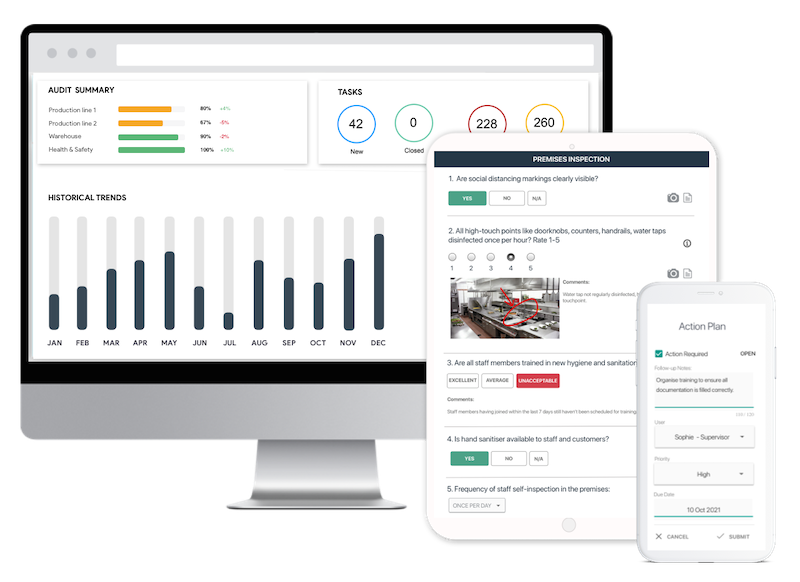
- Easily capture & attach photos, directly on your mobile device.
- Instantly generate and share detailed reports after the inspection.
- Track corrective actions, view historical trends, improve standards.


What Is a Construction Punch List?
A construction punch list is a document that records all incomplete work, defects, or items that do not meet contract specifications at the end of a construction project. The GC, architect, or owner’s representative compiles the list during a final walkthrough, then assigns each item to the responsible subcontractor for resolution before project closeout and final payment.
The term has practical origins. Contractors would physically punch a hole next to each item on a paper list to mark it complete. Today, digital punch list templates replace that paper process with a mobile checklist that captures photos, assigns tasks, and generates reports automatically.
Final punch list vs. rolling punch list
A final punch list is produced at or near practical completion, after the main construction work is done. A rolling punch list (sometimes called a project punch list) runs throughout the build, allowing teams to flag and resolve issues continuously rather than facing a long list at handover. Most experienced GCs use a rolling approach to keep the final closeout manageable.
Punch list vs. project closeout checklist
These two documents are often confused. The punch list tracks physical defects and unfinished work items. The closeout checklist covers documentation, warranties, as-built drawings, commissioning records, and owner training. Both are needed before handover; they serve different purposes.

What Should a Construction Punch List Template Include?
A well-structured punch list template is organized by trade, not by room. Room-based lists work for simple residential walkthroughs, but on any project with multiple subcontractors, a trade-organized format makes it easier to assign items, track completion by discipline, and avoid defects falling through the gaps between trades.
A general construction punch list should cover 12 areas:
- Site and Exterior Grounds, drainage, paving, fencing, external lighting, and signage. These items are often left until last and easy to miss in a room-by-room walkthrough.
- Structure and Building Envelope Roof, façade and cladding, external walls, waterproofing, sealants, and expansion joints. Any failures here affect the whole building.
- Internal Walls and Ceilings Drywall finish quality, paint coverage, texture uniformity, cracks, tape joints, and trim. High visibility to the owner on day one.
- Floors Finish quality, transitions between surface types, levelness tolerances, and any damage caused during construction operations.
- Doors and Windows Operation, locking, sealing, glazing integrity, hardware, and frames. Check every unit, not a sample.
- Electrical Outlets, switches, panel labeling, circuit testing, lighting fixtures, emergency lighting, and exit signs. The electrical punch list template is often managed separately by the electrical subcontractor and merged into the master list before the final walkthrough.
- Plumbing Fixtures, connections, drainage flow, water pressure, leak checks, and shut-off valve access.
- Mechanical and HVAC Units, ductwork, diffusers, thermostats, zone controls, ventilation rates, and noise levels. Commission before the walkthrough if possible.
- Fire and Life Safety Sprinklers, smoke and CO detectors, fire doors, emergency lighting, extinguisher mounting, and exit route clearance. Non-negotiable for certificate of occupancy.
- Finishes and Fixtures Joinery, hardware, shelving, and fittings that vary by project type but always require a final check before handover.
- Cleanliness and Handover Readiness Construction debris removed, all surfaces cleaned, keys and warranties handed over, and utilities commissioned and tested.
- Outstanding Items and Sign-Off A running list of open items with responsible parties, due dates, and space for owner or architect sign-off. This section drives the final payment process.
An architectural punch list may add specification compliance checks and design intent verification. For residential new builds, a room-by-room format is often more practical. Browse the full range of options in the construction inspection checklist library, where all templates are available free as PDF or in-app.
👉 Corrective Action Software: A punch list is only as useful as the follow-through. GoAudits lets you assign each defect to a responsible party, set a deadline, and track resolution to closure without chasing by email or phone.
How to Conduct a Construction Punch List Walkthrough
A punch list walkthrough is most effective when it follows a defined process. Here is how experienced GCs and project managers run it.
Step 1: Run a pre-punch walk before the formal inspection
Before the architect or owner representative arrives, the GC or superintendent walks the site to identify and resolve obvious defects. This reduces the length of the formal punch list and demonstrates that the team has already applied quality control in construction before handover. The pre-punch is sometimes called a contractor punch list or internal walk.
Step 2: Conduct the formal walkthrough with the right people
The standard final walkthrough involves the GC, the architect or owner’s representative, and sometimes the lead subcontractors for each trade. Each party works from the same punch list template, either on paper or on a shared mobile device. The walk is systematic, section by section, following the same trade-organized structure as the checklist. For a broader look at how to structure construction site inspections at every stage of a build, see our full guide.
Step 3: Document every item on the spot
For each defect or incomplete item, record a description, location, responsible subcontractor, and priority level. Attach a photo directly to the item. A punch list template with photos removes ambiguity: any subcontractor can see exactly what needs fixing without a separate site visit. Templates managed in spreadsheets or Word documents create a documentation gap, as photos are stored separately and items need to be transcribed after the walk.
Step 4: Assign items and set deadlines
Each item needs a named owner and a due date. Assign to trades immediately after the walkthrough, not days later. This is where most paper-based punch list formats break down: there is no built-in workflow for assignment, reminders, or sign-off confirmation.
Step 5: Track completion and close out
Subcontractors notify the GC when items are complete. The GC verifies, marks the item resolved, and moves on. The final punch list sent to the owner should show every item with its status, resolution date, and confirmation photo. The owner or architect then signs off, clearing the way for final payment. For teams managing this across multiple active projects, construction reporting software replaces manual write-ups with instant visibility into what is open, what is resolved, and where delays are building up.
👉 Case Study: How Woodside Homes achieved consistent 95%+ quality scores by replacing inconsistent site-by-site QC with a structured digital inspection process across all their construction projects.
How GoAudits Helps With Construction Punch Lists
GoAudits gives GCs and project managers a mobile platform to run punch list walkthroughs, assign defects, and track every item to closure across sites and subcontractors.
- Run punch list walkthroughs on any iOS or Android device, online or offline on site
- Attach timestamped photos to each item so subcontractors see exactly what needs fixing
- Generate a complete construction punch list PDF report the moment the walkthrough is finished
- Assign each defect to the responsible trade with a deadline and track resolution from a single inspection dashboard
- Customize any punch list template by project type, trade, or client requirement

Common Construction Punch List Mistakes
Even experienced teams run into the same problems at project closeout. These are the most common ones and how to avoid them.
Starting the punch list too late
Waiting until the final week to begin punching creates a bottleneck. Subcontractors may have already demobilized, material lead times add delays, and the owner’s move-in date becomes a pressure point. Starting a rolling punch list during the last phase of construction, not after it, keeps items manageable and subcontractors accountable while they are still on site.
No clear ownership on each item
A punch list item with no assigned owner does not get fixed. “Electrical” is not an owner. The item needs a company name, a contact, and a due date. Without that, every follow-up conversation restarts from scratch. Digital punch list templates that require an assignee field before an item can be saved prevent this from happening.
Relying on photos stored outside the checklist
Taking photos on a personal phone and attaching them to an email later is how documentation gets lost. By the time the report is assembled, photos are out of order, mislabeled, or missing. Capturing photos directly inside the punch list item, tied to a location and timestamp, keeps the evidence chain intact and makes the final report credible.
Accepting verbal sign-off instead of written confirmation
Subcontractors say items are complete. Owners say they are satisfied. Neither matters without a written record. A signed punch list sign-off template protects the GC if disputes arise after handover and is often a contractual requirement before final payment is released.
Using a format that does not match the project
A residential punch list template applied to a commercial build misses electrical panels, fire suppression systems, emergency lighting, and exterior site work. A generic simple punch list template misses the trade-specific detail that makes items actionable. Matching the checklist format to the project type is not optional.

FAQs
When should a construction punch list be started?
The best practice is to start a rolling punch list from practical completion rather than waiting until the final walkthrough. Starting early means defects are flagged while subcontractors are still on site and easier to mobilize. A rolling punch list updated throughout the final stages of construction typically results in a shorter, faster closeout than a single walkthrough at the end.
What is the difference between a punch list and a snag list?
A punch list and a snag list are the same thing with different names. Punch list is the standard term in the United States and Canada. Snag list is used in the United Kingdom and Ireland. Both refer to the document used to record incomplete work and defects that need to be resolved before project handover and final payment.
How many items are typically on a construction punch list?
It varies by project size and how well quality control has been managed during the build. Small residential projects often have 20 to 50 items. Large commercial builds can run into several hundred. Teams that use a rolling punch list throughout the project tend to arrive at the final walkthrough with far fewer open items than those who save everything for the end.
What happens if punch list items are not completed before handover?
Most construction contracts in the United States allow the owner to withhold final payment until punch list items are resolved to their satisfaction. Some contracts also allow the owner to engage a third party to complete outstanding work and deduct the cost from the contractor’s final payment. Unresolved items can also delay the certificate of occupancy, which affects the owner’s ability to occupy or operate the building. For more on the construction handover process, see our full guide.
What is the best app for managing a construction punch list?
GoAudits is built for exactly this workflow. It lets you run walkthroughs on a mobile device, attach photos to each item, assign corrective actions with deadlines, and generate a shareable PDF report on the spot. For a full breakdown of features and alternatives, see our guide to punch list apps.
Other Popular Construction Inspection Templates:

Digitize your Site Inspections
- Easily perform audits anywhere on the site using a mobile device, even offline
- Attach photos to document issues or prove compliance
- Assign tasks, set deadlines and track progress - all within a single app
- Analyze data from audits to identify trends, pinpoint recurring issues, and assess compliance levels.