

Commercial Cleaning Checklist Templates
Template Library > Facility & Services > Commercial Cleaning Checklist
Hold the Same Standard on Every Site with Commercial Cleaning Checklists
A commercial cleaning checklist sets out what gets cleaned in a business premises, how often, and to what standard. Cleaning contractors use it to brief crews and prove the work was done. In-house facilities teams use it to keep standards steady when staff rotate or sites multiply.
These commercial cleaning list templates cover:
- Office and workplace sites — reception, workspaces, kitchens, restrooms
- Retail and customer-facing units — trading floors, fitting rooms, entrances
- Medical and dental practices — clinical areas, waiting rooms, washrooms
- Schools and education sites — classrooms, corridors, communal areas
- Industrial and warehouse premises — floors, welfare areas, external zones

With the GoAudits Facility Inspection App, you can:
- Eliminate paperwork: conduct efficient digital audits, add photos from mobile device
- Customize this template or easily create your own
- Save time with instant reports & assign corrective actions
Reception Area
Cubicles/Offices
Kitchen/Break Area
Bathrooms
Reception Area
Cubicles/Offices
Kitchen/Break Area
Bathrooms
Save Time with Digital Inspections
- Easily capture & attach photos, directly on your mobile device.
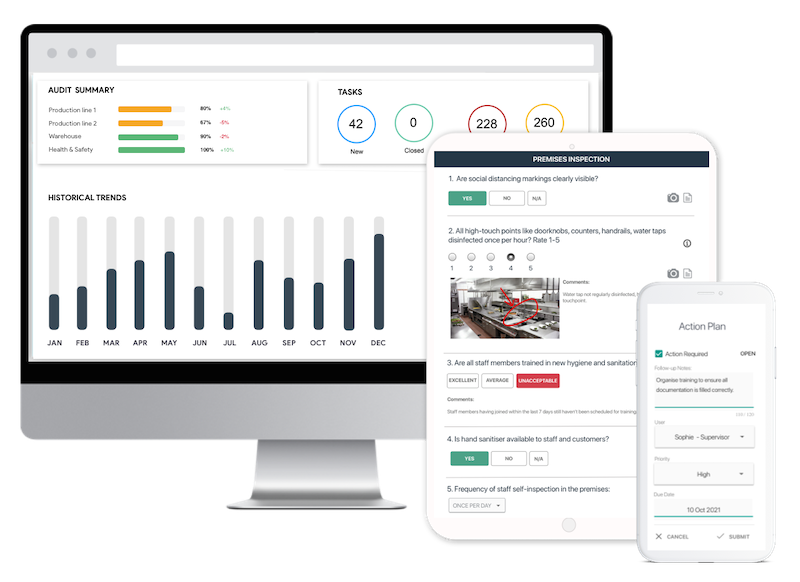
- Instantly generate and share detailed reports after the inspection.
- Track corrective actions, view historical trends, improve standards.


What is a Commercial Cleaning Checklist?
A commercial cleaning checklist is a structured list of cleaning tasks for a business premises, grouped by area and by how often each task needs doing. It covers the work itself, who is responsible, and what finished looks like.
The word “commercial” covers any premises used for business. An office, a shop, a dental surgery, a gym, a school and a distribution centre are all commercial sites, and each one needs a different version of the same basic document.
You may also see this called a janitorial checklist, particularly in the US and Canada. The two describe the same work. If you are running quality control on cleaning rather than planning it, the janitorial inspection checklist templates cover inspection and scoring instead.

Why Use a Commercial Cleaning Checklist Template?
A commercial cleaning checklist template removes the guesswork from a job where standards drift quietly. Nobody notices skipped skirting boards for three weeks, and then a client notices all of them at once.
Four things a written commercial cleaning template gives you that a verbal brief does not:
- Consistency across staff. New cleaners, cover shifts and holiday relief all work to the same list.
- Evidence for the client. A completed checklist is a record that the contracted work happened.
- Faster onboarding. A new starter can work a site without shadowing someone for a week.
- A defensible scope. When a client asks why something was not done, you can point to what was agreed.
That last one matters more than it sounds. For contractors bidding on larger accounts, documented cleaning processes are often a condition of entry rather than a nice extra.
👉 Standards note: ISSA’s Cleaning Industry Management Standard (CIMS) is the main international benchmark for cleaning organisations. Certification requires documented processes and is assessed on site by an accredited third party, with organisations needing to meet 100% of mandatory elements and 60% of recommended elements in each section. In the UK, BICSc sets the equivalent training and competency framework. A written checklist is where both start.
What Does a Commercial Cleaning Checklist Include?
A basic commercial cleaning checklist covers five zones: entrance and reception, workspaces, kitchens and break areas, restrooms, and the exterior. Everything else is a variation on those.
Below is what belongs in each. Items are written as checks rather than instructions, so the same commercial cleaning list template works for the cleaner doing the job and the supervisor confirming it afterwards.
Reception and entrance
The first thing a client sees, and the area most likely to trigger a complaint.
- Entrance glass and both sides of front doors cleaned
- Mats straightened, vacuumed or replaced
- Reception desk, phone and counters disinfected
- Seating, tables and reading material tidied
- Hard floors swept and mopped, carpets vacuumed
- Waste bins emptied and liners replaced
Workspaces and shared areas
- Desks, chairs and work surfaces wiped down
- Keyboards, monitors and shared equipment cleaned
- Shelves, cabinets and hard surfaces dusted
- Window sills, blinds and internal glass cleaned
- Floors vacuumed, swept or mopped
- Waste and recycling emptied
Kitchens and break rooms
One of the most common sources of complaints on office and workplace sites.
- Counters and tables cleaned with disinfectant
- Sink and taps cleaned, dishes cleared
- Microwave, fridge and coffee machine cleaned
- Fridge emptied of unclaimed items on an agreed cycle
- Bins and recycling emptied
- Floors swept and mopped
Restrooms
- Toilets, urinals and seats cleaned and disinfected
- Sinks, taps and dispensers cleaned
- Mirrors and glass polished
- Soap, paper towels and toilet paper restocked
- Hand dryers checked as working
- Floors mopped with disinfectant, bins emptied
Restrooms carry the heaviest daily load on most contracts, which is why they often get their own document. The commercial bathroom cleaning checklist breaks this zone down further.
Exterior and entry points
Often left off the list, and often the first thing a client mentions.
- Entrance approach and walkways clear of litter and debris
- External glass, canopies and signage cleaned
- Cigarette bins and external waste emptied
- Cobwebs removed from overhangs and light fittings
- Car park and delivery areas checked

👉 Case Study: How Partnership Cleaning Solutions delivers consistent quality standards across offices, retail, healthcare and industrial sites, running 100+ point inspections with every issue assigned to a named owner.
You will also want a matching commercial cleaning supplies list so crews are not halfway through a site before finding the stock ran out.
Commercial Cleaning Schedule: Daily, Weekly and Monthly Tasks
A commercial cleaning schedule template sorts the same task list by frequency instead of by room. Most commercial contracts run on three cycles.
Daily. Waste removal, restroom cleaning and restocking, kitchen surfaces, entrance glass, high-touch points such as door handles and light switches, floors in traffic areas.
Weekly. Internal glass and partitions, dusting of shelves and cabinets, window sills and blinds, vacuuming under desks and furniture, mopping hard floors throughout, appliance interiors.
Monthly or periodic. Carpet and hard floor treatment, high dusting and vents, skirting boards and door frames, upholstery, light fittings, external power washing.
Two things to settle before the schedule goes live:
- Match frequency to footfall, not to the calendar. A reception handling 400 visitors a day and a back office with six people do not need the same cycle.
- Put the periodic work in writing. Monthly tasks are the ones that slip, because nobody notices on any given day.
Set up as a commercial cleaning schedule checklist, the same document then doubles as a record of when periodic work was last completed. For heavier periodic work, the professional deep cleaning checklist templates go further than a routine cycle cover.

Commercial Cleaning Checklists by Facility Type
The five core zones stay the same across premises. What changes is frequency, method and what counts as compliant.
Medical and dental practices. Clinical areas need documented disinfection with specified contact times, separate equipment for clinical and non-clinical zones, and clinical waste handled apart from general waste. Waiting rooms need higher-frequency touchpoint cleaning than a standard office. See the medical office cleaning checklist.
Retail and customer-facing units. Cleaning has to work around trading hours and stay invisible to customers. Fitting rooms, tills and entrances need daily attention, and presentation standards sit alongside hygiene. See the retail cleaning checklist.
Schools and education sites. High occupancy, tight turnaround between sessions, and a real infection control burden. Classroom surfaces, shared equipment and washrooms need daily cycles, with deep cleaning slotted into holidays. See the classroom cleaning checklist template.
Industrial and warehouse premises. Floor areas dominate, dust and spills matter for safety as much as appearance, and vehicle routes need keeping clear. Welfare facilities carry a heavy load. See the warehouse cleaning checklist templates.
Offices and workplaces. The most common commercial site and the baseline most other versions adapt from. See the office cleaning checklist templates.
Who Uses a Commercial Cleaning Checklist?
Three groups use the same document for different reasons, and it is worth knowing which one you are.
Cleaning contractors use it as a task list for crews and as proof of delivery for clients. For most contract cleaners, the completed record is part of the product, not admin that sits behind it.
In-house facilities teams use it to hold standards without a full-time supervisor watching. It sets expectations once rather than repeating them.
Business owners and office managers use it the other way round: as a yardstick for work someone else is doing. If you are paying for a cleaning service and are not sure you are getting what you agreed, a written commercial cleaning checklist turns a vague feeling into a specific conversation.
👉 Checking rather than planning? If your job is verifying work after it happens rather than scheduling it, you need scoring and a structured walkthrough rather than a task list. The janitorial inspection checklist templates cover quality control, supervisor walkthroughs and scored inspections.
How GoAudits Helps With Commercial Cleaning Inspections
For cleaning contractors and facilities teams running the same standards across multiple sites, GoAudits turns the checklist into a working record.
- Run checks on mobile, including offline on sites with poor signal, and attach photos as evidence of completed or missed work
- Generate a client-ready report the moment an inspection ends, rather than typing it up later
- Score sites and compare performance by location, contract or area manager on one dashboard
- Assign issues as actions with a named owner and a due date, then track them to closure
- Build your own site-specific versions from the template, or have the GoAudits team digitise the checklists you already use
FAQs
Is there a free commercial cleaning checklist template?
Yes. Every commercial cleaning checklist template on this page is free to download as a PDF or use in the GoAudits app. You do not need to fill in a form or share your revenue figures to get one. The same applies to the other free commercial cleaning templates and forms in the library, including supplies lists and area-specific checklists.
Can I download a printable commercial cleaning checklist as a PDF?
Yes. Select a template and download it as a commercial cleaning checklist PDF, then print it for crews who prefer paper. A printable commercial cleaning checklist works well for fixed daily rounds, though you lose the timestamp and photo record that a digital version captures automatically.
What is the difference between a commercial cleaning checklist and a janitorial checklist?
They describe the same work in different vocabulary. “Janitorial” is the standard term in the US and Canada, while “commercial cleaning” and “contract cleaning” are more common in the UK and Australia. In practice the distinction on this site is one of purpose: commercial cleaning checklists plan and record the work, while janitorial inspection checklists score and verify it after the fact.
Can I use a commercial cleaning checklist for a medical or retail facility?
Yes, with adjustments. The five core zones apply to any commercial premises, but medical sites need documented disinfection contact times and separate clinical waste handling, and retail sites need cleaning scheduled around trading hours. Start from the general template and layer the sector requirements on top, or use the facility-specific checklist linked above.
How often should a commercial cleaning checklist be reviewed?
Review it at least once a year, and any time the site changes. New equipment, a layout change, a shift in occupancy or a new client requirement all make parts of an existing list wrong. Complaints about cleaning quality often trace back to a checklist that describes the building as it was two years ago.
What should a commercial cleaning services checklist include?
A commercial cleaning service checklist should list the agreed scope by area, the frequency of each task, and who is responsible. This is the version shared with the client rather than the crew, so it needs to match the contract exactly. Vague entries like “clean kitchen” cause disputes; “wipe counters daily, clean fridge interior monthly” does not.

Other Cleaning Checklists:

Digitize your Building Inspections
- Easily perform audits anywhere in the facility using a mobile device.
- Attach photos to document issues or prove compliance
- Assign tasks, set deadlines and track progress - all within a single app
- Analyze data from audits to identify trends, pinpoint recurring issues, and assess compliance levels.