


Didn't find what you are looking for? Get in touch and we'll help you build your own custom template.
Free Care Home Audits & Templates
Library of care home audit checklists to ensure care quality, safety and CQC compliance in residential care. Save time with digital inspection reports using our inspection app.
Care Home Audit Checklists & Templates for Compliance and Quality Inspections
📃: Eliminate paperwork with digital checklists
⏳: Save time in monitoring
📈: Demonstrate evidence of continuous improvement to regulators
Care home audits help providers maintain safe, compliant, and high-quality care services. By using structured audit checklists and templates, care teams can review standards consistently, identify risks early, and demonstrate compliance with regulatory expectations.
Care home audits enable providers to:
- Monitor compliance with care regulations, internal policies, and safeguarding standards
- Identify risks, gaps in documentation, and areas for quality improvement
- Prepare confidently for regulatory inspections and external reviews
- Track corrective actions and ensure improvements are implemented
- Maintain consistent standards across teams, shifts, and locations
Template Library > Residential Care
Care Home Audit Templates: Top Downloads
GoAudits has partnered with care compliance experts to build a toolkit of 40+ care home audit templates, aligned with the latest CQC single assessment framework. All templates are free to access on a trial and can be customised to your service.
Easy Start with Digital Checklists
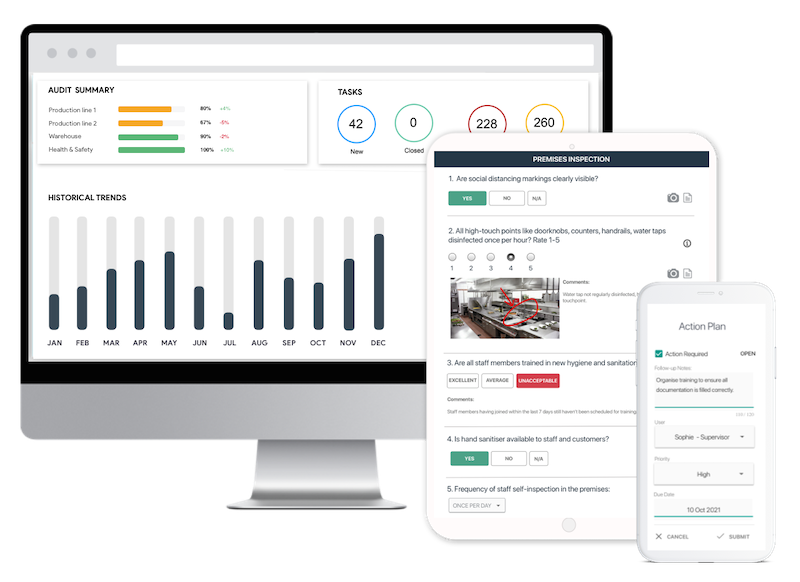
- Capture photos as proof of compliance or areas needing attention
- Instantly generate and share detailed reports after the inspections
- Assign follow-up tasks and track completion on a centralized dashboard


What is a Care Home Audit?
A care home audit is a systematic review of a care home’s operations, checking quality, safety, and regulatory compliance across areas such as medication management, infection control, and resident care. Using checklists and templates helps managers conduct structured internal audits and prepare for CQC inspections.
Care home audits are part of the quality assurance and improvement cycle operated by all care providers — they involve a review of the efficiency and success of local and regulated safe systems of work and practice against the proven and agreed standards for high-quality care.
In the UK, residential care compliance is regulated and monitored by specific bodies in each country:
- England: Care Quality Commission (CQC). GoAudits offers free CQC inspection checklists to perform mock CQC inspections, implement the new CQC framework, and ensure CQC compliance.
- Scotland: Care Inspectorate
- Wales: Care Inspectorate Wales (CIW)
- Northern Ireland: Regulation and Quality Improvement Authority (RQIA)
Internal care home compliance audits enhance resident outcomes, person-centered care, safety, and trust while addressing complaints and governance for continuous improvement.
What Should a Care Home Audit Cover? The 5 Key Areas
Good practice in auditing care homes means covering five domains consistently. These align closely with the CQC’s five key questions, making your internal audit programme directly useful as evidence at inspection.
1. Resident Care & Care Planning Are care plans current, person-centred, and regularly reviewed? Is consent documented? Are daily records accurate and reflective of the care actually delivered?
2. Medication Management Is medication ordered, stored, administered, and disposed of correctly? Are controlled drug records reconciled? Are staff competency checks up to date?
3. Infection Prevention & Control Are hand hygiene standards consistently followed? Is PPE available and used correctly? Are cleaning schedules completed and documented? Are isolation protocols in place and understood?
4. Health, Safety & Environment Are maintenance checks completed on schedule? Are fire safety, legionella, and equipment safety records current? Is the physical environment safe, accessible, and well-maintained?
5. Leadership, Governance & Workforce Are staff supervisions and appraisals taking place? Is the training matrix up to date? Are complaints and incidents reviewed and acted upon? Is there documented evidence of learning and improvement?
Covering all five areas consistently — and with digital records to prove it — is what CQC inspectors are looking for when they assess whether a service is well-led.
See also: CQC Quality Statements: A Complete Guide
💡 GoAudits in Action: Northern Healthcare
Northern Healthcare, a specialist adult care provider operating across 15 UK locations, used GoAudits to replace paper-based compliance checks with a single digital audit app — running 150–200 audits daily across 150+ checklists. In their first year, the team logged and resolved over 1,100 quality improvement actions, reducing response times and strengthening CQC compliance governance.
How Often Should Care Homes Conduct Audits?
There is no single legally mandated frequency for every audit type, but best practice — and CQC’s expectation of a well-led service — points to a tiered approach based on risk.
Daily checks cover the highest-risk, highest-impact areas: staff rota coverage, resident room checks, call bell access, medication records, and cleanliness.
Monthly audits are appropriate for areas including medication, infection control, accidents and incidents, pressure area care, falls management, and fire safety.
Quarterly audits suit governance areas such as care plan reviews, safeguarding logs, complaints, and staff supervision records.
Annual audits typically cover personnel files, training matrices, environmental safety certificates (gas, electrical, legionella), and full mock CQC inspections.
Running audits on a schedule — and recording them digitally — also helps you demonstrate to CQC that your governance is systematic rather than reactive.
💡 GoAudits in Action: Careville
Careville, a specialist nursing and care agency in Bedfordshire, replaced a fragmented system of spreadsheets and separate documents with GoAudits, cutting audit report generation from half a day down to 10 minutes. The team now runs care plan, MAR, health & safety, and pre-CQC inspection audits from a single app, with time-stamped, logo-branded reports ready to file instantly.
How to Use a Care Home Audit Template
Using a structured audit template is straightforward, but getting the most out of the process requires a consistent approach.
Step 1 — Choose the right template. Select the audit type relevant to the area you’re reviewing. If auditing medication, use the Medication Audit template; if reviewing care records, use the Care Plan Audit.
Step 2 — Assign a lead auditor. This should be someone with sufficient knowledge of the area being audited — a senior carer, registered manager, or compliance lead. For higher-stakes areas, consider involving an external reviewer periodically.
Step 3 — Conduct the audit on the ground. Walk through the checklist in the relevant area of the care home. Observe practices, review documentation, and speak to staff. Capture photographic evidence where relevant.
Step 4 — Score and record findings. Note every item, including areas of compliance as well as gaps. A partial or poor score on an item is not a failure — it is exactly the kind of finding the audit is designed to surface.
Step 5 — Raise corrective actions. For every non-compliance identified, assign a named responsible person, a clear action, and a due date. This is the step that turns an audit from a paperwork exercise into a quality improvement tool.
Step 6 — Review, close, and store. Once actions are resolved, sign off the audit report and store it securely. At the next audit cycle, review whether previous actions were effective. Over time, this creates the trend data and improvement narrative that demonstrates strong governance.
Using digital audit tools means steps 3 through 6 happen automatically — instant reports, auto-assigned actions, and searchable records ready for CQC.
See also: Risk Assessment in Health and Social Care: A Complete Guide
How to Customise Care Home Audit Templates?
Here’s how you can customise audit templates effectively:
Assess the Unique Needs of Your Service
Start by evaluating your service model, client base, and workforce structure. Consider specific challenges, such as medication management, safeguarding, or staff training. This assessment highlights the areas that require more detailed audit measures.
Define the Scope of the Audit
Decide whether the audit will cover all aspects of care or focus on a specific area, such as health and safety or client satisfaction. A clear scope prevents gaps and ensures that the audit remains manageable and relevant.
Identify Regulatory Requirements
Review the regulations and standards that apply to domiciliary care in your region. For example, compliance may involve national health guidelines, data protection laws, or workforce standards. Aligning your template with these requirements ensures audits support legal and professional accountability.
Create Clear and Measurable Criteria
Translate expectations into specific questions or checkpoints. Replace vague prompts like “Is care adequate?” with measurable criteria such as “Are care plans reviewed within the required timeframe?”. This approach provides evidence-based outcomes and reduces subjectivity.
Follow a Consistent Structure
Maintain uniform sections across all audits, such as compliance, safety, staff performance, and client outcomes. A consistent structure makes audits easier to compare over time and improves clarity for both staff and management.
Use Digital Tools for Residential Care
Use digital tools, like GoAudits, to customise, store, and manage your templates, automate scoring, flag risks, and generate reports instantly. They also make it easier to update templates when regulations or organisational needs change.
👉 GoAudits can simplify your audit process with a mobile-first solution. You can customise industry-specific checklists, conduct audits even offline across web, iOS, and Android, and generate reports instantly, boosting inspection speed by up to 5 times. You assign corrective actions on the spot, trigger workflows with reminders and escalations, and track resolution in real time via interactive dashboards. GoAudits is known for its ease of use, customisation, offline functionality, and responsive customer support.
Frequently Asked Questions on Care Home Audits
What is a care home audit checklist?
A care home audit checklist is a structured tool that guides a care home manager or auditor through a systematic review of a specific area of the service — such as medication management, infection control, or care planning. It lists the items to check, provides a consistent scoring method, and generates a record of findings and actions.
What does a care home compliance audit involve?
A care home compliance audit reviews whether the home’s practices and documentation meet the standards set out in the Health and Social Care Act 2008 (Regulated Activities) Regulations 2014, CQC fundamental standards, and any additional internal policies. It typically covers safe care, staffing, medication, premises, and governance.
How do care home audits differ from CQC inspections?
Care home audits are internal — conducted by the home’s own staff or an independent consultant as part of ongoing quality assurance. CQC inspections are external regulatory assessments carried out by the Care Quality Commission, which can be unannounced and result in a published rating. Regular internal auditing is one of the strongest ways to prepare for and perform well at a CQC inspection.
What is the best internal audit tool for care homes?
The best care home internal audit tool is one that your staff will actually use consistently. This means it should be quick to complete, accessible on any device (including offline), capable of generating instant reports, and easy to track corrective actions. Digital platforms like GoAudits are purpose-built for care settings and include 40+ ready-made templates aligned with CQC standards.
How often should care homes conduct internal audits?
Best practice is a tiered approach: daily checks for highest-risk areas, monthly audits for medication and IPC, quarterly reviews for care plans and governance, and annual audits for personnel files and environmental safety certificates. Frequency should also increase following incidents, complaints, or any CQC concern.
Are care home audit templates free to download?
Yes — all GoAudits care home audit templates are free to access on a trial. You can also send GoAudits your existing checklists and they will digitise them at no additional cost.
Easy start with digital checklists
- Capture photos as proof of compliance or areas needing attention
- Instantly generate and share detailed reports after the inspections
- Assign follow-up tasks and track completion on a centralized dashboard