

Key Takeaways
- Accurate mystery shopping reports help businesses monitor compliance, evaluate staff performance, and improve customer experience.
- Delayed feedback, inconsistent evaluations, memory-based reporting, and fragmented data make reporting challenging.
- Mystery shopping software like GoAudits standardize audits with digital checklists, real-time reporting, and centralized dashboards, helping businesses collect reliable data and act on insights faster.
A well-structured mystery shopping report turns a single secret shopper visit into actionable operational insight. When designed correctly, it helps managers identify service gaps, compare performance across locations, and implement targeted improvements that strengthen the overall customer experience.
In this guide, we’ll explore what a mystery shopping report is, how to structure one effectively, examples of report formats, and the best practices businesses use to make their mystery audit programs more reliable and impactful.
- What is a Mystery Shopping Report?
- How to Design a Secret Shopper Report That Drives Action?
- Free Mystery/Secret Shopper Report Sample PDFs
- What are the Core Components of a Secret Shopping Report Format?
- Practical Challenges & Solutions of Mystery Audit Reporting
- Simplify Mystery Shopping With GoAudits
- FAQs
What is a Mystery Shopping Report?
A mystery shopping report is a structured document that records what a secret shopper observed during an anonymous visit to a business. It typically includes scored checkpoints, comments, photo evidence, and details such as the date, time, location, and staff involved. Businesses use these reports to measure whether frontline teams follow service standards, identify recurring operational gaps, and benchmark performance across locations.
A secret shopper report captures customer experience observations such as:
- Staff behavior and service quality
- Sales practices and product knowledge
- Compliance with brand standards
- Overall customer journey performance
Traditionally, mystery shoppers relied on memory and handwritten notes. They would leave the location and complete a report later using spreadsheets or paper forms. This process created several reliability problems:
- Missing details
- Subjective interpretations of service quality
- Delayed feedback for field teams
- No photographic proof of conditions
Today, companies use mobile audit tools to standardize mystery inspections. Shoppers complete checklists on their phones while conducting the visit. They can attach photos, record timestamps, and instantly generate a mystery shopper report PDF.
Platforms like GoAudits allow companies to build digital mystery shopping templates, capture evidence, and automatically distribute reports to managers and leadership teams.

Why are Secret Shopping Reports Critical for Business Growth?
Mystery shopping reports provide operational visibility that traditional customer feedback cannot. Surveys measure customer satisfaction after the experience. A secret shopper report, however, documents whether employees actually follow protocols during the visit. This makes mystery shopping a powerful diagnostic tool.
Organizations use these reports to identify where the customer journey breaks down, such as:
- Customers not being greeted at a crucial checkpoint
- Long wait times at checkout
- Staff failing to recommend products
- Hygiene issues in restrooms or dining areas
With these observations, businesses can identify patterns across locations and implement targeted improvements.
How Do Reports Drive Front-line Behavior Change?
When employees know that an anonymous evaluation may occur at any time, they are more likely to follow operational standards consistently. This creates an ongoing state of readiness rather than temporary compliance.
While many companies hire external consultants for occasional visits, GoAudits enables businesses to formalize internal mystery shopping audits. This allows for higher frequency and lower costs, ensuring standards remain high between official external inspections.
By using GoAudits, we have clearly gained efficiency in the implementation and evaluation of the mystery audits. The dynamic graphs make data clear and easy to analyse.
Tobias Müller, Managing Partner, Nuance Advisory
👉 Read More: How Nuance Advisory simplifies mystery shopping data collection and analysis with GoAudits.
Why is Data Integrity More Important Than Reporting Speed?
Many organizations demand mystery shopping reports instantly, but speed alone does not guarantee value. If reports contain errors or inconsistencies, employees quickly lose confidence in the program.
Industry experts emphasize that validation and quality review are essential, even if it slightly delays delivery. This means every report should be checked for internal consistency, complete answers, evidence of the visit, and objective observations. Otherwise, the program risks becoming what researchers call “fast garbage in, fast garbage out.”
High-quality mystery shopping reports become a trusted operational tool used for:
- coaching employees
- tracking service standards
- performance incentives
- operational improvements
Digital reporting platforms like GoAudits help enforce these standards through validation rules, mandatory evidence fields, and structured evaluation criteria.
👉 Mystery Shopping App: Collect data efficiently and ensure quality across all your sites, stores, and venues
How to Design a Secret Shopper Report That Drives Action?
It’s fundamental to get the mystery shopping report format right. The shoppers filling out your evaluation forms will follow whatever structure you give them. If that structure is vague, you get vague data. If it relies on subjective judgments, you get opinions instead of evidence.
The goal is to build a reporting framework that captures objective, measurable observations and delivers them in a format managers can act on the same day.
What Should You Include in Your Mystery Shopping Report Instructions?
To get the most out of your evaluators, your instructions must be precise and measurable.
- Focus on Objectivity: Instead of asking “Was the staff friendly?” (subjective), ask “Did the staff greet you within 30 seconds and make eye contact?”
- The Chronological Flow: Design the format to follow the natural customer journey, from the parking lot to the point of sale. This makes it easier for the shopper to record data accurately without missing steps.
- Mandatory Evidence: Specify which sections require proof. This might include a photo of the restroom cleanliness or a snapshot of the sales receipt to verify the exact time of the visit.
How to Balance Quantitative and Qualitative Data in a Mystery Shopper Report?
A strong secret shopper report sample combines structured scoring with descriptive context.
- Binary Scoring (Quantitative): Use “Yes/No” questions for 80% of the report for instant scoring and benchmarking across different locations.
- Narrative Feedback (Qualitative): Use open-ended comment boxes to capture the “why” behind the score. This provides the context managers need to coach their teams effectively.
Use the GoAudits mystery shopping app to strike this balance. Set mandatory comments for any failed items, so you never receive a low score without an explanation. Each completed audit is scored automatically, giving you an instant view of location performance without manual calculation or post-processing in spreadsheets.
Free Mystery/Secret Shopper Report Sample PDFs
Below are two common examples of mystery shopper report templates used across industries.
Free Retail Mystery Shopper Report Example
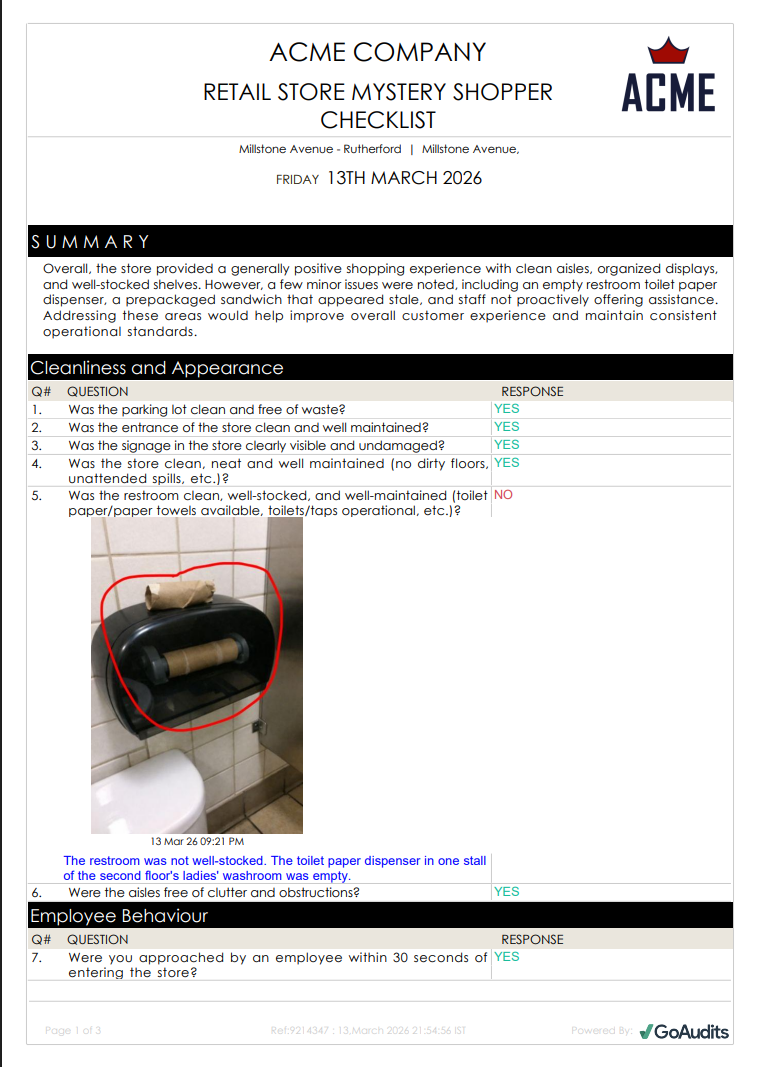
This mystery shopper report example for retail was generated using a digital retail mystery audit checklist and the GoAudits mobile app to ensure every store display was checked and every upsell attempt was logged.
Free Mystery Shopper Report Sample for a Restaurant
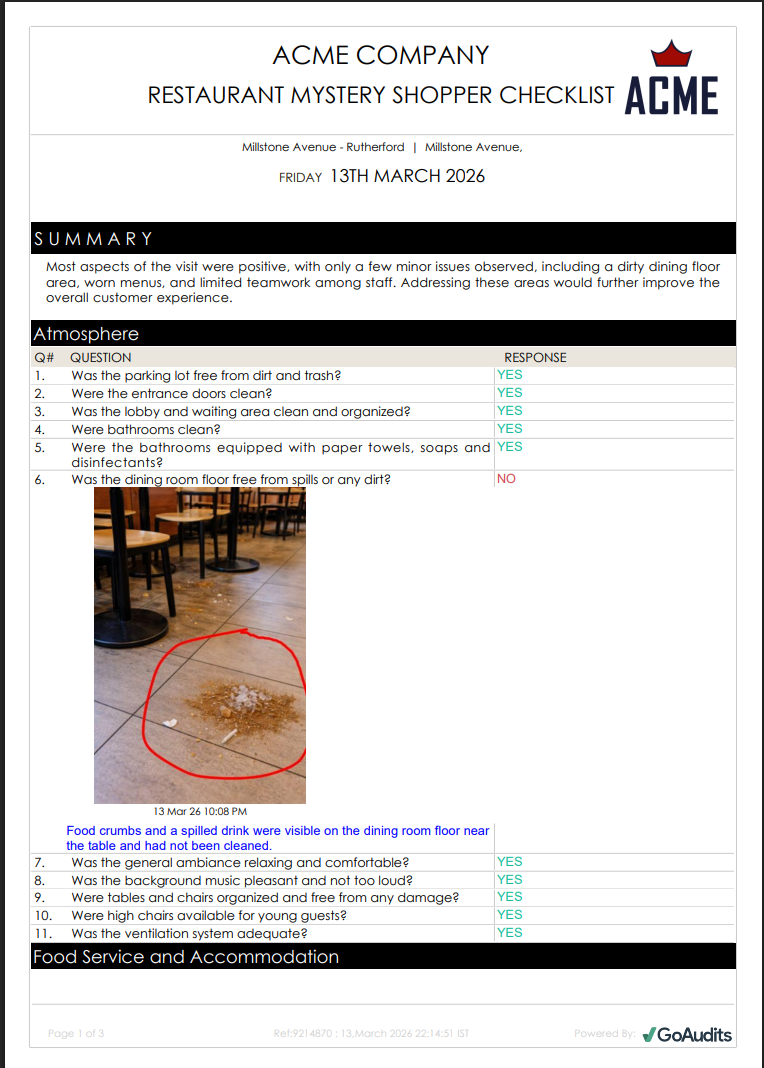
This secret shopper report example was generated using a mystery shopper checklist for a restaurant and our mobile app, which allows the shopper to snap a photo of their meal and instantly timestamp exactly when their appetizers arrived without blowing their cover.
Here are essential checklists to help you get started:
- Generic Mystery Shopper Checklist
- Retail Store Mystery Shopper Checklist
- Restaurant Mystery Shopper Checklist
- Hotel Mystery Shopper Checklist
- Hotel Audit Checklists
- Retail Store Audit Checklists
- Restaurant Audit Templates

What are the Core Components of a Secret Shopping Report Format?
Regardless of your industry, every professional example of a mystery shopper report should contain these four pillars:
- Identification Data – “who, where, and when”: Date, time, location, and the names or descriptions of employees the shopper interacted with. This anchors every observation to a specific visit.
- Objective Checkpoints: Binary Yes/No questions such as “Did a staff member greet the customer within 30 seconds?”, eliminating any personal bias. These scored items make up the majority of the report and allow direct comparison across locations.
- Subjective Narrative: A chronological account of the visit, from arrival to departure. This gives managers the context behind the scores, such as why a greeting checkpoint failed or what made a service interaction stand out.
- Proof of Visit: A receipt, storefront photo, or GPS-verified location stamp that confirms the shopper completed the visit at the reported time and place.
Practical Challenges & Solutions of Mystery Audit Reporting
Even the best-designed programs face hurdles that can undermine their effectiveness. Here is how to solve the most common issues that hamper traditional mystery audit reporting.
Challenge #1: Predictability and the “Gaming the System” Effect
If mystery shopper visits occur at fixed intervals, such as the first week of every month or the same day each quarter, employees eventually learn when evaluations are likely to happen. Once this pattern becomes obvious, staff may temporarily improve service standards during those windows.
This creates what managers call the “danger zone effect.” Employees deliver peak service when they expect a secret shopper visit, but standards quietly slip once that window passes. The result is misleading mystery shopping reporting that reflects staged behavior rather than the everyday customer experience.
Solution: Randomized Automated Scheduling
Mystery shopper visits should occur at random intervals and varying times of day so staff cannot anticipate evaluations. This ensures that reports capture normal operational behavior instead of temporary performance spikes.
Digital auditing platforms help automate this process by:
- Randomizing mystery audit schedules
- Assigning inspections without revealing timing in advance
- Distributing visits across days, shifts, and locations
With randomized scheduling, businesses receive more realistic secret shopper reports that reflect true service consistency rather than rehearsed compliance.
Challenge #2: The “Logic Conflict” and the “Defensive Response”
Another common reporting issue occurs when numerical scores contradict written comments. For example, a mystery shopper might record:
Score: 1 out of 5 for service quality
Comment: “The staff member was friendly and helpful.”
When managers receive a mystery shopper report sample with this type of inconsistency, the reaction is often defensive. Instead of focusing on improving service, managers question the accuracy of the report. They may assume the shopper misunderstood the situation or made an error while completing the evaluation.
This shifts attention away from operational improvement and toward disputing the report’s credibility. When this happens repeatedly, frontline teams stop trusting the mystery shopping program entirely.
Solution: Mandatory Logic Branching
Logic branching rules can automatically enforce consistency by requiring additional context when certain answers are selected.
For example:
- If a shopper selects a low score, they must provide a comment explaining the issue
- Failed checkpoints require photo evidence
- Inconsistent responses trigger validation prompts before submission
These logic rules ensure that each secret shopper report delivered to management contains clear, defensible insights rather than ambiguous feedback. As a result, managers spend less time disputing reports and more time coaching employees.
Challenge #3: Delayed Feedback and the Quality vs. Timeliness Conflict
There is a constant tension in mystery shopping programs between two competing priorities:
- Delivering reports quickly so field managers can act
- Ensuring that reports are accurate and validated
Manual quality checks can delay reporting by several days or even weeks. By the time the report reaches the field manager, the feedback is stale. But as covered earlier in this guide, rushing reports without validation destroys trust in the program. The question is how to get both speed and accuracy.
Solution: Instant Reporting with Real-Time Dashboards
GoAudits mystery audit app allows shoppers to submit reports directly from their mobile devices, which can be instantly shared with stakeholders. Managers can then view results through centralized dashboards that highlight:
- failed checkpoints
- recurring issues
- performance trends across locations
This approach provides timely feedback without sacrificing data integrity.
Challenge #4: Inefficient Data Collection for Mystery Shoppers
Small but important details are easily lost between the visit and the report. If a shopper doesn’t log observations during the visit, they reconstruct from memory later, and the final report reflects what they think happened rather than what actually did.
Manual data entry slows down the reporting process and increases the risk of such errors, particularly when shoppers transfer handwritten notes into a separate system after the visit.
Solution: Mobile First Auditing Apps
Mobile auditing tools solve this by keeping data capture inside the visit itself. With a mobile audit app, shoppers can:
- Complete structured checklists during the visit
- Capture photos immediately
- Upload receipts as proof of visit
- Submit the report the moment the visit ends
This removes the gap between observation and documentation. A mobile workflow also eliminates manual transcription, allowing shoppers to generate standardized mystery shopping report PDFs automatically.
Challenge #5: Fragmented Data and Lack of Visibility for Leadership
In many organizations, mystery shopping results are distributed as individual reports sent via email. Each visit generates a separate mystery shopper report PDF, which is typically reviewed by the area manager responsible for that location.
While these reports provide useful local insights, they create a major challenge for leadership teams. Executives and regional managers must review dozens or even hundreds of individual reports to identify patterns across the organization. This leads to what many operations leaders call data fatigue.
Key strategic questions become difficult to answer:
- Which locations consistently fail greeting standards?
- Which regions struggle with cleanliness compliance?
- Are customer service scores improving or declining over time?
Without consolidated data, it is nearly impossible to see the bigger operational picture.
Solution: Aggregated Digital Dashboards
Centralized reporting platforms solve this problem by pulling data from every mystery audit into a single view. Instead of reviewing isolated reports, leadership teams can compare:
- Location-level performance side by side
- Regional trends in service quality over time
- Compliance rates across different checkpoints
- Which specific areas (greeting, cleanliness, upselling) are weakest company-wide
Platforms like GoAudits automatically consolidate results from all mystery audit reports into a single dashboard. This brings fragmented data into a strategic heatmap that helps leadership teams identify systemic issues and assign corrective actions across the organization. Instead of reacting to individual incidents, businesses can identify the root causes behind recurring failures and address them at scale.
Simplify Mystery Shopping With GoAudits
GoAudits is a mystery audit platform designed to help businesses monitor service standards, brand compliance, and customer experience across multiple locations.
Its scalable features allow operations teams to standardize mystery shopping programs, collect reliable field data, and gain real-time visibility into frontline performance.
With GoAudits, you can:
- Create custom mystery shopper checklists tailored to your brand standards.
- Schedule and assign mystery audits across locations, teams, or external evaluators.
- Conduct audits using the mobile app, even in locations with limited internet connectivity.
- Capture photos, timestamps, and proof of visit while completing structured evaluations.
- Generate professional reports instantly and share them with managers and leadership.
- Track recurring service issues and assign corrective actions to improve frontline performance.
With a rating of 4.8 stars on Capterra, GoAudits is trusted by organizations worldwide to streamline operational audits, standardize reporting, and maintain a consistent customer experience across locations.
» GoAudits Reviews: See how companies use GoAudits to improve operational compliance and service quality across their locations.
FAQs
Businesses commonly use mobile inspection software, survey tools, or specialized mystery shopping platforms. Mobile audit solutions are preferred because they support structured checklists, photo evidence, and automated report generation.
Aggregated mystery shop reports combine individual visit data into dashboards that reveal patterns across locations and time periods. Leadership teams use them to monitor service KPIs between regions, track whether scores are improving or declining quarter over quarter, and identify which specific checkpoints fail most often across the organization.
A mystery shopping report measures observed service behaviors during a structured evaluation. A customer satisfaction survey collects feedback from real customers after their experience. Mystery shopping focuses on compliance with standards, while surveys measure perceived satisfaction.
Most reports contain between 20 and 60 structured checkpoints along with short narrative comments. The exact length depends on the complexity of the customer journey being evaluated.
Most mystery shopping scores are calculated using weighted checklists. Each question is assigned a point value based on its importance. The shopper’s responses are scored automatically, and the total is expressed as a percentage of the maximum possible score. Some programs also weigh entire sections differently, so customer service might account for 40% of the total, while store appearance accounts for 20%.
Mystery shopping reports are commonly used as one input in performance reviews, but rarely as the sole basis for disciplinary action. Most programs combine mystery shop scores with direct manager observations, customer feedback, and multiple shop results over time. Using a single report to discipline an employee undermines trust in the program and increases the risk of disputes over data accuracy.
A restaurant secret shopper report typically evaluates the full dining journey: host greeting and seating time, server product knowledge and upselling, food presentation and temperature, restroom cleanliness, order accuracy, and bill handling. Most formats include timestamped photos of the meal and a receipt as proof of visit. Reports are scored by section, so management can see whether service, food quality, or cleanliness is the weakest area.
