Key Takeaways
- A data center audit is a structured review of a facility’s physical infrastructure, environmental systems, security controls, and operational procedures.
- The six main audit types range from physical security walkthroughs and environmental checks to compliance reviews and asset inventories.
- A data center inspection is the recurring operational layer that catches issues between formal audits.
- An effective data center audit plan has eight steps: from defining the scope to closing corrective actions.
- Tools like GoAudits let IT and facilities teams run data center inspections on mobile, capture photo evidence on the floor, and generate instant audit reports.
According to the Uptime Institute’s 2025 Annual Outage Analysis, 85% of human error-related outages trace back to staff failing to follow procedures. That figure rose by ten percentage points in a single year.
That’s a process problem, not an equipment problem. Teams require a regular, structured program of physical inspections and operational checks that catches procedural drift before it becomes downtime. The trouble is that most organizations treat data center auditing as an annual event tied to a regulatory deadline and a formality rather than an operational discipline.
This guide covers the six types of data center audits, what a thorough physical inspection entails, how to build an audit plan that runs year-round, and what a solid audit report should include. It also flags the five challenges that most internal programs stall on and how to fix them.
What is a Data Center Audit?
A data center audit is a systematic review of a facility’s physical infrastructure, environmental systems, security controls, and operational procedures to verify they are functioning correctly.
The term covers two distinct activities:
- An external audit conducted by an independent firm to produce a formal compliance attestation: a SOC 2 report, an ISO 27001 certificate, or a PCI DSS assessment.
- An internal audit run by the organization’s own IT operations managers, facilities directors, and internal compliance teams to manage risk proactively and maintain operational standards between compliance cycles. They can be conducted using a well-structured checklist and a disciplined inspection schedule.
Why does frequency matter? A single annual audit produces a snapshot. It tells you what the facility looked like on one day. Quarterly or monthly physical inspections produce a trend line, which shows whether controls are holding up or quietly degrading between formal reviews.
What are the Main Types of Data Center Audits?
Data center audits fall into two broad categories: physical and operational audits that require someone on the floor, and compliance audits that verify controls against a regulatory standard. The first category is where most day-to-day operational value comes from. The second is for formal certifications that customers and regulators require.
Here’s how the main types compare:
| Audit Type | What It Covers | Primary Standard | Who Conducts It | Frequency |
| Physical Security | Access controls, CCTV, perimeter, cabinets | TIA-942, ISO 27001 | Internal team | Monthly/Quarterly |
| Data Center Inspection | Physical conditions, cabling, labeling, airflow | TIA-942, internal SLAs | Internal team | Monthly |
| Environmental & Energy | Temperature, humidity, cooling, UPS, generators | ASHRAE, TIA-942 | Internal team | Monthly/Quarterly |
| Reliability & Risk Assessment | Redundancy, DR readiness, backup power testing | Uptime Institute Tiers | Internal + specialist | Annually |
| Asset Inventory | Physical hardware reconciliation against records | ISO 27001, SSAE 18 | Internal team | Semi-annually |
| Compliance Audit | Controls verification against SOC 2, PCI DSS, HIPAA | SOC 2, ISO 27001, PCI DSS | External auditors | Per certification cycle |
- Physical Security Audit: A data center security audit of physical systems verifies that every physical access point, surveillance system, and cabinet-level control is working as intended. This means checking biometric and keycard access systems, reviewing visitor and contractor logs, testing CCTV coverage for blind spots, verifying that all cabinets are locked, and confirming that perimeter security is intact.
- Data Center Inspection: It is the recurring operational walkthrough that catches physical issues between formal audits. It covers the day-to-day state of the facility: cable management and labeling, rack organization, physical damage to equipment, environmental sensor placement, airflow patterns, and general housekeeping. Since it’s a recurring internal audit that requires consistency, use a checklist to produce reliable operational records.
- Environmental and Energy Efficiency Audit: Checks that the facility’s temperature, humidity, cooling, and power systems are operating within safe parameters. This includes reading temperature and humidity at rack level, verifying hot/cold aisle containment, checking cooling unit operation and filter status, testing UPS load and battery health, confirming generator fuel levels and last test date, and reviewing power usage effectiveness (PUE) figures.
- Reliability and Risk Assessment: Aka data center evaluation, it evaluates a facility’s ability to maintain operations through disruptions: power failure, natural disaster, network outage, or a major security incident.
- Asset Inventory Audit: It physically reconciles every piece of hardware in the facility against the asset records: servers, storage systems, network gear, PDUs, cabling, and cooling infrastructure.
- Compliance Audit: It verifies that the facility’s controls meet the specific requirements of an applicable regulatory standard. These audits typically involve external auditors and produce a formal attestation or certification.
Free Data Center Audit Checklists
Here are a couple of IT & data center audit checklists to help you get started:
- Data Center Security Checklist
- Network Security Audit Checklist
- IT Infrastructure Audit Checklist
- Data Center Maintenance Checklist
- Server Room Inspection Checklist
- ISO 27001 Checklist
- HIPAA IT Audit Checklist

What to Check During a Data Center Inspection
A data center inspection is a structured physical walkthrough of the facility, checking that every area is in the condition it should be. Below are the five areas every inspection should cover.
- Physical Security: Check that all access control systems are functioning: biometric readers, keycard systems, door seals, and cabinet locks. Review the visitor and contractor log for the period since the last inspection. Walk the CCTV coverage and look for new blind spots caused by rack reconfigurations.
- Environmental Controls: Take temperature and humidity readings at rack level. Verify that hot/cold aisle containment is intact. Any gaps in blanking panels, cable cutouts, or aisle doors let hot air recirculate. Check cooling unit operation, filter condition, and whether any units have been running on backup or bypass mode.
- Power and Electrical: Check UPS status panels for alarms, battery health indicators, and load readings. Confirm generator fuel levels and log the date of the last load test. Walk through the PDU readings and compare against expected loads. Verify that redundant feeds are active and that the last failover test result is documented.
- IT Infrastructure: Check rack labeling against the asset register. Look for unlabeled equipment, decommissioned hardware still occupying rack space, and unsecured patch panel ports. Verify cable management because loose cables blocking airflow or hanging unsecured create both operational and physical security risks.
- Safety and Housekeeping: Confirm fire extinguisher placement and check inspection dates. Verify emergency exit routes are clear and signage is visible. Check for any signs of water ingress, pest activity, or general housekeeping issues that could affect equipment.
Running the inspection on a digital inspection platform like GoAudits means every item is photo-documented, timestamped, and included in an automatically generated report at the end of the walkthrough.
GoAudits works offline. In restricted-access data center zones where internet-connected devices aren’t permitted, the app runs the full checklist without connectivity and syncs automatically when the device reconnects. Photo evidence, findings, and sign-offs are captured on the floor.

What Standards Apply to Data Center Audits?
Compliance standards define what needs to be checked during a data center audit, not just what needs to be certified. The data center audit standards that apply to your facility depend on the type of data you process, your industry, and the markets you serve.
- TIA-942-C is the primary physical infrastructure standard, covering power, cooling, cabling, and physical security design across four Tier ratings (Tier I through Tier IV). In February 2026, TIA issued a call for an addendum specifically addressing AI computing infrastructure, which is relevant for any facility handling GPU-heavy workloads.
- Uptime Institute Tier Standards are the most widely used independent benchmark for data center reliability. Tier I represents basic infrastructure with no redundancy; Tier IV is fully fault-tolerant with concurrent maintainability. These standards are commonly referenced in colocation contracts and used to verify that physical infrastructure matches the contracted tier level.
- ISO 27001:2022 is the international information security management standard. It explicitly requires a documented internal audit program covering physical and environmental controls, and requires a recurring inspection schedule to be part of the standard’s own requirements.
- SOC 2, PCI DSS v4.0, and HIPAA are the primary compliance drivers for data centers processing sensitive customer, payment, or health data.
How to Build a Data Center Audit Plan
A data center audit plan is a documented framework that defines what will be audited, who will do it, when, against which standard, and what happens when issues are found. Here are the eight steps to build a program that runs end-to-end. This also serves as a practical data center audit plan example that internal teams can adapt:
- Define Scope and Objectives: Decide which areas, systems, and processes are in scope: physical infrastructure only, or IT systems too? Clarify the objective: routine operational monitoring, pre-certification preparation, or post-incident review. Document the scope formally before anything else.
- Identify Applicable Standards: Map each in-scope area to the relevant standard: physical security to TIA-942, data handling to ISO 27001 or SOC 2, payment processing to PCI DSS. This mapping becomes the basis for your checklist items.
- Assign the Audit Team: Identify who has the right knowledge for each area. Facilities staff cover physical and environmental checks; IT security staff cover logical systems and network controls.
- Build or Select Checklists: Convert standard controls into actionable verification steps. Customize to your facility’s size and configuration. The Data Center Audit Checklist and Data Center Assessment Checklist are ready-made starting points that can be adapted for specific requirements.
- Schedule Audit Cycles: Build the schedule into a recurring calendar with an audit scheduling software like GoAudits. Physical security and environmental checks: monthly or quarterly. Compliance audits: annually, per certification cycle. Asset inventory: semi-annually.
- Conduct the Walkthrough: Execute against the checklist: every item, every time. Capture photo evidence of findings at the point of observation.
- Document Findings and Produce the Report: Record every finding with the relevant control or standard it maps to, the observation, photo evidence, and a risk rating. Share with stakeholders promptly.
- Assign Corrective Actions and Track to Closure: Every finding requiring remediation gets a named owner, a due date, and a priority level. Track status until confirmed resolved. Re-audit corrected items in the next cycle to verify the fix held.
How to Run a Recurring Data Center Audit Program
A one-off data center audit produces a snapshot. A recurring audit program produces a trend line. The trend line shows whether controls are improving or degrading.
Here’s the frequency structure that works for most organizations:
| Audit Type | Recommended Frequency |
| Physical security walkthrough | Monthly or quarterly |
| Environmental controls check | Monthly |
| Compliance audit | Annually |
| Asset inventory | Semi-annually |
| Reliability/risk assessment | Annually |
| Design audit | On build or renovation |
Paper checklists make recurring programs hard to sustain: different auditors check different things, there’s no photo evidence, no audit trail, and reports take hours to write up. Digital inspection platforms solve the consistency problem. The checklist is identical every cycle, evidence is captured automatically, and the report is ready the moment the walkthrough ends.
For organizations managing multiple data center sites or co-location facilities, centralized audit dashboards let operations managers compare completion rates, open findings, and compliance trends across all locations in a single view.
Free Data Center Audit Report Template
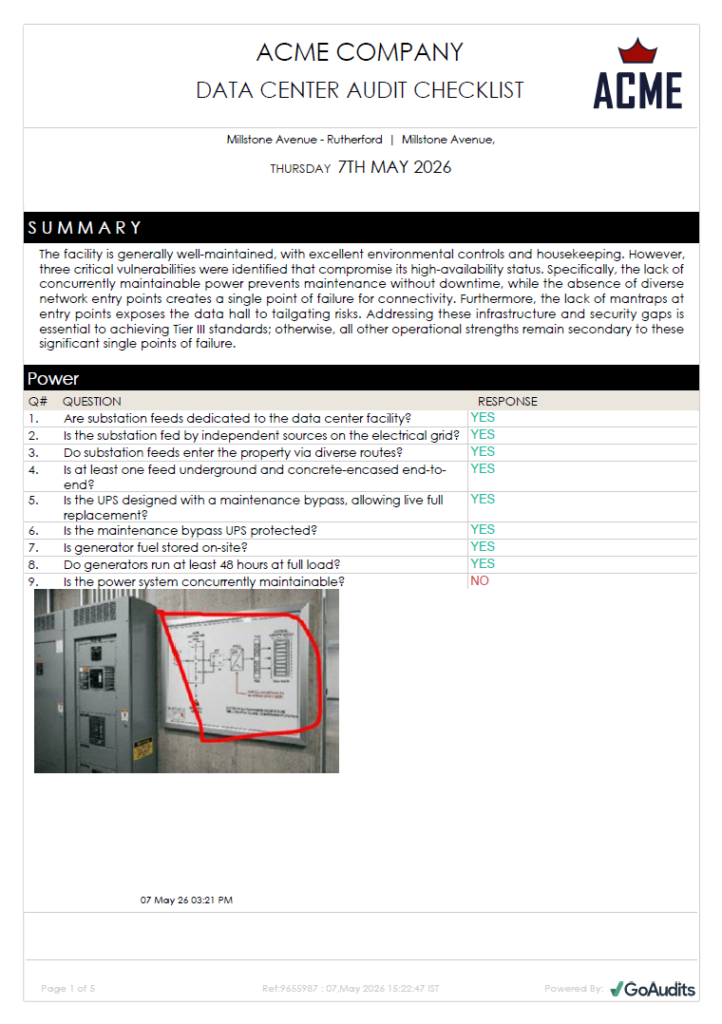
Here’s a sample data center audit report generated using the GoAudits reporting app and Data Center Audit Checklist.
What Should a Data Center Audit Report Include?
A data center audit report is a formal document that records what was audited, what was found, how findings map to applicable standards, and what actions are required to fix non-conformances. A well-structured report does two things: it gives internal teams a clear action list, and it gives external auditors the documentary evidence they need.
Every data center audit report should include:
- Executive Summary: A brief overview of the audit scope, date, team, and headline findings. Gives senior stakeholders a quick read without requiring them to process every finding.
- Scope and Methodology: What was audited, which standards were applied, what tools and checklists were used, and any areas explicitly excluded from scope.
- Findings by Category With Risk Ratings: Each finding logged with the control or requirement it relates to, the observation, photographic evidence, and a risk rating: critical, high, medium, or low.
- Compliance Status Summary: A clear mapping of current posture against each applicable standard: which controls are met, which are partially met, and which are not met.
- Corrective Action Plan: For every non-conformance, mention the action required, the named owner, the target completion date, and priority level. This section turns an audit report into an operational tool.
- Sign-off and Audit Trail: Auditor name, date, and e-signature. For regulated environments, a clear chain of custody on the report itself is part of the compliance evidence.
Common Data Center Audit Challenges (and How to Address Them)
Data center audit programs fail in predictable ways. Most of the failure points have nothing to do with the walkthrough itself. They come from what happens before and after it.
These five challenges come up consistently across IT and facilities teams.
Challenge 1: Compliance Evidence is Scattered and Hard to Retrieve
When an external audit is scheduled, teams scramble to locate access logs, configuration records, incident reports, and change management documentation that should have been current all along. Gaps in evidence raise questions about whether controls were actually in place during the period under review, even when they were.
Solution: Treat Audit Documentation as a Continuous Operational Output
Different tools serve different parts of this. DCIM platforms retain environmental and infrastructure data. ITSM tools maintain change and incident records. For physical walkthrough evidence, inspection platforms like GoAudits auto-generate a timestamped, retrievable audit trail after every cycle.
Challenge 2: Managing multiple overlapping regulatory frameworks
Many data centers must simultaneously satisfy SOC 2, ISO 27001, PCI DSS, and HIPAA. These frameworks overlap without being identical. Teams without a cross-framework control map either duplicate audit effort or miss the gaps where frameworks diverge.
Solution: Start With a Cross-Framework Control Mapping Exercise
Before building checklists, run a control mapping exercise that cross-references every applicable framework against a unified control set. The NIST Cybersecurity Framework is widely used as a neutral mapping layer. GRC platforms automate control mapping across multiple frameworks and surface divergences automatically.
Challenge 3: Staffing and Internal Expertise Gaps
A thorough data center audit requires people who understand physical infrastructure, IT systems, network architecture, and compliance frameworks, often at the same time. That combination is rare on most internal teams.
Solution: Identify Expertise Gaps Before the Audit Starts
Physical infrastructure assessments, penetration testing, and disaster recovery validation benefit from independent external specialists. The Uptime Institute and major data center consulting firms offer structured assessment services. For routine operational walkthroughs, well-structured checklists reduce dependence on individual expertise by specifying exactly what needs to be checked.
Challenge 4: Ghost Assets and Inventory Drift
Equipment listed in the records doesn’t match what’s physically in the racks. Servers get decommissioned without being logged, hardware gets relocated, and labels fade. ISO 27001 and SSAE 18 auditors verify that physical assets reconcile with digital records. Discrepancies are a direct compliance gap.
Solution: Establish a Formal Change Management Procedure
Make sure no hardware moves, gets added, or gets decommissioned without a corresponding record update. For large or complex facilities, dedicated DCIM software is built for asset tracking at scale. For smaller facilities, a well-maintained spreadsheet with strict change control discipline is often enough. Conduct recurring physical inspections to catch drift between what the records say and what’s actually in the racks.
Challenge 5: Corrective Actions that Never Close
Findings get documented, reports get shared, and then remediation stalls. No named owner. No deadline. No verification that the fix was actually implemented. The same finding reappears in the next audit cycle. Recurring open findings are a clear signal to an external auditor that an internal program isn’t functioning.
Solution: Assign Every Finding an Owner, a Due Date, and a Close-Out Step
Use an inspection and corrective action tracking software like GoAudits, which allows auditors to assign resolutions with due dates right away and track them through the dashboard. Set automatic alerts for overdue items and reassign corrective actions when required.
How GoAudits Supports Data Center Audits
GoAudits is a leading audit and inspection software designed to simplify IT audits and enhance operational efficiency. Conduct paperless audits of your IT systems using mobile or tablet devices.
Store all audit data securely on the cloud for future reference and compliance purposes. Generate and share detailed IT audit reports with stakeholders instantly, ensuring swift decision-making and corrective actions.
With the GoAudits, you can:
- Schedule and manage all types of data center audits in advance.
- Customize audit templates to suit your organization’s unique requirements.
- Ensure compliance with industry standards, data protection laws, and governance policies.
- Identify and share noncompliance issues with your team and initiate immediate resolutions.
With a rating of 4.8 stars on Capterra, GoAudits is trusted by leading names across industries for audits and inspections.
» GoAudits Reviews: Read how other businesses leverage GoAudits to meet security and operational standards.
FAQs
Digital inspection platforms are used by IT and facilities teams to run physical walkthroughs, capture photo evidence, generate reports, and track corrective actions. GoAudits is one option among data center operational audit platforms, with a purpose-built IT and data center checklist library. For the logical and cybersecurity audit layer, GRC platforms serve a different function from physical inspection tools.
Physical security and environmental controls should be checked monthly or quarterly, depending on the facility’s tier level and regulatory obligations. Compliance audits follow certification cycles: typically annually for SOC 2 and ISO 27001. Asset inventory reconciliation works well on a semi-annual basis, with additional checks after any significant hardware changes.
Digital inspection tools produce consistent results across every auditor and every cycle because the checklist is standardized. Photo evidence is captured at the point of observation. Reports are generated automatically, removing the hours typically spent compiling findings into a formatted document. Corrective action tracking closes the loop that paper-based programs leave open.
Internal audits cost staff time primarily. A well-structured program with digital tools reduces that cost significantly by cutting report preparation time and standardizing the inspection process. External compliance audits typically range from $15,000 to $100,000 or more, depending on the scope, auditor, and organization size.