Key Takeaways
- Site visit reports help detect safety hazards and potential problems that can lead to delays and rework early on.
- Inspectors often spend hours manually compiling findings into reports, making the whole process tedious, time-consuming, and often prone to error.
- An inspection and on-site reporting app allows you to collect data, generate reports, and share them with stakeholders —instantly, on-site.
Accurate and on-time reporting in construction ensures projects are completed safely, on time, and within budget. However, the industry faces significant challenges in terms of project and quality management. Look at the following statistics:
- Only 25% of construction projects are completed within 10% of their original deadlines (KPMG report).
- Construction workers spend nearly two full working days each week addressing avoidable issues and searching for project information, with almost half of all rework stemming from poor communication and inaccurate data (FMI survey).
Accurate and timely reporting can help tackle these challenges. Comprehensive construction work site visit reports serve as indispensable tools for project managers and stakeholders, facilitating informed decision-making, proactive problem-solving, and the prevention of costly delays and rework.
In this article, we’ll focus on how to write a construction site visit report, its time-sensitive nature, the importance of using checklists, and how construction inspection and on-site reporting apps enhance the process.
Importance of Site Observation Reports in Construction
- Serves as a Record for Project Management: A construction site visit report documents observations on a building site, serves as a record for project management, and enables informed decision-making. It includes observations like site conditions, project progress, safety hazards, and other issues.
- Prevents Costly Rework: In the construction industry, time and money directly impact project success. A building construction site observation report helps detect potential problems early, avoiding escalations and costly rework during renovations.
- Tracks Adherence to Timeline and Budget: Delays and discrepancies disrupt the workflow and can add to the overall cost. For example, if workers and equipment are required to stay longer than anticipated, this can increase labor, equipment, and operational costs. A construction site inspection report tracks whether all activities adhere to the deadlines and whether the overall project is aligned with the predetermined timeline.
- Promotes On-Site Safety: According to the US Bureau of Labor Statistics, out of 5,070 workplace fatalities in 2024, construction and extraction occupations accounted for 1,032 deaths, just over 20%, or nearly three fatal accidents every day. The construction fatality rate fell to 9.2 per 100,000 full-time workers, the lowest since 2011, though the industry remains among the most dangerous in the country. To reduce on-site accidents and injuries, companies must conduct regular construction site inspections and collaborate with regulatory bodies.
- Provides Legal Documentation: A construction project report provides documented evidence of safety to regulatory authorities to verify that all activities on the project site comply with the approved specifications and best practices.
- Improves Communication Among Stakeholders: A comprehensive and up-to-date construction site condition report serves as a communication tool between all stakeholders, contractors, workers, personnel, clients, investors, and others, ensuring everyone is informed about what’s happening on-site.
Case Study: How FiberRise streamlines construction site visits and quality control processes with software and a mobile app.
What is a Construction Site Visit?
A site visit is an in-person inspection of a construction site. It is an opportunity for teams behind the project to see the actual work in action and identify any issues, such as safety hazards, deviations, non-compliance, etc. Depending on the type of assessment or the scope of the on-site visit, it can be conducted by the project manager, architect, engineer, or any other member of the project team.
Who Writes the Site Visit Report?
The same visit produces different reports depending on who is walking the site.
- Engineer’s site visit report. A civil or structural engineer focuses on technical compliance: whether the work matches the drawings and specification, whether materials and testing meet requirements, and whether anything on site raises a structural concern. These reports carry more measurements and specification references than a general progress report.
- Project manager’s report. Progress against programme, resourcing, coordination between trades, and anything threatening the schedule or budget.
- Safety officer’s report. Hazards, PPE compliance, scaffolding and working-at-height conditions, and unsafe practices observed.
- Client or investor site visit report. Higher level, focused on progress, spend, and risk rather than technical detail.
Architects produce a distinct document under construction contract administration. See our guide to architect field reports and site visit reports for that format specifically.
Types of Construction Reports
While a site visit report is a specific type of documentation, it’s helpful to understand the broader landscape of reports used in construction. Each serves a unique purpose in maintaining project oversight.
- Change Order Reports: Used to officially document and justify any deviations from the original project scope, timeline, or budget.
- Daily Construction Site Reports: These are the most frequent reports, summarizing daily activities, resource allocation, and any on-site issues.
- Weekly/Monthly Status Site Inspection Reports: A broader summary of project health, including progress against the schedule, budget updates, and a look at upcoming tasks.
- Construction Site Safety Reports: Focused exclusively on health and safety compliance, documenting potential hazards and required corrective actions. See our guide to construction site safety reports for the templates and structure behind them.
- Incident Reports: A detailed record of any accidents, injuries, or near-misses that occur on the job site.
What You Need to Cover in Your Building Construction Site Visit Report
An engineer’s site visit report template provides a detailed summary of site conditions and activities. Start with an introduction, including the visit’s date, location, and purpose. The main body should cover key elements based on the checklist:
- Header Information: Include project name, location, date, time, weather conditions, inspector details, attendees, and visit purpose to establish context for the construction inspection report template.
- Project Status Overview: Summarize the construction phase, completion percentage, schedule status, and general observations to give readers an immediate understanding of project status.
- Work in Progress Details: Document active trades, specific tasks, equipment used, worker count, and materials being installed with precise location information.
- Quality Assessment: Evaluate workmanship, material quality, proper storage, specification compliance, and any deviations, including details about tests performed.
- Safety Observations: Document safety protocol compliance, PPE usage, scaffolding conditions, housekeeping, signage, and any unsafe practices to prevent accidents.
- Issues and Concerns: Identify problems with descriptions, locations, potential impacts, resolution recommendations, responsible parties, and timelines using factual language.
- Documentation and Visual Evidence: Include photographs with annotations, plan references, measurements, and marked-up drawings with clear identification of locations.
- Follow-up Actions: Outline action items with responsibilities, deadlines, required inspections, follow-up visits, and needed coordination to transform the construction work report into an action plan.
- Conclusions and Recommendations: Summarize your overall assessment of progress, major concerns or successes, process improvement recommendations, and professional opinions.

How to Write a Building Construction Site Report
A well-written site report is clear, objective, and actionable. Here is the process, step by step.
- Gather your details before you arrive. Project name, location, date, time, weather, your name and role, and who else is on site. Filling these in afterwards from memory is where errors creep in.
- Walk the site with a checklist, not a blank page. A structured checklist stops you from documenting whatever catches your eye and missing what doesn’t. It also means two different inspectors produce comparable reports.
- Photograph as you go, not afterwards. Capture each issue at the moment you see it, with enough context in frame to show where it is. A close-up of a crack is useless without a wider shot placing it on the building.
- Write observations, not opinions. “Scaffold guardrail missing on the north elevation, level 3” is a finding. “Scaffolding looks unsafe” is an opinion, and it is the sentence that gets challenged in a dispute. Record what you saw, where, and when.
- Assign an owner to every issue and a date. A finding with no name against it will still be there at your next visit. State who is responsible and when it needs resolving.
- Separate what changed from what stayed the same. Progress since the last visit is the part stakeholders actually read. Lead with it.
- Send it the same day. A report that arrives a week later describes a site that no longer exists. Same-day distribution is what makes the report useful rather than archival.
Avoid vague language that cannot be acted on, findings without locations, photos without captions, and reports that list problems without naming who fixes them.
Why Use a Checklist to Compile Construction Site Visit Assessment Reports
Using checklists to perform inspections and writing a construction site visit report ensures thoroughness, consistency, and efficiency.
- Ensures Consistency and Prevents Oversight: Checklists are a reliable memory aid, helping inspectors systematically assess all critical areas, even in complex environments. They prevent oversight by prompting the evaluation of both targeted concerns and general site conditions.
- Standardizes Data and Tracks Trends: Construction checklists standardize reporting across multiple visits and inspectors, making it easier to track trends, identify recurring issues, and compare data over time.
- Improves Efficiency and Ensures Compliance: They also improve efficiency by streamlining the inspection process, allowing inspectors to focus on assessments rather than remembering what to check. Checklists can be modified to include industry standards, which ensures the final report of site visits contains relevant information related to compliance and reduces the risk of disputes.
- Provides Legal Protection and Training: They help train new inspectors and provide clear evidence of due diligence, protecting against liability. As industry standards evolve, checklists can be updated to maintain relevance, ensuring comprehensive and accurate site assessments.
To improve accuracy and reduce paperwork, use a digital construction checklist app like GoAudits that allows users to access checklists, complete inspections, generate instant construction field reports, and share them with stakeholders—all on-site.
This site visit software also offers a library of free customizable digital construction inspection checklists. Here are a few examples of GoAudits construction site visit checklists:
- Construction Site Risk Assessment Checklist
- Construction Site Inspection Checklist
- Construction Site Safety Checklist
- Checklist for Site Inspection

Checklist-Based Construction and Building Site Visit Report Sample/Template PDF
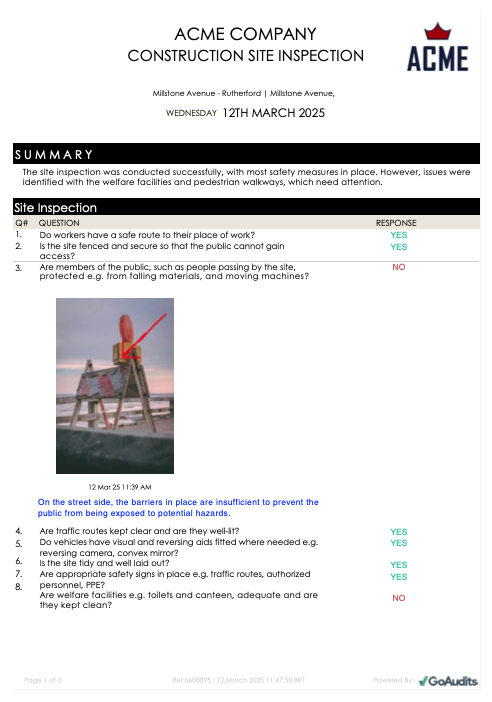
Now that you know what you need to cover in your site visit report and the importance of using checklists, here’s an example of a checklist-based construction site visit report template generated with GoAudits.
Site Visit Report Format: Word, Excel, or Digital?
Most teams start with a Word or Excel site visit report template, and for a one-off visit that works. The friction shows up once you are running regular inspections:
- Word templates are fine for writing but awkward on site. You are typing on a phone or writing on paper and transcribing later, which is where the same-day deadline usually slips.
- Excel templates handle repeat data well but are poor at photos, which are the most useful part of a construction site report.
- Neither version-controls itself. Once three site managers have their own copy, your reports stop being comparable.
The GoAudits template above is a PDF because it is the output, not the input. You complete a digital checklist on your phone at the site, and the formatted PDF report generates itself, with photos, timestamps, and GPS location already embedded. If you already have a Word or Excel site visit report format you like, send it over, and the team will build the digital version at no cost.
Why Construction Project Site Visit Reports Are Time-Sensitive
The construction industry operates under strict contractual deadlines; delays in completing project phases can trigger penalties, increased costs, and contractual disputes. Timely reports allow for the early identification of issues, enabling prompt corrective actions to keep projects on schedule and within budget.
Building projects often involve multiple contractors whose timelines are interdependent. Delays in one area can cascade into delays for others, making real-time monitoring essential. Site visit reports help maintain synchronized schedules and mitigate disruptions across teams. From a risk management perspective, these construction work reports serve as early warning systems. Faster documentation prevents small issues from escalating into major problems that could jeopardize the project’s financial and operational health.
Investors and stakeholders sometimes rely on up-to-date reports to assess project viability and financial performance. Delays can lead to misinformed decisions, potentially resulting in costly resource misallocations or missed opportunities.
Fast-track Construction Site Inspection Reports: Capture, Compile, and Share Instantly!
Contractor site visit reports are essential documentation tools that capture critical information during on-site inspections. However, they often become time-consuming administrative burdens for inspectors.
After site visits, inspectors often return to the office and type out the reports manually: compiling findings, attaching photos and comments, updating suggested/implemented corrective measures, and quantifying results. Regular site visits require and generate a lot of paperwork in the form of checklists, reports, and more, which are susceptible to getting misplaced.
Thus, manual reporting is not only time-consuming but also tedious and prone to error.
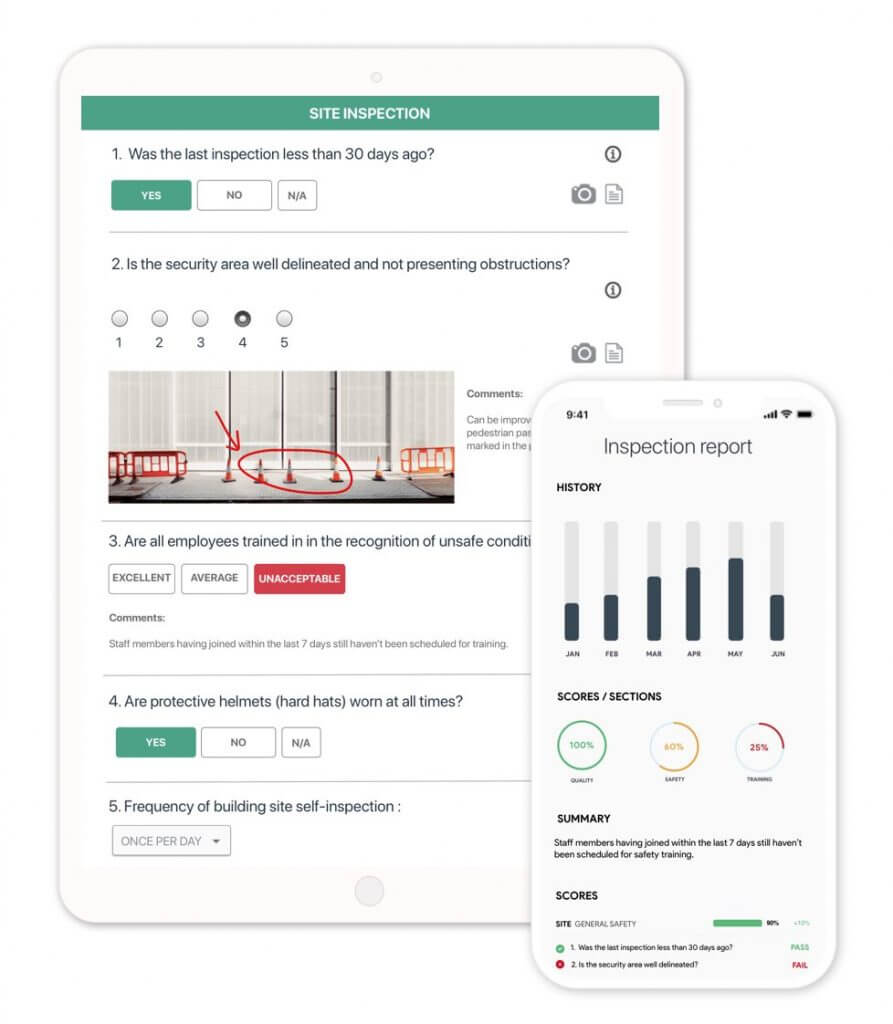
Construction inspection apps, like GoAudits, replace the conventional “writing/typing” method with an automated process. They offer digital checklists that provide a structured way for data collection. And once the inspection is complete, all the data is automatically compiled into a well-formatted, comprehensive construction project report.
By capturing data directly through mobile devices, you can document observations, take photos, and note compliance issues in real-time, without spending hours attaching extra information and proofreading the construction site inspection report template. Thus, construction inspection software eliminates the most time-consuming aspect of traditional reporting—the actual writing and formatting of the document.
Using such construction compliance software and mobile apps leads to several additional benefits that further enhance the efficiency of the site inspection process.
- The structured nature of digital checklists ensures consistent and complete documentation across all site visits.
- Ability to capture multimedia evidence, like photos and voice notes, providing richer documentation with less manual input.
Moreover, these applications also enhance the quality and accessibility of site visit information. You can generate reports in a standardized format, ensuring all stakeholders receive consistent, professionally formatted reports, regardless of who conducted the inspection.
With cloud-based storage, you can make construction field reports immediately available to your project teams, enabling faster decision-making and issue resolution. Additionally, the accumulated data creates a searchable historical record that you can analyze for trends, compliance patterns, and performance metrics over time.
The final reports with pictures, a convenient summary, and an overall neat appearance are really helpful to us. GoAudits is a great tool that does everything we need and helps us deliver better homes to our customers.
Ciaran Mullins, General Superintendent, Woodside Homes
Streamline Construction Site Visits and On-Site Reporting With GoAudits
GoAudits is a construction inspection & reporting software that allows project managers to do their best work while meeting the safest and highest quality control standards. Its scalable features allow contractors to streamline processes, eliminate communication bottlenecks, enhance resource utilization, and handle multiple projects.
With GoAudits, you can:
- Create custom construction site inspection checklists.
- Schedule all types of construction inspections and site visits.
- Perform checks using the GoAudits mobile app, even in locations with limited internet connectivity.
- Assign corrective actions and ensure their on-time completion.
- Make sure all stakeholders stay updated through instant on-site reporting.
- Monitor adherence to all safety, quality, and operational standards.
With a rating of 4.8 stars on Capterra, GoAudits is trusted by some of the biggest names in the construction management industry.
» GoAudits Reviews: Read how companies leverage GoAudits to meet standards in their construction operations.
FAQs
To create a safety observation report in construction, start by documenting header information and using a standardized checklist to evaluate safety hazards. Include objective, factual observations and support them with photos. List down all the safety issues, who is responsible, and suggest actionable recommendations to resolve them. Finally, distribute the report promptly to all relevant stakeholders.
A construction monitoring report is a document that tracks a project’s progress over time to ensure it aligns with the predetermined timeline and budget. It standardizes reporting across multiple visits and inspectors, allowing project managers to identify trends and recurring issues.
Regular site visit reports are the traditional answer, but they only tell you what was true on the day of the visit. Digital inspection tools close that gap: site teams complete checklists on their phones, reports reach you automatically the moment they are submitted, and a dashboard shows which sites are current, which have open issues, and where the same problems keep recurring across multiple projects.
It depends on project phase and risk. Active construction typically warrants weekly visits at minimum, with daily checks during high-risk activities such as excavation, lifting, or working at height. Quieter phases may need only fortnightly or monthly visits. Contracts often specify a minimum frequency, so check yours.