

Janitorial Checklist Templates
Template Library > Facility & Services > Janitorial Checklist
Verify Cleaning Quality with Janitorial Checklists and Inspection Forms
A janitorial checklist does two jobs. It tells cleaners what to do, and it gives supervisors something to score. Attendance records show who was on site; only a completed checklist shows what was actually done.
These janitorial cleaning list templates cover:
- Daily janitorial duties — restrooms, trash, floors, high-touch points
- Weekly and periodic work — glass, dusting, vents, floor treatment
- Inspection and quality control — scored walkthroughs with photo evidence
- Supervisor checks — closet condition, supply levels, work verification
- Training and onboarding — what a new custodian needs to know

With the GoAudits Facility Inspection App, you can:
- Eliminate paperwork: conduct efficient digital audits, add photos from mobile device
- Customize this template or easily create your own
- Save time with instant reports & assign corrective actions
Janitorial Checks
Janitorial Checks
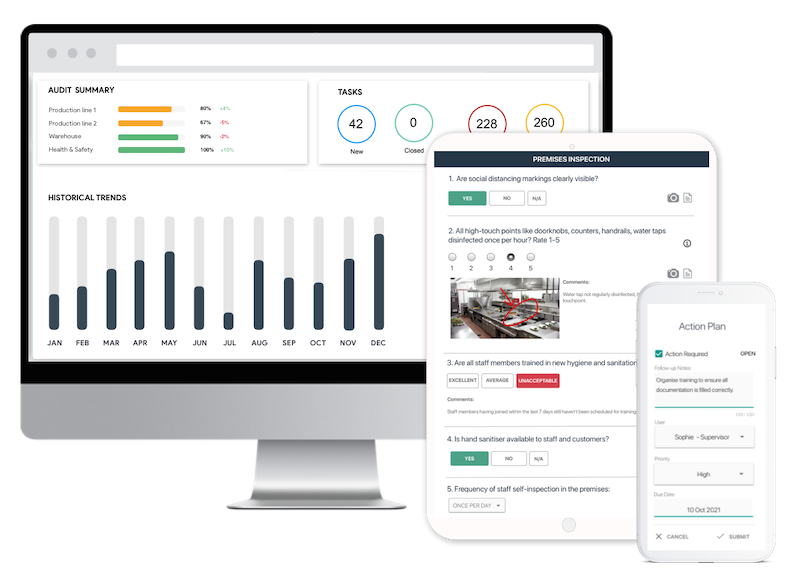
Save Time with Digital Inspections
- Easily capture & attach photos, directly on your mobile device.
- Instantly generate and share detailed reports after the inspection.
- Track corrective actions, view historical trends, improve standards.


What Is a Janitorial Checklist?
A janitorial checklist is a structured list of cleaning tasks for a building, used either as a work instruction for custodial staff or as an inspection form for the supervisor checking their work. Most janitorial operations need both.
If you are planning and scheduling the work rather than verifying it, the commercial cleaning checklist templates are organized by facility type instead.

What Does a Janitorial Cleaning Checklist Include?
A janitorial cleaning checklist template is organized by how often each task happens, not by room. That is the difference between a task list and a schedule, and it is why two buildings with identical layouts can need completely different checklists.
Daily Janitorial Duties
The non-negotiable list. If these slip, someone notices the same day.
- Restrooms cleaned, disinfected and restocked
- Trash and recycling emptied, liners replaced
- Entrance glass and door handles cleaned
- High-touch points wiped: handles, switches, elevator buttons, handrails
- Break room counters, sinks and tables cleaned
- Floors swept, vacuumed or mopped in traffic areas
- Spills and spot marks addressed
Weekly Janitorial Tasks
- Internal glass, partitions and mirrors cleaned
- Dusting of shelves, ledges, sills and furniture
- Vacuuming under and behind furniture
- Baseboards and door frames wiped
- Appliance interiors cleaned
- Stairwells and corridors detailed
Monthly and Periodic Work
- Carpet extraction and hard floor treatment
- High dusting, vents and light fixtures
- Upholstery cleaning
- Exterior glass, canopies and entry approaches
- Deep restroom work: grout, drains, partitions
Periodic tasks are where most janitorial programs fail. Nobody notices a missed monthly task on any given day, which is exactly why it needs a date and a signature rather than a memory. A janitorial deep cleaning checklist run on a fixed cycle catches what daily rounds are not designed to.
👉 Also useful: the janitorial supplies checklist for stock checks, and the cleaning SOP guide if you are writing procedures rather than checklists.
Janitorial Inspection Checklists: Scoring and Quality Control
A janitorial inspection checklist is a different document from a task list, even when it covers the same areas. The task list asks a custodian what to do. The inspection form asks a supervisor whether it was done well enough, and records an answer that can be compared across buildings and over time.
This is the part most janitorial operations skip, and it is the part clients pay attention to.
One Form for Every Building, or One Per Area
Most teams start with a single general janitorial inspection form used across every site: floors, glass, horizontal surfaces, trash, restrooms, odor. It gives you a comparable score for any building on the portfolio.
Area-specific forms come next. A restroom, a classroom, a gym and a lobby each have items the general form cannot carry, and a supervisor inspecting a school needs different line items than one inspecting a warehouse. Most mature programs run both: a general form for trend data, area forms for detail.
Choosing a Rating System
Your janitorial quality control checklist needs a scoring scale before it needs more line items. The common options:
- Pass/fail. Fastest to run, least useful for tracking improvement.
- 1 to 3. Poor, acceptable, excellent. A reasonable default for most contractors.
- 1 to 5. More granularity, more inspector disagreement.
- Pass/amber/fail. Flags items that are imperfect without failing them. Useful in contracts with penalty clauses.
- APPA levels. The five-level appearance standard used widely in education and increasingly written into RFPs.
Whichever you pick, the scale has to mean the same thing to every inspector, or the scores are decoration. Two supervisors walking the same corridor should land on the same number. Our guide to APPA cleaning standards covers the five levels and how teams keep scoring consistent between inspectors.
One warning worth stating plainly: a scoring system without photo evidence invites pencil whipping. Forms get signed in the break room rather than in the building. Photos and timestamps are what make a janitorial inspection form trustworthy to a client.

👉 Case Study: How Partnership Cleaning Solutions runs consistent quality control across offices, retail, healthcare and industrial sites, with 100+ point inspections and every finding assigned to a named owner.
Janitorial Supervisor and Walkthrough Checklists
A janitorial supervisor checklist covers what the cleaner’s list does not. It is less about surfaces and more about whether the operation is running.
- Janitor closet condition. Organized, clean, chemicals correctly labeled with safety data sheets, no decanted bottles without labels.
- Equipment. Vacuums, buffers and carts working and maintained, cords undamaged.
- Supply levels. Enough consumables to cover the next cycle without an emergency run.
- Dilution and chemical use. Correct products in the right places, correct dilution ratios.
- Vacant and low-traffic spaces. Areas nobody visits are where standards decay unseen.
- Outstanding actions. Whether the last inspection’s findings were actually fixed.
A cleaning walkthrough is the version of this you run with the client present. It follows the route a visitor takes rather than the route a cleaner takes, which surfaces different problems: the smell in the stairwell, the mark on the lobby glass at eye height, the bin that is always full at 4pm.
Walkthroughs are also where contracts are won and lost. If you are being inspected rather than inspecting, the same cleaning walk through checklist template tells you what the client will be looking at.
Janitorial Training and Onboarding Checklists
A janitorial training checklist is the cheapest quality control you can run, because it stops problems before they need inspecting.
New custodians need to be signed off on more than a task list. What belongs on the onboarding version:
- Chemical safety, safety data sheets, dilution and PPE
- Correct color-coded cloth and mop system to prevent cross-contamination
- Equipment operation and basic maintenance
- Site access, keys, alarm codes and lone-working procedure
- Waste streams, including clinical or confidential waste where relevant
- What to report and to whom, including damage and security concerns
- Sign-off that the trainee has run a full round under supervision
Keeping training records against the same system as inspections makes an obvious pattern visible: when a site’s scores drop, you can see whether the staff working it were ever signed off on that work. For broader guidance on what to hold staff to, see our guide to cleaning standards.

How GoAudits Helps With Janitorial Inspections
For contract cleaners and custodial teams running the same standards across multiple buildings, janitorial inspection software turns the checklist into a record clients will accept.
- Score inspections on mobile, offline where signal is poor, with photos attached to individual findings
- Send a client-ready report the moment the walkthrough ends, short enough that customers actually read it
- Apply weighted scoring so restrooms carry more weight than window sills, and compare buildings on one dashboard
- Assign findings as actions with a named owner and due date, then verify the fix on the next visit
- Add unlimited free users for staff who only need to receive and close actions
- Have the GoAudits team digitize the janitorial forms you already use
FAQs
Is There a Free Janitorial Checklist Template?
Yes. Every janitorial checklist template on this page is free to use in the GoAudits app or download as a PDF, with no form to fill in first. The library also includes free janitorial inspection forms, supply checklists and area-specific versions. You can edit any of them rather than working around a fixed list.
Can I Download a Printable Janitorial Checklist as a PDF?
Yes. Select a template and export it as a janitorial checklist PDF to print for crews who work off paper. A free printable janitorial checklist template works for fixed daily rounds, but paper cannot timestamp a check, attach a photo, or tell you whether last week’s findings were fixed.
What Is the Difference Between a Janitor Checklist and a Custodial Checklist?
Nothing substantive. “Janitor” and “custodian” describe the same role, with custodian more common in schools, universities and government buildings, and janitor more common in commercial property. A custodial cleaning checklist template and a janitor checklist template cover the same ground. Pick the word your client uses.
What Should a Janitorial Quality Control Form Score?
Score outcomes, not activities. “Restroom floor free of debris and streaks” can be verified by looking; “mopped the floor” cannot. Keep each item to a single observable condition, attach a photo to anything scored below standard, and keep the form short enough to complete in one pass. A 30-item form that gets used beats a 200-item form that gets skipped.
How Often Should Janitorial Inspections Be Done?
Weekly per site is a reasonable baseline for a contract cleaner, with monthly formal inspections shared with the client. Higher-risk or higher-profile sites justify more. The frequency matters less than the consistency: an inspection every Friday produces trend data, while inspections run whenever someone has time produces anecdotes.
Do I Need a Separate Checklist for Each Building?
Not at first. Start with one general janitorial checklist form across every site so scores are comparable, then add area-specific versions where the general form keeps missing things. Running a different bespoke checklist per building is how teams lose the ability to compare performance across a portfolio.

Other Cleaning Checklists:

Digitize your Building Inspections
- Easily perform audits anywhere in the facility using a mobile device.
- Attach photos to document issues or prove compliance
- Assign tasks, set deadlines and track progress - all within a single app
- Analyze data from audits to identify trends, pinpoint recurring issues, and assess compliance levels.