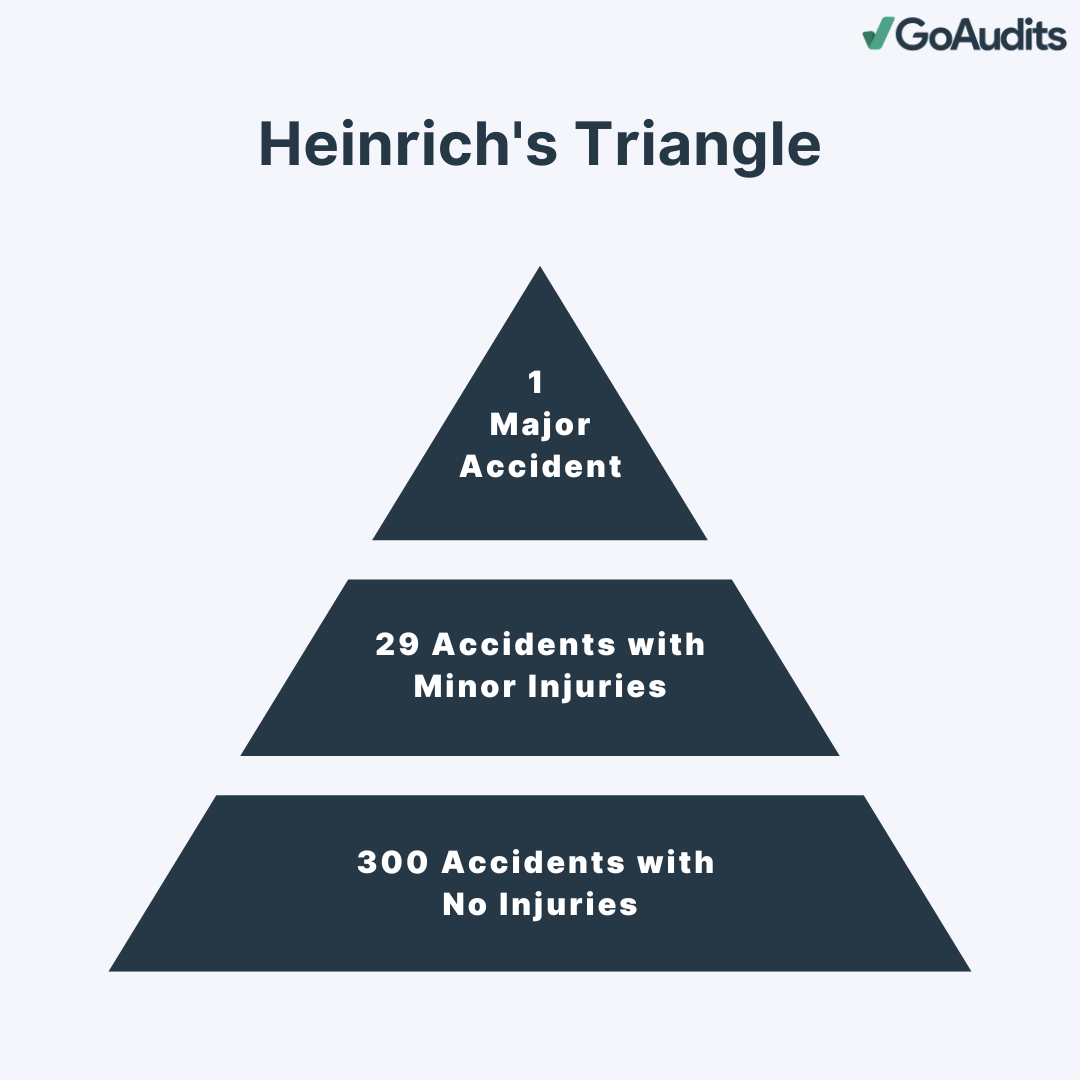
Near miss incident reporting is essential to ensure workplace safety. In that regard, Heinrich’s Triangle (also known as Heinrich’s Pyramid) is a foundational concept in workplace health and safety. Introduced by Herbert William Heinrich in 1931, this theory establishes a link between minor and major accidents: for every major injury accident, there are 29 minor injury accidents and 300 no-injury accidents. Focusing on and reducing the number of minor accidents can significantly decrease the occurrence of major accidents. Though this approach is simple and straightforward, a majority of near miss incidents go unreported, even when a worker has sustained an injury in the workplace.
This article will explore how near miss incident reporting and addressing minor incidents will prevent major accidents in the future.
- What is Near Miss Incident Reporting?
- Near Miss Incident Examples in the Workplace
- Key Components of Near Miss Incident Reporting
- Free Near Miss Incident Report Sample
- What is the Near Miss Reporting Procedure?
- How to Improve the Near Miss Incident Reporting Process?
- Report Near-Misses & Accidents in Real-Time with GoAudits
- FREE & Customizable Health & Safety Checklists
- What is a Near Miss Program?
- Key Components & Steps to Implement a Near Miss Program
- Best Practices for Sustaining a Near Miss Program
- FAQs
What is Near Miss Incident Reporting?
Near miss incident reporting is a proactive safety management practice. It involves identifying, documenting, and analyzing incidents that could have resulted in injury, damage, or loss but were narrowly avoided. These incidents, often referred to as ‘close calls,’ provide valuable insights into potential hazards and risks within an organization. Effectively reporting and addressing near misses can prevent future accidents, enhance workplace safety, and improve operational efficiency.
The concept of near miss incident reporting revolves around the principle that every near miss represents an opportunity for improvement. Identifying and recording these near miss incidents helps you fix problems before they result in an accident. It involves a systematic process where employees report these incidents as soon as they occur, even if no harm is done.
What are Near-Miss Incidents?
Near miss incidents are often brushed off since no immediate harm was observed or injury was narrowly avoided. However, these incidents highlight potential hazards that could lead to severe consequences if not addressed. They are also indicative of underlying organizational safety issues that need addressing.
Near miss incidents often stem from various causes, such as human error, equipment failure, or environmental factors. Human error can include mistakes due to fatigue, lack of training, or inattention. Equipment failure might involve malfunctioning tools or outdated machinery. Environmental factors could be slippery floors, poor lighting, or obstructions in walkways.
Why is Near Miss Incident Reporting Important?
Let’s look at some reasons why near miss event reporting is important.
- Helps identify hazards before they cause accidents.
- Reporting near misses allows corrective actions that reduce future incidents.
- Provides useful data to analyze causes and improve safety strategies.
- Encourages employees to share concerns without fear of blame.
- Reveals recurring safety issues through pattern analysis.
- Prevents accidents, lowering costs from injuries, damage, and downtime.
- Supports meeting workplace safety laws and reporting requirements.
Are you looking for an easier way to capture near misses in real time?

Near Miss Incident Examples in the Workplace
Here are some common examples of near miss incidents that can occur across various work environments:
| Near Miss Incident | Examples |
| Slips and Trips | An employee might slip on a wet floor that hasn’t been marked with a warning sign, catching themselves just in time to avoid a fall. Similarly, tripping over an improperly stored item, such as a loose carpet edge or cable, can be a near miss if no injury occurs. |
| Equipment Malfunctions | A forklift operator could lose control due to a mechanical failure, nearly hit a coworker, or cause property damage. |
| Falling Objects | A forklift operator could lose control due to a mechanical failure, nearly hitting a coworker, or cause property damage. |
| Electrical Hazards | An employee finds a damaged electrical cord lying in a pool of water, which could lead to electrocution if not noticed in time. |
| Chemical Spills | A chemical spill might be narrowly avoided when a container is found leaking but is promptly secured. |
| Signage and Communication Failures | Workers might nearly collide in a warehouse due to missing signs, or an area under construction might not be marked, leading to workers unknowingly entering a hazardous zone. |
| Risky Behavior | Employees operating machinery without proper training, handling hazardous materials without personal protective equipment (PPE), or engaging in risky behavior that nearly results in an accident. |
Key Components of Near Miss Incident Reporting
To effectively manage near miss incidents, it’s essential to understand the key components of the reporting process:
- Identify: Recognition of a near miss event is the most crucial aspect. Employees should be able to recognize and differentiate between a routine task and a potential hazard that narrowly avoided becoming an incident.
- Report: Once identified, the near miss incident must be immediately reported. Creating an easy and accessible reporting system encourages prompt reporting. Reports should be detailed, noting the time, location, and circumstances of the near miss, along with any potential causes.
- Investigate: Investigating the near miss is crucial to understand not just what happened, but why it happened. This involves analyzing the event to identify the root cause and any contributing factors.
- Intervene: Based on the findings of the investigation, appropriate interventions should be implemented. This could range from modifying existing safety protocols, introducing new training programs, or updating equipment.
- Review: It involves reviewing the effectiveness of the intervention and the near miss reporting process itself. This should be an ongoing process with adjustments made as necessary to improve both safety outcomes and the reporting process itself.
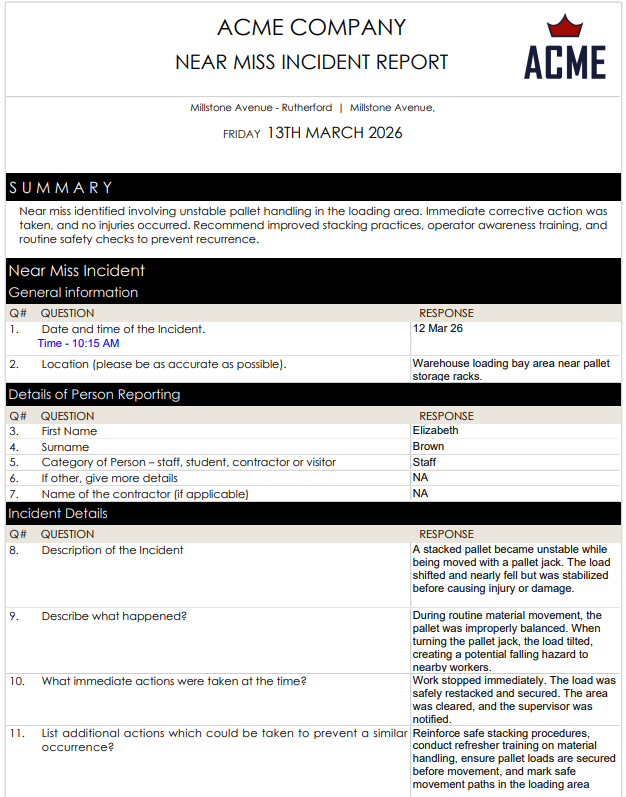
Free Near Miss Incident Report Sample

What is the Near Miss Reporting Procedure?
Let’s explore the near miss incident reporting procedure:
1. Identify Hazards & Where the Near Miss Incidents Occurred
Identify unsafe conditions, behaviors, and the exact location where the near miss incident occurred. Employees should be encouraged to report every incident, even if it seems minor. Recording the precise location and circumstances helps safety teams understand environmental risks, identify specific hazards in that area, and implement targeted corrective actions to prevent similar incidents in the future.
2. Include All Employees When Performing the Risk Assessment
Conduct a thorough risk assessment immediately after a near miss is reported to evaluate the potential severity and likelihood of harm. Prioritize safety actions and ensure that the most critical risks are addressed first. Employees who witnessed or were involved in the incident should participate in the assessment. Involving staff also strengthens workplace safety culture and encourages shared responsibility for preventing future incidents.
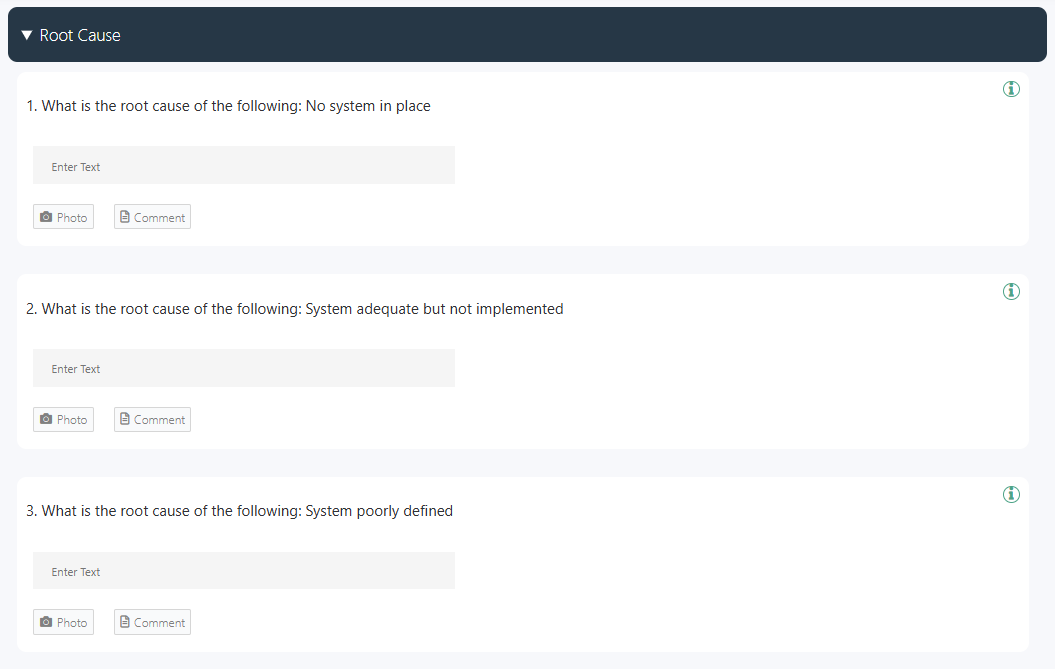
3. Determine and Analyze the Root Cause
Identify the root cause of the near miss through a detailed analysis. Look beyond immediate causes to uncover underlying issues. The 5 Whys and Fishbone Diagram are the most common ways of understanding the root cause of any problem for implementing effective preventive measures.
👉 Did You Know?
The 5 Whys technique is a straightforward yet effective method for identifying the root cause of a problem by repeatedly asking the question ‘Why?’ The process typically involves asking ‘Why?’ five times, but it can vary depending on the complexity of the issue.
Fishbone Diagram, also known as the Ishikawa or Cause-and-Effect Diagram, is a visual tool used to systematically identify and present potential causes of a problem. Shaped like a fishbone, this diagram helps organize thoughts and facilitate a thorough exploration of potential root causes. To create a Fishbone Diagram, identify the problem, determine major categories, brainstorm possible causes, and finally, analyze the diagram.
You can use this free root cause analysis checklist to perform a detailed analysis and identify the root causes behind near misses and accidents, and prevent future occurrences.
4. Inform the Management
Keep management informed about the incident and the findings from the initial assessment. Transparent communication ensures that necessary resources and support are available to address identified risks.
5. Implement Corrective Actions
Develop and implement corrective actions based on the findings from your risk assessment and root cause analysis. These actions should address both immediate and long-term safety concerns.
6. Document Findings
Document all findings from the near miss incident, including identified hazards, risk assessments, root cause analyses, and implemented corrective actions. It helps track and monitor trends, provide a reference for future safety improvements, and comply with safety regulations.
7. Implement Risk Minimizing Strategies
Develop and implement strategies to minimize risks proactively. This might include revising safety protocols, enhancing employee training programs, or upgrading equipment.
8. Regularly Review & Monitor the Process
Continuously review and monitor your near miss incident reporting procedure. Regular workplace inspections can help identify gaps or areas for improvement.
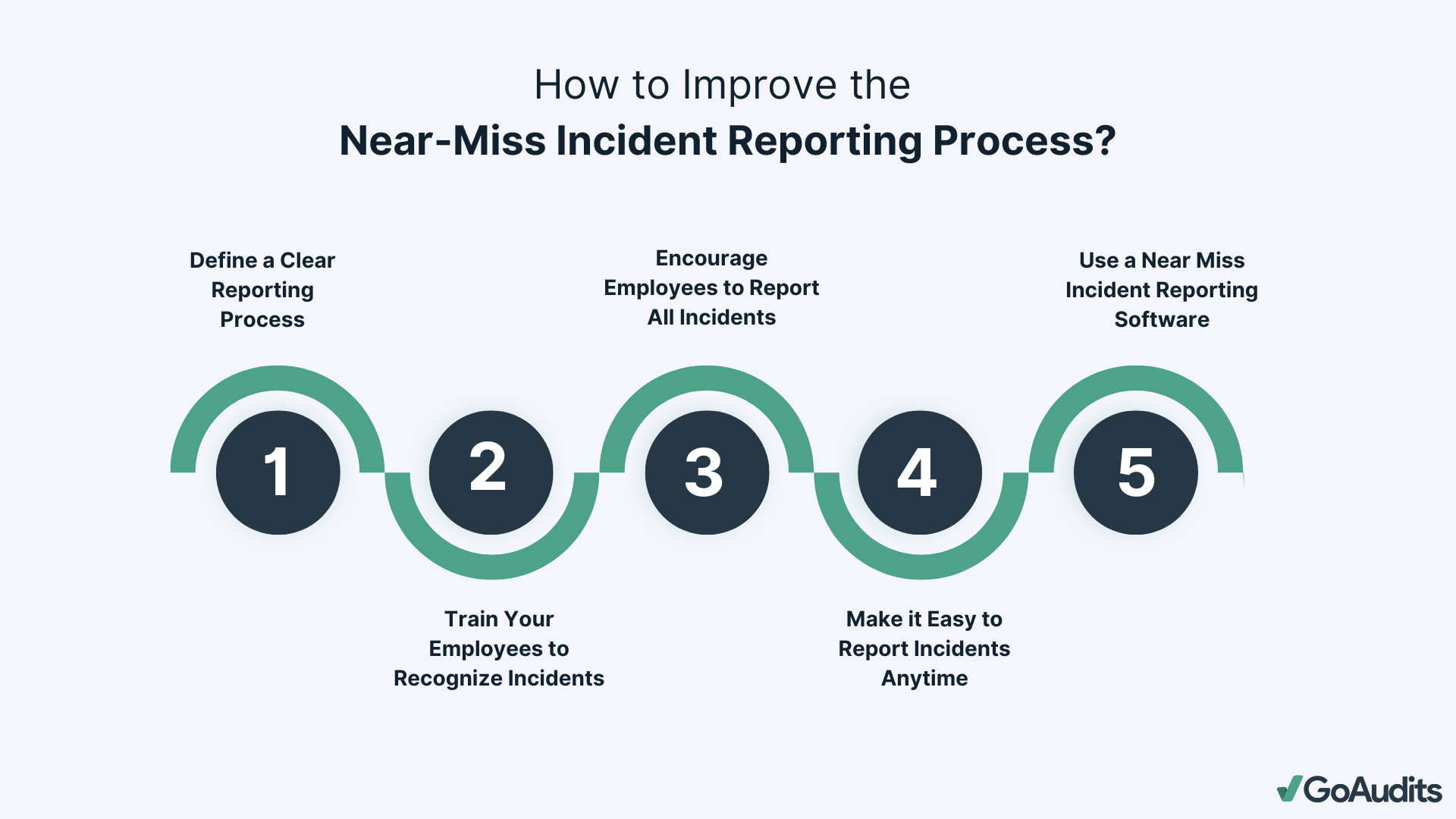
How to Improve the Near Miss Incident Reporting Process?
Here’s how you can encourage your employees to report near miss incidents.
Define a Clear Reporting Process
Define what a near miss is and provide simple examples. Use a clear, step-by-step guide or flowchart so employees know exactly how and when to report incidents.
Train Your Employees to Recognize Incidents
Conduct regular training using real-life scenarios and role-playing. Offer refresher sessions to keep employees confident in recognizing and reporting incidents.
Encourage Your Employees to Report All Incidents
Promote open reporting in safety meetings and training. Explain how reporting prevents accidents and consider recognizing employees who actively report near misses.
Make it Easy to Report Incidents Anytime
Provide multiple reporting options such as mobile apps, online forms, or paper forms. Keep the process quick, easy, and available anytime.
Use Digital Tools to Simplify the Process
Leverage near miss reporting software, like GoAudits, to automate reporting, track data in real time, and generate insights. This improves transparency and helps prevent future incidents.
Report Near-Misses & Accidents in Real-Time with GoAudits
Safety is paramount. GoAudits safety inspection software enables you to report near-miss incidents and accidents in real-time.
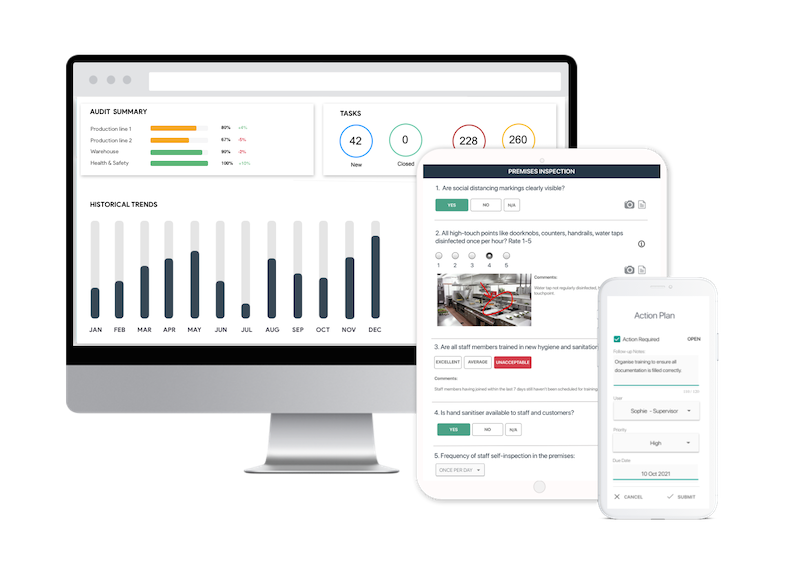
Here’s how GoAudits helps you streamline the process and maximize safety within your organization:
- Report incidents instantly from anywhere, anytime. No need to wait until you’re back at your desk.
- You can report incidents and capture crucial details even without an internet connection. All data syncs automatically once you’re back online.
- Create tailored checklists specific to your industry and needs, ensuring you capture all relevant information about the near-miss or accident.
- Analyze historical data, identify recurring issues, and proactively address potential hazards before they escalate.
- Assign corrective actions directly within the app, ensuring prompt resolution of identified issues and preventing future incidents.
- Generate comprehensive reports automatically, including photos, timestamps, and geolocation data, providing a clear record of the incident.
- Gain real-time insights into your safety performance with smart dashboards, enabling you to monitor trends and take immediate action.
FREE & Customizable Health & Safety Checklists
Explore our extensive library of free health and safety audit checklists and workplace inspection checklists.
- Near Miss Incident Report
- Office Hazards Checklist
- HSE COSHH Assessment Template
- Chemical Risk Assessment Template
- Accident Investigation Checklist
- Manual Handling Risk Assessment Checklist
- Office Safety Inspection Checklist
- JSA Form – Job Safety Analysis Checklist
- EHS Audit Checklist
- Hazardous Material Inspection Checklist
- Equipment Inspection Form
- Property Fire Risk Assessment
- Ergonomic Risk Assessment Template
- Worksite Incident Report Checklist
- Chemical Safety Checklist – COSHH

What is a Near Miss Program?
A near miss program is a structured initiative within organizations aimed at identifying, reporting, and analyzing near-miss incidents — events that could have led to injury, illness, or damage but did not, either by chance or timely intervention. The primary purpose of such programs is to proactively address potential hazards, prevent future accidents, and enhance the overall safety culture.
What is the Difference Between a Near Miss Program and Near Miss Reporting?
Near miss reporting involves reporting an event, while a near miss program is the complete system that manages those reports and improves safety.
| Aspect | Near Miss Program | Near Miss Reporting |
| Definition | A structured safety management system designed to identify, track, analyze, and prevent near-miss incidents in the workplace. | The process of documenting and communicating a specific near-miss event that almost caused injury, damage, or loss. |
| Scope | Broad system that includes policies, safety procedures, training, investigation, and corrective actions. | A single activity within the safety system where employees submit details of a near-miss incident. |
| Purpose | To manage and improve workplace safety proactively by analyzing trends and preventing accidents. | To record and share information about a close-call event so it can be investigated and corrected. |
| Components | Reporting system, investigation process, root-cause analysis, corrective actions, and safety improvement measures. | Incident form, description of event, location, time, cause, and people involved. |
| Role in Safety | Strategic and organizational approach to continuous safety improvement. | Operational step that supplies data to the program. |
Key Components & Steps to Implement a Near Miss Program
The following key components and steps are crucial for establishing an effective near miss safety program:
- Define Near Misses Clearly: A near miss is an unplanned event that could have caused injury, illness, or damage, but didn’t. A clear definition helps employees recognize and report incidents consistently.
- Create a Simple Near Miss Reporting System: Set up an easy reporting method that allows employees to submit near misses quickly and confidentially.
- Train Employees: Educate staff on identifying hazards, the importance of reporting near misses, and how to use the reporting system.
- Investigate and Take Action: Review each report to find root causes and implement corrective actions to prevent future incidents.
- Analyze Data and Share Feedback: Track reports to identify trends and communicate findings with employees to improve safety and encourage continued reporting.
Best Practices for Sustaining a Near Miss Program
To ensure the program’s effectiveness and longevity, consider the following best practices:
- Build a safety culture where employees can report near misses without fear. Active leadership involvement encourages trust and transparency.
- Make reporting easy with user-friendly tools and offer different options, such as digital platforms or forms.
- Analyze reports thoroughly, identify root causes, and implement fixes to prevent similar incidents.
- Share investigation results and actions taken to reinforce the importance of reporting.
- Monitor reporting trends, response times, and corrective actions to continuously strengthen the program.
FAQs
Several factors contribute to near miss incidents going unreported. Employees might fear blame or disciplinary action. There could be a lack of awareness about the importance of reporting near misses. Sometimes, the reporting process is cumbersome or time-consuming, discouraging employees from reporting. Additionally, a workplace culture that doesn’t prioritize safety can lead to underreporting.
Near misses, incidents, and accidents differ primarily in their outcomes. A near miss is an event where no injury or damage occurs, but it has the potential to do so. An incident is a broader term that includes any unplanned event that could lead to an accident, injury, or damage, but it may or may not result in harm. An accident, on the other hand, is an event that results in injury, illness, or property damage.
There isn’t a set number of near miss incidents that should be reported, but the goal is to report every near miss. Reporting all near misses allows you to identify patterns, address potential hazards before they lead to more serious incidents, and improve safety protocols.
The Occupational Safety and Health Administration (OSHA) defines a near-miss incident as an unplanned event that did not result in injury, illness, or damage but had the potential to do so. These incidents reveal underlying safety issues that, if not addressed, could lead to more severe accidents in the future. OSHA encourages reporting and investigating near-misses to identify and rectify unsafe conditions or behaviors. Addressing the root causes of near-misses through thorough investigations and corrective actions is essential for creating a safer work environment.
Safety models such as Heinrich’s Triangle suggest that hundreds of near misses may occur before a serious injury. While the exact number varies by workplace, tracking and addressing every near miss significantly reduces the likelihood of future accidents.
Near miss reports strengthen safety programs by identifying risk patterns early. Analyzing these events helps organizations implement targeted training, improve procedures, and remove hazards before injuries occur, making safety programs proactive rather than reactive.
Near miss training teaches employees how to identify hazards, understand reporting procedures, and recognize unsafe behaviors. Regular training sessions supported by digital tools like GoAudits can simplify reporting and encourage employees to document incidents immediately.
The fastest way to improve reporting rates is to simplify the process and remove the fear of blame. Using mobile reporting tools such as GoAudits allows employees to document near misses instantly, attach photos, and submit reports in seconds.