

Key Takeaways
- With regular irrigation inspections, commercial properties and municipalities can prevent water waste, maintain healthy landscapes, and stay compliant with local regulations.
- Inconsistent checks, hidden or obscured defects, pressure and flow issues, and slow, fragmented documentation make inspections challenging.
- Irrigation inspection software address these challenges with standardized checklists, photo capture, instant reporting, and automated follow-ups across all sites.
Managing irrigation across large landscapes such as commercial properties, municipalities, resorts, sports or agricultural sites comes with recurring challenges. Multiple zones, aging infrastructure, and complex controllers make it easy for leaks, misaligned heads, pressure issues, and programming errors to go unnoticed during routine operations.
Irrigation inspections are designed to systematically identify and document such issues, while irrigation audits evaluate how efficiently water is applied using field data and performance metrics. Read on to explore how to conduct standardized, efficient irrigation inspections and audits across multiple sites or properties, with digital checklists and a mobile app.
- What are Irrigation Inspections?
- What are Irrigation Audits and How are They Different From Inspections?
- How to Conduct an Irrigation Inspection
- Free Irrigation Inspection Report Template
- Key Challenges and Solutions of Lawn Irrigation Inspections
- Streamline Irrigation Checks With GoAudits Inspection Software
- FAQs
What are Irrigation Inspections?
An irrigation inspection is a systematic visual and functional evaluation of a property’s irrigation system. It typically involves activating each irrigation zone to verify that components, such as valves, sprinkler heads, nozzles, piping, and the controller, are operating as intended and delivering water to the correct areas.
Inspections focus on identifying visible defects, operational issues, and maintenance needs that can lead to water waste, uneven coverage, or landscape stress if left unaddressed.
Importance of Accurate Irrigation System Inspections
Maintaining a consistent, documented irrigation inspection program supports several key operational objectives:
- Immediate Waste Prevention: Routine inspections help identify issues such as broken or misaligned sprinkler heads, clogged nozzles, leaking lateral lines, and valve failures. The U.S. Environmental Protection Agency’s WaterSense program notes that even small irrigation system leaks or broken components can waste thousands of gallons of water over a single irrigation season if left unrepaired. Early detection reduces unnecessary water use and associated utility costs.
- Liability and Hardscape Protection: Over-irrigation is a direct threat to physical assets. Chronic overspray leads to “hardscape damage,” where water erodes asphalt sub-bases and undermines pavement over time. Furthermore, runoff onto walkways creates slippery conditions and encourages algae growth, representing a major slip-and-fall legal risk.
- Sustainability and Resource Management: In climates where droughts are frequent and resources are limited, professional water management is a core business requirement. Regular inspections ensure that water is used as a strategic asset, supporting plant health and protecting the organization’s reputation.
- Regulatory Compliance and Documentation: In drought‑prone regions, water is often treated as a strictly managed asset under local landscape efficiency ordinances and water management policies. For example,
- In California, the Model Water Efficient Landscape Ordinance (MWELO) provides a framework for utilities to enforce water budgets, where exceeding limits can trigger tiered pricing or penalties.
- In Australia, water efficiency guidelines for urban irrigation and landscapes help water authorities and local governments promote sustainable outdoor water use and avoid waste, particularly during periods of scarcity.
A digital history of irrigation system inspections is often used to demonstrate due diligence when addressing overuse concerns.
Case Study: How LaTour Hotels leverages inspection software to standardize checks and audits across 30+ locations.
Who Performs Lawn Sprinkler System Inspections
Irrigation inspections are typically carried out by one or more of the following groups:
- On-Site Property or Facilities Teams: Responsible for routine observation and basic checks, such as identifying broken heads, pooling water, or obvious leaks.
- Landscapers & Grounds Managers: Focus on aligning irrigation performance with plant health and landscape requirements, adjusting coverage and run times as needed.
- Certified Irrigation Technicians: Specialists trained to diagnose more complex issues, such as pressure problems, electrical faults, low-head drainage, or distribution imbalances, using diagnostic tools.
Why Professional Oversight Matters
While visible failures are easy to spot, trained professionals are equipped to identify less obvious issues that can quietly drive up water use and maintenance costs, including:
- Misting: Indicating excessively high pressure that turns water into a fine mist that blows away, wasting significant portions of applied water.
- Head-to-Head Coverage: Ensuring that the spray from one head reaches the base of the next to prevent “donuts” or dry patches.
- Controller Logic Errors: Verifying that “smart” weather sensors are actually overriding the system during rain events.
How Municipalities & Resorts Optimize Costs
Large commercial sites, municipalities, and resorts often use a tiered approach to irrigation oversight:
- In-House Scouting: Grounds staff perform regular zone-by-zone visual inspections using standardized checklists, consistent with commonly accepted maintenance practices across the irrigation industry.
- Professional Diagnostics: When the in-house team detects an anomaly they cannot fix, they report it to the Certified Technician. This allows them to arrive on-site knowing exactly where to go and what tools to bring.
GoAudits Reporting and Corrective Action Software: Explore how GoAudits streamlines and accelerates reporting and communication for on-site teams.
Recommended Inspection Frequency
The frequency of a lawn sprinkler inspection varies by climate, system size, and usage, but common commercial practices include:
- Weekly Wet Check: Briefly run every zone to check for physical damage or clogs.
- Monthly System Tuning: Checking the controller, cleaning filters, and adjusting misaligned heads.
- Seasonal Comprehensive Evaluation: Full system “tune-up,” including pressure testing and backflow prevention checks.

What are Irrigation Audits and How are They Different From Inspections?
An irrigation audit is a data-driven performance analysis of an irrigation system that evaluates how efficiently water is applied across a landscape. In contrast, an irrigation inspection is a visual and functional health check designed to identify obvious system failures such as leaks, broken heads, clogged nozzles, or controller errors.
Audits are often tied to external requirements. Green building programs such as LEED, as well as many water utility rebate and conservation programs, require a certified irrigation audit report rather than a basic irrigation inspection. In these cases, organizations must demonstrate measurable improvements in water efficiency, not just proper system maintenance.
From an operational standpoint, inspections reduce immediate waste and risk. Audits support long-term water optimization, regulatory compliance, and financial incentives.
Why Irrigation Audits May Be Required?
Irrigation audits may be required for several reasons.
- Many water utilities and government agencies require an irrigation audit to qualify for water-efficiency rebates or “water-smart” incentive programs.
- Audits may also be required to support water budgets and allotments, particularly for large landscapes with high outdoor water use.
- Programs aligned with EPA WaterSense principles and similar water-efficiency frameworks often reference irrigation audits as a best practice for commercial landscapes.
- Additionally, many organizations rely on irrigation system audits for commercial sustainability reporting as they provide measurable indicators that support ESG goals, corporate water stewardship commitments, and public-sector conservation mandates.
How to Conduct Irrigation System Audits
A professional irrigation system audit follows a structured process designed to collect accurate field data and translate it into actionable insights.
- Pre-Audit Inspection: Make sure all visible defects, such as leaks, broken sprinkler heads, misaligned nozzles, and controller programming, are corrected before testing begins. This step ensures that audit data reflects system performance rather than repair issues.
- Catch-Can Test: Place collection containers throughout the irrigation zone, and run the system for a measured period. Record the volume of water captured in each container to evaluate how evenly and how quickly water is applied.
- Post Audit Analysis: Analyze the data collected from the catch-can test and calculate the KPIs (DU and PR). Compile the results into an irrigation audit or irrigation system evaluation report, along with recommendations for system improvements.
What’s DU and PR?
- Distribution Uniformity (DU): measures how evenly water is distributed across a zone. Higher DU values indicate consistent coverage, while lower values reveal uneven application that often leads to overwatering.
- Precipitation Rate (PR): shows the rate at which water is applied, typically expressed as depth per hour. It is used to determine appropriate run times and assess whether the system is applying water faster than the soil can absorb.
How to Conduct an Irrigation Inspection
A professional irrigation system inspection for commercial properties, municipalities, and agricultural operations follows a consistent, repeatable, zone-wise process designed to identify visible failures, operational risks, and early signs of inefficiency.
- Controller Check: Verify the date and time settings, active programs, and run times for each zone. Confirm that rain sensors or weather-based controls are enabled and functioning correctly. Controller errors are a common cause of unnecessary watering, even when field hardware appears intact.
- Visual Walkthrough: Run the system zone by zone and observe operation in real time. Look for obvious leaks, broken pipes, geysering sprinkler heads, pooling water, and overspray onto pavement, buildings, or walkways. This step forms the core of most lawn sprinkler system inspections and is essential for identifying immediate water waste.
- Safety Check: Inspect all electrical components, valve boxes, and controller enclosures for exposed wiring or damage. Note slippery surfaces caused by runoff, standing water near walkways, or trip hazards around valve boxes.
- Head-by-Head Review: Inspect each sprinkler head within the active zone. Check for misalignment, clogging, damage, or mismatched nozzles within the same zone.
- Pressure Assessment: Use a pressure gauge to measure operating pressure at a representative sprinkler head. Compare readings against manufacturer recommendations.
- Record Deficiencies: Document all issues identified during the lawn irrigation inspection using a structured form. Each finding should include the location, type of defect, and supporting notes or photos.
Free Irrigation Inspection Checklist Templates
Standardized irrigation inspection checklists help ensure no step is missed and inspections remain consistent across teams and sites. For organizations managing multiple properties, checklists are critical for maintaining quality control and inspection accountability.
- Water Audit Checklist
- Farm Audit Checklists
- Park Quality Inspection Checklist
- Landscape Quality Audit Checklist

Free Irrigation Inspection Report Template
Here’s what an irrigation inspection sample report generated using the GoAudits app and digital checklist looks like:
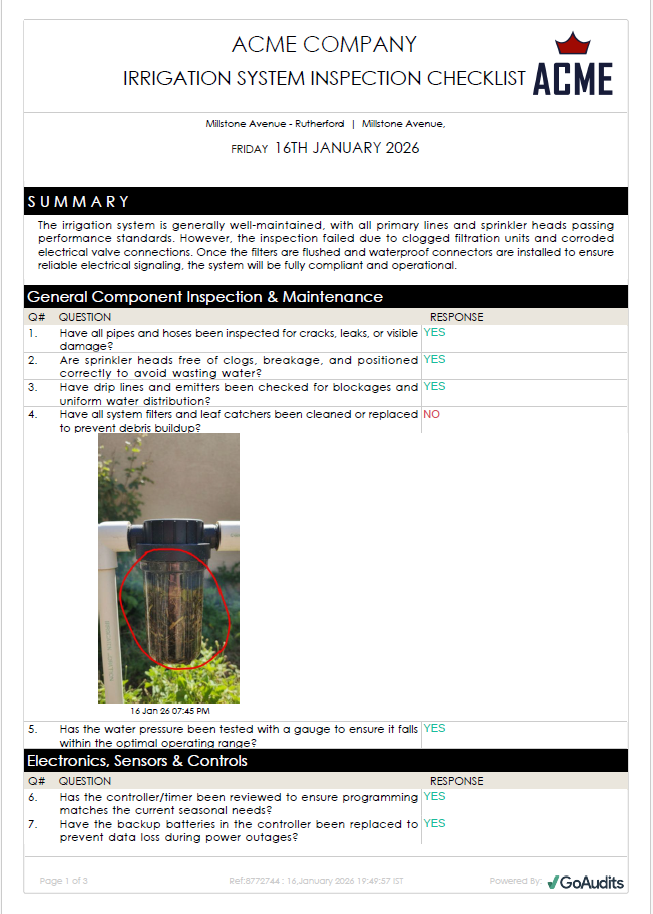
This report was generated using the irrigation inspection checklist and the GoAudits mobile app. Once completed, users can sign off on the inspections, add a summary, and generate irrigation inspection reports instantly using the app. Moreover, you can also share them immediately with contractors, facility managers, and other stakeholders.
Key Challenges and Solutions of Lawn Irrigation Inspections
Even experienced teams encounter recurring challenges when performing lawn sprinkler system inspections across commercial and municipal properties. Addressing them requires both technical knowledge and standardized inspection workflows.
Identifying Correct Pressure and Diagnosing Flow
High pressure can turn water into mist that blows away, while low pressure leaves dry patches, reducing plant health and causing waste. Variations across zones or elevations make these problems difficult to detect without deliberate measurement.
To solve this, measure the operating pressure at representative sprinkler heads and compare readings against manufacturer specifications. Observe the flow patterns and look for areas where coverage is insufficient or misting occurs. Correcting pressure and flow issues promptly prevents overwatering, reduces component wear, and ensures uniform coverage.
Standardization Across Portfolios and Skipped Inspection Steps
In large commercial properties or multi-site portfolios, inspections are often inconsistent. Relying on memory or informal routines can result in skipped zones, overlooked heads, or incomplete controller checks, leaving defects unrecorded. Inconsistent inspections reduce reliability and make it difficult to track performance over time.
The solution is to follow a defined inspection sequence that covers all critical components. Train staff to perform the same steps each time and verify compliance through documented checklists. Use an irrigation inspection app like GoAudits to ensure every step is executed in order, preventing missed items and maintaining consistency across teams.
Ineffective Documentation and Client Proof
Even when inspections are performed correctly, fragmented notes, separated photos, or handwritten forms make it hard to demonstrate what was checked. This can create friction with contractors, clients, or internal stakeholders and risk compliance and liability protection.
Use digital checklists to capture photos, annotate notes, and link observations directly to specific zones, creating a clear, verifiable record. Compile all proofs into professional reports and share them with clients, managers, supervisors, and other stakeholders.
Detecting Mismatched and Obscured Components
Over time, irrigation systems can develop mismatched nozzles, inconsistent precipitation rates, or heads that are blocked or obscured by turf, plant growth, or debris. These hidden issues reduce coverage uniformity, create dry patches or overspray, and make it difficult to maintain plant health.
To address this, perform a systematic head-by-head inspection of each zone. Check that each nozzle type matches manufacturer specifications and that spray patterns are consistent across the zone. Remove or trim vegetation that blocks sprinkler heads and adjust or replace heads that are misaligned or obstructed.
Slow Reporting and High Administrative Cost
Manual inspection workflows often require inspectors to transcribe notes, organize photos, and compile reports after leaving the field. This takes hours and delays communication, slows decision-making, and increases administrative costs.
To address this, record all inspection observations directly during the walkthrough using structured forms or digital templates. Use the GoAudits mobile app to generate reports immediately after the lawn sprinkler inspection, ensuring findings are delivered to maintenance teams or managers without delay.
Closing the Repair Loop and Lost Revenue
Without a clear system to track repairs, minor defects can persist, leading to ongoing water waste, reduced system efficiency, and missed revenue opportunities for service providers. Unresolved issues also weaken documentation for compliance and client reporting.
To solve this:
- Assign corrective actions immediately, specifying responsible personnel and expected completion dates.
- Follow up regularly to confirm that repairs are completed correctly, and update records to reflect changes.
- Maintain a log of follow-up tasks and repair status to hold personnel accountable and enable management to spot recurring problems before they escalate.
For managing multiple properties or teams, use a corrective action software like GoAudits. Assign repairs on-site, automate follow-ups, identify recurring issues, and analyze performance across all or any site in just a few clicks.
Streamline Irrigation Checks With GoAudits Inspection Software
GoAudits inspection software is a digital tool designed to help property managers, municipalities, resorts, and agricultural operations streamline irrigation and other property inspections. It simplifies complex inspection tasks, reduces errors, and ensures consistent performance across multiple sites.
With GoAudits, you can:
- Create custom irrigation inspection checklists or use ready-made templates.
- Conduct regular lawn sprinkler inspections, even in remote locations.
- Ensure inspection procedures and SOPs are always accessible.
- Enable maintenance teams to coordinate and address issues promptly.
- Keep all stakeholders informed with notification alerts and instant reports.
With a rating of 4.8 stars on Capterra, GoAudits is trusted by some of the biggest property management brands to streamline operations.
» GoAudits Reviews: Read how companies leverage GoAudits to meet standards and deliver consistent services across locations.
FAQs
The cost of a professional irrigation inspection varies widely depending on property size, system complexity, and location. For routine inspections, costs can range from roughly $40 to $300+ per visit for basic evaluations. Larger commercial systems or inspections bundled with maintenance contracts can be higher, especially when advanced diagnostics or seasonal tune‑ups are included.
Select a farm inspection software that captures field data and photos, allows custom checklists for each zone, tracks historical trends, and generates standardized reports. It should support offline use, simplify inspections, and integrate with farm management workflows to ensure repeatable and actionable results.
Professional irrigation inspection software is usually sold directly by specialized vendors. Look for companies, like GoAudits, serving commercial, municipal, or agricultural clients that offer mobile apps, licensing options for teams or multiple sites, and support resources. Demos or enterprise pricing are commonly available on vendor websites.
The best irrigation inspection and audit software offer mobile apps for data capture, customizable inspection templates, photo annotation, offline functionality, instant report generation, and cloud-based storage. The ideal choice depends on your industry, team size, and whether integration with existing maintenance or farm management systems is required.
For commercial and municipal irrigation systems, a DU of 70–80% is generally considered good, while above 80% is excellent. Higher DU ensures consistent coverage, reduces water waste, and improves overall system efficiency.

