

Key Takeaways
- Domiciliary care software manages care delivery operations. A CQC compliance audit trail is a separate layer that most platforms were not primarily built to provide.
- Regulation 17 of the Health and Social Care Act 2008 requires providers to have auditing systems to monitor and actively drive improvement in care quality — not just record it.
- The most common reason for a “Requires Improvement” under Well-Led is not poor care. It is poor documentation of how issues were identified and resolved.
- A dedicated home care compliance / audit tool works alongside any care management platform (Birdie, PASS, Access, Log My Care, etc)
- GoAudits gives UK home care providers 40+ ready-made domiciliary care audit templates, a structured corrective action workflow, and a compliance evidence trail — without replacing your existing setup.
A CQC inspector asks to see your improvement loop. Not your rota. Not your care plans. They want to know: when your team finds a problem, what happens next? Is it documented? Was it fixed? Can you prove it?
Most domiciliary care providers have a management platform that handles scheduling, care delivery and eMAR. Fewer have a structured system for the compliance and audit trail that sits alongside it. This gap (between running a good service and being able to evidence that you run a good service) is where CQC ratings are won and lost.
This guide covers what domiciliary care software typically does, how the leading UK platforms compare, why care quality monitoring and governance need their own approach, and how home care providers can build an audit trail that holds up at inspection.
- What Does Domiciliary Care Software Do?
- Best Domiciliary Care Software for UK Home Care Providers
- Why CQC Compliance and Governance Need a Structured Approach
- Do You Need a Dedicated Home Care Compliance Tool Alongside Your Management Platform?
- What Should a Domiciliary Care Audit Programme Cover?
- How GoAudits Helps Home Care Providers Stay CQC-Ready
- Frequently Asked Questions
What Does Domiciliary Care Software Do?
Domiciliary care software is a digital platform designed to manage the planning, delivery and monitoring of care provided in service users’ own homes. It replaces paper rotas, handwritten care notes and physical MAR charts with connected digital systems.
Most platforms on the market today handle a similar core set of functions:
- Rostering and scheduling — matching carers to service users, managing travel time, handling last-minute changes
- Electronic care plans — person-centred plans that carers access on a mobile app during visits
- eMAR (electronic Medication Administration Records) — digital medication records that flag missed or late doses in real time
- Electronic call monitoring — GPS-verified visit start and end times, with alerts for missed or late calls
- Finance and invoicing — automated billing linked to completed visits, payroll calculations
- Carer app — mobile access to schedules, care plans, tasks and notes during visits
- Quality and compliance tools — incident logging, concern tracking, audit trails and evidence tagging; depth varies significantly by platform and pricing tier
These are the operational foundations of a well-run domiciliary care service, and the main platforms do them well. What they were built around, first and foremost, is care delivery efficiency. Care delivery records and a compliance audit trail are not the same thing, and conflating them is where many providers run into difficulty at inspection.
👉 Did you know?
Domiciliary care registrations with the CQC rose by around 33% between 2020/21 and 2023/24, according to the CQC’s independent review of its assessment framework. The sector is growing fast, and regulatory scrutiny is intensifying alongside it.
Best Domiciliary Care Software for UK Home Care Providers
The right domiciliary care management software depends on your service size, model and priorities. Below is an honest overview of the main platforms used by UK home care providers.
| Platform | Best for | Key strengths |
|---|---|---|
| Birdie | Growing providers, quality-focused services | All-in-one platform: care management, rostering, finance, eMAR and compliance in one system. Strong analytics and Q-Score benchmarking. DSCR-assured. |
| everyLIFE PASS | Small to mid-size providers | Care plans, eMAR, rostering and reporting in one place. NHS-assured. Quick onboarding — most services go live within 30 days. Trusted by 1,250+ providers. |
| The Access Group | Larger or multi-service providers | End-to-end platform covering care delivery, workforce, compliance and finance. Suits providers managing domiciliary, residential and supported living. |
| Log My Care | Providers focused on person-centred practice | Intuitive interface, strong care planning and incident reporting. Popular with learning disability and elderly care providers. |
| Unique IQ | Providers wanting configurable systems | Configurable to each service’s workflow. 24/7 support. Includes rostering, care planning and call monitoring. |
| CareLineLive | Tech-forward smaller providers | Cloud-based, integrates care planning, eMAR, rostering and payroll. Strong CQC SAF preparation guidance. |
Each of these platforms addresses the core operational challenge of domiciliary care: getting the right carer to the right person at the right time, with the right information. Where they differ is in depth of compliance tooling, pricing structure, and how well their audit features serve the governance requirements that CQC inspects under the Well-Led question.
For providers evaluating social care software for the first time, any of these platforms represents a significant step up from paper. For providers already using one of them and looking to strengthen their compliance and audit trail, a dedicated tool that sits alongside your existing system may be the more targeted option, covered in the sections below.
Why CQC Compliance and Governance Need a Structured Approach
Good care delivery is necessary, but it is not sufficient. CQC assesses domiciliary care services against five key questions: Safe, Effective, Caring, Responsive and Well-Led. A disproportionate number of “Requires Improvement” ratings are handed out under Well-Led, even to providers delivering good care day to day.
Well-Led sits on Regulation 17: Good Governance. This is the legal requirement for providers to have auditing systems that assess, monitor and drive improvement in care quality. The word “drive” matters. Recording that something happened is not the same as demonstrating that issues were found, acted on and resolved.
Inspection reports for services rated ‘Requires Improvement’ under Well-Led tend to reflect the same failure patterns:
- The provider did not identify the problem; audit systems were absent or ineffective
- The problem was known but no action was taken
- Action was taken but not documented — so it cannot be evidenced to an inspector
- Feedback from service users or staff was collected but not used to change anything
Every one of these is a process failure, not necessarily a care quality failure. A provider can be running a good service and still receive “Requires Improvement” under Well-Led because the evidence does not exist to prove it.
The improvement loop is the documented cycle CQC wants to see: audit → identify issue → assign corrective action → resolve → evidence. This cycle needs to run continuously across all key compliance areas (medication management, safeguarding, infection control, care planning and staff competency), not just in the weeks before an inspection.
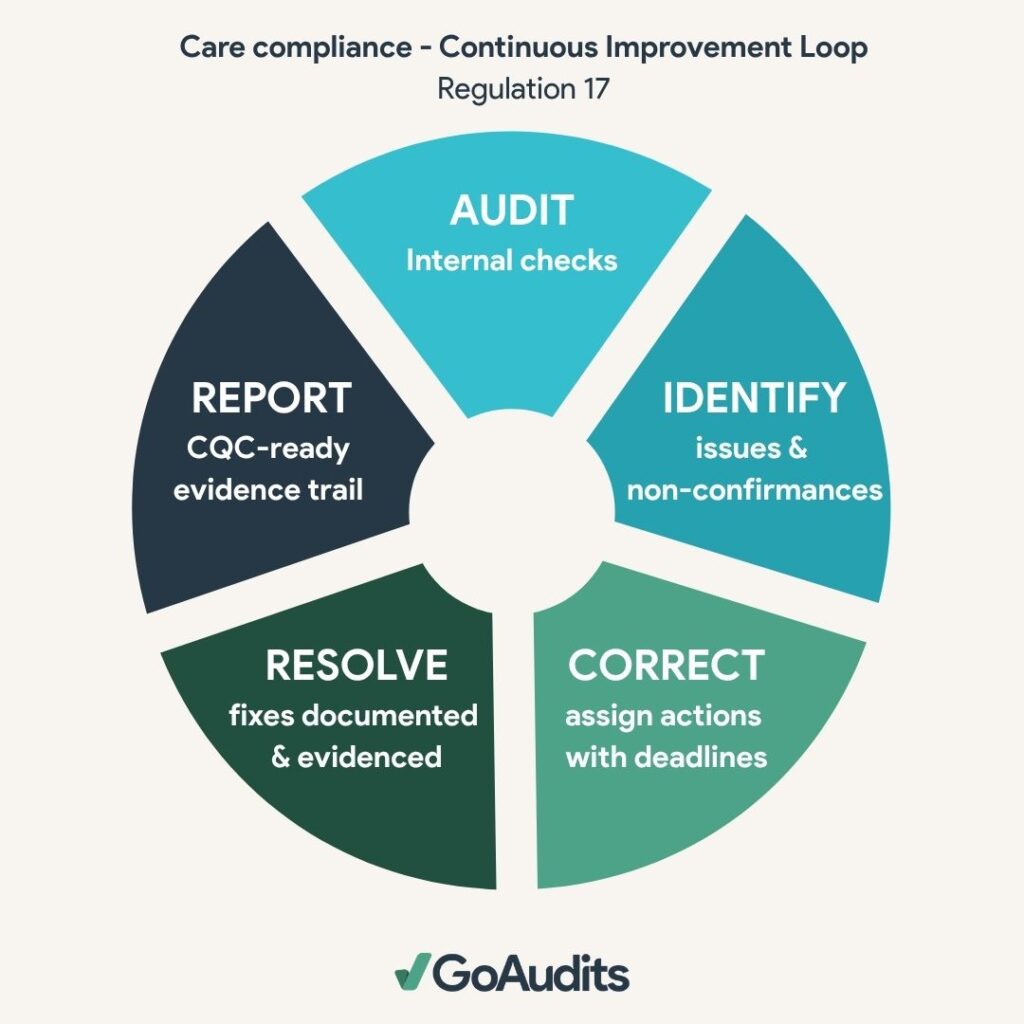
What Regulation 17 requires in practice:
– Regular, scheduled internal audits covering key care quality and safety areas
– Corrective actions assigned to named individuals, with deadlines and documented resolution
– Records showing that findings led to measurable improvements over time — not just that audits were completed
👉 For a full overview of the CQC’s current assessment approach, see our guide to the CQC Single Assessment Framework.
Do You Need a Dedicated Home Care Compliance Tool Alongside Your Management Platform?
Many home care providers assume their management platform covers their CQC compliance needs. Sometimes it does. Often it covers them partially, and the gap sits precisely where CQC inspectors look hardest.
The question is not whether your platform has compliance features. Most do. The question is whether those features give you what Regulation 17 specifically requires: a structured audit programme, a corrective action trail, and trend data showing continuous improvement.
The table below shows how the two approaches compare on the compliance and audit layer specifically. Note that this is not a question of one replacing the other — the categories serve different purposes.
| Care Management Platform | Dedicated Audit Tool (e.g. GoAudits) | |
|---|---|---|
| Primary purpose | Care delivery: rostering, care plans, eMAR, finance | Audit, compliance and governance evidence |
| CQC-aligned audit templates | ⚠️ Varies — basic or tied to platform data | ✅ ready-made domiciliary care audit templates |
| Structured corrective action workflow | ⚠️ Concern tracking in some platforms | ✅ Assign, deadline, track, escalate — full workflow |
| Compliance trend analytics | ⚠️ Available in higher tiers of some platforms | ✅ Score trends, matrix reports, location comparisons |
| Pricing model | Per care hour / per active client — grows with caseload | Per user/month — predictable, scales independently |
| Setup time and IT overhead | Weeks to months; data migration required | Days — free trial, no migration, no IT project |
| Offline mobile audits | ⚠️ Varies by platform | ✅ Full offline mode, syncs when connected |
| Works with any existing setup | ❌ Tied to its own ecosystem | ✅ Platform-independent |
Three situations where a dedicated home care compliance management tool adds clear value:
- You want a richer internal audit capability. Most compliance features in care management platforms are built around their own data: visit records, medication logs, care plans created within that system. A dedicated audit tool adds a structured programme of scored, scheduled internal audits across medication, safeguarding, infection control, care planning and staff competency, generating its own timestamped evidence trail independently of your care management data.
- Full compliance tooling sits in a pricing tier you do not need. Some platforms bundle advanced governance features with rostering, finance or workforce modules in higher-cost packages. A standalone audit tool gives you exactly the compliance layer you need, at a fraction of the cost, without modules you will not use.
- You want a tool that works regardless of your management platform. Whether you are on Birdie, PASS, Access, Log My Care, or a combination of systems, a platform-independent audit tool works the same way. If you change your management platform in future, your compliance infrastructure stays intact.
What any effective audit and corrective action software needs to deliver: scheduled recurring checklists, a workflow that assigns issues to named people with deadlines, an inspection dashboard that tracks scores and trends over time, and the ability to generate timestamped, signed reports that a CQC inspector can review during a visit.
Case Study: Explore how the Careville care agency, one of the UK’s leading nursing and care staff providers, used GoAudits to replace a compliance process that required manually cross-referencing multiple documents. Reports that previously took close to half a day now take 10 minutes, with professional, branded outputs ready to present to the CQC.
Questions to ask about any compliance tool:
- Does it run a structured audit schedule, or does it mainly store documents?
- Can corrective actions be assigned, tracked and evidenced as resolved — all within the same system?
- Does it produce timestamped, signed reports that an inspector can review on the spot?
- Does it work independently of your care management platform, or only with that platform’s data?
What Should a Domiciliary Care Audit Programme Cover?
A well-structured internal audit programme gives CQC inspectors the evidence they need under Well-Led: that problems are being found, acted on, and resolved. Below are the core areas every domiciliary care service should cover on a regular schedule.
- Medication and MAR — medicines management policies, MAR chart accuracy, storage, disposal and administration practice. Separate competency sign-offs for carers authorised to administer medication, with renewal dates tracked.
- Care planning and care records — confirming that care plans are person-centred, reviewed on schedule, and matched by what visit records actually show. Plans that no longer reflect a service user’s current needs are a consistent finding in “Requires Improvement” reports.
- Care notes — verifying that records are completed promptly after visits, are specific enough to evidence what care was delivered, and are consistent across the carer team.
- Infection prevention and control — PPE availability and use, hand hygiene practice, waste management and outbreak procedures in service users’ homes, where the provider has limited control over the environment.
- Safeguarding — training is current for all staff, incidents are reported in line with local authority procedures, and mental capacity considerations are embedded in care records.
- Staff competency and workforce compliance — DBS renewals, mandatory training completion rates, supervisions, appraisals and probationary reviews all on schedule.
- Complaints and feedback — concerns are logged consistently, investigated properly, and learning is documented and shared with the team. CQC wants to see that feedback drives change, not just that it is collected.
- Quality of visit reviews — spot-checks and shadow visits to assess care delivery directly, separate from paper-based audits but feeding into the same governance picture.
Every audit should produce a timestamped report with corrective actions assigned to named individuals. That workflow (not the audit itself, but what happens after it) is what turns a compliance exercise into the governance system Regulation 17 requires.
👉 Case Study
Northern Healthcare, a specialist adult care provider operating across 15 UK locations, used GoAudits to embed exactly this kind of structured programme. Within their first year, the team ran 150–200 audits daily across 150+ checklists and resolved over 1,100 quality improvement actions.
Danielle Ruane, Training, Compliance and IT Manager at Northern Healthcare, puts it directly: “Regulation 17 of the Health and Social Care Act draws attention to good governance. With GoAudits, we meet and surpass the requirements of this regulation — making sure our systems and processes meet the requirements of all other regulations, meaning that we operate a safe service.” Read the full case study →
GoAudits ready-made audit templates for domiciliary care:
Medication Audit
MAR Audit
Care Plan Audit
Care Notes Audit
Infection Control Audit
Safeguarding Audit
Medication Competency Assessment
All CQC-aligned and ready to customise. Browse the full domiciliary care audits library →
How GoAudits Helps Home Care Providers Stay CQC-Ready
GoAudits is purpose-built care compliance software for providers who need a structured audit and governance trail. It does not manage rotas or care plans. It manages the compliance evidence that sits alongside them, independently of whichever care management platform you already use.
For registered managers and home care providers looking to strengthen their compliance position without replacing their existing setup, GoAudits provides:
- 40+ ready-made domiciliary care templates — CQC-aligned checklists covering medication, MAR, care planning, care notes, infection control, safeguarding and staff competency, available from day one. No building from scratch.
- Full offline mobile app — audits completed in service users’ homes sync automatically when a connection is restored. Works on any iOS or Android device.
- Structured corrective action workflow — issues found during an audit are assigned immediately to the right person, with a deadline and an escalation path if unresolved. Every step is logged. This is the documented improvement loop that Regulation 17 requires and that CQC inspectors expect to see under Well-Led.
- Compliance trend dashboards — track audit scores over time, spot recurring issues, and compare performance across locations. An inspection dashboard that shows continuous monitoring, not a scramble in the week before a visit.
- Fast to set up, easy to use — most teams are live within days. No IT migration, no mandatory implementation programme, no steep learning curve. GoAudits starts from approximately £8–10 per user per month, with no bundled modules for features you do not need.
See our CQC inspection checklists for a preview of the templates available, or book a demo to see the full domiciliary care audit toolkit.

Frequently Asked Questions
What is domiciliary care software?
Domiciliary care software is a digital platform used by home care providers to manage the delivery of care in service users’ own homes. It typically covers rostering, electronic care plans, eMAR, electronic call monitoring and carer mobile apps. The main platforms in the UK include Birdie, everyLIFE PASS, The Access Group, Log My Care, Unique IQ and CareLineLive. Compliance and audit tools like GoAudits sit alongside these platforms to manage the governance evidence trail.
What is the best domiciliary care management software for audit readiness?
The best domiciliary care management software for audit readiness depends on whether you need an all-in-one platform or a dedicated compliance layer. Full-suite platforms like Birdie and PASS include compliance features tied to their care delivery data. For a structured internal audit programme covering scored checklists, corrective action tracking, trend analytics and CQC-ready evidence packs that work independently of your management platform, GoAudits is a dedicated option. Many providers use both: a management platform for care operations and GoAudits for the governance audit trail.
Which domiciliary care management software supports audit trails?
GoAudits provides a complete, timestamped audit trail for domiciliary care services. Every audit generates a signed, dated report with photo evidence and scores. Issues are assigned as corrective actions with deadlines, and the system tracks their resolution to completion. Managers can view compliance trends over time and across locations from a central dashboard. The full audit history (checklists, reports, actions, resolutions) is stored in one place and accessible during a CQC inspection.
How does domiciliary care software help with CQC inspections?
Domiciliary care software helps with CQC inspections by maintaining the records inspectors ask to see: care plans, medication records, visit logs, incident reports and training documentation. Dedicated audit tools like GoAudits go further by generating the governance evidence that the CQC specifically requires: a structured audit programme, a corrective action log, and trend data showing that the service identifies issues and resolves them over time. Together, a care management platform and a dedicated homecare compliance tool cover the full evidence picture a CQC inspector expects.
How do I automate audit documentation in a domiciliary care service?
Audit documentation can be automated using a dedicated audit app like GoAudits. Carers and managers complete structured digital checklists on a mobile device, even offline in service users’ homes. When the audit is submitted, a branded PDF report generates instantly with scores, photos and e-signatures included. Issues are automatically flagged for corrective action, assigned to a named person and tracked through to resolution. Scheduled audit reminders ensure the programme runs consistently throughout the year.
Can domiciliary care software track carer certifications and renewals?
Some care management platforms include staff record management with training expiry alerts. GoAudits supports this through its staff competency assessment templates, which create a dated, signed record of each competency check. Recurring audit schedules can be set to align with training renewal cycles, so a flag triggers before a certification lapses rather than after. This is particularly important for medication competency, where documented sign-off is a Regulation 17 requirement.
Does domiciliary care software need to be DSCR-assured?
DSCR (Digital Social Care Records) assurance applies to platforms that store digital care and support records: visit notes, care plans, medication records. It is a quality mark for care delivery data systems. Audit and compliance tools like GoAudits sit in a separate category: they generate governance documentation rather than care delivery records, so DSCR assurance does not apply to them. If you are selecting a primary care management platform, checking for DSCR assurance is worthwhile. For a dedicated audit tool, the relevant question is whether it produces the structured, evidenced audit trail that CQC requires under Regulation 17.
