

VelocityEHS is a well-known enterprise EHS software platform used by mid-size and large organizations to manage incidents, compliance, chemical safety, risk, and regulatory compliance in one system. While it offers broad functionality, many teams begin exploring VelocityEHS alternatives when implementation becomes complex, reporting feels slow, or frontline adoption stalls.
If you’re evaluating VelocityEHS competitors, this article compares the top alternatives based on mobile usability, deployment speed, pricing transparency, and overall fit for inspections, audits, and compliance management.
VelocityEHS Reviews: Why are Companies Looking for Alternatives?
VelocityEHS is widely used in safety and compliance programs, especially by enterprise safety teams. However, user feedback across review platforms shows consistent friction points that push organizations to evaluate other solutions.
Here are the most common reasons companies start exploring VelocityEHS alternatives:
- Confusing Navigation and Fragmented UX: Many users report that the platform feels split into separate modules rather than one cohesive system. Moving between workflows often requires extra clicks, different layouts, or switching contexts.
- Limited Customization Capabilities: Organizations with complex workflows often struggle to tailor the platform to their processes. Users mention constraints when adjusting fields, modifying workflows, or configuring data structures.
- Slow Support Response: Another recurring theme in reviews is delayed customer support, particularly when requests involve configuration changes or technical troubleshooting.
- Administrative Limitations: Some administrators report they cannot independently edit certain data lists or structural settings. Instead, they must request vendor assistance.
- Pricing and Perceived Value: While VelocityEHS is positioned as an enterprise-grade solution, some reviewers question whether the cost aligns with the functionality delivered. This concern typically emerges when companies outgrow basic modules, need advanced reporting, and require custom workflows.
- Time-Consuming Reporting: Users frequently note that generating reports or extracting insights can be slower than expected.
- Steep Learning Curve: VelocityEHS can feel complex for new users, especially those unfamiliar with enterprise EHS platforms. Teams report needing significant onboarding time before they feel comfortable navigating the system or running reports.
Top 5 VelocityEHS Competitors
| App/software | Best for | Pricing | Free trial & demo |
| VelocityEHS | Enterprise-wide EHS management, incident tracking, chemical/SDS management, ergonomics, regulatory compliance across multiple sites | Not available | Only demo |
| GoAudits | Inspection-heavy safety programs that prioritize fast mobile audits, corrective action tracking, and frontline adoption over enterprise compliance modules | $10-$30 per user per month; billed annually | 14-day free trial and personalized demo |
| Cority | Large enterprises needing deep occupational health, industrial hygiene, ESG reporting, and global compliance standardization | Pricing not publicly available | Only demo |
| ComplianceQuest | Unified QHSE within Salesforce, strong automation, cross-functional traceability | Contact for pricing | Only demo |
| EHS Insight | Good balance of features, faster implementation than enterprise EHS suites, strong mid-market fit | Variable, depending on the number of modules you choose and the number of workers, contractors, etc., in your organization | Free trial and demo |
| Fluix | Excellent offline reliability, strong document workflow automation, ideal for regulated field operations | $20 per user per month for up to 10 users | Free trial and demo |
1. GoAudits
For organizations where safety performance depends on frequent inspections and fast corrective actions, complexity becomes friction. GoAudits removes that friction.
GoAudits is a mobile-first inspection and audit platform built to help organizations standardize safety, quality, and compliance checks across sites.
Instead of deploying a multi-module EHS suite, with GoAudits, safety teams can digitize checklists in days, complete audits offline, generate reports instantly, and track corrective actions in one mobile-first workflow, while still producing structured data for management analysis and compliance tracking.
If your priority is field execution rather than enterprise compliance architecture, GoAudits delivers faster ROI and higher frontline adoption.
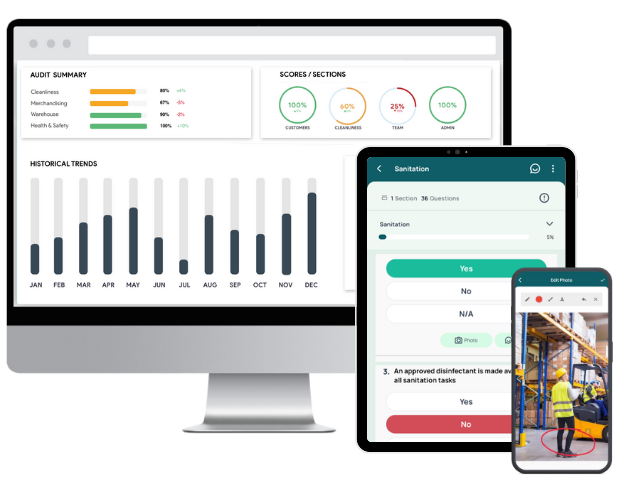
Main features & benefits of GoAudits:
- Access a library of ready-to-use inspection templates, customize them to standardize processes and meet site-specific requirements, or let the GoAudits team digitize your existing forms at no additional cost.
- Conduct audits anywhere, even without internet. Data syncs automatically once the device reconnects, ensuring inspections aren’t delayed by poor network conditions.
- EHS reports are automatically generated immediately after inspections, pre-filled with photos, timestamps, assigned actions, and audit scores.
- Assign corrective actions during inspections with priorities, deadlines, and responsible owners. Track completion status centrally and follow up on overdue actions without chasing updates manually.
- Use smart dashboards to view trends, recurring issues, audit scores, and performance comparisons across locations or teams.
Best for:
- Inspection-heavy safety programs
- Multi-site retail, food, hospitality, healthcare, logistics, and manufacturing
- Teams replacing paper or spreadsheets
- Organizations prioritizing frontline adoption
Why is GoAudits a Strong VelocityEHS Alternative?
VelocityEHS offers a broad compliance ecosystem. GoAudits focuses on execution and driving improvements.
The GoAudits safety inspection app is designed for rapid rollout, allowing teams to conduct mobile inspections, capture evidence on site, and generate reports immediately. For organizations where safety performance depends on frequent audits and consistent on-site execution, GoAudits often leads to faster adoption, quicker results, and stronger engagement from operational staff.

2. Cority
Cority is an enterprise-grade EHS and ESG platform designed for large, compliance-heavy organizations. It focuses on configurable modules covering safety, industrial hygiene, occupational health, and environmental reporting, making it suitable for companies that need deep regulatory tracking rather than quick inspection workflows.
Key features:
- Modular EHS suite covering safety, environmental, and occupational health
- Incident tracking with corrective action management
- Industrial hygiene exposure monitoring
- Advanced analytics dashboards and reporting tools
- Integration with ERP, HR, and compliance systems
Cority vs VelocityEHS
| Cority | VelocityEHS |
| Deep, enterprise-scale EHS platform covering safety, health, environment, and quality. Strong for global standardization, compliance reporting, and structured programs. | Focuses on usability and frontline adoption with mobile workflows, chemical management, and simple incident tracking. Faster to deploy and easier to run. |
| Choosing Cority may come with longer rollout, higher costs, and heavier admin needs. | Less specialized in occupational-health depth and advanced reporting. |
3. SafetyQuest by ComplianceQuest
SafetyQuest is a cloud-based safety and EHS solution built on Salesforce infrastructure. It targets enterprise organizations that want unified quality, safety, and compliance workflows in one platform, emphasizing automation and traceability across operations.
Key features:
- Salesforce-native architecture for scalability and integrations
- Risk assessment and hazard identification workflows
- Incident reporting with root-cause analysis tools
- Training and competency tracking
- Automated compliance documentation and audit trails
ComplianceQuest vs VelocityEHS
| ComplianceQuest | VelocityEHS |
| Built on Salesforce, offering a configurable QHSE ecosystem linking quality, safety, risk, and ESG. | Purpose-built for EHS execution with quick setup, mobile inspections, and streamlined compliance workflows. |
| Ideal for enterprises wanting deep customization and cross-functional integration. | Better for teams prioritizing fast operational value over platform extensibility. |
4. EHS Insight
EHS Insight is a mid-market EHS platform built to balance usability and functionality. It covers incident tracking, audits, compliance, and analytics while aiming to remain simpler to implement than large enterprise EHS suites.
Key features:
- Incident and near-miss reporting workflows
- Audit and inspection management tools
- Compliance calendar with regulatory tracking
- Document control and training management
- Built-in analytics and performance dashboards
How does it compare to VelocityEHS: EHS Insight is recognized for its faster implementation, more user-friendly and intuitive interface for frontline employees, and better mobile functionality, whereas VelocityEHS can be more complex.
5. Fluix
Fluix is a mobile-first workflow automation platform focused on digital forms, inspections, and field documentation. It’s widely used by construction, aviation, and energy teams needing offline data capture and fast document workflows rather than full EHS lifecycle management.
Key features:
- Offline-capable digital inspections and checklists
- Secure document distribution and approvals
- Field reporting with photo/video capture
- Workflow automation and task routing
- Integration with cloud storage and business systems
How does it compare to VelocityEHS: Fluix offers offline mobile access, no-code custom digital forms, fast deployment, and more intuitive field form handling compared to some users’ experience with VelocityEHS.
How to Choose the Best VelocityEHS Competitor App?
Selecting the right replacement for VelocityEHS starts with understanding how your team actually works, and not just which platform has the longest feature list. Focus on operational fit, usability in the field, and long-term ROI.
Clarify Your Primary Use Case
Start with the workflow that matters most. If inspections, audits, or frontline reporting drive your safety program, prioritize EHS software with strong mobile functionality and quick form execution. If your organization needs enterprise-wide risk management, incident reporting, and compliance documentation, look for software with deeper governance modules and analytics.
Weigh the Pros and Cons from Real Users
User feedback often reveals issues (adoption barriers, workflow friction, or reporting delays) that product demos don’t show. Compare platforms based on whether they address the common complaints users raise about complexity, support responsiveness, or configuration limits.
Compare Pricing and Total Cost of Ownership
Licensing costs alone don’t reflect the real investment. Factor in implementation time, onboarding support, training requirements, and ongoing admin workload. A platform that reduces manual reporting or increases frontline adoption may deliver a stronger ROI even if the subscription price is higher.
Evaluate Mobile App Field Performance
For inspection-heavy teams, the mobile experience determines success. Assess offline capability, data sync reliability, media capture tools, and the speed of completing audits on-site. If field teams struggle to use the EHS app, compliance data will suffer regardless of back-office features.
Customization vs Configuration
Determine how much control your internal team needs. Some platforms allow administrators to modify workflows, forms, and logic without vendor support, while others require professional services for even minor changes. Faster internal configuration typically leads to better long-term agility.
Implementation Speed and Vendor Support
A solution that takes months to deploy can delay safety improvements. Review onboarding timelines, training resources, and support SLAs. Vendors with structured rollout frameworks and responsive technical support reduce risk during transition.
Regulatory and Industry Fit
Consider whether it supports your industry and compliance standards, audit frameworks, and geographic regulations. Tools designed for highly regulated sectors often include prebuilt templates and compliance tracking that shorten setup time.
Validate Through Free Trials and Demos
Before committing, run a controlled pilot with real users. Measure completion time for inspections, reporting accuracy, and user satisfaction. Hands-on testing is the most reliable way to confirm whether a platform improves efficiency or simply shifts complexity elsewhere.
Final Verdict: Which VelocityEHS Competitor is Right for You?
There’s no single replacement that fits every safety program. The best VelocityEHS alternative depends on whether your priority is field execution, balanced EHS governance, or enterprise-level compliance depth.
| Priority & use case | Best VelocityEHS alternative | Why they fit |
| Fast mobile inspections and offline data capture | GoAudits, Fluix | Field execution, strong offline capability, quick checklist completion, and faster reporting cycles for frontline teams. |
| Balanced EHS management with mobile support | ComplianceQuest, EHS Insight | Combine governance tools with usable mobile workflows. Suitable for both compliance oversight and practical field reporting. |
| Enterprise safety compliance and broad EHS scope | Cority | Strong for multi-site enterprises requiring occupational health, environmental tracking, analytics, and centralized compliance management. |
FAQs
VelocityEHS is typically designed for mid-to-large organizations with complex compliance requirements. Smaller teams may find it expensive and resource-intensive to implement, especially if they only need inspections, audits, or basic safety workflows rather than a full enterprise EHS platform.
VelocityEHS pricing is usually module-based and scales with users, which can raise long-term costs. In contrast, simpler tools like GoAudits offer predictable pricing, a 14-day free trial, and plans starting at about $10 per user/month when billed annually.
For inspection-heavy teams, GoAudits is often the strongest choice due to its offline audits, fast reporting, and simple adoption in the field. It’s built specifically for on-site workflows, unlike broader EHS suites that prioritize compliance management over frontline usability.
Compared with legacy on-premise EHS systems, VelocityEHS offers cloud deployment, broader integrations, and improved automation. However, it can still feel complex and compliance-centric, whereas modern mobile-first tools focus more on usability, faster data capture, and real-time visibility for operational safety teams.
Yes. VelocityEHS provides mobile apps that support inspections, incident reporting, and safety data access. VelocityEHS allows users to capture observations, photos, and corrective actions in the field and sync data once connectivity is available.
Fully free enterprise EHS platforms are rare, but GoAudits is a practical option. Its free trial and low entry pricing make it accessible for SMEs that need inspections, checklists, and compliance tracking without committing to a large-scale EHS implementation.


