Many organizations adopt Cority for its broad environmental, health, and safety capabilities, but over time, some teams find the platform heavier to manage than expected. Common concerns include complex navigation, long implementation cycles, consultant-driven configuration, and rising total costs as needs evolve. As a result, companies increasingly explore Cority alternatives that prioritize faster deployment, stronger mobile usability, clearer workflows, and predictable pricing, especially when inspections, audits, and operational compliance matter more than enterprise-level system depth.
In this article, we have listed the top Cority competitors. You can compare their features and pricing and choose the best one that fits your needs.
Cority Reviews: Why Companies are Looking for Alternatives
Across major review platforms, including Capterra, G2, and Software Advice, Cority is widely viewed as a powerful enterprise system, but not always a practical fit for teams that need speed, flexibility, or predictable costs.
Several recurring issues explain why organizations evaluate alternatives.
Core Usability Issues
Many users report that the platform feels heavy in daily use. The interface can appear fragmented, with multiple modules behaving differently and requiring separate navigation logic. Some users also mention that workflows require too many clicks and screens to complete routine tasks, which discourages adoption outside the core EHS team.
Implementation and Vendor Issues
Deployment is frequently described as complex and consultant-driven. Implementation often involves structured timelines, configuration dependencies, and external consulting hours. This makes projects harder to control internally. Users also report changing account managers or support contacts during the lifecycle, which can affect continuity.
Functional Limitations
Some operational workflows feel constrained. Users report that certain modules are rigid when adapting processes to site-level realities, particularly for investigations, inspections, or corrective actions. Template outputs and report formats may also require additional customization effort to meet operational reporting needs.
Cost Concerns
Beyond licensing, users highlight the ongoing need for consulting services, configuration support, or change requests. This can make budgeting unpredictable and increase dependency on external resources to maintain or expand the system, especially for mid-size organizations.
Top 5 Cority Competitors & Alternatives
| Apps like Cority | Best for | Pricing | Free trial & demo |
| Cority | Comprehensive, highly configurable, and integrated EHSQ management platform for high-risk industries, complex audits & compliance requirements | Pricing not publicly available | Only demo |
| GoAudits | Fast checklist digitization support, strong offline capabilities for field teams, minimal training, customizable reports, task ownership, visual evidence, multiple-industry support | $10 per user per month; billed annually | 14-day free trial and personalized demo |
| EHS Insight | Transparent pricing tiers, modular deployment, strong OSHA alignment, scalable for growing teams | Variable, depending on the number of modules you choose and the number of workers, contractors, etc., in your organization | Free trial and demo |
| VelocityEHS | Ergonomics capabilities, built-in chemical safety database, ESG reporting, predictive safety insights | Not available | Only demo |
| Xenia | Fast deployment, strong frontline usability, workflow automation without heavy configuration | Per-user and per-site pricing models available | Free trial and demo |
| Intelex | Enterprise governance controls, deep analytics capabilities, global scalability, mature compliance framework | $49 per user per month; billed annually (a minimum of 25 users) | Free trial and demo |
1. GoAudits
GoAudits is a mobile-first inspection and auditing platform. It’s built to help teams capture accurate site data, generate reports instantly, and close compliance gaps faster. Instead of functioning as a heavy enterprise EHS platform, it focuses on making audits easier to perform, easier to review, and easier to act on. GoAudits safety inspection software is designed for organizations that want consistent standards across locations while reducing paperwork, reporting delays, and manual follow-ups.
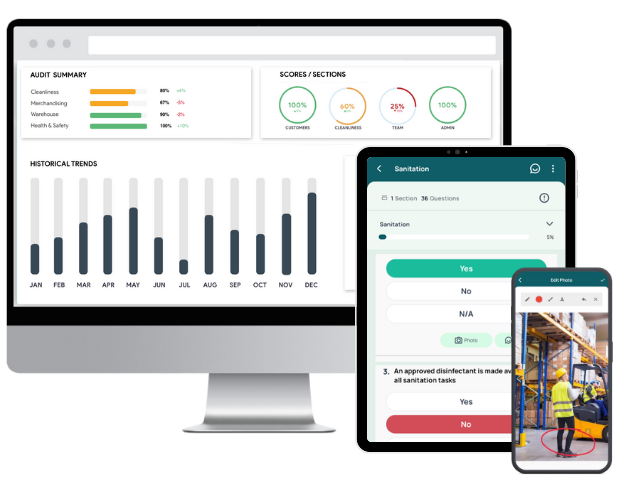
Main features & benefits of Goaudits:
- Access workplace inspection checklists, customize them to meet OSHA, ISO, and other requirements, or have existing forms digitized at no additional cost.
- Conduct audits anywhere, even offline, and data syncs automatically once online.
- Capture visual evidence, including photos, timestamps, and geolocation, for accountability and transparency.
- Automatically generate branded inspection reports instantly after completion, with scoring, visuals, and audit details.
- Assign tasks during inspections, set deadlines, and monitor completion centrally.
- Configure notifications, approvals, escalations, and report distribution to ensure the right stakeholders are involved.
- View audit performance, scores, trends, recurring issues, and action status across teams or locations in real time.
Best suited for: Distributed operations, such as retail chains, hospitality groups, construction firms, and facilities teams, that need fast field data capture, consistent reporting, and clear accountability without heavy enterprise implementation
How GoAudits Compares with Cority EHS software
Cority is a broad enterprise EHS platform covering compliance, health, safety, and environmental risk management at scale. GoAudits, in contrast, is more lightweight and inspection-centric. It’s faster to deploy, easier for frontline teams, and better suited for organizations prioritizing operational audits rather than full-scale EHS program management.

2. EHS Insight
EHS Insight is a configurable EHS management platform built to support compliance, reporting, and safety performance tracking. It balances structured workflows with customization, making it suitable for mid-market organizations needing regulatory coverage without enterprise-level implementation complexity.
Key features:
- Incident management with investigation workflows
- Compliance tracking aligned with OSHA and ISO standards
- Training and certification management modules
- Audit management with automated follow-ups
- Built-in analytics and safety performance dashboards
How it compares to the Cority app
EHS Insight is typically simpler and more affordable, whereas Cority offers deeper enterprise integrations and global regulatory support. Many mid-sized companies choose EHS Insight for quicker rollout.
3. VelocityEHS
VelocityEHS is a cloud-based EHS and ESG platform focused on simplifying safety programs, ergonomics, and environmental management. It combines traditional compliance tools with modern analytics and risk-prevention capabilities. It’s suitable for organizations prioritizing proactive safety strategies.
Key features:
- Ergonomics and industrial hygiene assessment tools
- Environmental compliance and chemical management
- Risk assessment and hazard tracking workflows
- ESG and sustainability reporting modules
- Mobile access for audits and inspections
How it compares to Cority EHS software
VelocityEHS differentiates through ergonomics, chemical safety, and ESG analytics, whereas Cority tends to be stronger in occupational health and enterprise compliance breadth.
4. Xenia
Xenia is a frontline operations and compliance platform designed to help distributed teams manage inspections, corrective actions, audits, and daily workflows in one place. It emphasizes execution on the ground rather than just reporting, making it particularly useful for SMBs and multi-site operations that need real-time visibility into compliance and performance.
Key features:
- Mobile-first inspections, checklists, and audits
- Automated corrective action tracking with accountability
- Task scheduling tied to locations, assets, or teams
- Digital logs for safety, maintenance, and operations
- Real-time dashboards for site-level performance tracking
How it compares to the Cority mobile app
Cority is broader and enterprise-oriented, while Xenia focuses on execution and usability at the site level. Xenia often suits SMBs needing faster adoption and lower complexity.
5. Intelex
Intelex is an enterprise-grade EHSQ platform combining safety, quality, and environmental management into a unified system. Its strength lies in configurability and structured data management, making it well-suited for large organizations with complex compliance and reporting requirements.
Key features:
- Integrated EHSQ platform with cross-module data linking
- Advanced reporting and business intelligence tools
- Workflow automation for investigations and approvals
- Document control for quality and compliance records
- Cloud-based deployment with configurable modules
How it compares to Cority EHS software
Both target enterprise customers, but Intelex often appeals to organizations prioritizing configurability and analytics depth, while Cority is known for its extensive regulatory and health management modules.
How to Choose the Best Cority Alternative?
Choosing a Cority alternative should start with the operational problems you’re actually trying to solve. Many EHS software look similar on paper, but they differ significantly in usability, deployment risk, and long-term cost. Use the framework below to avoid repeating the same issues that push companies away from Cority in the first place.
Start with Your Real Problems
Before evaluating software, map the friction in your current workflows:
- Are audits slow to complete or difficult to standardize?
- Are corrective actions getting lost or delayed?
- Are reports manual, inconsistent, or hard to trust?
A platform that directly addresses these operational bottlenecks will deliver far more value than one with dozens of unused modules.
Prioritize Usability Over Feature Depth
Complex systems often fail because teams avoid using them. Field adoption matters more than theoretical capability.
Look for platforms where:
- Navigation is intuitive for frontline users
- Data entry is fast on mobile devices
- Training requirements are minimal
- EHS reports can be generated automatically without specialist help
If employees hesitate to log incidents or inspections, the software becomes a reporting burden rather than a safety tool.
Evaluate Implementation Risk Early
Many enterprise EHS deployments stall because they require heavy configuration, consulting hours, or workflow redesign. To reduce risk, prefer EHS apps with strong functionality, ask how long typical deployments actually take, and check how much vendor involvement is required after launch
Organizations that plan implementation carefully, including training, migration, and testing, experience smoother adoption and faster ROI.
Assess Total Cost of Ownership, Not Just the License Price
The subscription fee rarely reflects the true cost of EHS software. Include:
- Set up and configuration services
- Training time for staff
- Ongoing admin workload
- Future customization costs
A platform with a higher upfront price but lower maintenance effort can be significantly cheaper over time.
Check Scalability and Integrations
Your alternative should support future growth, not just current compliance needs. Evaluate whether the system integrates with HR, ERP, or BI tools, supports multiple sites or business units, and allows adding modules without rebuilding workflows.
Involve the Right Stakeholders Before Choosing
Software decisions made in isolation often fail during rollout. Bring in EHS leadership for compliance requirements, operations teams for daily usability, and IT for security, integration, and data governance.
Early stakeholder involvement improves adoption and reduces resistance during implementation.
Final Verdict: Which Cority Alternative is Right for You?
There’s no single ‘best’ alternative to Cority, only the best fit for your organization’s size, maturity, and operational priorities.
| Use Case & Priority | Best Alternative | Why It Fits |
| Cost-effective solution for fast inspections and frontline adoption by small teams | GoAudits | Ideal for teams that need inspections to run quickly without a heavy setup. Mobile-first workflows, instant reports, and simple checklists make it practical for operations staff. |
| Best balanced alternative for SMBs and mid-market teams | EHS Insight | Compliance, audits, incidents, and training without enterprise-level complexity for organizations moving beyond spreadsheets but not ready for large-scale EHS suites. |
| Best for large organizations needing predictive safety insights | VelocityEHS | For enterprises that want analytics-driven safety programs, centralized compliance oversight, and scalable audit management across multiple sites and regulatory frameworks. |
| Best for operations-driven companies with distributed teams | Xenia | Suits organizations with field teams, facilities, or multi-location workflows. Focuses on execution, task visibility, and operational compliance rather than regulatory reporting. |
| Best for complex, regulated industries | Intelex | Built for highly regulated sectors where audit trails, compliance frameworks, and configurable workflows matter more than simplicity, with capabilities expanding gradually. |
FAQs
The best Cority alternatives depend on your organization’s size and compliance needs. Platforms like GoAudits, EHS Insight, VelocityEHS, Intelex, or Xenia all offer EHS management capabilities with different strengths. Small to medium-sized organizations typically look for faster deployment, strong mobile usability, and simpler inspection workflows, where GoAudits stands out as a strong option.
If usability is the main concern, GoAudits, Xenia, or EHS Insight are strong alternatives to Cority. They are often perceived as more intuitive, especially for frontline employees completing audits, inspections, or corrective actions. These platforms tend to emphasize mobile access and streamlined workflows over heavy enterprise customization.
For organizations where inspections drive compliance performance, inspection-first platforms may be more practical than full-suite EHS systems. GoAudits and Xenia are strong for structured checklists, photo evidence capture, corrective action tracking, and instant reporting. Enterprise platforms like Intelex and VelocityEHS also support audits, but they are typically embedded within broader compliance frameworks.
Many SMBs struggle with the cost and rollout effort of enterprise EHS suites. GoAudits fits smaller teams well because it’s faster to implement, easier for frontline staff to adopt, and focused on the operational workflows most mid-market companies actually need.
Cority pricing is not publicly listed and typically involves enterprise-level implementation. More affordable alternatives include GoAudits, which offers per-user pricing (from $10 per user per month) with fast deployment and no additional overhead, as well as EHS Insight, which provides modular pricing based on company size and needs.
GoAudits offers structured reporting with timestamps, images, and automated summaries, which improves visibility into issues and trends. While enterprise platforms provide broader EHS coverage, GoAudits often wins where clear, actionable inspection data and fast reporting matter most
GoAudits supports transparent audit trails through signatures, timestamps, photos, and task tracking. For companies needing clear evidence and traceability rather than deep regulatory modules, this approach can be more practical than traditional enterprise EHS documentation workflows.
Corrective actions in GoAudits are tightly linked to findings, owners, deadlines, and follow-ups. This makes accountability clearer and prevents issues from getting lost after inspections, something many teams struggle with in complex EHS platforms.
Yes. GoAudits is particularly suited to distributed teams. It supports standardized checklists, centralized dashboards, and mobile inspections across locations, helping smaller multi-site organizations maintain consistent compliance without deploying a heavy enterprise system.