- Library
- IT & Data Center
- Cyber Incident Response Checklist
Cyber Incident Response Checklist
71 questions in 15 sectionsInteractive preview: try the answers
Section 1 of 15 · 7 questionsIdentify Key Contact Information
Have you identified key contact information for incident management?
Have you designated an incident response handler within your organization?
Have you appointed a third-party incident response provider?
Do you have contact information for product/service vendors?
Are you aware of the relevant regulatory bodies to contact?
Have you established contacts with law enforcement agencies?
Have you identified key contacts for clients and others?
Section 2 of 15 · 5 questionsIdentify Investigation Resources
Have you created a list of key assets and data and documented where they are located or hosted?
Do you have network diagrams for investigation purposes?
Have you established a baseline for your IT systems’ activities?
Do you have documentation for IT systems and software versions?
Are there backups of important data available for investigation?
Section 3 of 15 · 4 questionsDevelop Relevant Plans
Do you have prevention and detection plans in place?
Have you developed containment, eradication, and recovery plans?
Is there a crisis management and communications plan prepared?
Do you have a business continuity plan?
Section 4 of 15 · 7 questionsPreventing Incidents
Have you identified and understood the types of attacks that could affect your organization?
Do you have action plans to deal with malware attacks?
Are you prepared for phishing attacks?
Do you have plans for distributed denial of service (DDoS) attacks?
Are you ready to handle ransomware incidents?
Do you have procedures in place for a data breach?
Have you planned for data corruption incidents?
Section 5 of 15 · 5 questionsCommunicating And Exercising The Plans
Are action plans for responding to common incidents accessible and updated regularly?
Are you communicating with employees and key stakeholders about updates to the plans?
Have you implemented user awareness and training programs?
Are you regularly reviewing and updating plans (e.g., during system onboarding, new hires, or at scheduled intervals)?
Do you conduct walk-throughs or exercises of your plans?
Section 6 of 15 · 7 questionsDetection And Analysis
Are you prepared to recognize possible attack vectors?
Do you have systems in place to detect poorly designed web applications?
Are misconfigured systems a recognized attack vector in your organization?
Do you address potential risks from internet downloads?
Are you ensuring good cyber hygiene practices to prevent attacks (e.g., strong passwords, up-to-date software)?
Are human lapses being accounted for in your security preparedness?
Are authorized third parties monitored for security threats?
Section 7 of 15 · 4 questionsReviewing Possible Sources Of Precursors And Indicators
Are you reviewing security software such as Intrusion Detection Systems (IDS), Security Information and Events Management Systems (SIEM), and anti-virus software?
Are you examining logs from operating systems, services, applications, and network devices for potential threats?
Are you reviewing publicly available information and vendor vulnerability notifications?
Are you involving internal staff in identifying potential threats and precursors?
Section 8 of 15 · 4 questionsMaking An Initial Assessment And Prioritizing The Next Steps
Are you correlating events against your baseline to determine if an incident has occurred?
Are you checking incidents against known threat precursors and indicators?
Have you made an initial assessment of the scope and nature of the incident?
Are you prioritizing incident handling activities, including whether to activate crisis management and communications plans?
Section 9 of 15 · 5 questionsGathering Evidence
Are you documenting the summary of the incident for evidence purposes?
Have you gathered incident indicators and system events?
Are you recording actions taken during the incident?
Are you collecting logs of affected systems and forensic copies for further analysis?
Have you identified other forms of evidence that need to be documented?
Section 10 of 15 · 3 questionsKnowing Your Stakeholders And/or Fiduciary Obligations
Have you notified relevant stakeholders and affected parties, including the Board of Directors?
Are you communicating with regulators, law enforcement, and other government agencies?
Have you informed clients and the media about the incident?
Section 11 of 15 · 5 questionsDeveloping A Containment Strategy
Have you developed strategies to isolate compromised network parts by disconnecting affected systems?
Do you have plans in place to re-route or filter network traffic?
Are you using firewall filtering to block unauthorized access?
Have you closed vulnerable ports and mail servers to prevent further access?
Are you taking steps to block additional unauthorized access?
Section 12 of 15 · 4 questionsEradicating The Threat
Are you prepared to wipe out malware after containing the incident?
Have you disabled any breached user accounts?
Are you patching vulnerabilities that were exploited across all affected hosts?
Are there additional eradication steps that need to be taken?
Section 13 of 15 · 5 questionsTaking Steps Toward Recovery
Are you restoring systems from backups after an incident?
Are you rebuilding affected systems from scratch when necessary?
Have you changed both administrator and user passwords as part of the recovery process?
Are you tightening network perimeter security to prevent future incidents?
Have you confirmed the integrity of business systems and controls after recovery?
Section 14 of 15 · 2 questionsMonitoring And Maintaining Vigilance
Are you continuing to monitor the network for anomalous activity or signs of intrusion?
Are you considering higher levels of system logging or network monitoring, depending on the incident?
Section 15 of 15 · 4 questionsPost-Incident Review
Are you conducting a post-incident review to identify and resolve deficiencies in systems and processes?
Have you identified deficiencies in the planning and execution of your incident response plan?
Are you assessing whether additional security measures are necessary to strengthen your security posture?
Are you communicating lessons learned and building on them for future preparedness?
Checklist by GoAudits. This checklist is an example: we do not guarantee compliance with the laws applicable to your territory or industry. Seek professional advice to adapt it to your workplace or jurisdiction.
Free PDF
Download the Cyber Incident Response Checklist
By downloading this checklist you agree to the GoAudits privacy policy and terms of service.
NEW! Try generating a custom checklist with our free AI tool:
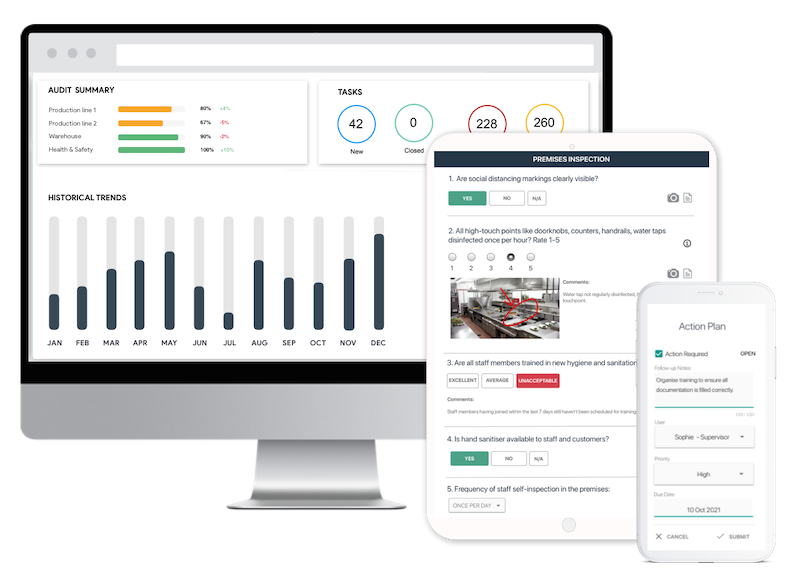
Easy inspection app for your digital checklists
- Conduct inspections anytime, anywhere - even offline
- Capture photos as proof of compliance or areas needing attention
- Instantly generate and share detailed reports after the inspections
- Assign & track follow-up tasks, view historical trends on a centralized dashboard