- Library
- IT & Data Center
- ADA Website Compliance Checklist
ADA Website Compliance Checklist
63 questions in 11 sectionsInteractive preview: try the answers
Section 1 of 11 · 5 questionsOperable
Is all functionality available from a keyboard?
Is enough time given for users to read and use the content?
Is content avoided that causes seizures or physical reactions?
Is navigation and content finding made easier for users?
Is it made easier to use inputs other than the keyboard (e.g., screen reader)?
Section 2 of 11 · 4 questionsPerceivable
Are text alternatives provided for non-text content?
Are captions and other alternatives provided for multimedia?
Is content created in a way that it can be presented in different ways, including by assistive technologies, without losing meaning?
Is content designed to make it easier for users to see and hear content?
Section 3 of 11 · 3 questionsRobust
Is HTML validated to maximize compatibility with current and future user tools by writing clean code?
Do all elements have appropriate labels?
Do status messages sent to the user not interrupt their workflow by giving focus to an element?
Section 4 of 11 · 3 questionsUnderstandable
Is text made readable and understandable?
Does content appear and operate in predictable ways?
Are users helped to avoid and correct mistakes?
Section 5 of 11 · 8 questionsAccessibility Statement
Does the accessibility statement include a commitment to accessibility for people with disabilities?
Does it specify the accessibility standard applied, such as WCAG 2.1?
Is contact information provided in case users encounter problems?
Are any known limitations mentioned to avoid frustrating users?
Are measures taken by the organization to ensure accessibility described?
Are technical prerequisites, such as supported web browsers, listed?
Are environments in which the content has been tested to work mentioned?
Are references to applicable national or local laws and policies included?
Section 6 of 11 · 6 questionsContent Alternatives
re there no images of text on the site; all text is coded as text (excluding logos, graph labels, etc.).
Do all meaningful images have alt text, while decorative images do not need alt text?
Is table data easy to understand if read aloud?
Do any tables that are too complex to be read aloud have a manageable alternative and/or text caption that accurately describes the data?
Do all videos with meaningful audio contain closed captioning that is synced to the video?
Are all audio files and videos accompanied by an accurate text transcript that conveys the meaning of the audio or video and is available directly below the file?
Section 7 of 11 · 4 questionsSite Appearance Standards
Is the site layout and navigation consistent? While the logical variance is acceptable (e.g., sub-pages may differ from top-level pages), are they consistent across page types (e.g., all sales pages should have similar layouts)?
Can text be zoomed in up to 200% of the original size without negatively impacting readability?
Are text links within the body of the text distinctive from the surrounding text, using at least two of the following: color, underline, bold, and italics?
Does all text on the site have a contrast ratio of at least 4.5:1 against the background?
Section 8 of 11 · 10 questionsSite Development And Functionality
Is the site free from HTML errors, broken links, and error pages?
Do all form fields have clear labels that exist outside of the form element?
Do all form fields have clear instructions on input formats and what is expected?
Do all form fields have instructions on how to fix errors?
Do identical images and elements throughout the site also have identical labels and alt tags?
Does each page use a hierarchy of headings, starting with the
tag and proceeding to the
,
, and so on to
if needed?
Do page titles use clear, descriptive text?
Do headings use clear, descriptive text?
Do links use clear, descriptive text that indicates the content that follows?
Is the meaning of website text not conveyed only with color, with additional cues used if color is the primary conveyance?
Section 9 of 11 · 6 questionsUsability Standards
Are all links and fields on the website equipped with a way to indicate when a user's keyboard, mouse, or other input devices are focused on them?
Can all website content and functions be accessed with only a keyboard, using the tab and arrow keys to navigate?
Is there a sitemap accessible from the homepage (at minimum)?
Is there search functionality accessible from the homepage (at minimum)?
Is there a link available in the top left of every page allowing users to skip the main navigation of the page?
Is a default language set for the website?
Section 10 of 11 · 10 questionsUser Control Standards
Does the site avoid using automatic pop-ups, including discounts, newsletter sign-ups, etc.?
Is content that automatically refreshes able to be paused (rotating ads are an exception)?
When submitting important information, like financial data, SSN, reservation dates, etc., is the user allowed to review and correct the information before the final submission of the data?
Do audio and video not auto-play, with these types of media only playing upon initiation from the user?
Does the site avoid changing unexpectedly or without warning?
Are timed elements such as pop-ups requiring input or scrolling text (excluding necessary limits like auctions) present on the website?
Are they user-adjustable and extendable?
Can they be extended up to 8 times the default limit before the timer begins?
Is a warning provided before the expiration?
Is there an alternative way to authenticate that does not require a cognitive test (e.g., 2-factor authentication) if there is a cognitive test to prove you are human (e.g., Captcha)?
Section 11 of 11 · 4 questionsWeb Documents
Do all linked documents not in HTML formats, such as PDFs, presentations, spreadsheets, and Word documents, meet their type's basic accessibility requirements?
Are PDFs machine-readable, excluding scanned or password-protected documents?
Are PDFs tagged in the valid reading order for accessibility?
Do electronic publications have page numbers, and do those numbers match the printed version?
Checklist by GoAudits. This checklist is an example: we do not guarantee compliance with the laws applicable to your territory or industry. Seek professional advice to adapt it to your workplace or jurisdiction.
Free PDF
Download the ADA Website Compliance Checklist
By downloading this checklist you agree to the GoAudits privacy policy and terms of service.
NEW! Try generating a custom checklist with our free AI tool:
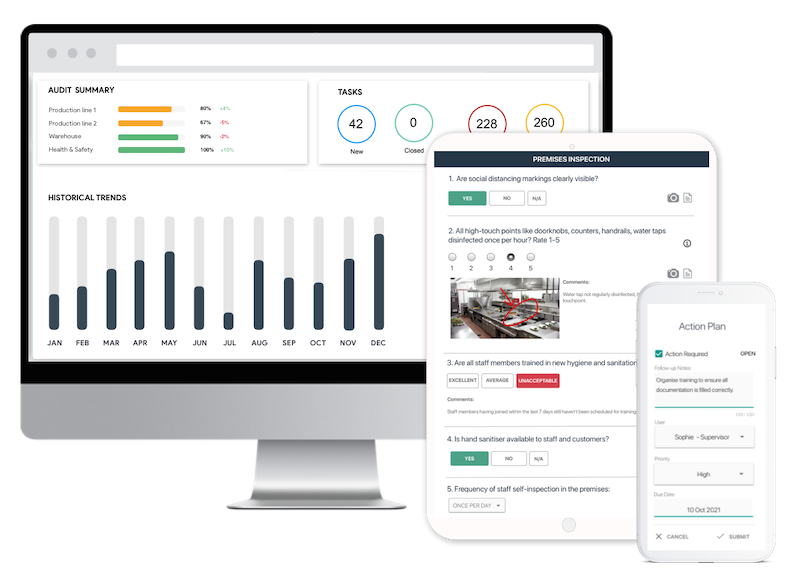
Easy inspection app for your digital checklists
- Conduct inspections anytime, anywhere - even offline
- Capture photos as proof of compliance or areas needing attention
- Instantly generate and share detailed reports after the inspections
- Assign & track follow-up tasks, view historical trends on a centralized dashboard