CQC publishes no list of audits a care home must run. Regulation 17 of the Health and Social Care Act 2008 (Regulated Activities) Regulations 2014 requires systems and processes, including regular audits baselined against Regulations 4 to 20A.
A few premises and equipment checks carry a frequency fixed in law. A care provider sets every other frequency itself, and must be able to justify it.
- Which Care Home Checks Have a Frequency Fixed in Law?
- Which Audits Does a Care Provider Decide for Itself?
- Who Should Carry Out Each Audit in a Residential or Nursing Home?
- What is the Difference Between a Care Home Audit, a Spot Check and a CQC Inspection?
- What Should Happen When a Care Home Audit Finds a Problem?
- Will CQC Hold It Against a Home if Its Own Audits Find Problems?
- How Does GoAudits Help Care Homes Run Their Audits?
Which Care Home Checks Have a Frequency Fixed in Law?
Only a short list of premises and equipment checks in a care home carries a frequency written into law.
- Hoists, slings and other equipment used to lift residents need a thorough examination at least every six months, or at the intervals set by a written examination scheme, under the Lifting Operations and Lifting Equipment Regulations 1998. Both the examination and the scheme are the work of a competent person.
- Gas appliances and pipework serving residents’ accommodation, such as the central heating boiler, need a safety check at least every 12 months by a Gas Safe registered engineer, under Regulation 36 of the Gas Safety (Installation and Use) Regulations 1998. Appliances used only in non-residential areas, such as a commercial kitchen, fall under Regulation 35, which requires safe maintenance but sets no interval.
- Fire and legionella risk assessments must be kept current, but each assessment sets its own review date, as the Health and Safety Executive’s code of practice sets out.
Statutory premises and equipment duties apply UK-wide. CQC’s audit expectations apply in England; Scotland, Wales and Northern Ireland answer to the Care Inspectorate, CIW and the RQIA.
Which Audits Does a Care Provider Decide for Itself?
A care provider sets the frequency of every audit outside the checks fixed in law, because Regulation 17 tests the system rather than a list.
CQC’s guidance says providers must have systems and processes such as regular audits, baselined against Regulations 4 to 20A. An assessor asks whether the programme covers the regulations that apply to your service, and whether the programme changes anything. Running care plan audits monthly is your decision to make and your decision to defend.
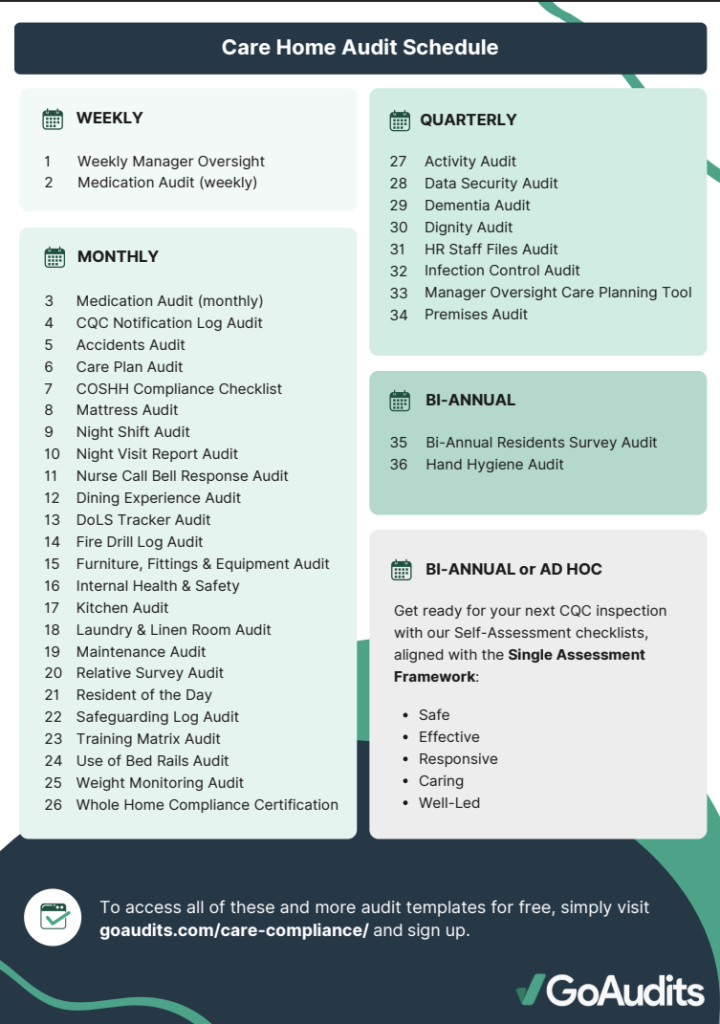
The care home audit schedule below is an example developed by GoAudits with care compliance specialists at Care Quality Solutions. It is not a CQC-prescribed timetable.
| Audit | Typical frequency | Usually run by |
| Manager oversight and governance | Weekly | Registered manager |
| Medication and MAR charts | Weekly and monthly | Nurse or senior carer |
| Care plans | Monthly | Deputy manager |
| Accidents, incidents and safeguarding log | Monthly | Registered manager |
| Night shift | Monthly | Registered or deputy manager |
| Kitchen and dining experience | Monthly | Chef with a manager |
| Mattresses, bed rails and equipment | Monthly | Maintenance lead |
| Infection prevention and control | Quarterly | IPC lead |
| HR and staff files | Quarterly | Registered manager |
The full 36-audit schedule is attached as a PDF, with free care home audit checklist templates and a care home compliance toolkit that runs it in the app. See also our guide to CQC compliance.
Who Should Carry Out Each Audit in a Residential or Nursing Home?
Each audit is best carried out by someone who knows the area well but is not answerable for its results. Where that is impractical in a small home, a manager signing off the result or sampling the same records gives the scrutiny Regulation 17 asks for.
Care providers tell us the common failure is handing audits to staff who have never been shown what an audit is for, with nobody reviewing what comes back. With GoAudits care home audit software, every completed audit generates a timestamped report that goes straight to named recipients, so a registered manager sees what each auditor actually recorded rather than finding out at the next governance meeting.

Can a Care Home Manager Audit Their Own Area?
A manager auditing their own area produces a weaker record than the same audit run by somebody else, because the person judging the standard is the person accountable for that area. If the deputy runs care plan audits, the registered manager should sample the same records.
What is the Difference Between a Care Home Audit, a Spot Check and a CQC Inspection?
A care home audit is a scheduled, scored review of one area against a set standard. Recording the score lets a manager compare each audit with the previous one.
A spot check is a short, usually unannounced look at one thing, such as whether a medication trolley is locked. Spot checks catch practice as it happens and carry no score. Many care homes use a spot check form for care workers alongside the audit cycle.
A CQC inspection is an external assessment by the regulator. A care home’s own audits are the evidence it brings to a CQC inspection.
What Should Happen When a Care Home Audit Finds a Problem?
Every finding should become a named action with an owner and a due date before the auditor leaves the area. Care providers describe ending up with a separate action plan for every audit, and no single view of what is still outstanding. A care home needs one action list for the whole home, with one named owner per action.
How Does a Care Home Show CQC That the Action Worked?
A closed action needs evidence that practice changed, not only a completion date. Re-audit the failed item at the next cycle and record the new score beside the original finding.
Will CQC Hold It Against a Home if Its Own Audits Find Problems?
A care home that finds and fixes its own problems is showing the governance CQC asks for. Regulation 17 asks providers to identify where quality or safety are compromised and respond without delay. An audit file full of findings and closed actions shows that the system is working.
Two patterns in a care home audit file read badly.
- A finding that reappears cycle after cycle shows the audit running but the response failing.
- An audit record showing full compliance while complaints and incidents say otherwise means the audit is not looking hard enough.
How Does GoAudits Help Care Homes Run Their Audits?
GoAudits turns a care home audit schedule into checklists staff complete on a phone, with every finding becoming an action that has an owner and a due date. The report is ready the moment the audit is signed off, so a registered manager can see what was found and what is still open without chasing anyone.
Careville, a nursing and care provider in Bedfordshire, moved its care plan, MAR, health and safety, and pre-CQC audits into GoAudits, cutting each report production from half a day to 10 minutes.
Start with the regulations that apply to your service, set the audit frequencies yourself, and keep a clear record of why you chose them.