- Library
- Health & Safety
- Supplier Quality Audit
Supplier Quality Audit
84 questions in 16 sectionsInteractive preview: try the answers
Section 1 of 16 · 4 questionsQuality Management
Are quality-performance objectives clearly established and included in the business plan?
Is the quality system reported, controlled and advanced to precisely describe current practices?
Are quality reports, trend charts and data analysis regularly used by management to identify and distinguish areas of opportunity?
Does executive management engage in periodic quality system reports addressing quality-connected feedback from clients and internal quality metrics?
Section 2 of 16 · 4 questionsContinuous Improvement
Are defensive actions taken based on the analysis of business trends, design studies, customer gratification surveys or other data and inputs?
Is there a written approach in place to actively track cost containment and other continuous development activities throughout the company?
Is there a corrective action system that uses root cause analysis and takes timely and adequate action to stop recurrence?
Does the corrective action system cover consumer, internal and supplier issues?
Section 3 of 16 · 3 questionsEducation & Training
Are the professional and educational levels needed for each job documented and appropriate training implemented?
Is employee skill/certification taken into account where the quality outcome of the method is strongly dependent upon operator ability?
Are suitable processes used to verify training effectiveness?
Section 4 of 16 · 4 questionsOccupational Health & Safety
Does the health and safety management system discuss the safety of employees without involving the achievement of product quality demands?
Does the health and safety policy state the company’s health and safety goals and management's dedication to the continuous development of H&S metrics?
Does the health and safety management system approach the demand for emergency planning?
Are methods used for the on-going identification of dangers, risk assessment and the implementation of required control measures?
Section 5 of 16 · 5 questionsDesign & Development Support
Are human and technological resources sufficient to meet the demands for design collaboration, tooling design, and electronic illustration and data exchange?
Are Critical-to-Quality (CTQ) features identified, registered and the records retained?
Are product specifications and drawings generated, regulated and sustained for new or changed product designs?
Is design confirmation an integral component of the design process and is it completed prior to the product release?
Are customer requirements included in product designs and/or production processes?
Section 6 of 16 · 6 questionsQuality Planning
Is product fidelity test data accessible upon request?
Does the historical test performance data reveal a highly stable process and product plan?
Are customer production demands and quality specifications reviewed to guarantee they can be met on a regular basis?
Are reliability test plans established and routinely followed?
Is testing used to support the design specifications, drive design developments and present an ongoing check of materials and workmanship?
Are production examples examined and granted to customers upon request?
Section 7 of 16 · 5 questionsCustomer Documentation
Does customer advice/approval lead to changes to control plans, production site, product transfers, raw material or product obsolescence?
Are new and improved customer specifications reviewed and performed in a timely manner?
Are current process control documents in place and worked with for production start-up and proceeding production?
Are quality records maintained?
Is there a record control scheme for the protection, identification, storage, retrieval, retention time, and disposition of quality records?
Section 8 of 16 · 5 questionsProcurement
Are preventive actions used to continuously develop and improve the performance of the supplier base?
Is buying from unapproved suppliers limited by choosing suppliers from a properly managed and available approved supplier list?
Is there a formal method used for the selection, modification and qualification of suppliers?
Does the supplier assurance system guarantee that all purchased product or material conforms to established specifications and applicable regulatory or customer demands?
Is there a system for the identification, verification and protection of products provided by customers that includes informing the customer if the product is destroyed or lost?
Section 9 of 16 · 3 questionsIncoming Material
Is all material that is examined effectively identified (acceptance or dismissal) and is it traceable to get an inspection report?
Is inventory received as per documented systems?
Do suppliers improve quality based on root cause studies?
Section 10 of 16 · 6 questionsManufacturing Quality
Is there a confirmed plan used to qualify new or rebuilt production tools prior to production use?
Is the investigation and process status of the product identified and sustained throughout the manufacturing process?
Are control plans used to organise and deploy inspection and test functions during the production process?
Are proper inspections, tests and process adjustments made to establish conformance at key points throughout the manufacturing process and prior to shipment?
Are relevant work instructions available where required to accurately describe all work processes including inspections and tests to be done throughout the production?
Are customers informed of low yield production lots or issues that affect product reliability?
Section 11 of 16 · 6 questionsProcess Control
Are key part features and process parameters examined?
Are statistically based checks and/or problem-solving tools used to control variation?
Is process capability regulated and are actions taken to sustain established (minimum) targets?
Are out of control circumstances noted on charts?
Is corrective action taken to bring the method back into control?
Are written development plans implemented to decrease sources of variation?
Section 12 of 16 · 13 questionsNon-conforming Material
Are non-conforming supplies, parts and assemblies isolated (where possible) and recognised to prevent unapproved use?
Are control plans utilised to plan and use inspection and test functions during the production process?
Are appropriate inspections, tests and process arrangements made as per applicable work instructions to support conformance at key points during the process, prior to shipment?
Is the inspection and process status of the product recognised and sustained throughout the production process?
Are appropriate work directions available that correctly describe all work methods including examinations and tests to be done during production?
Are customers informed of low yield production lots or issues that influence product reliability?
Are key part components and process parameters evaluated and statistically based controls and/or problem-solving tools are used to control variation?
Are written development plans implemented to decrease sources of variation?
Are out of control conditions are noted on charts and is corrective action taken to bring the process back into control?
Is the use of non-conforming material reported and written down before a formal waiver or concession system?
Is there a positive recall system to report customers of non-conforming assets?
Are reworked material, components and assemblies re-inspected or re-examined to confirm compliance?
Is product traceability maintained to facilitate problem assessment and to improve action?
Section 13 of 16 · 5 questionsMonitoring & Measurement
Are evaluations made to check the validity of previous measurements done on goods where out-of-calibration measuring tools were used?
Are measuring tools and test equipment regularly calibrated and controlled as per documented methods?
Are there relevant controls to verify the accuracy and performance of computer software prior to initial use in checking output quality or control of processes?
Are standards and test equipment calibrated against standards visible to a recognized regulatory body or agency?
Are repeatability and reproducibility studies conducted to check the suitability of measuring tools in quality control?
Section 14 of 16 · 3 questionsMaintenance
Is equipment stored in a proper, clearly established area, with systematic tracking that gives traceability, particularly of customer-owned tools and equipment?
Does a well-defined Preventive Maintenance System (PM) exist for production equipment?
Is a preventive maintenance schedule followed?
Section 15 of 16 · 4 questionsEnvironment
Is there a program in place to decrease the use, disposal and emissions of dangerous chemicals not used in the production process?
Is there an environmental management system that assures compliance to all applicable government laws and there are no unusual, unresolved violations of these arrangements?
Does a documented environmental policy exist that involves a commitment to comply with important environmental legislation and regulations?
Is there an on-going emphasis placed on using supplies that are with relevant regulations like biodegradable, recyclable, reusable, decreases pollutant emissions at the point of use?
Section 16 of 16 · 8 questionsStorage & Packing
Are areas around the buildings clean and orderly?
Is equipment properly stored and readily accessible for use?
Is lighting and air quality sufficient?
Is the appropriate equipment and methods used to limit product damage in all phases of the material handling process?
Are documented procedures followed to assure control and preservation of handling, storage (FIFO), packaging, and shipment of the product?
Is the appropriateness of product packaging evaluated and concerns communicated to the customer prior to initial production delivery?
Is stocked product/material periodically inspected, and are actions taken to prevent deterioration as per documented systems, if necessary?
Have contingency plans that describe actions to be taken in the case of a major delay of the production process been established?
Checklist by GoAudits. This checklist is an example: we do not guarantee compliance with the laws applicable to your territory or industry. Seek professional advice to adapt it to your workplace or jurisdiction.
Free PDF
Download the Supplier Quality Audit
By downloading this checklist you agree to the GoAudits privacy policy and terms of service.
NEW! Try generating a custom checklist with our free AI tool:
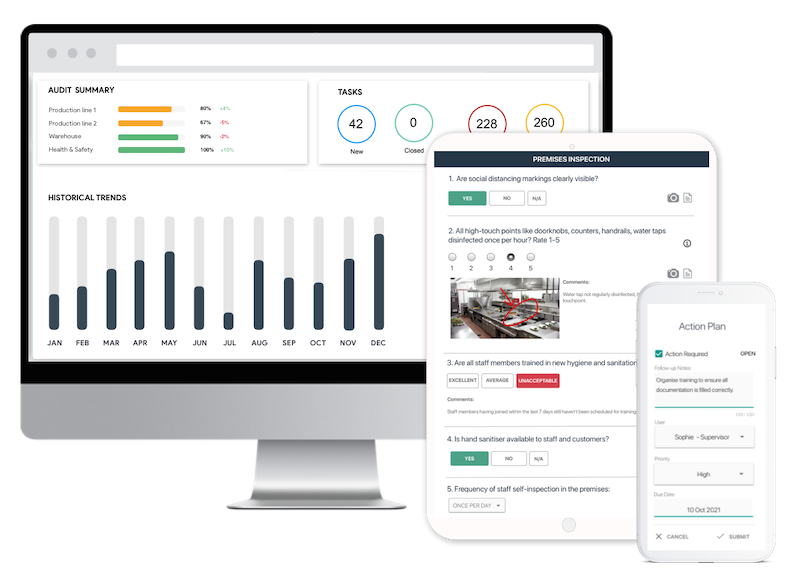
Easy inspection app for your digital checklists
- Conduct inspections anytime, anywhere - even offline
- Capture photos as proof of compliance or areas needing attention
- Instantly generate and share detailed reports after the inspections
- Assign & track follow-up tasks, view historical trends on a centralized dashboard